No Right to Forcibly Resist Tyranny? (A Somewhat Updated Blast from the Past as “Rights and Government”).

declaration

Democrat Presidential Candidate Francis O’Rourke (calling himself “Beto” to try to give himself a Hispanic cachet) said, as part of his arguments for gun confiscation (call it a “mandatory buy-back” if you will it’s still confiscation) said that you can’t fight a tyrannical government “nor do you have a right to.” (I’ve dealt with the “you can’t” argument before.)

That follows, of course, if you take the view that rights are something granted by government.  If Rights are granted by government then of course there is no right to forcibly resist that government.

I do not subscribe to that view.  Here’s why.

First off consider what it means if rights only exist because the government says they do.  That directly implies that rights don’t exist if the government says they don’t.  If you take that position, then nothing government does can ever be “wrong”.

Let’s look at some examples to see where the government granting rights, and therefore is able to take them away, leads.

In March of 1492, the then government of Spain, specifically the Joint Catholic Monarchs of Spain, Isabella I of Castile and Ferdinand II of Aragon, ordered the expulsion of all the practicing Jews from Castile and Aragon and all their territories and possessions (including essentially all of modern Spain as well as additional territories).  This, of course, was entirely proper (given our presumption that government grants rights) since the government is simply rescinding the right of those Jews to live in Castile and Aragon and possessions.

There can be no objection to this, of course, since the right to live there was granted by the government and therefore could be taken away by the government.

In 1836 the “Treaty of New Echota” called for the removal of the Cherokee from all lands east of the Mississippi.  Some few moved voluntarily in response to this treaty.  However, in the end the Cherokee were forced first into concentration camps, then on the horrible Trail of Tears in forced migration to the west.

There can be no objection to this, of course, since the right to live east of the Mississippi, or to live at all, was granted by the government and therefore could be taken away by the government.

In 1838 the then Governor of Missouri issued a proclamation that the new religion of Latter Day Saints (Mormons) were to be treated as enemies of the State and exterminated or driven out.  (This order was not rescinded until 1976).

There can be no objection to this, of course, since the right to live in Missouri, or to live at all, let alone practice ones religion, was granted by the government and therefore could be taken away by the government.

In 1934, among many other things, German law stripped Jews of their German citizenship, forbade them from marrying or having sexual relations with non-Jews. (There was much worse to come, of course, so let this stand in proxy for that.)

There can be no objection to this, of course, since the right to citizenship, to marry, and who one might have sex with, were granted by the government and therefore could be taken away by the government.

If Francis has his way, at some future date he will deprive people of their arms.  There can be no objection to this, of course, since the right to keep and bear arms was granted by government and, therefore, can be taken away by government.

Well, we could go on and on.  If one takes the view that rights are granted by government and follows that through to its conclusion that therefore government can rescind those rights at its pleasure, then there is no atrocity, no matter how heinous, that government can do and one is left with no basis to object.  If your right to life comes from government, then it is equally valid for government to rescind that right and kill you.

No, if rights exist at all, they must exist independent of government.  They might be, as the Founders of the US stated something a person is “endowed by their Creator” or simply something they hold simply as the virtue of being human.  This is the only way that one can say that a government does right or wrong.  If rights come from government then nothing a government does can be wrong.  Only if rights are inherent in being human can say that a government does wrong.

The people who made up the Continental Congress did not think it necessary to go through this reasoning to come to the conclusion.  It was “water to a fish” to them.  Thus: “We hold these truths to be self-evident, that all men are created equal, that they are endowed by their Creator with certain unalienable rights, that among these rights are Life, Liberty, and Pursuit of Happiness, that to secure these rights governments are instituted among men, securing their just powers from the consent of the governed.”

Governments do not grant rights, not in the ultimate sense.  We may use the word “right” to refer to some things that are not innate human rights, but are tied to the form of government.  The right to vote is a big one there.  But when it comes to the basic human rights, they are completely independent of government.  Government does not grant them.  Government can not rescind them.  Government can only uphold them or infringe upon them.

And when government infringes upon them, it is government that is wrong.  And it is the right of the people, collectively or individually, to stand against that government and say “no.”

History, of course, is replete with examples of governments trampling on the rights of the people.  Indeed, that seems to be the norm to the point of being universal.  It is only when the people, united in their determination to enforce their basic human rights stand up and force government to recognize their rights, when they are willing to put their all behind the rights not just of themselves but of all men and women within their reach, that “life, liberty, and pursuit of happiness” becomes an achievable idea.

It happens when to these ends “We Mutually Pledge To Each Other Our Lives, Our Fortunes And Our Sacred Honor.”


Snippet from a Work in Progress

“Is that to your liking, Your Highness?” Tanya set the brush down on the dresser.

Elara, Queen Presumptive of the elves of Greenwood, reviewed her reflection in the mirror.  Her thin face with its weak jaws stared back out at her.

Elves in the court, as Elara had heard when they thought she was not listening, thought her much too stout to be attractive.  The orcs who had raised her had thought her too thin, feeble-looking as they had termed it. Only her adoptive parents and Buck Tooth, dear, sweet Buck Tooth, had looked beyond her whispy appearance to find… Elara did not know what they found, only that they had loved her just as she had loved them.

The sight of Tanya’s reflection in the mirror broke into Elara’s thoughts.  She nodded.

“That will be all, Tanya.  Thank you.”

“Very well, Your Highness.  I will–”

A tapping at the door interrupted Tanya.  She left Elara’s side and cracked opened the door.

“Who…Lord Witharin?”

“May I speak with the queen?” Witharin’s voice came from behind the door.

“My apologies, Lord, but the queen has prepared for bed and–”

“Let him enter, Tanya.  It is as well to hear what he has to say now as later, for I am sure I will hear it.”

Tanya stood back, pulling the door open with her.  Witharin stepped into the room and bowed.

“Your Highness.”

Elara nodded in return. “How may I help you, Lord Magician?  You may leave us, Tanya.”

“As you wish, Your Highness?” Tanya bowed and retreated to the back rooms of the suite.

Witharin waited until the door had closed behind Tanya before speaking. “I am troubled by your actions at the reception, Highness.”

Elara sighed. “Did Odarin send you?”

“Odarin and I differ in many things, this not the least.  No, Highness, he did not send me. But it is because he came that I am here.”

Elara leaned back in her seat.  She studied Witharin for a moment.  She often thought that Witharin understood her all too well.  To the elves, she was an adolescent, little more than a child.  Witharin alone seemed to grasp that she had grown swiftly among the orcs, that she was an adult who had tended a fire of her own and a husband to share it.

Buck Tooth, his body full of elvish arrows, the sword she had forged still in his cold hand.

She blinked the vision away.

“Not at his bidding, yet he is why you came?  You bring me riddles?”

Witharin inclined his head. “Odarin would have you wedded to Prince Farian.  An alliance would bring much wealth.”

Elara shrugged. “An alliance with any of the suitors would bring much wealth.”

“This is true, but I believe he hopes that the Prince will inherit Lariendel.  The issue of your union would then rule both.”

Elara leaned forward, an idea teasing at the corners of her mind. “Is Farian likely to inherit?”

Witharin shrugged. “Normally, I would say no.  His father is old, nearing his fifth century and not likely to live much longer.  Farian’s elder brother, Seledan, already has three sons. If Seladan outlives his father even a single day, then the line passes to his issue.”

“So why, then, Odarin’s hopes.” Elara drew in a sharp breath, as though a thought had just occurred to her. “Are you suggesting he is planning an assassination?”

Witharin raised both hands as though to ward off the thought. “Elm, Oak, and Ash, no.  I simply believe he knows, or thinks he knows, something that makes Farian’s ascent likely.”

Elara tried to keep her thoughts from showing on her face as she considered Witharin’s words.  An assassination plotted against the heir of an elvish kingdom by the regent of another elvish kingdom could easily lead to war.  Elf warring against elf. The plot need not be true. Rumor, if sufficient evidence could be created, would suffice. She held back a smile.  It would be a start.

“And how does my actions at the reception enter into this?”

“Highness?”

Elara turned up an open hand. “You said that my actions troubled you.”

Witharin nodded. “Quite so.  The law states that no one may compel the monarch in who they choose as consort.  There is a long history as to why that is the case.”

“Please.” Elara held up both hands. “No.”

“Very well.  Suffice it to say that while the council can insist that you do choose a consort, the choice of who is yours and yours alone.”

“I still do not understand what this has to do with my actions at the reception.”

Witharin sighed. “It was obvious to all that you were indifferent to the elves presented to you.  Odarin might use this indifference to push you in the direction of his favored choice. I would caution you not to be unduly influenced by him.”

Elara stared at Witharin, stunned. “You came here…this late…delaying my rest…to caution me not to let Odarin decide for me who I should wed.  Have you, perhaps, taken too much wine?”

“You take this too lightly, Highness.  This is an important matter. Odarin has his own ambitions.  If he lets Farian know that his influence won him the role of consort, then, that will stand in his favor.”

“And you, Witharin?  What reasons have you to keep Farian from a seat at my side?  What are your ambitions?”

“My ambition is simply to avoid disaster,” Witharin said. “Your life has not become what you wished.”

Elara laughed. “Not what I wished?  That’s like saying the sun is a little like a candle, the sea, like a teacup.”

Witharin sighed and nodded. “I had hoped by revealing the machinations of another you might come to understand that not all who surround your are enemies.”

Elara stood and leaned close to Witharin. “And you?  Are you my enemy?”

“I am not.”

Elara leaned closer. “But I am yours.”

Witharin stepped back. “Perhaps.  But you, nevertheless, are my queen.”

Witharin bowed, turned and left the room without waiting for, or even requesting, dismissal.

Elara cursed herself for revealing too much as she closed the door.

Witharin might not think himself her enemy, but that did not make him less dangerous.  It made him more so.

Update on the Ice Follies.

It’s getting to be a bit more difficult to get technique practice during the public skate times.  As we move into early fall, we start approaching the busy season for the rink.  With more people, in particular more beginners and folk who are shaky on the ice, I can’t work back and forth at one end (working backward skating).  Just too much danger of running into somebody.

In Saturday’s afternoon public skate, I was lucky in that they weren’t terribly busy.  I was able to spend some time on the backward skating I’m working on.

My instructor had suggested, in working on backward one foot glides to use “swizzles” rather than “wiggles” to get going.  With “swizzles” I end the stroke with my feet together, which is the ideal position to shift weight to my supporting leg and pick up the other.  That’s been coming along well.  I do two or three backward swizzles to get moving then pick up one foot or the other.  I’m getting a few seconds of glide that way.  I think the goal for Basic/Adult 3 is 4 seconds.  I’ve done that occasionally, but I can’t really do it reliably.

Another thing my instructor has me trying is some very basic backward stroking.  While it’s essentially the reverse of forward stroking (toe in and push out and forward with the stroking foot vs. toe out and push out and backward) but I find it a whole lot more awkward.  The video here showing how it works goes from stroke into glide.  I’m not doing that (yet).  That’s a “basic 6” thing (like the last step before the “free skate” series, where one starts learning serious figure skating with jumps and spins) and I’m working on Basic 3 and Basic 4 stuff.  The idea is to get me started on the motion.  I get a little push and then go into a two-foot glide.  It’s really clumsy looking but it’s a start.

I’m getting a good 25 minutes to half an hour of skating in on each session. Still having the ongoing foot problems but I’m trying to push a bit longer each time before I have to stop and let my feet recover. Right now I’m going about 15 minutes before I have to stop, then give my feet a few minutes rest, then I’m good for another 10-15 minutes before I get tired enough that my balance gets bad and it becomes time to stop.

Okay, Dick Button even at 90 years old has nothing to fear from me.  Still, I’m so, so far ahead of where I was six months ago that I think I have pretty good reason to be proud.

“How can you talk economics when we’re talking about people’s lives!”

It never fails.  When I (or a lot of other people) talk about the economic cost of some policy we always get “how can you think of economics when we’re talking about people’s lives here” or “you can’t put a price on human life” or the big one “if it saves just one life, it’s worth it.”  “If we don’t do this, people will die!”

The problem is that economics translates into lives.  And while whatever folk want to “solve” with their economically unviable proposal might “cost lives” impoverishing people, either as individuals or as the economy as a whole also costs lives.

Consider, that an Earthquake of a severity that might kill a dozen people in California, would kill hundreds, or even thousands, in someplace like Bangladesh.  Wealthier societies are more likely to have buildings built of sufficient strength to withstand earthquakes and, thus avoid crushing their inhabitants.  Wealthier societies are more likely to have networks of roads that allow sick and injured to reach hospitals or aid stations quickly–and the more quickly you can treat, the better the chances for recovery.

Or, never mind Earthquakes.  In wealthier societies more people have shelter from weather that can threaten their health, and not just against storms, but heat is a known killer, as is cold.  Having a draft-free dwelling with adequate heating and cooling for the weather saves lives.  Sure, for a lot of people it’s about comfort but many of the very old and very young, or the sick and injured, are less able to deal with temperature extremes.  Heat waves and cold snaps are invariably accompanied by rising death rates (with cold being by far the worse killer of the two).  Adequate heat and air, and modern, high-tech clothing meant to protect the wearer from temperature extremes make a big difference.

Ordinary illnesses and injuries?  People have accidents, get sick.  Once again, that extensive network of roads–a feature of wealthier societies–allows people to get their sick and injured to doctors and hospitals quickly.  And not just via ambulance.  That might be arranged by some government program which allows people to…

Oh, I can’t do it.  The simple fact is that many times, a person can get a sick or injured loved one to the hospital faster than an ambulance can get to them.  At least they can if they have their own car, which is something that is not common except in wealthy nations.

Look, some economists have tried to study this, to try and figure how many dollars (or whatever monetary unit you care to use) of GDP equates to how many lives saved.  Because of the complexities of such analysis results vary.  After all, there are other things that affect death rates than just the wealth of society.  The basic principle, however, is so universal that it’s not even controversial–people live longer, and better, in wealthier societies.

gdp-life-expectancy
The source for this is a site that does data visualization, but the data is very much real.

The results of all this is that you cannot dismiss economic realities–the cost of doing whatever “good thing” you want to do via government comes at the expense of no longer being able to do something else with those resources.  After all, Economics is the study of cause and effect relationships in the allocation of scarce resources that have alternative uses.  Scarce, meaning you never have enough for everyone that wants it.  And so, use them for one thing and lose the ability to use them for something else.

In politics, people tend to make categorical decisions.  We must do this, regardless of the cost.  And doing “this” means we don’t do “that.” Political solutions tend to miss the incremental tradeoffs.  How much of “that” are we willing to give up for how much of “this”?

And when the “that” is something as nebulous to most people’s thinking as a Gross Domestic Product, particularly when a lot of that product is in other people’s hands rather than ones own, the very real effects of trading “that” get lost in the shuffle.

It’s very short-sighted and we need to work hard to not do that.

Unless, of course, you want people to die.

Angry Swedish Girl is Angry

angryswedishgirl

So, the Swedish girl being given all the headlines got up in a speech claiming that “we” “stole her childhood” and got all indignant.

Oh, please.  She has no clue how good she has it.  Now, I don’t blame her.  She’s been carefully groomed and indoctrinated.  People have played on her self-admitted Asbergers, giving her something of a passion to be fanatical about and pointing her in the direction they wanted her to go.  She’s being used by people who do not have her best interest at heart but for their own self serving ends (and, yes, I include her parents in that).

As for stealing her childhood?  I grew up with Vietnam, the Cold War, with two countries aiming enough missiles at each other that, as Albert Einstein was reported to say, “I don’t know with what weapons World War III will be fought, but World War IV will be fought with stones and spears.”

I grew up with predictions of imminent nuclear Armageddon.  That’s in addition to the various ecological and environmental disasters that were going to bring about the end of the world.  Paul Erlich was saying the fight against global starvation was already over.  Worldwide famines could no longer be avoided.  Air pollution was going to require all of us to wear gas masks by 1980 (1980!).  Then there was Vietnam and the disaster that was the Tet Offensive.  (Well, yes, it was.  But not for us.) Oh, and not to forget the AIDS epidemic.  We were doomed!  Doomed, I tell you!

Then there was my parent’s generation.  They had the Cuban Missile Crisis.  Duck and Cover drills. (Yep, that old “Nuclear Armageddon” thing.) The Red Scare.  Polio.  And a little fracas called World War II.

Oh, and their parents.  The Great Depression.  World War I.  The Spanish Flu.

Their parents?  More worldwide epidemics.  War as an endemic condition.  And, frankly, a standard of living even among the middle and upper classes of the then developed world that someone like Greta Thunberg would consider, if she stopped to think about it, to be poverty more crushing than anything in her experience.

And, somehow, all of us in all these various generations facing all these real, not imagined terrors and disasters managed to have childhoods but Greta, Thunburg, fed some scare scenarios about “global warming” has hers stolen from her?  I don’t think so.

And, no, I don’t really blame her.  She’s just doing what the adults around her want her to do.  She’s doing what gets her not just attention (which can be all important to a 16 year old even without adding Asbergers to the mix), but what is for her positive attention.  She is being cynically used as a human/child shield to deflect criticism and challenge.  I’m not buying it.

I mean, Angry Swedish Girl is angry so we’re supposed to drop everything and conform to her no-doubt heartfelt but ill-informed rants?

Well color me unimpressed.

No, it’s not Capitalism.

money-3970589_640

On the Book of Faces, we had this:

Unlike Capitalism that has no faults? (Well I mean other than, slavery, oppressions, destruction nature in the name of profit, waste of natural resources, killing citizens, false imprisonments, withholding healthcare and eliminating the middle class. But other than that, capitalism is flawless)

First, we need to define terms.  Capitalism is an economic system of voluntary exchanges with prices determined by the free market.  “Voluntary,” in this instance means coercive force.  It’s not coercive force if someone offers terms that you don’t like, even if you really, really want what they have.  And if it involves coercive force, it’s not capitalism.

So, with that said, we have:

Slavery is not capitalism. It cannot be capitalism since capitalism is the system of voluntary exchanges (of labor, skill, material goods etc.) with individuals having control over their own property.

Oppression is not capitalism. See “voluntary exchanges”. Even if somebody chooses not to make a particular exchange with you (see “voluntary”) that’s not oppression. Oppression requires force. Force is either criminal or government (which some will claim is another way of saying the same thing; I don’t go quite that far). It is not capitalism.

Destruction of nature is not capitalism. If you own property it’s your property. You get to decide what constitutes “destruction” or not. Likewise other people get to decide what constitutes “destruction” of their own property. Yes, there is such a thing as the “Tragedy of the Commons” but note that word “commons”?  That’s something that’s not someone’s property.  It’s by definition something held in common.  I.e. Socialism.

There are some issues with what Milton Friedman called “neighborhood effects” (somebody does something with their property that affects your property–and so people who are not party to one of those voluntary exchanges can experience costs, or benefits, arising from it–“External costs/benefits” as Sowell put it in Basic Economics).  And those neighborhood effects/externalities can lead to loss of worth of other people’s properties without their being involved in a voluntary trade for it.  And, yes, there may be a role for government in protecting against that.  But, as Sowell notes in Basic Economics, and elsewhere, just because the government can sometimes do better than the free market, doesn’t mean that it will.  As Friedman points out in Free to Choose, while we all want clean water (to use one example) does it really justify reducing lead in wastewater from 1 mg/L (about 1 ppm by weight, the EPA limit for waste water) to a few PPB (permissible for drinking water) or to parts per trillion when the resources used to do that could be used for other nice things we’d like to have?

But, you know, far from being a symptom of “capitalism” it’s also endemic to Socialist systems. See Aral Sea, Yellow River Pollution, and just who’s dumping the vast majority of the trash in the ocean.

Waste of natural resources is not capitalism. See “voluntary exchanges” and “control over one’s own property”. Just because you disagree with a use does not mean it’s a waste. In Capitalism, the natural resource would not be used unless the people to whom it is traded (see “voluntary exchanges”) do not value it more than the people who own it in the first place. And they wouldn’t trade for it unless they can use it to produce something someone else values more than they do. Once again, that whole “voluntary exchanges” thing.

Indeed, “waste” is another way of saying “opportunities for profit not realized.” In the 19th century, gasoline was a “waste product” of kerosene production and was just dumped into the local waterways (ouch).  John D. Rockefeller and his company figured out how to use that gasoline to power the refining process, saving the waterways and making kerosene a whole lot cheaper.  In the process he made a ton of money.  And since the primary use of kerosene was in lamps and the primary competing material was whale oil, reducing the cost of kerosene reduced the profitability and quantity demanded of whale oil.  Rockefeller may have been responsible for the survival of several species of whale long before the founder of Greenpeace was even a dirty thought in his father’s mind.

Or consider the coal tar produced as a waste product of coking coal for ironmaking.  Someone decided to see if some use could be made of the tar rather than just dumping most of it.  One of the early results was aniline dyes, including a color called “mauve” which was so popular the “Mauve Decade” was named after it.

Capitalism provides every incentive to minimize waste and find ways to produce value even from the waste.  And one man’s waste is another man’s resource.

Killing citizens is not capitalism. I’m failing to see how you can even think that this has anything to do with voluntary exchanges with prices controlled by the free market.

It wasn’t capitalism that slaughtered over 100 million of its own people over the course of the 20th century.  Not talking those killed by enemy forces in war, but people killed by their own governments.

False imprisonments is not capitalism. See “voluntary exchanges.”  See also “gulag,” “reeducation camp,” “Dachau,” “Buchenwald,” “Cultural Revolution,” et al.

Withholding healthcare is not capitalism. Voluntary exchanges. You are perfectly at liberty to make whatever voluntary exchanges for healthcare that you wish. If, instead, you choose to spend the resources you could have used for healthcare for something else, well, that’s your choice. I am not obligated to cover your poor choices. Is health care expensive?  Yes.  And it’s made more so by various government controls and regulations that are the very opposite of capitalism.

And as for withholding healthcare? Ask Charlie Gard or Alfie Evans. Oh, wait, you can’t. They’re dead. Their government not only withheld health care but forcibly prevented them from seeking it elsewhere.  Private health care and health insurance can only decline to pay.  It takes government to actively prevent you from seeking alternatives.

Eliminating the middle class is not capitalsim. But even if it were, the “shrinking” of the “middle class” is because people are moving up out of it. And even the poor of today, at least in the mostly capitalist United States, experience wealth that all Rockefeller’s millions could not have bought him a century ago. My roughly “middle class” lifestyle would have been pretty damn rich compared to my parents upper-middle-class life back when I was in middle school.

So, bluntly, all of those “criticisms” of capitalism are substantially without merit.  Indeed, except for “Destruction of nature” they are completely without merit and in that one they are no worse that socialist systems.

Put simply, nothing has done more to improve the lot of the people as a whole than voluntary exchanges with prices determined by the free market…than capitalism.

“But Unbridled Capitalism is Bad Too!”

So I was making a post on the Book of Faces about the evils of Socialism. (Bluntly, to the extent you have socialism, you have slavery since you are using force–not persuasion and not trade, but force–to require some to work for others.) Naturally one of the left-leaning folk on my friends list had to come in and say “The evils of unbridled capitalism are as bad or worse as the evils of unbridled communism!”

sweatshop

What utter and complete crap.  Even if we credit the argument, it’s intellectually dishonest in that the existence of evil in the extreme does not mean that we’re anywhere close to that point and especially does not mean that we need “more socialism” now.  But they don’t stop at their being evil at some extreme.  No, they claim that the “evil” is all around us do to already being far too close to that “unbridled capitalism”.

First, let’s clarify terms.  Capitalism is a system where individuals have control of their own property and the uses to which they can put it and can engage in voluntary transactions involving that property without forcible coercion.  Basically, it’s what happens when you leave people alone to manage their own affairs.

The merging of business with the state is not capitalism.  That merging gets called by different names depending on the route toward that merging.  If it’s “seizure by the people” which ends up with the government owning everything it’s called socialism or communism.  If it’s government dictate what the businesses will produce and how much, what prices they can charge, and so forth while leaving (on paper) private ownership (with said owners having little actual say in how the businesses will run), it’s fascism.  If it’s through “regulatory capture” where a handful of big businesses through lobbying efforts get regulations passed that restrict competition, it’s merchantilism.

All of them rely on the coercive power of government.  And all of them are, quite frankly, built on the common foundation and structure of central control and planning.  The differences are simply arguments over what color curtains to hang int he window of that structure, or maybe what color siding to use for people outside to look at.

Capitalism, true capitalism, is where individuals and self-organized groups of individuals make their own decisions over property they own and manage that through voluntary transactions with others.

Once you understand that, it becomes brutally clear that the “unbridled capitalism” that is so often condemned is all too frequently anything but.

Consider the “company towns” that were the spur behind unionization in the late 19th century.  Consider the following:  employment monopsony (i.e. no other employers to compete for workers, meaning potential workers had no other choice), essentially issuing their own currency (“company scrip” usable only in the “company store”), generally physical isolation in a time where travel was much more difficult than today restricting the ability of people to “vote with their feet” and leave. Because of these, the company was acting more as a government than a business.  It was more a socialist/fascist model than capitalism.

Another one people point to is “sweat shops,” including the factory conditions often cited in the early Industrial Revolution.  However, this has proven, time and again, to be a temporary condition that fades with time.  Indeed, I’ve discussed that issue before. But, to summarize, going from a muscle-based agricultural economy to an industrial economy requires considerable learning.  As just one example, coordinating effort between people performing different steps of a process so that one group isn’t standing idle while waiting for the other to catch up can be a challenge.  And until they learn all the myriad skills and gain the requisite habits, the only thing they have to compete on is price.  As Thomas Sowell noted in his book Basic Economics, at one point factory workers in India were only 15% as productive as workers in the same types of jobs in the West.  One could pay Western workers five times as much and come out ahead.  If folk were going to build factories in India and develop an industrial base in the country to pull it out of poverty, those workers had to be competitive with workers elsewhere.  And that would only happen if they were paid, at most, 15% (less, actually because of uncertainty and risk factors) of what Western workers would be paid for ostensibly the same jobs.  And while soy-latte drinking pseudo-socialist college students might raise outraged voices at the “exploitation” the fact remains that even those low wages are better than other alternatives available to the people in those “sweatshops” and as the workers become more productive, it becomes more attractive for other businesses to locate there and hire away some of those low-cost yet productive workers.  Competition then bids up the price of the workers leading to their earning more.  As Thomas Sowell notes about a different example:  Japan after Perry forced its opening to the West:

As of 1886, the per capita purchasing power in Japan was one-fortieth of that in the United Kingdom, though by 1898 this had risen to one-sixth.

Later Japan would become one of the most technologically and economically prosperous nations in the world with a per-capita GDP (Purchasing Power Parity) per the IMF that places it #28 in the world. (The US, for comparison, is #10).

Indeed, this is a very common pattern in countries attempting to pull themselves out of Third World economies into modern, industrial and technological, prosperous economies.  It is the very pattern the First world went through in the beginning of the industrial age.  It may well be that there is simply no way to avoid it.

These are just a couple of examples of the mistakes (I’ll credit them as mistakes rather than deliberate dishonesty) involved when people make the claim about how bad “unbridled capitalism” is.  They either conflate government action with “unbridled capitalism”, or they confuse something other than capitalism (the crypto-fascism of the “company town”) with capitalism, or they look at a necessary stepping stone to better things which isn’t as good as they would like (while being better than was before) as though it were “evil exploitation”.  They conflate many things that are not capitalism into “unbridled capitalism” to give the impression of everpresent “evil” in order to justify the socialist programs they want to implement now.  It’s intellectually dishonest.

I’ve acknowledged before that there is a role for government.  That issues with external costs and benefits, goods that are indivisible so that people who don’t pay get the benefit so long as someone pays for them (therefore giving everyone the incentive to let someone else pay), and so forth.  But we are not anywhere near that point.  We are so far past that point that we can’t even see it behind us.

So, no, warnings about the evils of “unbridled capitalism” are not a valid excuse for “more socialism”.  We don’t have unbridled capitalism.  We aren’t even close to unbridled capitalism.  The problems we have are not because of too much capitalism.  They are because of too much socialism.  It’s not more socialism we need.  It’s more capitalism.


Science Fiction vs. Fantasy: A Blast from the Past

No, not a death match between the two genres, nor even a discussion of which is “better” in some way.  I like both in different ways.  Each suits a mood for me.  No, this is rather about when something is one or the other.  This will be something of a ramble.

Some folk have given long, involved definitions about when something is Science Fiction and when it’s Fantasy.  Me?  I like one similar to Orson Scott Card’s from one of his writing books.  Science Fiction has rivets and engineers.  Fantasy has trees and elves.

The late Arthur C. Clarke in his “three laws of prognostication” gave as his third law that “Any sufficiently advanced technology is indistinguishable from magic.”  Some folk, have inverted that: “Sufficiently advanced magic is indistinguishable from technology.”  Those twin statements are actually quite telling in looking at the fuzzy border between fantasy and science fiction.

A lot of it has to do with mindset, both the mindset of the writing and the mindset I fall into while reading it.  Sometimes a book can be both or either depending on how you look at it.

Take, for instance, the late Anne McCaffery’s Pern books.  They are science fiction.  A colony ship reaches Pern, an almost idyllic planet.  However, once the colonists have settled in and are essentially committed, an unexpected problem arises.  Another planet in the system, one with a highly elliptical orbit nears the sun and, for reasons that are mostly glossed over, extremely aggressive fungal spores cross the gap between this other planet and Pern.  The spores, called “thread” cause serious destruction, basically “eating” anything organic they hit, but are fortunately short lived so that they don’t completely lay waste to the planet.  Still, this is a disaster of epic proportions for the colonists.  A biologist on the planet engages in an emergency program of genetic manipulation, taking an indigenous species of flying lizard that has already demonstrated the ability to imprint on people at birth (forming an empathic bond) and not only augmenting that imprinting ability to a true telepathic as well as empathic bond and increasing their size, forming human carrying, self-replicating flamethrowers–dragons.

This is far backstory, however, for the first published Pern stories.  When we’re introduced to them, the world and its characters, due to a number of crises over the years, are essentially in a dark age and have forgotten much of their history and science.  So it’s a pre-industrial age with dragons and dragonriders.

Truth to tell, even knowing the back story, even having read the key prequel that told the story of landing and the first dragons, it still reads like fantasy to me.  My “mindset” while reading it is the one that I use when reading other fantasy.  The “fantasy elements”–the telepathic bonds, the ability of the dragons to go “between” (teleporting) are decoupled from the in-story “science” and they become the functional equivalent of magic.

On the flip side you have Rick Cook’s “Wizardry” books.  Here, Rick Cook has a clearly magical world but the main character, brought in from an analog of the “real world” takes a scientific approach to that magic, treating it like computer programming where small spells are created that function as functions, routines, and lines of code.  By bringing a scientific approach to the magic, it in many ways reads more as science fiction.

Similarly there is the late Poul Anderson’s Three Hearts and Three Lions.  The main character is once again taken to a fantasy world and approaches the magic of the world in an analytical way that unveils the deep thought Anderson clearly gave the magic of that world.  As one example, when the protagonist tricks a Troll into staying out past sunup and it is turned to stone, he realizes why Troll Gold is considered cursed.  The transmutation of carbon into silicon (the conversion from living flesh to stone) leaves the gold highly radioactive.  Anybody carrying it would soon sicken and die.

And so, this, too reads more like Science Fiction in many ways.

Now, consider Star Trek and Star Wars.  From the standpoint of modern physics, they are both ridiculous.  No, “reverse the tachyon flow” is no more scientific than “use the Force, Luke”.  (Someone basically just threw out the idea of “tachyons” from looking at the relativity equations.  If some particle had an imaginary rest mass and were traveling faster than light, in relativity that would give it a real momentum and a real energy.  There’s no evidence that tachyons exist.  And there’s nothing in physical theory that says they must, or even should, exist.  They’re just an idea someone tossed out in pure speculation.)

The two series’ have a lot in common.  Space travel.  Alien worlds.  Faster than light travel.  War, sometimes.  Exploration, sometimes.

However, there’s a big difference between the two series.  In Star Trek the presumption is that the fantastic elements are the result of science and engineering.  Research will (in the story world) lead us to those discoveries.  Scientists will find them.  Engineers will build them.  In Star Wars there is a lot of stuff that is built by science and engineering, but the story doesn’t center around that.  It centers instead around mysticism and, frankly, magic.  “The Force is what gives a Jedi his power.” “Your sad devotion to that ancient religion…” “‘You mean it controls your actions?’ ‘Partially, but it also obeys your commands.’”  And as the franchise developed, these mystics, these “space wizards” central even from the beginning of the series (from “Help me, Obi Wan Kenobi, you’re my only hope” to “You’ve switched off your targeting computer, what’s wrong?”–this mystical Force, this space magic and it’s users, were the key MacGuffin) grow to dominate.  It’s not the engineering and the science behind it that is central to the Star Wars universe as it is in Star Trek.  It’s the space magic.  Even the light sabers, a cool piece of technology in the beginning of the franchise, are quickly revealed (in the Expanded Universe) that one needs to use the Force to properly align the crystals at the heart of their operation.  They’re not cool tech any more.  They’re magic swords, forged by wizards.

So while both franchises have the trappings of science fiction, Star Wars, in many ways, has more of a fantasy feel.  But those trappings are enough for many people to still see it as science fiction.

And, so, in the end, it really comes down to the eye of the beholder.

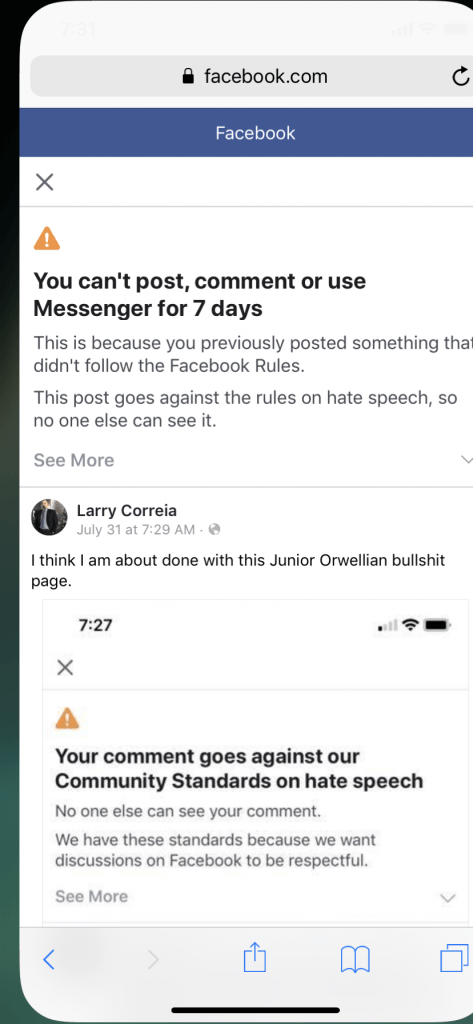
The Junior Orwell League Strikes Again.

Reblogged from Larry Correi’s Monster Hunter Nation.

FB-Ban-473x1024

This has just gotten silly.

Check the date. That comment was from a month and a half ago.  Basically if you ever attract the attention of an unscrupulous jackass, they can simply go through all your old posts and report everything as hate speech. Then Facebook, being a bunch of morons, will automatically, unthinkingly, reflexively block you.

I’ve been banned from Facebook a bunch of times now.  I believe that comment was me complaining about their dippy censorship (and was when I started investigating MeWe, because I really was tired of FB’s Junior Orwellian bullhsit) where anything a conservative or libertarian says Violates Community Standards and needs Snopes to fact check it, but anything a progressive or a socialist says is just great, even when they are literally threatening to murder you.

A month after I posted that comment above, I caught my first Facebook ban for hate speech, My crime? Pretending to be from one imaginary country of proud (but genocidal) sandwich makers, and insulting another imaginary country.  http://monsterhunternation.com/2019/08/13/another-example-why-facebook-is-super-dumb/

It was obviously the stupid Facebook bots, but my fans had a lot of fun with it.

But then, I caught another 3 day ban immediately after, and this is where our story starts to get nefarious:  http://monsterhunternation.com/2019/08/16/banned-again-facebook-gets-even-dumber-part-iii-the-saga-continues/

Because that one wasn’t bots with dumb code, that was a bunch of prog scumbags realizing that if they report my posts to Facebook, I just get auto blocked. We’ve even got screen shots of them bragging about it.

So I’ve been catching FB bans ever since, always for goofy crap. I got a 3 day ban last week. Why?  For talking about a scumbag  (Mike Glyer) who was pirating another author (said scumbag happens to own the same scumbag website where we got the last screen cap of them bragging about reporting me).

And the ban wasn’t even for the mean post where I actually insulted the pirate scumbag a bunch:

http://monsterhunternation.com/2019/09/16/another-example-why-i-think-mike-glyer-is-a-simpering-feculent-and-his-shitty-gossip-column-website-file-770-is-the-prolapsed-anus-of-fandom/

Oh no. That would make at least a little bit of sense. The ban was for a brief post the day before, where I tagged the author who was getting pirated to ask him for more info.  Pirating authors? Not a problem. Standing up to the scumbag doing the pirating? Violation of community standards.

And then today. Because apparently saying Facebook is Orwellian, will cause them to act Orwellian. Because hate speech? Or something. Hell if I know.

Basically what it comes down to is that if you ever come to the attention of scumbags, they can silence you on Facebook just by reporting all your posts. It doesn’t matter how innocuous the posts are, Facebook is stupid. I highly doubt any thinking humans ever actually look at any of this stuff.  Meanwhile, you can recruit child brides for ISIS terrorists while chanting death to the Jews, and Facebook says that’s totally cool. So it’s a teensy bit lopsided in its application.

It’s the Heckler’s Veto, only even more anonymous.  If you give a powerless chickenshit the ability to silence people they don’t like, without risk or repercussions, they’re  gonna use that power. It’s also a really good example of how Red Flag laws will inevitably be abused.

Like I said when I first started catching all these bans, I figure my days on Facebook are numbered. When mini painting posts are now Hate Speech, and pictures of my dog are Bullying. It is only a matter of time until I catch a perma-ban.

Now, I could do that silly thing where people make up fake EH accounts, but screw that. Facebook makes money off of me and my fans. I’m not going to reward them by working around their obnoxious bullshit, so that they can continue to mine our data.

The sad thing is that I spent years building up a fan base there. I’ve got one of the biggest and best (and actually functioning!) author fan pages on the internet.  And during most of that time, Facebook wasn’ttoo stupid.  It was bearably obnoxious.

But the stupid is becoming increasingly aggressive.  Now people want to leave, but they feel stuck. I’m not alone in this. Most content creators are in the same boat. We congregated our people there because it was convenient and then we became complacent. Now they think they own us, and can do whatever they want with impunity, because content creators don’t want to move away from where their fans are. So the abusive trailer park husband makes leaving hard, because he doesn’t hit you all the time, and he used to love you, and somebody needs to think of the kids.

I’m sure I’ve made a lot of sales off of Facebook.  Heck, my Book Bombs, most of the traffic for those comes from Facebook shares. And those are usually (by orders of magnitude) the biggest sales days of those authors’ careers.

So we stay in the abusive relationship with the incoherent alcoholic who occasionally beats us,  because of inertia.  And that’s just sad.

I’ve been transitioning more of my stuff over to MeWe. We’ve got a couple thousand people in the fan page over there now. But again, the sucky part of that is abandoning  a decade of community building and content. People don’t want to leave.

Here’s the thing though, the way things are going, you aren’t going to have a choice.  People like me are getting hit right now because the nail that sticks up has to be nailed down. I’m only a minor notable. (seriously, writer is like the lowest form of celebrity, right below Instagram gun bunny). But if random scumbags can control our ability to speak, it’s only a matter of time before they do it to everybody else.

So Facebook can either get its crap together, or let the Heckler’s Veto become their defacto working model. However, since Facebook is a giant evil megacorporation that only cares about prying into your life to sell your info to advertisers and to influence elections, good luck with that.

It’s a free market, Facebook is free to suck all they want, and we are free to leave once they become unbearable.

The “Slow Build” Myth

On the Book of Faces there was this.

70788708_2501774830040417_2292943783609761792_n.jpg

This “slow build” myth needs to die a gruesome death.  I’ve demolished that silly “Trump is a new Hitler” idea before.  But the general principle remains.

While the extermination camps came quite a bit later, most of what made Nazi Germany a totalitarian regime happened with remarkable rapidity once Hitler was appointed Chancellor to Germany.

24 days into Hitler’s chancellorship, 40,000 SA and SS men were given police powers–sworn in as “Auxiliary Police”.  The population of Germany then was about 62 million.  The US population at the beginning of 2017 was 324 million, more than five times as much.  24 days into “the new Hitler” where’s the 200,000 SA and SS equivalent made into auxiliary police?

27 days into Hilter’s chancellorship, less than a month, and the Reichstag fire happened.  The Congressional building is still standing, no fire.

28 days (still less than a month) and The Reichstag, seeing their meeting place burned and the burning attributed to enemies, grants Hitler expanded powers–the Reichstag Fire Decrees.

31 days, one month in, and the first concentration labor camp was opened–Orianenberg–for political opponents of Hitler’s regime.  While some people like to use the term “concentration camp” to refer to detention centers used to house illegal aliens caught trying to illegally enter the United States, you could not get out of this one by simply asking to be deported to your home country.

52 days and Dachau and Buchenwald–two more concentration labor camps for political opponents of the regime–opened.

54 days–less than two months–and Hitler was granted dictatorial powers.

87 days, less than three months, and the “Secret State Police” were established.

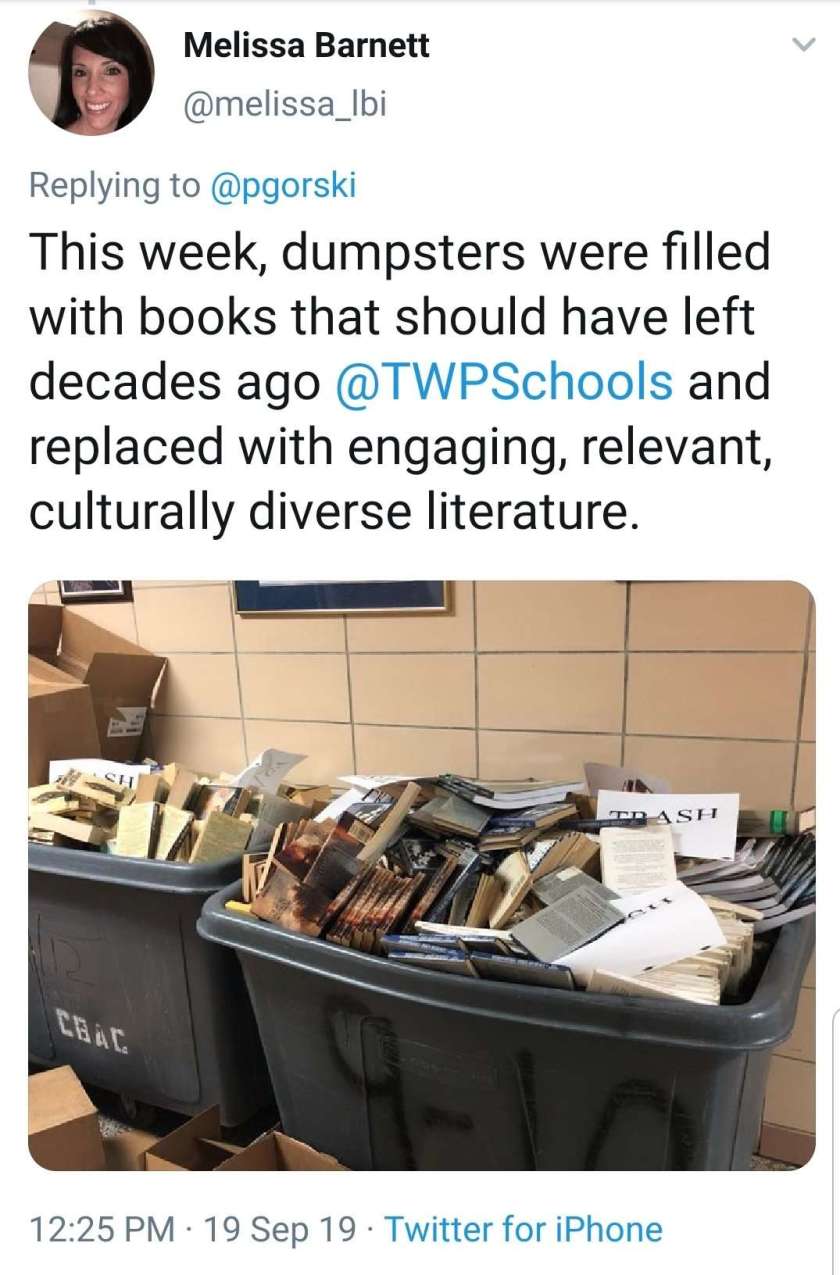
101 days and mass burning of books that the Nazis find offensive started. (It’s not the Right, and certainly not Trump, banning, let alone burning, books for insufficient wokeness.)

70839879_10156900605207807_5172577647426797568_o.jpg

123 days, about 4 months in, forced sterilizations of those with “genetic defects” begin along with more concentration camps (and still none where you could get out by saying “send me home”).

136 days, still in that fifth month, all parties but the Nazi party outlawed.

Within six months of his appointment as Chancellor, Hitler and the Nazis had seized total, complete, and uncontested power in Germany.  While the mass executions and exterminations had to wait for a few more years, when it came to seizing power and crushing dissent, they moved lightning quick.  Nazi Germany went from a democratic republic to a totalitarian regime not in years but in months.

The “slow build” thing is a myth, pure and simple.