
Category: Uncategorized
New Release: Lurker in the Water
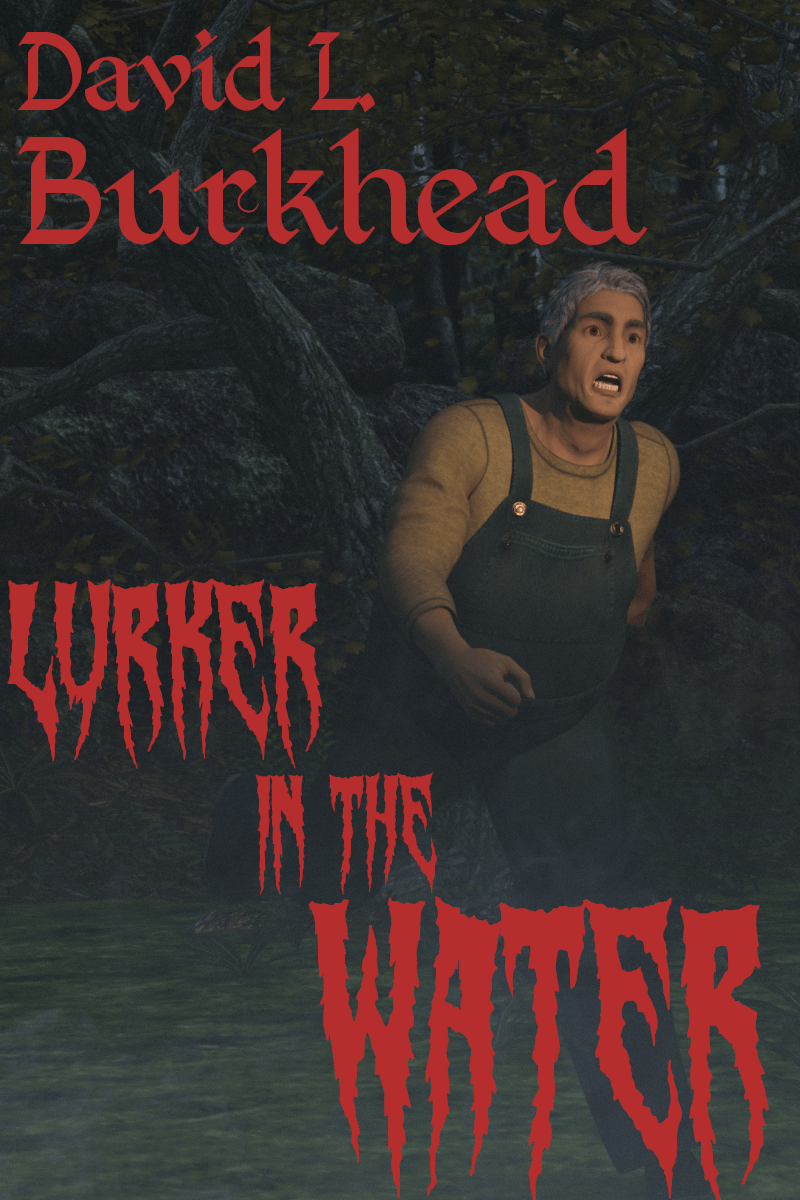
A short story
Nobody fishes the stretch of river called South Bight. There are no fish there.
Rudy Donne decides to ignore this folk wisdom. After all, if no one’s been fishing there for years, perhaps the fish have returned. Instead of fish, Rudy finds something else, something fearsome, for which he has no name.
Now, Rudy is in a race for for his very survival from something which nothing seems to stop.
“How do you propose to end mass shootings then?”
I get that question whenever I object to more “gun control” as a response to the latest tragedy. I have long held, and continue to hold, the position that more restrictions on law-abiding gun owners is not the answer to mass murder. It doesn’t work. It just leaves the law abiding helpless in the face of criminal violence.
First, let’s dispense with that “end”. I hate to tell you this, but you can’t end them. “Gun control” certainly cannot. France’s strict gun control did not prevent Charlie Hebdo nor the 2015 Paris attacks. India’s draconian gun laws did not prevent Mumbai. Norway’s gun laws did not stop the spree shooter there. And so on.
“Ending” is an unachievable target. No matter what you do, somebody, somewhere, who intends to harm others–particularly if the’re looking at going out in a blaze of “glory” (with “infamy” serving for their purpose)–will find a way to do it. When you use it as a justification for restrictions on the law abiding there is no end to that. No restrictions will ever be enough. So it will always be an excuse for more restrictions. And if at any point anyone objects, you can do then as you do now and say “Don’t you care about the victims of gun crime?”
Sorry if you don’t like that, but the truth hurts sometimes.
So, can’t end them, not entirely, but you can improve the situation. In fact, you can improve it a lot.
“Ah, hah!” you say. “Gun control, right?”
Nope. In fact, gun control is a large part of the problem. The vast, vast majority of mass shootings of the “spree killer” type (which is what most people think of when you say “mass shooting” and is different in causes and dynamics than the “domestic murder-suicide” types and the “gang war” types, both of which require different approaches to reduce) happen in gun free zones. The El Paso shooter, in his manifesto (of which only his rant on immigration got widespread publication in the media; for some reason they didn’t bother to mention his rant on the environment and his rant on business) said:
Remember: it is not cowardly to pick low hanging fruit. AKA (sic) Don’t attack heavily guarded areas to fulfll (sic) your super soldier COD [Call of Duty first person shooter video game] fantasy. Attack low security targets. Even though you might out gun a security guard or police man, they likely beat you in armor, training and numbers. Do not throw away your life on an unnecessarily dangerous target. If a target seems too hot, live to fight another day.
More than 90 percent of mass shootings happen in gun free zones. Numbers vary depending on source (which can vary in how they’re counted) but the figures I’ve seen range from 92 to 97 percent. Yes, even the Fort Hood massacre, on an Army base, and the Norfolk Navy Yard shooting, Navy base, were “gun free zones” for this purpose–the military forbade personnel from being armed unless they were doing so as part of their duties–Stateside that meant Military Police on duty.
These shootings tend to stop once the shooter encounters armed resistance. Indeed, as I have noted before, FBI studies covering 2000 to 2017 had 33 cases of spree killers where armed citizens were present. In 25 of them, the armed citizen totally stopped the attack. In an additional 6 the armed citizens reduced the number of casualties. That’s 94% of the time the situation is made better by armed citizens being present. And what about the claim that people “getting caught in the crossfire” would make the situation worse? Those same reports also give the number of innocents killed by the armed citizens in those incidents. It’s a surprising number, all told. That number?
Zero.
So, with that information in hand, here’s my approach to dealing with mass shootings:
- End “gun free zones.” The idea that forbidding law abiding American Citizens from being armed for their own protection somehow makes them safer is as ridiculous in specific locations as it is in general. As we’ve seen, it only makes those places attractive targets for those who don’t care that it’s illegal. If they’re going to break laws on murder breaking laws forbidding them to carry weapons at the place they plan to commit the murder isn’t going to stop them. It’s ridiculous. It’s patently absurd.
- End this practice of “may issue” on state licenses to carry firearms. Making the exercise of a Constitutional right dependent on the often arbitrary decision of government officials is a violation of basic human rights (the right to life is meaningless without the right to defend that life and the right to defend that life is meaningless without the right to effective means to defend that life). “May issue” which is generally worded as needing to show “good cause” generally works out in practice to issue only to those who are politically connected in the local power structure. It’s wrong. Stop it.
If you must have licensing (the Constitution and the Second Amendment should be all the license required but I recognize that’s not politically achievable at this time) then it needs to be “shall issue.” The State has to show good-cause to deny, not the other way around. - Nationwide reciprocity. The Constitution requires States to give “full faith and credit” to the “Public acts, records, and judicial proceedings” of the other States. Marriages in one state are valid in every other. Drivers licenses issued in one state are valid in every other. And so, carry licenses issued in one state should be valid in every other. Again, the Constitution and the Second Amendment should be the only license required but, again, that’s not politically achievable for the foreseeable future.
Boom. Done. Mass shooting spree killer problem dealt with. There are no longer soft targets for them to attack and if they decide to try anyway, the odds are good that someone will be present and in a position to deal with it.
Now, some folk will say we need to do more. Well, okay, I can give you more.
- Establish a fund to provide cash rewards to those who engage and stop a spree killer. Let’s show, clearly and unequivocally, of the “put your money where your mouth is” variety, that we as a society approve of people protecting themselves and those around them from those attempting to do them harm.
- We want more people skilled and able to deal with threats, so make marksmanship and CQB electives in highs school and college (“any institution that accepts federal funds must…” if the other side can use that, so can we). These classes to be taught by military personnel. (Frankly, I do not trust professional “educators” to do so, not with the indoctrination they get at the typical school of education. Military personnel is not an ideal solution but stipulating private organizations would allow anti-gun groups to be chosen and singling out specific pro-gun organizations as the sole possibilities presents makes me squicky from a liberty point of view.) Oh, and if that state requires training for a carry license (And while I’m a fan of training, I’m not a fan of mandating it–it’s a freedom thing) then make that class also available as an elective in High School and college.
- I’ll bend on the “not mandatory” in having gun safety and safe gun handling be a required course in elementary or middle school at the latest. Again, taught by military for the reasons mentioned above.
- Implement the “Some Asshole Initiative.” The reason these guys look for soft targets, look to rack up the high body counts in the first place, is that they’re looking for their moment of fame (infamy). Stop. Making. These. Assholes. Famous.
Unfortunately, there really isn’t any way to implement this “top down” without violating freedom so all I can really suggest here is a bottom up approach. People need to stop naming these people in their own communications and express their displeasure to the media when they put their pictures out, name them, and basically making them famous. Eventually, maybe, they’ll get the message that providing a forum and publicity to the spree killers is not good business.
Hey, I can hope.
There, while nothing can completely eliminate tragedies in this imperfect world, this can at least trim them back so they’re not “trendy.” And they would do far more to reduce the incidence than any “gun control” ever can.
That’s the nice thing about being philosophically in favor of freedom is that it’s almost always also pragmatically better. And the few exceptions we can usually deal with so long as we guard against going beyond those exceptions rather than using them as an excuse for yet more “exceptions.”
As for me, make mine freedom.
Ensuring the Militia is Well-Regulated.
The militia, as defined by the Founding Fathers, was the whole of the people, armed and disciplined and ready to arms at need. “Well-regulated”, in the vernacular of the time meant “properly functioning” as in a “well-regulated” clock was one that kept good time. And, indeed, the original “militia acts” specifying arms, ammo, and other supplies that each household was to retain on hand for use when called up certainly operated from those definitions
So, in order that the militia (the whole of the people, armed and disciplined) be well-regulated (properly functioning as a militia) I propose the following (I’ve got some caveats at the end, so read the whole thing before criticizing):
- Every American from the age 17 through 45, as well as those older individuals who wish to be included, who is not a conscientious objector nor a prohibited person shall be included in the militia. Note, this is somewhat broader than what law already is–the “Unorganized Militia” is all males 17-45 who is not a conscientious objector. I merely take out the sex discrimination and add in older individuals who wish to be included in the militia. After all, with the advances of medicine folk tend to remain healthy and vigorous a lot longer than they used to.
I would add that I’d be fairly broad on the allowance for “conscientious objector.” - Shooting ranges shall be established in each city and town such that at least one lane is available for every 300 militia members.
- Every militia member shall possess at least one firearm in one of the following calibers: 9X19 mm, .45 ACP, 10 mm, 5.56 NATO, 7.62 NATO, 7.62X39, .338 Lapua, .50 BMG, 12 Ga shotgun. If financial hardship prevents the militia member from owning such a weapon, loaners shall be available at the prescribed ranges for militia training. They shall also possess on hand no less than 250 rounds of ammunition in the caliber of their chosen weapon.
Note: while rifles are preferred, as suggested by the caliber list handguns and shotguns are acceptable. - Each militia member shall present themselves to a designated official no less than annually, demonstrating that they do, in fact, possess the required arms and ammunition.
- Each Militia Member shall, once each month, receive one hour plus reasonable travel time off with pay to attend a nearby shooting range (see point 2) to practice with their militia weapon. Employers that wish to provide an on-site shooting range for their own employees use may take a tax credit for the construction of such a range and an annual deduction for the operation of said range. Scheduling these monthly range trips shall be by mutual arrangement between employer and employee provided that they average at least one per month and no more than 45 days shall pass between consecutive range trips except in case of particular hardship.
- One hundred rounds of ammunition shall be provided to the militia member for use at each of those monthly range trips. Additional ammunition used shall be at the militia member’s expense.
- No limitations shall be placed on additional firearms that may be owned by militia members nor on their training with them save only that training must be conducted in a reasonably safe manner (i.e. clear lines of fire, adequate backstops, reasonable security against other people wandering into the line of fire).
- These rules shall in no way be considered to limit the use of firearms for sport, recreation, or personal protection.
There you go. A “well-regulated militia.” Now, I’ll be honest, if this were actually put forward seriously, I’d have several…concerns let us say…myself. The cost would be high (but perhaps not as high as some things of lesser value that the government already does) and I have a real problem with government mandates in general. I’m also accepting here (for sake of argument, not that I agree with it) the anti’s argument that the Federal government is claiming responsibility for “well-regulated” (which includes training–a State responsibility according to Article One). It’s in the order of “I don’t agree with it, but let’s take it and see where it leads.”
I do believe the above is Constitutional under the following provision from Article One of the United States Constitution:
The Congress shall have Power To provide for organizing, arming, and disciplining, the Militia, and for governing such Part of them as may be employed in the Service of the United States, reserving to the States respectively, the Appointment of the Officers, and the Authority of training the Militia according to the discipline prescribed by Congress.
One thing this would do is clearly and unequivocally establish a “well-regulated militia” in the sense the Founding Fathers meant the term. And I flat guarantee that the people repeating over and over again that the 2nd “says ‘well-regulated'” would go into vapors over such a proposal. For that reason alone, I’d love to see such a proposal seriously put forward, warts and all. Since it would show once and for all that their “it says ‘well-regulated'” is disingenuous claptrap meant merely to justify their desire to prohibit privately owned firearms (at least from anyone they don’t personally approve of).
So, can we get a real “well-regulated militia”?
“Just Doing My Job”
So there was this:
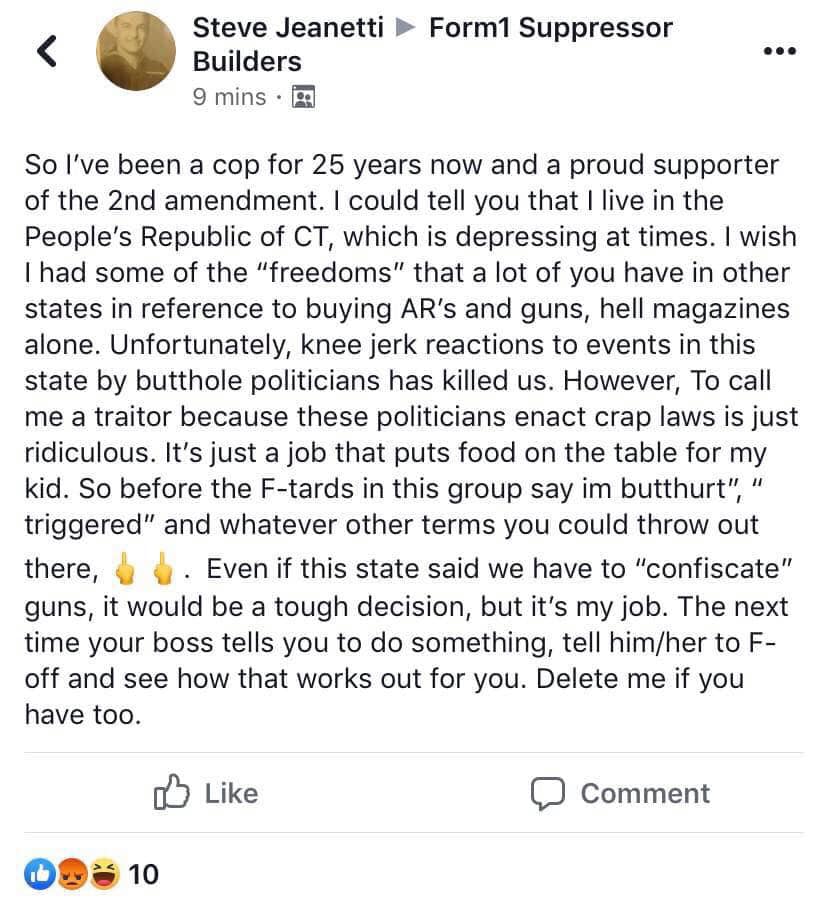
“It’s my job” he says. Which is just one step away from “I was only following orders.”
Sorry, Stevie. May I call you “Stevie”? Don’t really care, actually. Going to call you that anyway.
Look, Stevie. Short version: “It’s my job” is never an excuse for doing something unethical, let alone illegal, and certainly not unconstitutional. “It’s my job” does not make a wrong thing right. Period. End of short version.
Slightly longer version. Stevie, don’t think I didn’t notice how you just breezed over things with a boss telling you to “do something.” (Like “Some people did something”?) This vague generalization allows you to mask the truly monstrous idea you are attempting to justify here.
Look, if my boss tells me to clean up the warehouse, I clean up the warehouse even if it doesn’t fall under my normal job duties but still falls under “other duties as assigned.” Oh, in many places using a Senior Analytical Scientist as a janitor might be a poor use of scarce resources that have alternative uses but we’re a small company and we have to wear a lot of “hats” so you do what needs to be done when it needs to be done and don’t worry that much about official “job titles.”
But, if my boss said “Rob the office next door” do you think that would fall under “other duties as assigned”? (Spoiler: It doesn’t.) If my boss were to lose his mind and give me that order, I would tell him to F-off (in so many words) and I would then promptly warn the neighboring office and the police of his plans.
It’s called “ethics”, Stevie. You, apparently, don’t know anything about that.
Let’s take that a step farther. Suppose I, too, lost my mind and actually obeyed that ridiculous order thinking “I’m just doing my job.” Do you think that “it’s my job” would make it okay? When the police came to arrest me (after all, I don’t think I’d make a very competent crook) and I told them I was just doing my job would they say, “well, all right then. You can go”?
I didn’t think so.
Oh, and my first job after leaving the Air Force? I did tell my boss to F-off (albeit not in so many words–I was more polite then) when he asked me to do something I considered unethical. Not even illegal, just in violation of my personal ethics. Left that job and went working elsewhere–preferred washing dishes in a restaurant to violating my ethics.
It being “your job” doesn’t make it right. It doesn’t make it acceptable. A hit man for the Gambino family is just “doing his job” when he pops a rival boss. But he’s still a murderer and a criminal. He’s still morally repugnant.
Just like you would be, Stevie, to participate in the confiscation of arms from previously law abiding (law abiding until unconstitutional laws were passed making them criminals) members of the community.
Just like you would be, Stevie, to participate in that blatant violation of the Constitution and fundamental human rights. (Life, Liberty, and Pursuit of Happiness)
Just like you would be, Stevie, as a Jack Booted Thug.
Who Controls Society? A Blast from the Past
A commenter (read “Troll”) on Sarah Hoyt’s blog in the course of his posts made a statement about determining “who controls society”.
After much facepalming, I replied. I expand a bit on that reply here.
I don’t know why I try, but I essay:
This statement here shows such a profound ignorance that you can’t even ask meaningful questions. It’s a null statement. There is no answer to it as worded. It assumes a strict hierarchy that totalitarian regimes may approach but that never actually achieve.
Consider the barnyard example of a “pecking order” among chickens. This is a common grade-school example of heirarchy. Anyone who actually knows chickens knows that this is laughable. It’s not a hierarchical order but a collection of interacting relationships.
Likewise with canids. People talk about the “alpha wolf” the “beta” and so on down to the last one. (Fortunately, for people making these assertions, wolf packs generally don’t get large enough that they run out of Greek letters.)
Look, I’m a “dog person”. When I acquire a new dog, the dogs among them will establish their own internal dominance structures. However, despite the fact that I am “alpha” to all the previous dogs (I have to be since the dogs have to exist in mutual safety in human society) I still have to establish my individual dominance over the new dog even if it is subordinate to the other dogs. Individual relationships, not a fixed hierarchy. For example, “Hachi” is subordinate to me. We get the new dog“Trunks”. (My daughter gave them their names.) Trunks is subordinate to Hachi. (Hachi’s got real attitude–Bolt, the Pit Bull mix twice her weight is subordinate to her.) This does not mean that Trunks will automatically be subordinate to me just because I “rank” over Hachi. I have to establish that separately. And, incidentally, were I to fail to do so (purely a hypothetical in this case) that would not mean that Hachi, dominant over Trunks, would automatically become dominant over me. “Dominance loops” can, and in fact, do, exist.
Thus, the whole idea of “who controls society” does not, and indeed cannot have an answer. It’s like asking “how high is up”, or asking a person not affected with synesthesia what the color blue smells like (not a blue object, but the color itself).
Consider for instance how this works in the case of fashion. In China for a long time foot binding was a fashion. A horrible, horrible fashion. This is often described as being something imposed by men on women to force subervience on them. (After all, traditional Chinese culture was strongly patriarchal–few would dispute that–so of course, the men have to be the ones dictating this.)
When I was in college, I had to take two courses, 6 credit hours, in “World Civilizations”. One of the courses I took covered China. One of the texts we used was the book “Wild Swans”, a biographical account of three generations of Chinese women spanning pretty much the 20th century (and was used as a text in the “China” class in World Civilizations in college) describes the last generation to practice foot binding (while Manchuria, which did not practice foot binding ruled over the rest of China). It wasn’t the men imposing it. It was imposed by other women.
Note, the ruling Manchurian dynasty did not practice foot binding. Yet Chinese women, of other ethnicities within China nevertheless enforced it on their daughters. It was not a “patriarchy” imposing this on women, but women imposing it on each other.
Likewise with more mundane fashion choices. Men pretty much don’t care. At most men will be interested in whether or not the fashion shows off the female form because, for evolutionary reasons, men tend to highly approve of the female form. No. Fashion choices and the impositions thereof are driven almost entirely by pressure between and among women. (Yes, many fashion designers are men–but much of that crap they go down the runway with is never actually worn in public. It’s more “performance art” than actual fashion.)
Most of the pressures placed on women in modern Western society are placed their by other women for the ostensible benefit of those other women. Men don’t control that. They may try to grab hold for the ride, but the control is firmly in women’s hands.
Indeed, one can also argue that many of the pressures on men are put on them by women for the benefit of women and children.
Consider the various mating rituals in the animal kingdom. The brilliant plumage and mating dances of male birds. The “fights” of rutting bucks. A lot of people naively think that this competition is a display of male dominance. Exactly the opposite is the case.
These things are designed to impress the female because it’s. the. female. that. chooses. While the male activity is more visible the actual power lies with the female.
Likewise with many of the things that people claim are “patriarchal” in American society. They are actually aspects of female power and female choice. And even there, it’s a matter of individual issues with multiple subgroups.
Consider, I’m Goth (well, perhaps “Goth-lite”). Among many folk that would automatically make me lower in their personal heirarchy simply from my choices of style, appreciation of the dark, and liking for music with dissonant tones and dark subject matter. On the other hand, I can show up at a major business, deal with businessmen in their three-piece suites and short, parted on the left hair while I’m dressed in black T’s and jeans, long black hair with a purple streak pulled into a pony tail, and black painted nails and they don’t say “boo”. Because I bring something to them that they can’t do and they know it. (BTW: if you have a Blu-Ray player, you’re welcome.) People tell me that tailored suit and tie makes a person look powerful. People paying me to come fix their problems in my T-shirt, jeans, and pony tail? That, my friend, is power. And yet, the same people who come to me for help and pay the rather substantial fees my boss charges for it would have no problem disparaging me in a different context because their conventional style is considered higher status than my “looks like a freak”.
There is no one who “controls society”. It’s a lot of individual interconnections and relationships that are always changing, not just over time but with context, a chaotic system at best which cannot be predicted, much less controlled.
Continuing Ice Follies (well, more sidelines of Ice Follies this time).
At ice skating class last week we had a new student. When the instructor asked her whether she had any previous experience and she said as a teenager and had maybe one public skate before the class. I said that’s like when I started only she’s doing much better than I was then. (And she was. You really should have seen me. It was bad.) Mind you, she appears considerably younger than me so I can take comfort that she hadn’t had as much time to lose it all as I had.
During the course of the class I made a quip that I had to revise that initial estimation. She’s doing better than I am now.
At the end of the class I was sitting taking off my skates and she sat next to me (don’t make anything of that–all the “learn to play hockey” people were gearing up and the benches were pretty crowded). I, again, mentioned how she was doing really well–better than I was now after about six months of lessons (start of fourth set of eight week classes so, yeah, six months).
Her: “Oh, you’re doing great out there.”
Me: “Your backward skating, your edges, your crossovers, all are better than mine.” (And, to be honest, they are. Of the three, the crossovers bothers me because I used to be pretty good at them–when I was eighteen, so 40 years ago)
She seemed pleased at the complement, which was always nice.
She asked if I did the public skates. I did, and I explained that it’s actually cheaper to take the lessons and get the free public skates than to just pay for the public skate time. Two public skate sessions a week are the same cost as the lessons. Three and you’re ahead (I try to get in four on the weekends).
She asked how I found the place. I told her about Athena getting interested and basically web search with this being the one place with Sunday classes (when Saturday’s conflicted with Athena’s then ballet rehearsals). Found out they also had adult classes and, boom, we were in like Flynn.
By then I’d gotten my skates off, blades wiped down, and put away. She’d taken care of hers and we went our separate ways for the day.
So it seems that I can actually talk to people if:
- There is an actual topic at hand to talk about.
- I can open with an actual serious and sincere complement of the other person. (Being able to tell somebody something nice does take away a lot of the awkwardness). and…
- There is absolutely no chance the conversation leading to anything else. We’re taking a class together and that’s all it’s ever going to be. Sooner or later one of us will stop taking the Sunday afternoon Learn to Skate classes (me because of finances or her because she’s gotten what she wanted out of them and moved on to something else) and go our separate ways.
Anti-vaxers vs. Math, Part 3
A couple of things that people claim about vaccines which fail, or at least ignore, basic math:
“Most of the cases of people who get X have been vaccinated.”
That’s simply because, at least for now, the vast majority of people are vaccinated. Okay, let’s look at how that works. Let’s take a population of 1000, all of whom are exposed to a disease. Let’s say that the exposure is fifty percent likely to cause the person to get the disease. Now, 99% of those people have been vaccinated with a vaccine that’s 90% effective in preventing infection. So, let’s look at it.
First, the ten people who weren’t vaccinated. Half of them get the disease (50% of those exposed). That’s five unvaccinated people getting the disease.
What’s interesting, however, is what happens with the 990 who were vaccinated. Half of them, or 495 would catch the disease except the vaccine prevents that in 90% of those cases (446–rounding up). That leaves 49 who get the disease.
So, 49 vaccinated people got the disease but only 5 unvaccinated (total 54 sick people). Per anti-vax logic this shows that vaccinating increases the risk.
Only without vaccinating, that number would have been 500–half of the entire population of 1000–not just 54.
This “most of the cases are people who have been vaccinated” simply means two things: most people in the US are still vaccinated, and vaccines are not 100% perfect (which nobody claims except anti-vaxers in setting up straw men).
“The Mortality Rate from X fell long before we started vaccinating.”
This one is a little sneakier. It relies on the fact that what the “rate” is not based on the total population but only on the number who actually get the disease.
It goes like this.
One year, you get 10000 cases of the disease and 10% of them die. That’s 1000 people dying.
Supportive care improves. We get better at keeping people who have the disease alive. So, at a later year only 1% die. That’s 100 people. 900 people still alive who would have been dead before the improvement in supportive care. That’s great. That’s absolutely wonderful. No joke. No sarcasm. It’s an unequivocal win for medicine.
But now, at a later date that 90% effective vaccine is introduced and the population is vaccinated with it. Now, instead of 10000 cases of the disease we get 100. With the same supportive care and 1% mortality that means only 1 person dies.
Looking at mortality rate over time we see the big drop in mortality rate happening before the vaccine is introduced and the mortality rate didn’t change much when the vaccine was introduced. And that’s where the anti vaxers stop. “See, the _real_ improvement had nothing to do with vaccines.”
What they miss is that when you look beyond just the folk who have the disease and look to the total population, there are a lot fewer dead people because fewer people get the disease in the first place. The improvement in mortality rate for those with the disease certainly may have improved the odds of those who get the disease, but many more people don’t have to rely on that because they don’t get the disease–because they’re vaccinated.
Vaccinate your kids, people.
Night Force
Back in 1982 in the midst of the collapse of the “horror comic” market comic book writer Marv Wolfman got DC to try a new one, his own “Night Force.”
The comic centered around Baron Winters, a mysterious individual who could not leave Wingate Manner in Georgetown, a neighborhood in Washington DC. He arranges for others, individually or in groups to handle certain supernatural threats, and he is not above using manipulation or other dubious means to get his “operatives” into place. He is accompanied by a spotted big cat named Merlin with who he can apparently communicate although we never hear Merlin’s side of the conversations.
The operatives Baron Winters send out are generally deeply flawed, even broken, people. Their struggles with their own internal demons are as much a part of the story as the supernatural demons they fight and it can well be those internal demons that make it possible for them to fight the supernatural ones.
I found it delightfully dark at a time when I was just discovering my own inner appreciation of the “dark side” of life (and right before I got convinced by someone I had reason to trust that “you need to start wearing bright colors if you want…” and he wasn’t just talking about clothes. I’ve told that story elsewhere.)
The original comic ran for fourteen issues. I followed starting from issue two or three through issue ten. Somehow I’d missed the introduction in The New Teen Titans (which Marv Wolfman was also writing). I don’t understand how that happened since I was an avid fan and collector of TNTT back in the day.
In any case, the stories were gripping. And I found that I could appreciate endings that were not “happy ever after”. These endings left the main characters still struggling with problems, often serious ones. Yes, they beat the evil forces and stopped worldwide disaster but life continues and is a struggle. And beating the bad guys does not magically cure ones inner demons. Night Force showed me that, but it did it without the nihilism that turns me off of so much of what passes for “horror” elsewhere.
I’ll note that a passing reference in an early issue of Night Force, prompted me to first go check out Brahm Stoker’s Dracula (the novel, not one of the endless movies that purport to tell–badly–the story) which remains one of my favorites to this day.
Apparently the series has been revived twice, briefly each time, once in 1996 and once in 2012. I, unfortunately, have not seen these versions.
More recently I discovered that a graphic novel, including Kindle format, of the original fourteen issue run. The graphic novel includes the New Teen Titans introduction. I find it every bit as enjoyable as when I first discovered it thirty-seven years ago and am enjoying the parts I missed the first time.
Highly recommended.


Note: Click on the cover image to see the amazon listing.
“The Rise in Violent Crime has been Caused By…”: A Blast from the Past
Once again an atrocity has happened and people look for a simplistic scapegoat. People always blame guns, of course, but this time they’re again bringing out the old canard about “violent video games.” I’ve dealt with that claim before. So, without further ado:
Well, today I saw a police officer on a video repeating an old claim that violent video games are part of the reason for the rise in violent crime.
I’ve seen similar claims about the availability of guns, about divorce rates, about taking prayer out of schools, about decline in religious (particularly Christian) fervor, and many other things.
There’s just one problem: violent crime isn’t rising. Oh, there’s been a slight increase in the last few years, but only slight in comparison to what it’s been in the recent past.
So, let’s take a look at crime rates and violent video games:
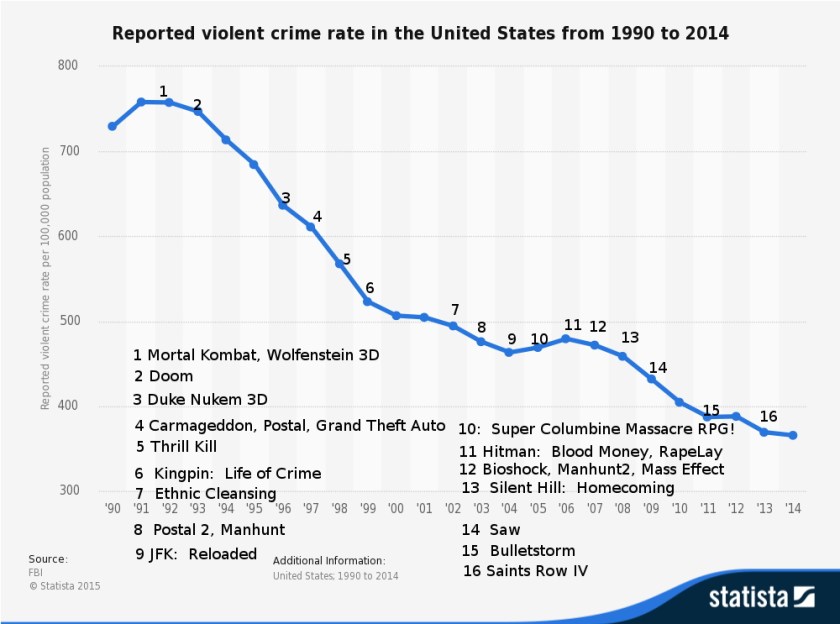
Mortal Kombat was particularly noted as a fighting game where one graphically killed ones opponents. Wolfenstein 3D and Doom were among the first fairly realistic “first person shooters”.
Now, I’m not going to claim that the reduction in violent crime is a result of these games release. Correlation does not equal causation. But what it does show is that the claimed link to “violent video games” and any rise in crime is ridiculous because crime hasn’t risen. If playing these kinds of caused people to commit real-life crimes we would expect to see a rise in crime coupled with the games becoming available and popular. We do not.
Have many violent criminals played these kinds of games? Probably. But then lots of people have played these games so that’s to be expected even in the absence of any causal connection. Or perhaps there’s a causal connection the other way. Perhaps those prone to violence are more likely to play violent video games. That would give you a higher percentage of violent playing the games without the games being any kind of cause.
There are all sorts of possible reasons that folk might see a connection between video games and violent crime. It may seem “reasonable” to them that what they “practice” in the game they might try to do in reality. But the simple fact is, there is no increase in violence to explain.
So this is just one example of many, where people try to use something that, for whatever reasons they want to restrict, as an “explanation” for crime and violence. You have to agree with their restriction, right? Why not? Don’t you want to reduce crime and violence? What kind of monster are you?
The only problem with that is that what they’re wanting to restrict often has little or nothing to do with actually causing crime and violence. That’s not even to consider whether the restriction itself is even more dangerous than the crime and violence it’s supposed to combat. Why, yes. The cure can be worse than the disease.
It’s especially nonsense when the rise of the thing they’re wanting to restrict is accompanied by a fall in crime and violence.
 The Writer in Black