Daughter’s Birthday

So we went out to celebrate.  We’ll do something more substantial this weekend.

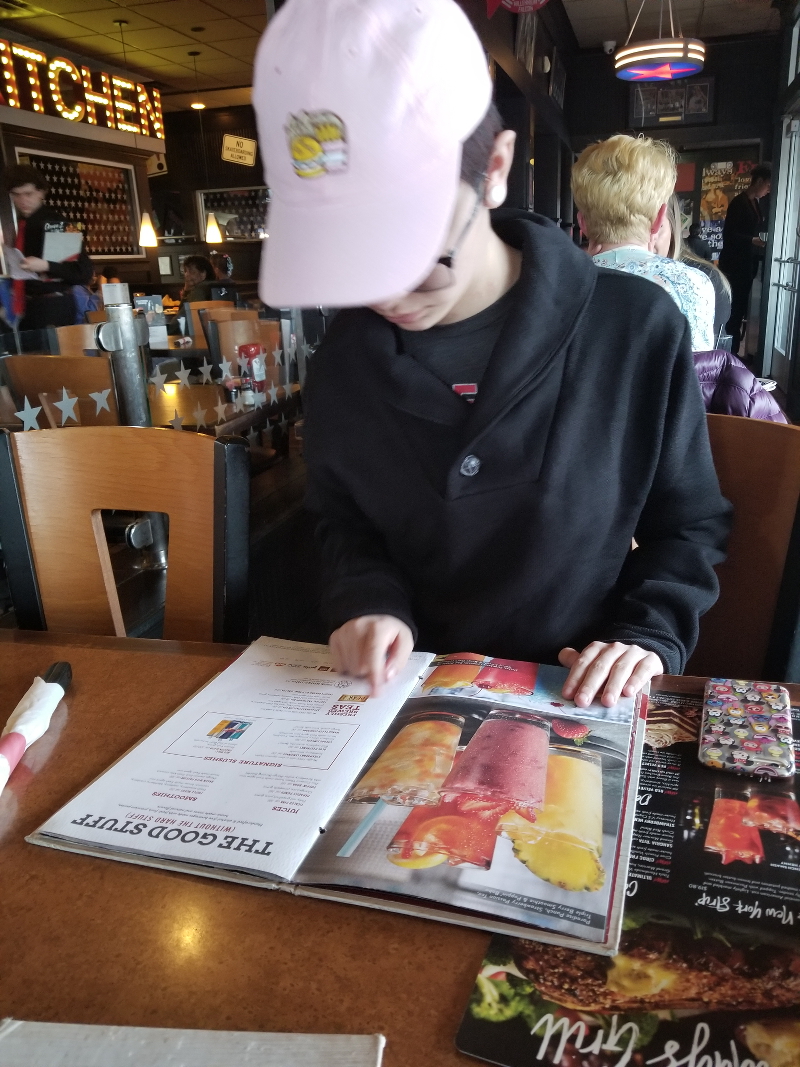
So here are some pictures

The top she’s wearing is one of her birthday presents–she’d put on her Amazon “wishlist” and it just mysteriously showed up. 😉

20180405_185229 web.jpg

20180405_185847 web.jpg
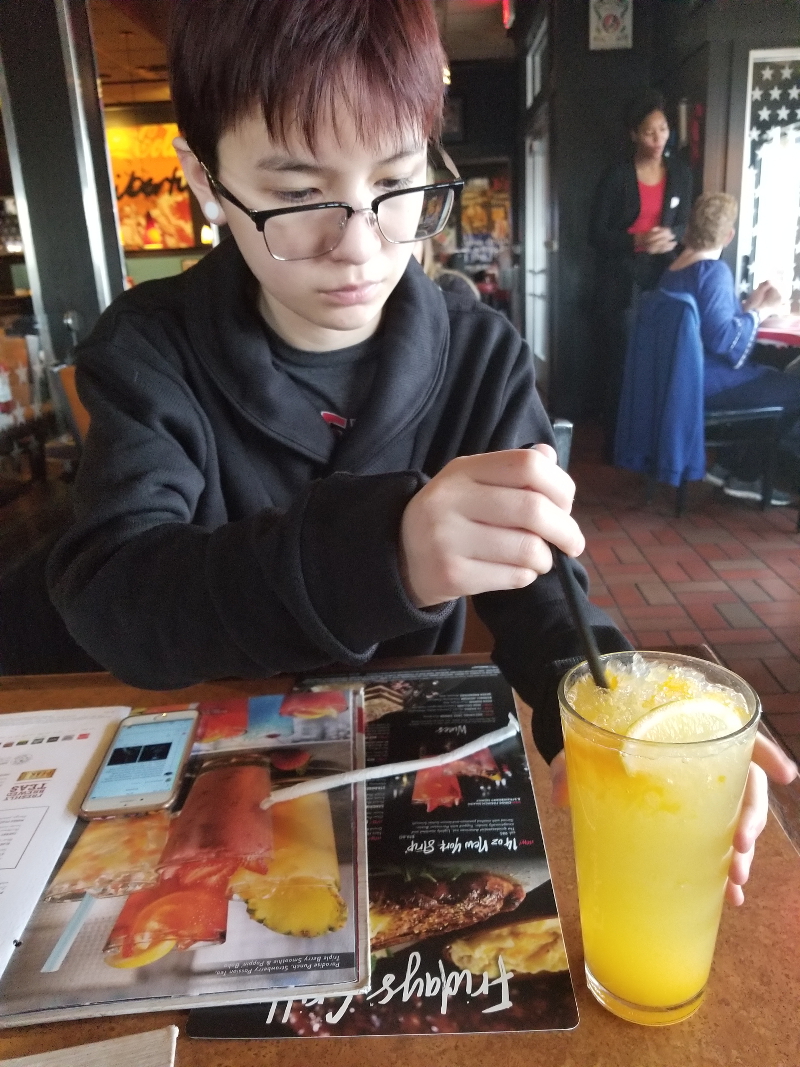
The drink is a mango-something lemonade.  She likes mango.  A lot.
20180405_192450 web.jpg
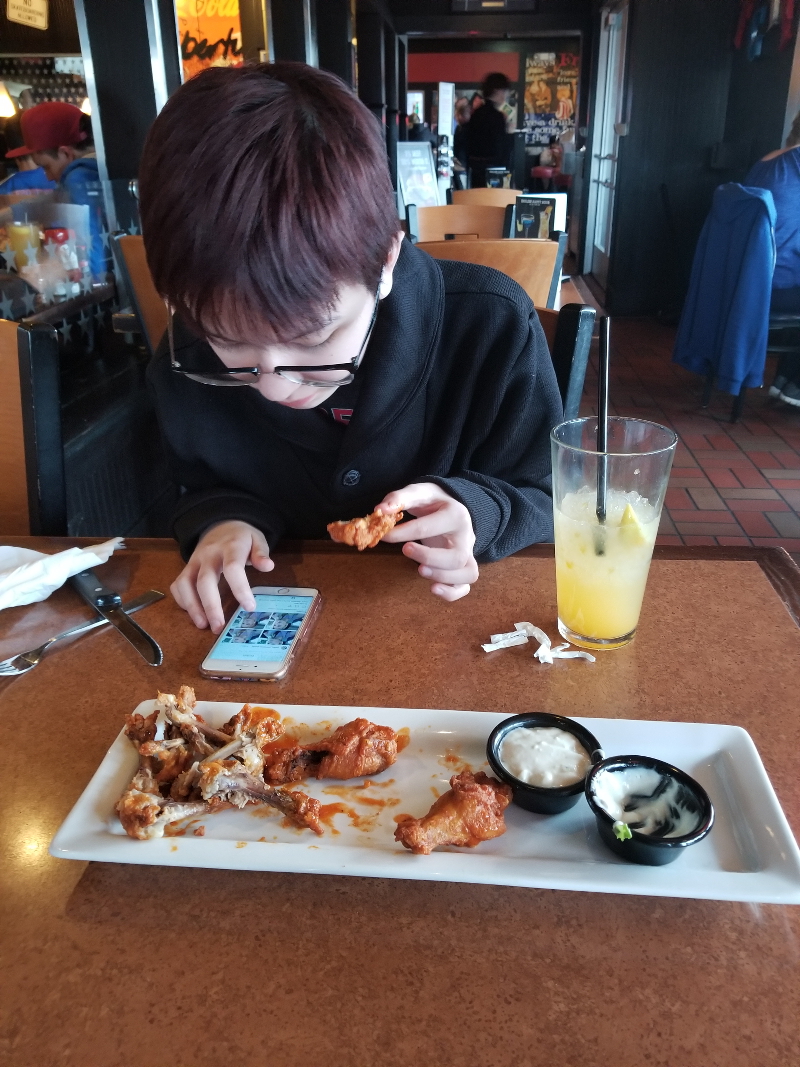
Yep.  She’s wedded to that phone.


20180405_193135 web.jpg

20180405_195421 web.jpg

20180405_195428 web.jpg

Yes, it’s next to impossible to get a smile out of her.

Finishing beta edits so how about another snippet.

I’ve been cranking on the beta edits for Alchemy of Shadows before getting it out to the proofreader/copy editor.  So here’s another snippet:


I woke on Jeff’s couch the next morning to the sound of thumping on the door.  I heard Jeff moving in his bedroom as I sat up and wiped at my eyes.

The thumping sounded again.  I stood up and took a step for the door then hesitated.  Not my apartment.  Not my place to answer.

As if in response to my dilemma, Jeff stuck his head out the door to his bedroom. “Adrian, could you get that?”

I waved in Jeff’s direction and walked to the door.  Through the peephole, I saw Becki, her hand raised to knock again.  I opened the door.

Becki’s hand started to come forward.  She stopped.  I grinned.  My timing had been perfect.

“Hey, Adrian,” Becki said. “How’s Jeff?”

“I’m fine,” Jeff said from behind me, his voice sounding strangely distorted.

I glanced back and saw him barefoot, wearing sweatpants, a toothbrush in his mouth and foam trickling down his chin.

Becki raised her hands in mock fear. “Oh, no!  It’s rabid!  Call animal control.”

“Very funny, sis.”

“I thought so.” She grinned. “But you’d better hustle if you’re going to make class.”

“Yes, mother.”

“And you Adrian?”

“Thursday, so just got afternoon classes.”

“Excellent!” Becki held up her hand for a “high five.” Puzzled, I slapped my hand against hers and wondered what she was thinking.

She did not leave me wondering long.

“You–” she pointed at Jeff. “–can get to class.  You–” she stabbed me in the chest with her finger. “–can take me to the hospital to check on Darryl.”

I looked at Jeff, who shrugged.

“Better go along with her or she’ll be just…well, it won’t be pretty.”

I chuckled and held up my hands. “Fine.  Fine.  I surrender.  But…can I maybe get breakfast first?”

“No,” Becki said, then smiled. “You’re doing me a favor, so I’ll take you to breakfast.  But–” she leaned close and sniffed. “–Maybe a shower?”

A snippet

Eeep!  I had gotten so wrapped up in working on beta edits for Alchemy of Shadows (Soon, my precious.  Soon.) that I almost forgot to do a post today.  So, here’s a snippet.


I was packing the last of my alchemical supplies into a case when someone pounded on the door.

“Open up.  Police.”

Becki’s hands snapped up to cover her mouth.  Jeff looked at me, his eyes wide.

“What do we do?” he whispered.

I shrugged. “Open the door.”

Becki went to open the door.  I still had my hands in my bag, feeling for the jar I wanted.

The door opened.  A police officer stood in the doorway.  I quickly twisted the cap off the jar.  The police officer wore dark glasses, even in the poorly lit hallway.  His hand rested on the butt of his gun.

I heard the snap of the release of the retention strap on the holster. “You.  Hands where I can see them.”

I turned, lifting my arms as though raising my hands.  The police officer started to draw his gun.  At the top of the arc of my arm motion, I flicked my wrist and opened my hand.  The jar went tumbling across the room, spilling its contents in a cloud in its wake.  The jar hit the police officer in the chest just as his gun started to come up.  He drew a breath, probably in preparation for speaking.  His face went slack.  He crumbled to the floor.

Becki’s eyes rolled back in her head and her own knees buckled.  She collapsed on top of the police officer.

Jeff started forward but I held a hand in front of him. “Wait.”

Jeff paused and looked at me.

“Don’t breathe the dust or you’ll be down there too.

He nodded and took a deep breath and went to grab Becki, pulling her out of the rapidly settling cloud of sleeping powder.

“So what do we do now?” He asked.

“We get out of here.  Did you notice the glasses?” I turned on the light next to me, then crossed to reach the light next to one of the beds.  Jeff caught the idea and set Becki on the other bed and turned on more lights.

“He’s one of those things?” Jeff asked.

“Ridden by one, I think.  Whether the police in general are after us, or just this one, I don’t know.” I stood staring down at the police officer on the floor. “If the police are after us they’ll probably have a description of my car, the Green Monster.”

“What are we going to do.”

“Get out of here first.” I grabbed my bags. The powder had settled enough. “Can you get Becki?”

Jeff nodded and hoisted Becki into a fireman’s carry.

My mind raced as we descended the back stairs toward the exit.  The last time I had to do back to back identity changes was before the modern day of ubiquitous identification and government computers all networked together.  It took time to insert data into the system.  And while I still had an emergency stash of gold, I did not have much ready cash.  I would have to sell some gold, but that would have to wait until pawn shops were open in the morning.  First we had to get out of town.  And avoid the police.

We reached the exit door.  The red and blue lights of a police cruiser flashed outside.  I peered at the car, shielding my eyes against the glare.  No one seemed to be inside.  It seemed there was only the one police officer.  Police cruiser in one direction, Monster in the other.

Unassailable?

“How dare you challenge this poor, oppressed (or victimized) person?”

Hear that a lot?  I do.  Whether it’s daring to contradict some member of a so-called “marginalized” group or challenge the statements of someone who was victimized in some way (or was just present when someone else was victimized), doing so will raise strident objections from certain groups of people.

Those people are wrong.

The late science fiction (and pretty much every other field) writer Isaac Asimov reported in one of his autobiographies (sorry, no link, I read them in “dead tree” years ago) a conversation in which he explained to someone that there is nothing about oppression that confers virtue on the oppressed.  Historically, people who have been oppressed are more than willing to oppress others when given the opportunity.

While the Good Doctor was speaking of tribes and nations, the same remains true on an individual level.  Being a victim does not make one good or noble or wise.  It does not confer expertise on any subject, not even the subject related to the victimization.  No more does my being in a traffic accident make me an expert on automotive design.

It’s possible that someone who is good and noble and wise can be a victim, certainly.  But the foolish and the vile can also be victims.  Having been a victim does not in and of itself change that.

So, no, someone or some group having been a victim does not make their positions unassailable.  It does not mean that no one could, or should, argue with them.  It does not make their motives unquestionable, their knowledge given, and their proposals the only acceptable ones.

And when victims lash out, especially when they lash out having been challenged, we might make allowances for their emotional response from what happened to them but, here’s the thing, sooner or later that excuse stops working.  It is not an unending license to attack everyone who disagrees with them while being shielded from any responses.

If a person is so emotionally damaged from the event that they cannot bear any contradiction, then that is all the more reason not to take them seriously.  Perhaps their time would be better spent seeking healing from their trauma than in trying to force public policy to fit their emotion-laden mold.

And if they are going to put themselves forward, or allow themselves to be put forward in an effort to drive that public policy, then they need to recognize and accept that it is right and proper for people to challenge both their positions, and their qualifications to put forward those positions.

And “something bad happened to me” is not a qualification for anything.

Government and Rights

Sorry about missing the last few days.  I’ve had a lot going on plus I’ve been fighting off (and losing the battle) the early stages of a cold.

Some people say that rights are something granted to you by government.  That you have something as a right because the government says you have it.  A related argument that people make is that a thing can’t be a right if the government can take it from you.

Both of these are absurd propositions.

First off consider what it means if rights only exist because the government says they do.  That directly implies that rights don’t exist if the government says they don’t.  If you take that position, then nothing government does can ever be “wrong”.

Let’s look at some examples to see where the government granting rights, and therefore is able to take them away, leads.

In March of 1492, the then government of Spain, specifically the Joint Catholic Monarchs of Spain, Isabella I of Castile and Ferdinand II of Aragon, ordered the expulsion of all the practicing Jews from Castile and Aragon and all their territories and possessions (including essentially all of modern Spain as well as additional territories).  This, of course, was entirely proper (given our presumption that government grants rights) since the government is simply rescinding the right of those Jews to live in Castile and Aragon and possessions.

There can be no objection to this, of course, since the right to live there was granted by the government and therefore could be taken away by the government.

In 1836 the “Treaty of New Echota” called for the removal of the Cherokee from all lands east of the Mississippi.  Some few moved voluntarily in response to this treaty.  However, in the end the Cherokee were forced first into concentration camps, then on the horrible Trail of Tears in forced migration to the west.

There can be no objection to this, of course, since the right to live east of the Mississippi, or to live at all, was granted by the government and therefore could be taken away by the government.

In 1838 the then Governor of Missouri issued a proclamation that the new religion of Latter Day Saints (Mormons) were to be treated as enemies of the State and exterminated or driven out.  (This order was not rescinded until 1976).

There can be no objection to this, of course, since the right to live in Missouri, or to live at all, let alone practice ones religion, was granted by the government and therefore could be taken away by the government.

In 1934, among many other things, German law stripped Jews of their German citizenship, forbade them from marrying or having sexual relations with non-Jews. (There was much worse to come, of course, so let this stand in proxy for that.)

There can be no objection to this, of course, since the right to citizenship, to marry, and who one might have sex with, were granted by the government and therefore could be taken away by the government.

Well, we could go on and on.  If one takes the view that rights are granted by government and follows that through to its conclusion that therefore government can rescind those rights at its pleasure, then there is no atrocity, no matter how heinous, that government can do and one is left with no basis to object.  If your right to life comes from government, then it is equally valid for government to rescind that right and kill you.

No, if rights exist at all, they must exist independent of government.  They might be, as the Founders of the US stated something a person is “endowed by their Creator” or simply something they hold simply as the virtue of being human.  This is the only way that one can say that a government does right or wrong.  If rights come from government then nothing a government does can be wrong.  Only if rights are inherent in being human can say that a government does wrong.

The people who made up the Continental Congress did not think it necessary to go through this reasoning to come to the conclusion.  It was “water to a fish” to them.  Thus: “We hold these truths to be self-evident, that all men are created equal, that they are endowed by their Creator with certain unalienable rights, that among these rights are Life, Liberty, and Pursuit of Happiness, that to secure these rights governments are instituted among men, securing their just powers from the consent of the governed.”

Governments do not grant rights, not in the ultimate sense.  We may use the word “right” to refer to some things that are not innate human rights, but are tied to the form of government.  The right to vote is a big one there.  But when it comes to the basic human rights, they are completely independent of government.  Government does not grant them.  Government can not rescind them.  Government can only uphold them or infringe upon them.

And when government infringes upon them, it is government that is wrong.  And it is the right of the people, collectively or individually, to stand against that government and say “no.”

History, of course, is replete with examples of governments trampling on the rights of the people.  Indeed, that seems to be the norm more often than not.  It is only when the people, united in their determination to enforce their basic human rights stand up and force government to recognize their rights, when they are willing to put their all behind the rights not just of themselves but of all men and women within their reach, that “life, liberty, and pursuit of happiness” becomes an achievable idea.

It happens when to these ends “We Mutually Pledge To Each Other Our Lives, Our Fortunes And Our Sacred Honor.”