As I have mentioned a time or two, I have been reading paranormal romances in an effort to get a feel for the field since I’m developing a story concept for one. In particular, I’ve been reading the finalists for the most recent “Rita” awards.
One thing I’ve noticed is a decided lack of concern for “fact checking.” In one, we have a person doing a “practice form” with a Western style sword that is apparently a long sequence of moves against notional (imaginary) opponents. There’s just one problem with that. The use of long, stylized forms like that are an Asian approach, not one used in Western swordplay.
Another writer had an extremely experienced diver apparently confused between air embolism and the bends (two different problems that can occur from among other things, ascending too fast) and got durations and the like wrong. A more subtle error was someone suddenly appearing having been “swept” there from a just sunken boat when no such boat was within sight beforehand. But how far could the person have been swept while still being not only alive but conscious?
The same thing happens in the “traditional” SF and Fantasy genre too. One writer recently had a ship leaving a station apparently in Earth orbit and taking weeks to return to Earth (the journey was interrupted before completion but the expected duration was weeks). Even if the ship was as far as the moon it would take less than 5 days on a minimum energy orbit. Anything longer than that would take more energy. There are reasons why the outbound leg might take that long (high efficiency, low thrust engines) but they won’t apply for a vehicle that returns from high orbit and reenters the atmosphere. [Ed: On later reflection it occurred to me that other tech they had suggested it would take as long as they want to take to come back and there were reasons they might have wanted to take longer for this particular trip–so less a mistake and more “‘Fridge logic.”]
These things dropped me right out of the story for at least a moment. I managed to get back into it but I should never have been dropped out in the first place.
A lot of people will say “but it’s fantasy” or it “uses future tech” or something like that. And that can be the case if a fantastic element is involved. If, for instance, the story is in an alternate world where Western martial arts took a different turn becoming more Asian in approach, that’s fine. But that needs to be explicitly part of the world and not “it’s a world identical to our own except some short time in the past people became aware of the existence of ‘supernatural’ creatures.” But the existence of the supernatural or “future tech” just increases the need to get the parts that aren’t part of that invention right. By showing the reader that you get the “mundane” aspects right you give them confidence to accept the fantastic.
Perhaps you, as the writer, think you can just get away with it. “Nobody will notice.” And there’s some justice to that. After all, these writers did get away with it. They were all finalists for a major award. (The non-romance in the above, was not only a finalist for a different award but actually won it.)
But somebody did notice. I noticed. And if I were not particularly motivated I might well have not taken the effort to get back into the story after those glaring (to me) errors. How many other people did stop after seeing those errors? How many people put down the book and wrote that author off? How many sales did the author lose? We’ll never know.
Now, on the other hand, whatever you do, you’re going to make mistakes. That’s part of being human. And maybe, someday, when you’re famous (or not so famous) you’ll get a letter from a reader saying “you got xxx wrong in your story.” It happened to me in my story “EMT” (Analog Science Fiction & Fact, December, 1993). It involved an ambulance service on the moon. For that story I spent a lot of time researching how ambulances operate, the effects of severe blood loss on the body, how CPR is performed and, especially, under what circumstances professionals performing CPR say “we’re done.” Despite all that effort, Analog forwarded a letter from a reader to me from a physician who, basically, said “you got that wrong.”
Does that mean one shouldn’t try? Of course not. You’re probably not a professional in every field you might have a character engage in. You do the best you can and realize that it won’t always be perfect. But you can hope to get things close enough that when a professional in the field calls you on it he qualifies things with “although it’s unlikely, I suppose it could happen” and “or course, protocols might change in the future.”
And the fewer and smaller mistakes you make, the fewer readers will lose that Willing Suspension of Disbelief that allows them to enjoy your work.
49 years ago I watched men from planet Earth first set foot on the moon. I never dreamed that 3 1/2 years later I would watch the last (for my lifetime most likely). The great disappointment of the Apollo program is that we didn’t go anywhere with it.
In any case, here’s a transcript of the communications of the Eagle’s terminal approach and landing:
Communicators in the text may be identified according to the following list.
Spacecraft:
CDR Commander Neil A. Armstrong
CMP Command module pilot Michael Collins
LMP Lunar module pilot Edwin E. ALdrin, Jr.
SC Unidentifiable crewmember
MS Multiple (simultaneous) speakers
LCC Launch Control Center
Mission Control Center:
CC Capsule Communicator (CAP COMM)
F Flight Director
Remote Sites:
CT Communications Technician (COMM TECH)
Recovery Forces:
HORNET USS Hornet
R Recovery helicopter
AB Air Boss
A series of three dots (…) is used to designate those portions of the communications that could not be transcribed because of garbling. One dash (-) is used to indicate a speaker’s pause or a self-interruption and subsequent completion of a thought. Two dashes (- -) are used to indicate an interruption by another speaker or a point at which a recording was terminated abruptly.
04 06 28 51 CC
Eagle, Houston. We read you now. You’re GO for PDI. Over.
04 06 28 57 LMP (EAGLE)
Roger. Understand. AELD control circuit breakers. DECA GIMBAL AC – closed?
04 06 29 23 CC
Eagle, Houston. Your alignment is GO on the AGS. On my Mark, 3 30 until ignition.
04 06 29 29 LMP (EAGLE)
Roger.
04 06 29 33 CC
Mark.
04 06 29 34 CC
3 30 until ignition.
04 06 29 38 LMP (EAGLE)
Roger. Copy. Thrust translation – four jets – Balance couple – ON. TTCA throttle – MINIMUM. Throttle – AUTO CDR. Prop button – RESET. Prop button. Okay. ABORT/ABORT STAGE – RESET. ATT CONTROL – three of them to MODE CONTROL. 0kay, MODE CONTROL is set. AGS is reading 400 plus 1. Standing by for …
04 06 30 45 LMP (EAGLE)
Hit VERB 77?
04 06 31 04 LMP (EAGLE)
Okay. Sequence camera coming on.
04 06 31 32 CC
Eagle, Houston. If you’d like to try high gain, pitch 212, yaw 37. Over.
04 06 31 45 LMP (EAGLE)
Roger. I think I’ve got you on high gain now.
04 06 31 49 CC
Roger.
04 06 32 03 LMP (EAGLE)
Say again the angles, though.
04 06 32 05 CC
Roger.
04 06 32 06 LMP (EAGLE)
I’ll set them in to use them before we yaw around.
04 06 32 08 CC
Roger. Pitch 212, yaw plus 37.
04 06 32 24 LMP (EAGLE)
OMNI’s in.
04 06 33 09 LMP (EAGLE)
… 10 … 10 percent …
(GOSS NET 1) Tape 66/5 Page 310
04 06 33 41 CC
Columbia, Houston. We’ve lost them. Tell them to go aft OMNI. Over.
04 06 33 51 CMP (COLUMBIA)
They’ve lost you. Use the OMNI’s again.
04 06 34 01 LMP (EAGLE)
…
04 06 34 05 CMP (COLUMBIA)
Say again, Neil?
04 06 34 07 LMP (EAGLE)
I’ll leave it in SLEW. Relay to us. See if they have got me now. I’ve got good signal strength in SLEW.
04 06 34 13 CMP (COLUMBIA)
Okay. You should have him now, Houston.
04 06 34 16 CC
Eagle, we’ve got you now. It’s looking good. Over.
04 06 34 23 CC
Eagle – –
04 06 34 24 LMP (EAGLE)
– – descent looks good.
04 06 34 25 CC
Eagle, Houston. Everything is looking good here. Over.
04 06 34 29 LMP (EAGLE)
Roger. Copy.
04 06 34 34 CC
Eagle, Houston. After yaw around, angles: S band pitch, minus 9, yaw plus 18.
04 06 34 46 LMP (EAGLE)
Copy.
04 06 34 59 LMP (EAGLE)
AGS and PNGS agree very closely.
04 06 35 01 CC
Roger.
04 06 35 14 LMP (EAGLE)
Beta ARM. Altitudes are a little high.
04 06 35 45 LMP (EAGLE)
Houston. I’m getting a little fluctuation in the AC voltage now.
04 06 35 51 CC
Roger.
04 06 35 52 LMP (EAGLE)
Could be our meter, maybe, huh?
(GOSS NET 1) Tape 66/6 Page 311
04 06 35 54 LMP (EAGLE)
Stand by, Looking good to us. You’re still looking good at 3, coming up 3 minutes.
04 06 36 13 LMP (EAGLE)
… real good …. about on.
04 06 36 18 CDR (EAGLE)
Our. position checks downrange show us to be a little long.
04 06 36 21 CC
Roger. Copy.
04 06 36 24 LMP (EAGLE)
AGS has gone about 2 feet per second greater …
04 06 36 36 CDR (EAGLE)
… ought to be … Stand by.,
04 06 36 43 LMP (EAGLE)
Altitude …
04 06 37 00 LMP (EAGLE)
… it’s going to stop.
04 06 37 18 CC
Eagle, Houston. You are GO to continue – –
04 06 37 19 LMP (EAGLE)
… closed … GO … at 4 minutes.
04 06 37 22 CC
Roger. You are GO – You are GO to continue powered descent. You are GO to continue powered des cent.
04 06 37 30 LMP (EAGLE)
Roger.
04 06 37 35 CC
And, Eagle, Houston. We’ve got data dropout. You’re still looking good.
04 06 38 04 LMP (EAGLE)
… PGNS. We got good lock-on. Altitude lights OUT. DELTA-H is minus 2 900.
04 06 38 18 CC
Roger. We copy.
04 06 38 20 LMP (EAGLE)
Got the Earth right out our front window.
I’ve got two main projects that I’m currently working on. Both are building toward their final climax. This is a couple of scenes from fairly early in one of them:
For three days, Tanaka had been pursuing the Thisok. The Great Pack Leader himself had served as Tanaka’s sponsor.
The rules, as explained to him were simple. He went into the field with nothing more than the traditional bone knife, effectively a short sword for a human. Nothing else. No tools, no weapons, no provisions, and no clothes. Everything he uses in the hunt he must wrest from the wilderness itself. At the end, he had to return with a tooth taken from a living Thisok, one that still lived to hunt again.
One further rule remained. No weapon but the bone dagger may pierce the flesh of the Thisok on this hunt.
So in addition to trying to take down the Thisok, Tanaka had to obtain food, ensure his own protection from the elements and other predators, and do it without the natural strength or inborn weaponry of an adult Eres.
He had one advantage. Humans, unlike either Eres or the Thisok, were cursorial hunters. That meant that they could pursue a target at a modest pace and keep pursuing it and keep pursuing it for hours, days even. The target was generally faster, it would run away from the human but would stop shortly thereafter. Before it had recovered from its sprint, the human would catch up and it would run again. Over and over, with the target growing progressively more exhausted with each repeat until it collapsed from exhaustion.
That worked so long as the Thisok moved away when he approached.
Tanaka’s whole body ached, but especially his legs. He had picked up the Thisok’s trail early on the second day of his hunt. He had been walking constantly since then, pausing only to check sign and ensure he was still on the beast’s trail or to pluck one of the plentiful fruits for its moisture.
So far, his unfamiliar scent had kept the Thisok uncertain, and moving away from him.
Tanaka paused at the edge of a stand of trees. His vision blurred and he shook his head to clear it. The neo-provigil, taken as a hedge just before he had begun the hunt, was wearing off and his body begged for him to lie down and sleep. Somewhere above, lightfliers were circling, tracking his progress. He could signal them; call this off.
There. On the field. He spied the thisok. It was moving, with a decided stagger, not more than two hundred yards ahead.
“Well, old fellow,” Tanaka murmured, “looks like your as tired as I am.” He looked down. Yes, the knife was still in his hand. He had dropped it once before without even realizing it and had had to backtrack an hour to find it.
Every such mistake drained him while giving the thisok opportunity to recover.
The wind shifted, now coming not from behind but to the side. Tanaka saw an instant change in the thisok’s demeanor. No longer confused by an unfamiliar scent carried on the breeze, it’s eyes turned toward Tanaka. It charged.
“Shit!” Tanaks spun and fled back into the trees. Adrenaline gave his feet wings as he leaped for a low-hanging branch.
Without being quite sure how he got there, he found himself scrambling higher into the tree top just as the thisok broke into the woods. It leaped, scrabbling at the bole of the tree with its claws but not finding purchase to climb. Its claws tore long strips from the tree as the beast howled.
Once he was confident that the thisok could not reach him, Tanaka settled down in a crotch of the tree to rest.
When Tanaka opened his eyes, night had fallen. All three moons graced the sky providing enough light for even Tanaka’s human eyes to see clearly. The thisok was nowhere to be seen.
While the unintended sleep had restored some of his energy, it had done nothing for the all-pervasive aches. With slow movement, he climbed down among the three’s branches, hung full length from the lowest branch, then dropped to the ground. He spotted the bone dagger where he had dropped it in his leap into the tree. He scooped it up.
He turned in place, letting his gaze sweep the woods around him while also listening, seeking with eyes and ears for any clue that the thisok might be waiting, ready to spring.
No sign of the thisok. He knelt, examining the torn-up ground. After shredding the local vegetation, the thisok had apparently headed.
“That way.”
He wet a finger and held it up. Such weak breeze as there was blew from before him. He doubted that the thisok would find his scent confusing any more and so thought it best not to be scented. Tanaka would have to find some other way to keep the beast moving. And who knew how much effort he had lost by his unintended nap. Crouching low, he advanced in the direction the thisok had gone.
Just outside the copse, the thisok lay still as if it had simply dropped, unable to proceed. Crouching close enough to see its shallow, ragged breathing, Tanaka thought that was much what had happened. Its fury at the tree had expended the last of its energy.
Tanaka stood. After a quick glance to see that there was a climbable tree ready to hand he raised his arms and waved them. “Hey!”
The thisok did not move. Tanaka stepped forward and repeated his wave and shout.
Holding his breath, Tanaka crept up to the side of the Thisok. The thisok remained unmoving although a low groan rose from its chest.
The thisok, like the terran shark, constantly grew new teeth and shed old ones. And so it was a simple matter for Tanaka to find a tooth ready to break free and pry it loose with the bone knife. He picked up the fallen tooth, raised the dagger in salute, and turned and walked away.
A few minutes later he stopped at the hum of a lightflyer approaching. The lightflyer set down next to him and an Eres stepped out.
“I salute you, Great Pack Leader of Tanaka Pack.”
At that voice, Tanaka felt his eyebrows climbing toward his hairline. “I salute you,” he said in response, “Great Pack Leader of all the Eres.”
#
Tanaka entered the Great Pack Leader’s office, followed closely by Kaleka.
“I greet you, Great Pack Leader of all the Eres,” Tanaka said.
“I great you, Great Pack Leader among humans.”
Behind him, Tanaka could hear Kaleka shift uncomfortably. Tanaka understood. He had not said he bared the throat.
Krashnark paused for a moment, then gestured acknowledgement. “Sit. I will have refreshments brought.”
“Thank you,” Tanaka said. He saw a chair designed for humans, not an office chair but a reclining chair more more appropriate to watching grav-soccer on holovision than to office meetings. He sat and leaned back in the chair. Kaleka took a position behind him.
Krashnark, from his position behind his work table, looked down at Krashnark. “Rest yourself young one. All is safe here.”
Kaleka gestured acknowledgement and sat in one of the Eres stool-chairs.
Krashnark turned back to Tanaka. “Are you well enough?”
Tanaka rubbed his right arm. “Sore, if I’m to be honest. It’s been an intense few days.”
“But worth it, Great Pack Leader,” Krashnark said. “Worth it indeed.”
Tanaka frowned at the repetition, calling him “Great Pack Leader”.
“Worth it? Sheshak told me why he wanted me to make that hunt.” Tanaka glanced sideways at Kaleka. “Or perhaps there was more to it than that?”
Krashnark made the hissing sound that served as laughter for the Eres. “More? Indeed. Tell me, young Kaleka, what did you think of the human’s Hunt.”
“I…ah…”
“You may speak,” Krashnark said. “I ask for a reason.”
“The human is terrifying,” Kaleka said. “There was no charge, no rending, no trapping. He just walked. And when the thisok trotted away from the human, the human walked. And when the Thisok stopped, the human walked, and approached. And the thisok trotted away again. And again the human came, still walking. And again the thisok departed. And again the human came. And again and again and again. As a youngling, I had nightmares so: the monster that never quits. In the end, he walked up to the thisok and took its tooth. And the thisok raised neither claw nor fang to stop him.”
Krashnark touched tongue to teeth in agreement. “Three times we Eres have gone forth in Great Hunts against the humans and their allies. Three times, they have driven us back. This, I think, is why.”
Tanaka spread his hands, a gesture that, by coincidence, in this context meant much the same to Eres and human. “Is that why you asked me to come here, to tell me I’ve become an Eres monster?”
“Not entirely,” Krashnark said. “Hear my words, Great Pack Leader.”
Tanaka tilted his head and waited.
“The Jekat sect say that those who know, who feel, who think, your word…sothont…”
“Sophont?”
“Yes, sothont.”
Tanaka nodded. Lacking lips, the Eres could not produce the “f” sound.
“Sothont are not lawful prey to Eres.”
“Are you Jekat then?”
“I am not,” Krashnark said. “As Great Pack Leader to all the Eres, I must be above individual sects.”
“I see,” Tanaka said.
“Sothont are not lawful pray, but all sothont, whether Eres, or Human, or Rela, or others, hunt. All.”
Tanaka caught his breath. This could be dangerous territory. “Not all humans hunt,” he said softly.”
“Humans as a type hunt. That some individuals do not is unimportant.” Krashnark stood and paced behind his desk. “Not all hunters are sothont, but all sothont are hunters. Or so we thought.”
Tanaka leaned forward waiting.
“Keshak-tal,” Krashnark said. “They were keshak-tal.”
Grass-eaters, Tanaka thought. “Were?”
“Are,” Krashnark said. “They eat only the plants of their homeworld. Perhaps others too, now.”
“I do not understand.”
“A ranging vessel found their home. They had been long confined to shipboard and thought to stop for some hunting. Not all Keshak-tal are meek. Not all keshak-tal are stupid. But these… They used tools. They used fire. They had steam power. We think they had electricity. And they breed.”
“Breed?”
“They breed. Each female gives birth to a litter of four every year. They have no predators, save each other.”
Tanaka chilled. “That does not sound good.”
“They breed and they fight. They slaughtered the crew of the Third Fang Ch’chnak. They took the ship and…”
“Don’t tell me they learned to use it.”
Krashnark stopped and looked straight at Tanaka. “You guess. They took the ship and they fought other Eres. And they defeated them and took their ships.”
“I don’t see the problem,” Tanaka said. “A few primitives with stolen ships?”
“They have taken thirty two worlds,” Krashnark said. “Singly, or in small groups, we can defeat them. But they swarm. And they are building ships, copies of ours.”
“Wait a minute,” Tanaka said. “How can they be…”
“I do not know. A few, perhaps in captured yards, but they build thousands.”
“Given what you told me was their starting point, they must be the galaxy champs in fast learning.”
“I do not know. I only know that they will be here in less than three hundred days and I cannot stop them.”
Kaleka’s chair fell over as Kaleka rose and stumbled backward. Krashnark rounded his work table and dropped to a low squat in front of Tanaka. “I called you here so I might beg aid of the humans in protecting my people.” He lifted his head high in the air. “I bare the throat, Tanaka, Great Pack Leader among the Humans. I bare the throat.”
You know, I’ve always found that expression a bit annoying. Wouldn’t it be: “Sometimes you get the bear. The bear gets you once“?
Be that as it may, the subject right now is writing, in particular getting stuck. Most of the writers I know have had the experience of sitting down to work on a project and it just won’t come. You sit there, staring at the page (screen these days) and the words just don’t want to come. As I said, most writers I know have had the experience and I suspect most of the others just won’t admit it. But I could be wrong.
The term for that is “writer’s block.”
I don’t like that term. For one thing in every other job in the world, there are times when one doesn’t feel motivated, doesn’t feel “inspired,” when the body and mind say “I don’t want to do this.” They don’t get special terms. There’s no “bricklayer’s block” or “engineer’s block” or “corporate CEO’s” block. But writers? Writers get to say “I have writers block” and people nod in sympathy and maybe buy them another beer.
You know. I think that may explain much of writer’s block.
Seriously, though, there are times when the words come easily, where the story is just there. You sit, your fingers fly over the keyboard, and words appear on the screen. Magic. It’s just about the greatest feeling in the world. (Just about. I can think of one or two others that are better.)
Then there are other times, times when you sit there and write one word. Then you sit there and write another word. Then one more, each word like giving birth to a porcupine . . . breach.
And the thing is, at least in my own writing, there’s no difference I can tell between the results of the “easy” writing and the “squeezed out one agonizing word at a time” writing. They’re just as likely to be good (as in “saleable”) or just as likely to be dreck. Some of my published work is one, some the other.
The interesting thing is, writing for me rarely falls between those two. It’s either one or the other but never, say, a little struggle to find the right words, or anything like that. No, that’s reserved for editing.
I’ve never liked the expression “the end justifies the means” either in straight or ironic mode because sometimes it does and sometimes it doesn’t. Point out to someone using it ironically that there are cases where it does apply (the means of shooting someone dead is justified by the end of protecting ones family) and they’re “but that’s different” without articulating why it’s different.
The thing that got me thinking about this was the number of times when I was talking about some policy in Realpolitik terms–what might be achievable in the short run even though it falls far short of ideal–somebody will come and look at the “deal making” necessary to get the gain, sneer at the “compromise” and smuggly spout off about “The Ends (not) Justifying the Means”. It’s usually some big-L (Libertarian) type decrying that the policy in question includes a lot of stuff we don’t want–but have to agree to in order to get something we do want and which is actually a net movement in the direction we want to go.
So the way I have generally encountered it is being used in smug sanctimony to dismiss legitimate “you do what you have to, to make the gains you can” and is why we can’t have nice things.
And it’s generally Big-L types (largely because the policies I favor universally push in the “L” direction–I don’t know of anything on a public policy position which is too libertarian).
People who know me know that I lean very libertarian. But I also have what I think is a realistic appraisal of the world and recognize that’s a minority position so I need to think more in terms of moving in the direction I want rather than magically getting my ideal society.
In my own thinking there’s three tests where (whether you call it “the end justifies the means” or not) doing something that on its own would be bad becomes justifiable in a particular situation or for a particular end:
1) The end must, itself, be something “good”. “The Holodomor was necessary to get rid of the Kulaks and enforce the collectivization of farmland in the Soviet Union” (an argument I’ve actually heard), breaks down once you recognize that “getting rid of the Kulaks” (by starving them to death) and enforced collectivization were themselves evil. Evil cannot justify evil.
2) The means must be necessary to the end. At the very least, one must reasonably believe that said means are necessary. There might be circumstances where I would have to perform emergency surgery on someone (stranded in the wilderness, for instance), but I can’t just cut someone who has an inflamed appendix open when the option of taking them to the hospital is available. I would include as a special case in this “is the end reasonably achievable by these means”. (No, the “end” of a “fair” society is not reasonably achievable by establishing socialism. It’s failed every time. Whatever excuses you give for “that wasn’t real socialism” the fact remains that the attempt failed. It always does.)
3) The “means” cannot be “bigger” than the good “end” to be achieved–even if we accepted collectivization as a “good” the lives lost in the Holodomor weigh far larger than any “good” accomplished. This one is a bit more complicated in some ways because how do you weigh, for instance, one person killing six attackers in defense of themselves–one life vs. six. But you can’t weigh it like that, or not only like that. Six who threaten the lives of innocents vs. one who does not seems to me a much more justifiable balance. And add in that the six are unlikely to stop with the one, that one isn’t just defending himself but himself and all who come after.
It seems to me the “bad” examples of “the end justifies the means” (the kind of examples used to claim that it does not) fails one or more of these tests.
The thing is, people want a blanket statement like “the end justifies the means” to always be true or always be false. This leads to twisting words around to try to make it fit that desired truth/falseness when the simple truth is that blanket statements are rarely (SWIDT?) always one or the other. The real world is more complicated than that.
If you claim it’s always false, then when you have to do something unpleasant toward a longer term goal (like, say, rise in resistance to a government turned tyrannical), then somebody points out that unpleasantness and ask if you think the ends justify the means, well, then you’re left trying to explain how by using this and so definition of words that you don’t really think the ends justify the means and lose sight of the simpler question: In this case, does it? Sometimes it does and sometimes it doesn’t. I think the three tests I gave provide a good start to determining whether a particular case does or does not.
A while back I bought a 30″ charcoal grill with a side smoker. At the time I thought that certain other problems were near the end and it was on sale ($79, plus free shipping on Amazon Prime) so I treated myself. And there it sat, with the box not even open since I didn’t have time to do anything with it.
I can’t find the one I got on Amazon now, but this one is close (and on sale now, although not as good a deal as I had before):
(You can click on the link to see the product listing).
Well, I finally pulled the thing out and assembled it. I found a whole beef brisket at the store–a pretty expensive chunk of meat, but I did the math and, well, it will probably be cheaper over the course of the week than my usual fare.
So today I fired it up. Hardwood lump charcoal (don’t care for briquettes) and apple wood pieces for smoke and got the fire started. While the grill was heating, I trimmed the excess fat from the brisket. To season, I mixed equal amounts of coarse ground pepper, coarse kosher salt, and garlic powder in a mixing bowl then put them into a shaker. I shook the seasoning from about 2 ft above the meat to let the seasoning “spread” and give me a moderate dusting over the entire brisket, flipping it to get both sides..
When I was done preparing the meat, I checked the temperature of the grill–about 300 degrees Fahrenheit. This was higher than I wanted but despite fiddling with the venting, I wasn’t able to get it lower with the lid closed. So I decided to proceed. I put the meat on the grill and…my remote readout leave-in meat thermometer was dead. Well, it had been quite some time since I’d used it. So I ran out to the store to pick up a replacement. Came back. Temperature in the grill had risen to 325. Not what I wanted but…not much I could do about it. However, once it had been running for a couple of hours, the fire burned down enough to get closer to my darget temperature.Note for future. build a smaller fire to start with. You can always make it bigger if needed. This also means that this project is not a “start it, go away, and come back later to see if it’s done” event but something that requires frequent checks to ensure the temperature is where it should be.
In any case, I inserted the thermometer into the thick part of the meat, closed the lid again, and went away to do other things, while coming back frequently to check.
From time to time, I found that it stopped smoking. When that happens, I open the firebox and drop in a chunk or two of apple wood, then close up so I can get more smoke.
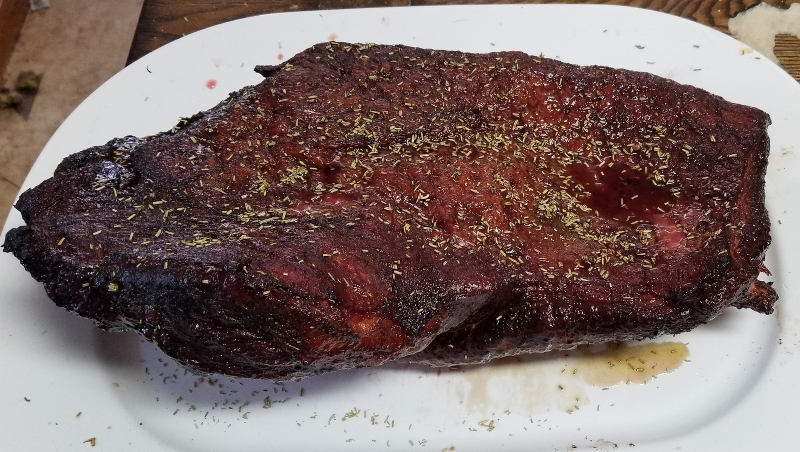
Once the internal temperature of the meat reached 160 I removed it from the smoker and lightly dusted both sides with crushed rosemary:
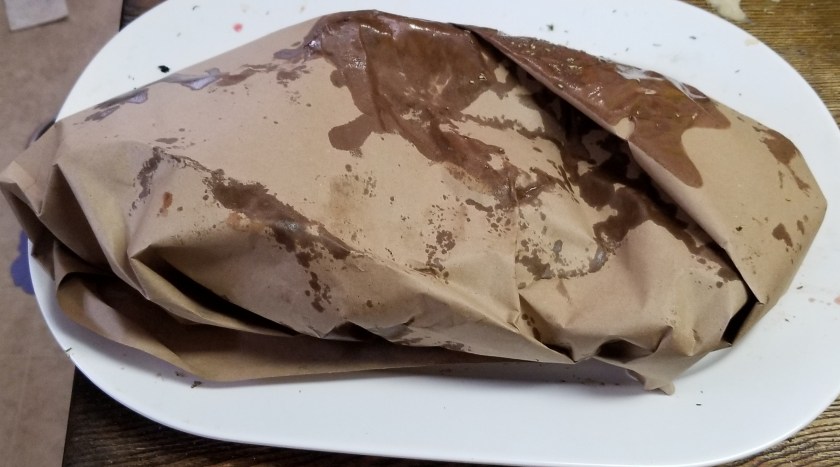
It already looks pretty good right there, but we’re not done yet. I wrapped the piece up in peach butcher paper:
And placed it back on the grill to continue smoking. Temperatures somewhere in the 200’s as I didn’t really have better control of it than that.
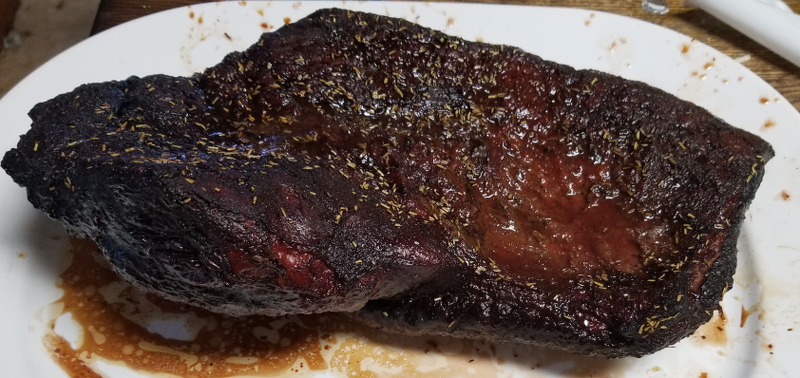
After about another four hours of cooking, the internal temperature reached 190. I opened the smoker in preparation for removing the brisket to let it rest (you can see the leave-in thermometer):
Let it rest 45 min before unwrapping and slicing.
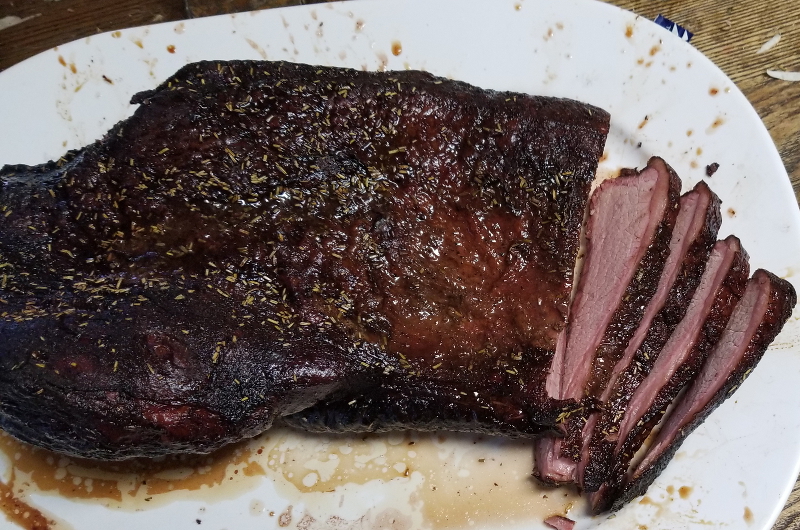
After resting and unwrapping, we end up with this:
And sliced:
I was a bit nervous about cooking to such a high internal temperature–and that was at the thick part of the meat. The thinner sections would be even higher–because in my past experience that usually left the meat dry and rather tasteless. But the meat here was tender, juicy and full of beefy goodness.
I served up a couple slices on a low-carb tortilla with a small bowl of low-carb barbecue sauce (several recipes for that elsewhere on this blog) for dipping but truth to tell it didn’t need it. The meat was more than capable of standing on it’s own.
So, not exactly an “active writer” recipe since it basically took all day (11 hours from first lighting the grill to slicing the meat) but definitely worth the effort and will feed me for some time.
In another Blog, the subject came up of people who claim “one true way” to write. That if you want to be a writer, you must write this way and no other.
I answer them with this piece:
In the Neolithic Age Rudyard Kipling
IN THE Neolithic Age savage warfare did I wage For food and fame and woolly horses’ pelt.
I was singer to my clan in that dim, red Dawn of Man, And I sang of all we fought and feared and felt.
Yea, I sang as now I sing, when the Prehistoric spring Made the piled Biscayan ice-pack split and shove;
And the troll and gnome and dwerg, and the Gods of Cliff and Berg Were about me and beneath me and above.
But a rival, of Solutré, told the tribe my style was outré— ‘Neath a tomahawk, of diorite, he fell
And I left my views on Art, barbed and tanged, below the heart Of a mammothistic etcher at Grenelle.
Then I stripped them, scalp from skull, and my hunting-dogs fed full, And their teeth I threaded neatly on a thong;
And I wiped my mouth and said, “It is well that they are dead, For I know my work is right and theirs was wrong.”
But my Totem saw the shame; from his ridgepole-shrine he came, And he told me in a vision of the night: —
“There are nine and sixty ways of constructing tribal lays, “And every single one of them is right!”
* * * *
Then the silence closed upon me till They put new clothing on me Of whiter, weaker flesh and bone more frail;
. And I stepped beneath Time’s finger, once again a tribal singer, And a minor poet certified by Traill!
Still they skirmish to and fro, men my messmates on the snow When we headed off the aurochs turn for turn;
When the rich Allobrogenses never kept amanuenses, And our only plots were piled in lakes at Berne.
Still a cultured Christian age sees us scuffle, squeak, and rage, Still we pinch and slap and jabber, scratch and dirk;
Still we let our business slide—as we dropped the half-dressed hide— To show a fellow-savage how to work.
Still the world is wondrous large,—seven seas from marge to marge— And it holds a vast of various kinds of man;
And the wildest dreams of Kew are the facts of Khatmandhu And the crimes of Clapham chaste in Martaban.
Here’s my wisdom for your use, as I learned it when the moose And the reindeer roamed where Paris roars to-night:— “There are nine and sixty ways of constructing tribal lays, “And—every—single—one—of—them—is—right!”
Struggling artist Leslie Jefferson keeps finding strange paintings on dark and disturbing themes in his studio. To all appearances, from the signature to the style, they are his work. Yet he has no memory of making them. Are these paintings the product of a sick mind, perhaps even his own, or do they portend something more terrible than he ever imagined?
Study in Black and Red
by
David L. Burkhead
Leslie Jefferson slid the key into the lock of his apartment door. Karen, his girlfriend, not content to wait until they were within, tickled the back of his neck.
Leslie pushed the door open and turned. Karen melted into his arms and tilted her face up for Leslie’s kiss.
“It’s been a long day,” Leslie said as he broke the kiss. “Make yourself comfortable while I grab a quick shower.”
“Don’t take too long.”
While the apartment was in one of the less affluent districts of town, it did have plenty of hot water. A few minutes later Leslie stepped out of the shower and wrapped a robe around himself.
A cloud of vapor billowed out of the bathroom when he opened the door. He did not see Karen but did see the open door to his studio.
Despite the warmth of the humid air, he felt a shiver run up his spine.
“Not again.”
He crossed the hallway to the studio, his feet leaving wet footprints on the fake wood floor. In the studio he saw Karen looking up at a painting, a big twenty-four by thirty-six piece. Acrylic on canvas.
“Leslie, this is your best one yet,” Karen stood admiring the painting. “If a bit dark.”
The painting showed Philadelphia burning. Thick black smoke blotted out the sky. Tiny people ran, clearly screaming, in the streets beneath buildings engulfed in flame.
His work. His painting. Any inspection would show that. From his signature in the lower right corner to the style. Right down to the brush strokes.
The only problem was Leslie did not know where the painting had come from. It had not been there when he had left for his date with Karen. More than a dozen times he had found paintings in his studio, his paintings, but with no memory of having painted them. He thought he had been sleep-painting or having some kind of fugue state. But this one? He had not even been home and here the painting was, a painting showing a terrible scene of fire and death. But a painting that was clearly his work.
Wrote this when I started my original “blogspot” blog back in 2011. Not much to change, really except, well, I’ve learned more about one of my earlier inspirations/mentors that, well, put me in a very odd place in my head indeed (and make me very glad that my interactions were all long distance and strictly limited to the subject of writing).
Getting started writing isn’t rocket science. The late Marion Zimmer Bradley defined it quite succinctly: “Apply the seat of the pants to the seat of the typewriter chair and stay there until you get results.” There’s really not much more than that.
Well, there’s not much more to it than that unless you want to write stories that sell. Even here, it’s hard to determine any hard and fast rules. It seems that for any rule one might name there’s somebody out there breaking it successfully. Still, there are some things that can help.
1) If you want to write, you have to be a reader. Read voraciously. If you want to write in a particular genre–science fiction, fantasy, mysteries, westerns, romance, whatever–then read that genre. But don’t read only that genre. Stretch your horizons. Read classics. Read non-fiction. Want to write Science Fiction? Read Romance. Want to write Romance? Read Westerns. Now, in addition to the reading, think about what you’ve read. What did you like about it? What did you dislike? If you liked some parts and disliked others, try to figure out why. What was different?
What you’re doing here is learning what goes into a successful story, what works for you and what doesn’t. You can read reviews to get an idea of what worked and didn’t work for others, and that can be valuable, but in the end it comes down to what works for you and no one else.
2) Get out and meet people. Watch them. Talk to them. Take notes, if only mental ones. In the end, stories are about people. All these interactions with people in the real world–good, bad, or indifferent–are ingredients that will go into your characters in stories. If your only source for characters comes from reading other people’s stories your characters will seem derivative and shallow. They will seem that way because they are derivative and shallow. So bring some real people into the mix.
I’m not a big fan of basing individual characters on individual real people but taking a bit from here and a bit from there and one can build interesting characters that will seem real to the readers. And that’s the goal. They don’t have to be real. They have to seem real.
3) Above all, write. Write character sketches, story ideas, complete stories. Write write write. Then take what you’ve learned from the reading and look at it again. What does and doesn’t work in what you’re writing? Something not working? Can you fix it? If so, try that. If not, set it aside (after all, there may be something you can mine out of that later) and try something else.
A “truism” in writing is that one has to write about a million words worth of crap in simply learning the craft. Now, there are some exceptions to that rule (you know who you are; yes you do) but that’s a pretty good rule of thumb. While there is a “talent” aspect to writing and storytelling they are also crafts that can be learned. But here’s the thing, you can’t just write any crap. You have to be trying your absolute best, writing the best crap you know how to write.
I started writing sometime in grade school. I was, at that time, a big reader mostly of science fiction. I was a big “space buff” and was writing mainly to get more stuff to read. During those years I wrote a lot of story beginnings but very few if any complete stories.
Then came 1977 and That Movie. I loved the movie. It inspired me to write a screenplay of my own. It inspired me to finish a screenplay of my own. Now, my screenplay was a cheap ripoff of Star Wars. It was a bad cheap ripoff of Star Wars. I mean this thing was seriously bad. I live in fear that somebody, somewhere, might turn up the only copy of the manuscript (written by hand on notebook paper) and threaten to release it to the world if I don’t pay blackmail money. Bad. But, it was nevertheless an important turning point. It was the first piece of any length that I had finished. I could finish a story.
And so my next big story was a novel written in study hall at school. It too, was very bad. Hackneyed, cliched, and implausible. Oh, and the main character was a complete Mary Sue (Marty Stu?). But, again, I demonstrated that I could complete a work of significant length.
Shortly after that I joined the Air Force and played around with writing a bit more. I had discovered SF magazines and realized that people paid money for short work, including short work from new authors. And so I began writing short fiction in earnest. Most of my work in this period was still quite derivative I wasn’t having any success. Writing was still an occasional thing with me but I’d write stories on my computer (Apple IIe), take the printed copy (9 pin dot matrix) over to the library to retype for submission, and send them out to collect rejection letters.
This was a very frustrating period but, without realizing it, I was learning the basics of the craft and the stories were getting better. It was in 1991 when I made my first sales. (More on that another time.)



 For food and fame and woolly horses’ pelt.
 And I sang of all we fought and feared and felt.

 Struggling artist Leslie Jefferson keeps finding strange paintings on dark and disturbing themes in his studio. To all appearances, from the signature to the style, they are his work. Yet he has no memory of making them. Are these paintings the product of a sick mind, perhaps even his own, or do they portend something more terrible than he ever imagined?
 The Writer in Black