Who Controls Society? A Blast from the Past

A commenter (read “Troll”) on Sarah Hoyt’s blog in the course of his posts made a statement about determining “who controls society”.

After much facepalming, I replied.  I expand a bit on that reply here.

I don’t know why I try, but I essay:

This statement here shows such a profound ignorance that you can’t even ask meaningful questions. It’s a null statement. There is no answer to it as worded. It assumes a strict hierarchy that totalitarian regimes may approach but that never actually achieve.

Consider the barnyard example of a “pecking order” among chickens.  This is a common grade-school example of heirarchy. Anyone who actually knows chickens knows that this is laughable. It’s not a hierarchical order but a collection of interacting relationships.

Likewise with canids. People talk about the “alpha wolf” the “beta” and so on down to the last one. (Fortunately, for people making these assertions, wolf packs generally don’t get large enough that they run out of Greek letters.)

Look, I’m a “dog person”. When I acquire a new dog, the dogs among them will establish their own internal dominance structures. However, despite the fact that I am “alpha” to all the previous dogs (I have to be since the dogs have to exist in mutual safety in human society) I still have to establish my individual dominance over the new dog even if it is subordinate to the other dogs. Individual relationships, not a fixed hierarchy.   For example, “Hachi” is subordinate to me. We get the new dog“Trunks”. (My daughter gave them their names.) Trunks is subordinate to Hachi. (Hachi’s got real attitude–Bolt, the Pit Bull mix twice her weight is subordinate to her.) This does not mean that Trunks will automatically be subordinate to me just because I “rank” over Hachi. I have to establish that separately. And, incidentally, were I to fail to do so (purely a hypothetical in this case) that would not mean that Hachi, dominant over Trunks, would automatically become dominant over me. “Dominance loops” can, and in fact, do, exist.

Thus, the whole idea of “who controls society” does not, and indeed cannot have an answer. It’s like asking “how high is up”, or asking a person not affected with synesthesia what the color blue smells like (not a blue object, but the color itself).

Consider for instance how this works in the case of fashion. In China for a long time foot binding was a fashion. A horrible, horrible fashion. This is often described as being something imposed by men on women to force subervience on them. (After all, traditional Chinese culture was strongly patriarchal–few would dispute that–so of course, the men have to be the ones dictating this.)

When I was in college, I had to take two courses, 6 credit hours, in “World Civilizations”.  One of the courses I took covered China.  One of the texts we used was the book  “Wild Swans”, a biographical account of three generations of Chinese women spanning pretty much the 20th century (and was used as a text in the “China” class in World Civilizations in college) describes the last generation to practice foot binding (while Manchuria, which did not practice foot binding ruled over the rest of China). It wasn’t the men imposing it. It was imposed by other women.

Note, the ruling Manchurian dynasty did not practice foot binding.  Yet Chinese women, of other ethnicities within China nevertheless enforced it on their daughters.  It was not a “patriarchy” imposing this on women, but women imposing it on each other.

Likewise with more mundane fashion choices. Men pretty much don’t care. At most men will be interested in whether or not the fashion shows off the female form because, for evolutionary reasons, men tend to highly approve of the female form. No.  Fashion choices and the impositions thereof are driven almost entirely by pressure between and among women. (Yes, many fashion designers are men–but much of that crap they go down the runway with is never actually worn in public. It’s more “performance art” than actual fashion.)

Most of the pressures placed on women in modern Western society are placed their by other women for the ostensible benefit of those other women. Men don’t control that. They may try to grab hold for the ride, but the control is firmly in women’s hands.

Indeed, one can also argue that many of the pressures on men are put on them by women for the benefit of women and children.

Consider the various mating rituals in the animal kingdom. The brilliant plumage and mating dances of male birds. The “fights” of rutting bucks. A lot of people naively think that this competition is a display of male dominance.  Exactly the opposite is the case.

These things are designed to impress the female because it’s. the. female. that. chooses. While the male activity is more visible the actual power lies with the female.

Likewise with many of the things that people claim are “patriarchal” in American society. They are actually aspects of female power and female choice. And even there, it’s a matter of individual issues with multiple subgroups.

Consider, I’m Goth (well, perhaps “Goth-lite”). Among many folk that would automatically make me lower in their personal heirarchy simply from my choices of style, appreciation of the dark, and liking for music with dissonant tones and dark subject matter. On the other hand, I can show up at a major business, deal with businessmen in their three-piece suites and short, parted on the left hair while I’m dressed in black T’s and jeans, long black hair with a purple streak pulled into a pony tail, and black painted nails and they don’t say “boo”. Because I bring something to them that they can’t do and they know it. (BTW: if you have a Blu-Ray player, you’re welcome.)  People tell me that tailored suit and tie makes a person look powerful.  People paying me to come fix their problems in my T-shirt, jeans, and pony tail?  That, my friend, is power.  And yet, the same people who come to me for help and pay the rather substantial fees my boss charges for it would have no problem disparaging me in a different context because their conventional style is considered higher status than my “looks like a freak”.

There is no one who “controls society”. It’s a lot of individual interconnections and relationships that are always changing, not just over time but with context, a chaotic system at best which cannot be predicted, much less controlled.

Continuing Ice Follies (well, more sidelines of Ice Follies this time).

At ice skating class last week we had a new student. When the instructor asked her whether she had any previous experience and she said as a teenager and had maybe one public skate before the class. I said that’s like when I started only she’s doing much better than I was then. (And she was. You really should have seen me. It was bad.) Mind you, she appears considerably younger than me so I can take comfort that she hadn’t had as much time to lose it all as I had.

During the course of the class I made a quip that I had to revise that initial estimation. She’s doing better than I am now.

At the end of the class I was sitting taking off my skates and she sat next to me (don’t make anything of that–all the “learn to play hockey” people were gearing up and the benches were pretty crowded). I, again, mentioned how she was doing really well–better than I was now after about six months of lessons (start of fourth set of eight week classes so, yeah, six months).

Her: “Oh, you’re doing great out there.”

Me: “Your backward skating, your edges, your crossovers, all are better than mine.” (And, to be honest, they are. Of the three, the crossovers bothers me because I used to be pretty good at them–when I was eighteen, so 40 years ago)

She seemed pleased at the complement, which was always nice.

She asked if I did the public skates. I did, and I explained that it’s actually cheaper to take the lessons and get the free public skates than to just pay for the public skate time. Two public skate sessions a week are the same cost as the lessons. Three and you’re ahead (I try to get in four on the weekends).

She asked how I found the place. I told her about Athena getting interested and basically web search with this being the one place with Sunday classes (when Saturday’s conflicted with Athena’s then ballet rehearsals). Found out they also had adult classes and, boom, we were in like Flynn.

By then I’d gotten my skates off, blades wiped down, and put away. She’d taken care of hers and we went our separate ways for the day.

So it seems that I can actually talk to people if:

  1. There is an actual topic at hand to talk about.
  2. I can open with an actual serious and sincere complement of the other person. (Being able to tell somebody something nice does take away a lot of the awkwardness). and…
  3. There is absolutely no chance the conversation leading to anything else. We’re taking a class together and that’s all it’s ever going to be. Sooner or later one of us will stop taking the Sunday afternoon Learn to Skate classes (me because of finances or her because she’s gotten what she wanted out of them and moved on to something else) and go our separate ways.

Anti-vaxers vs. Math, Part 3

A couple of things that people claim about vaccines which fail, or at least ignore, basic math:

“Most of the cases of people who get X have been vaccinated.”

That’s simply because, at least for now, the vast majority of people are vaccinated.  Okay, let’s look at how that works.  Let’s take a population of 1000, all of whom are exposed to a disease.  Let’s say that the exposure is fifty percent likely to cause the person to get the disease.  Now, 99% of those people have been vaccinated with a vaccine that’s 90% effective in preventing infection.  So, let’s look at it.

First, the ten people who weren’t vaccinated.  Half of them get the disease (50% of those exposed).  That’s five unvaccinated people getting the disease.

What’s interesting, however, is what happens with the 990 who were vaccinated.  Half of them, or 495 would catch the disease except the vaccine prevents that in 90% of those cases (446–rounding up).  That leaves 49 who get the disease.

So, 49 vaccinated people got the disease but only 5 unvaccinated (total 54 sick people).  Per anti-vax logic this shows that vaccinating increases the risk.

Only without vaccinating, that number would have been 500–half of the entire population of 1000–not just 54.

This “most of the cases are people who have been vaccinated” simply means two things:  most people in the US are still vaccinated, and vaccines are not 100% perfect (which nobody claims except anti-vaxers in setting up straw men).

“The Mortality Rate from X fell long before we started vaccinating.”

This one is a little sneakier.  It relies on the fact that what the “rate” is not based on the total population but only on the number who actually get the disease.

It goes like this.

One year, you get 10000 cases of the disease and 10% of them die.  That’s 1000 people dying.

Supportive care improves.  We get better at keeping people who have the disease alive.  So, at a later year only 1% die.  That’s 100 people.  900 people still alive who would have been dead before the improvement in supportive care.  That’s great.  That’s absolutely wonderful.  No joke.  No sarcasm.  It’s an unequivocal win for medicine.

But now, at a later date that 90% effective vaccine is introduced and the population is vaccinated with it.  Now, instead of 10000 cases of the disease we get 100.  With the same supportive care and 1% mortality that means only 1 person dies.

Looking at mortality rate over time we see the big drop in mortality rate happening before the vaccine is introduced and the mortality rate didn’t change much when the vaccine was introduced.  And that’s where the anti vaxers stop. “See, the _real_ improvement had nothing to do with vaccines.”

What they miss is that when you look beyond just the folk who have the disease and look to the total population, there are a lot fewer dead people because fewer people get the disease in the first place.  The improvement in mortality rate for those with the disease certainly may have improved the odds of those who get the disease, but many more people don’t have to rely on that because they don’t get the disease–because they’re vaccinated.

Vaccinate your kids, people.

Night Force

Back in 1982 in the midst of the collapse of the “horror comic” market comic book writer Marv Wolfman got DC to try a new one, his own “Night Force.”

The comic centered around Baron Winters, a mysterious individual who could not leave Wingate Manner in Georgetown, a neighborhood in Washington DC.  He arranges for others, individually or in groups to handle certain supernatural threats, and he is not above using manipulation or other dubious means to get his “operatives” into place. He is accompanied by a spotted big cat named Merlin with who he can apparently communicate although we never hear Merlin’s side of the conversations.

The operatives Baron Winters send out are generally deeply flawed, even broken, people.  Their struggles with their own internal demons are as much a part of the story as the supernatural demons they fight and it can well be those internal demons that make it possible for them to fight the supernatural ones.

I found it delightfully dark at a time when I was just discovering my own inner appreciation of the “dark side” of life (and right before I got convinced by someone I had reason to trust that “you need to start wearing bright colors if you want…” and he wasn’t just talking about clothes.  I’ve told that story elsewhere.)

The original comic ran for fourteen issues.  I followed starting from issue two or three through issue ten.  Somehow I’d missed the introduction in The New Teen Titans (which Marv Wolfman was also writing).  I don’t understand how that happened since I was an avid fan and collector of TNTT back in the day.

In any case, the stories were gripping.  And I found that I could appreciate endings that were not “happy ever after”.  These endings left the main characters still struggling with problems, often serious ones.  Yes, they beat the evil forces and stopped worldwide disaster but life continues and is a struggle.  And beating the bad guys does not magically cure ones inner demons.  Night Force showed me that, but it did it without the nihilism that turns me off of so much of what passes for “horror” elsewhere.

I’ll note that a passing reference in an early issue of Night Force, prompted me to first go check out Brahm Stoker’s Dracula (the novel, not one of the endless movies that purport to tell–badly–the story) which remains one of my favorites to this day.

Apparently the series has been revived twice, briefly each time, once in 1996 and once in 2012.  I, unfortunately, have not seen these versions.

More recently I discovered that a graphic novel, including Kindle format, of the original fourteen issue run. The graphic novel includes the New Teen Titans introduction.  I find it every bit as enjoyable as when I first discovered it thirty-seven years ago and am enjoying the parts I missed the first time.

Highly recommended.


Note:  Click on the cover image to see the amazon listing.

“The Rise in Violent Crime has been Caused By…”: A Blast from the Past

Once again an atrocity has happened and people look for a simplistic scapegoat.  People always blame guns, of course, but this time they’re again bringing out the old canard about “violent video games.”  I’ve dealt with that claim before.  So, without further ado:

Well, today I saw a police officer on a video repeating an old claim that violent video games are part of the reason for the rise in violent crime.

I’ve seen similar claims about the availability of guns, about divorce rates, about taking prayer out of schools, about decline in religious (particularly Christian) fervor, and many other things.

There’s just one problem:  violent crime isn’t rising.  Oh, there’s been a slight increase in the last few years, but only slight in comparison to what it’s been in the recent past.

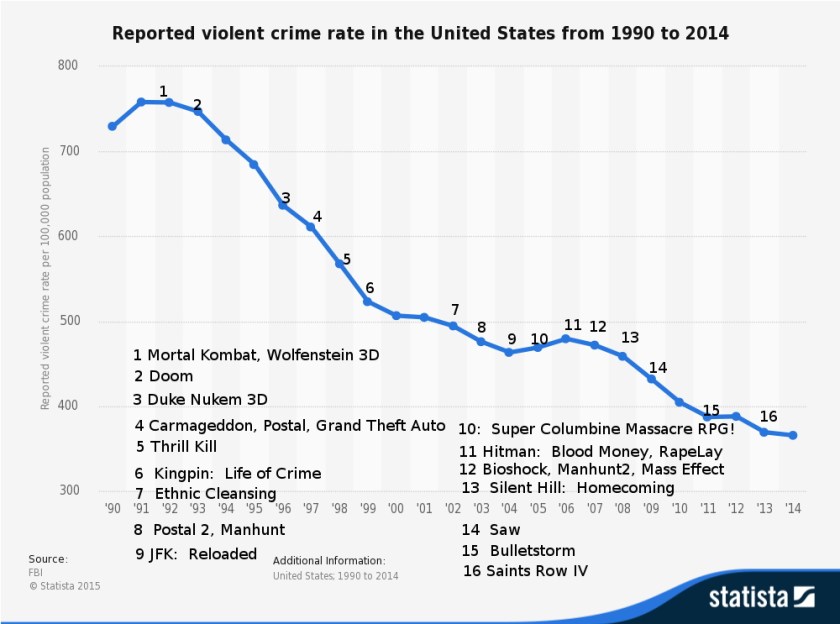
So, let’s take a look at crime rates and violent video games:

Mortal Kombat was particularly noted as a fighting game where one graphically killed ones opponents.   Wolfenstein 3D and Doom were among the first fairly realistic “first person shooters”.

Now, I’m not going to claim that the reduction in violent crime is a result of these games release.  Correlation does not equal causation.  But what it does show is that the claimed link to “violent video games” and any rise in crime is ridiculous because crime hasn’t risen.  If playing these kinds of caused people to commit real-life crimes we would expect to see a rise in crime coupled with the games becoming available and popular.  We do not.

Have many violent criminals played these kinds of games?  Probably.  But then lots of people have played these games so that’s to be expected even in the absence of any causal connection.  Or perhaps there’s a causal connection the other way.  Perhaps those prone to violence are more likely to play violent video games.  That would give you a higher percentage of violent playing the games without the games being any kind of cause.

There are all sorts of possible reasons that folk might see a connection between video games and violent crime.  It may seem “reasonable” to them that what they “practice” in the game they might try to do in reality.  But the simple fact is, there is no increase in violence to explain.

So this is just one example of many, where people try to use something that, for whatever reasons they want to restrict, as an “explanation” for crime and violence.  You have to agree with their restriction, right?  Why not?  Don’t you want to reduce crime and violence?  What kind of monster are you?

The only problem with that is that what they’re wanting to restrict often has little or nothing to do with actually causing crime and violence.  That’s not even to consider whether the restriction itself is even more dangerous than the crime and violence  it’s supposed to combat.  Why, yes.  The cure can be worse than the disease.

It’s especially nonsense when the rise of the thing they’re wanting to restrict is accompanied by a fall in crime and violence.

“The market can’t…”

Over on the Book of Faces, I came across, and shared, this image (one of the many “Harambe” memes that have been going around over the last few years):

67419959_1115803085475264_7437790558078107648_n

It was not long before someone, who in general claims to be for the “free market”, was coming in and saying that no, it doesn’t work like that, that you had to have government regulation or you would get the horrible conditions and low pay of the factory workers in the early industrial revolution.

I pointed out that as horrible as those circumstances seem to us, they were actually an improvement over available alternatives and a necessary stepping stone upwards in improving the lot of pretty much everyone. (As, indeed, I have pointed out is the case with so-called third world “sweatshops” today elsewhere on this blog.)

His “answer” was basically to flat deny that they were and, further, to claim that they were the inevitable consequence of laissez faire capitalism (because, apparently, the only difference between then and now was the lack of regulation on businesses–even if we granted the implicit claim of a complete lack of any such regulation).

Well, my head went through the desk then.

They weren’t better than available alternatives?  Then why did people take the jobs.  “Greed” might make the business owners want to offer next to nothing in pay.  It might want the business owners to work them at extreme hours with no concern for worker comfort or safety.  But that greed cannot explain why people took the jobs.  The business owners had no armed press gangs rounding people up and dragging them, kicking and screaming to the factories.  They had no barbed wire fences and chains keeping people in the factories.  No guarded and fenced in barracks to keep people from running off when not actually working.

People came to them seeking employment.  And the only real threat the business owners had to hold over the employees was employment.  “Do what you’re told or we’ll kick you out.”

If these factory jobs weren’t better than available options then why did people take the factory jobs rather than the other available options?

The simple truth was that life was hard back then.  Human life was cheap.  And misery was the common lot.  Factory conditions then reflected that longstanding truth of mankind.  And it was not going to change overnight in any system, market or otherwise.  Even Marx, if you look at what he actually wrote rather than the many “interpretations” attributed to him over the years, saw all this as a necessary step to his favored Utopian ideal.

But, I was told, this proved proved that the market didn’t work for providing decent conditions and wages for workers?

Why, then, did Henry Ford (to use one example) go to an eight hour work day long before any government regulations required it as well as long before Ford factories had unions to demand it?  Why the five day work week, likewise?  Why did he pay higher wages than his competitors?  Did the fact that the higher pay meant he could hire the better workers away from those competitors, giving him a more skilled, competent, productive work force that could produce more cars and therefore make more money for him have anything to do with it?  Did that an eight hour day in three shifts allowed for keeping production operations running around the clock so that he could get the most out of expensive capital equipment play a part?  Did the thought that having workers work five days with two off made them more productive during those five days than they would have been working six with one off influence his decision making?

Henry Ford made those changes, that improved the lot of his workers, not because of any great love for his workers, and not because regulations or unions demanded it.  He made those changes because, in the face of competition, they were simply good business that made. him.  more.  money.

Or take the case of South Africa during the days of Apartheid.  As Thomas Sowell points out in Basic Economics laws in South Africa restricted what businesses could do with regards to black labor.  No more than a certain number of blacks could be hired.  Work crews had to have a white supervisor.  And so on.  These laws were routinely broken by businesses.  They were broken because competition required them to do so.  If they didn’t then some other business that did, in violation of the law, would out compete them and they’d end up losing money.  It was a better business decision to break the law and pay the fines then to do without the black labor (and black supervisors), whatever the law said.  The market not only provided without government, it provided when both government and prejudice were actively opposed.

The market works.  It may not work as fast as you want.  It may not produce the precise solutions you want (and what hubris makes you think what you want is the way things inevitably should be).  But it does work.

Government is more likely to get in the way.  But that’s a topic for another day.

How the Civil War should have gone.

The Civil War was a major turning point in US History.  While it’s role in ending slavery is well known another factor is that it marked a shift in the relationship between the Federal government and the individual States.  This can be summed up by saying that before the Civil War we were “These United States”.  After it we were “The United States.”  Originally, the States were conceived of as separate sovereign entities that granted to the Federal government certain powers over them, mostly in the form of providing a “public face” to deal with the rest of the world.  After the Civil War, the States began taking on more and more subservient roles.

It was the simple fact of the assumption that the Federal Government had the power, not just “military might” but legal power, to keep a State (or group of States as it happened) in the Union against its will–a power nowhere granted to it in the Constitution–that was the prime mover of that change.

So what would we have without that?  If the right of a State to leave the Union was actually acknowledged.  How would things likely have gone?

  1. Acknowledge the States’ right to secede(should be a no-brainer given the 10th–there’s no language in the Constitution forbidding a State to leave the union nor granting the Federal Government power to retain a State against its will)
  2. However, Federal land still remains Federal since it was legally obtained.
  3. This requires negotiation and possibly payment for the repatriation of Federal Land to the South (for example, places like Fort Sumter).
  4. I do not think there is any way the South would have engaged in this. They would still have fired on Fort Sumter.
  5. At this point, we now have, not a rebellion, but a war between two sovereign powers.
  6. North (in this case the remaining United States) still wins. Only now, instead of reclaiming States, they have conquered a formerly sovereign nation.
  7. With the South as a conquered territory, we can establish whatever rules we like over it, including things like the abolition of slavery.
  8. The South is now a territory of the US to eventually (“when it’s ‘ready'”) be divided up into States to be re-admitted fully into the Union. Said new States may or may not match the original ones. There’s no particular reason why they must, but then no particular reason not too either.

And there we have it. Minimum violence done to the Constitution. Slavery still ended. And we’re still “These United States” rather than “The United States.” Furthermore, the Federal Government would have to limit itself to only those things which have an extremely broad consensus since the precedent would have been established that a State or group of States that became sufficiently dissatisfied could leave.

But Lincoln didn’t do it that way and the result is what we have.  At this point, I’m not sure if there is anyway to restore the “multiple laboratories of democracy”, a free nation of largely independent States freely trading with each other and relying on the Federal government primarily, if not strictly, for simply dealing with the world at large (whether diplomatically or militarily).

Which, frankly, is a great pity.

Yankee

With apologies to Rudyard Kipling.

Yankee

I went into a public-‘ouse to get a pint o’ beer,
The publican ‘e up an’ sez, “We serve no red-hats here.”
The girls be’ind the bar they laughed an’ giggled fit to die,
I outs into the street again an’ to myself sez I:
O it’s Yankee this, an’ Yankee that, an’ “Yankee, go away”;
But it’s “Thank you, Mister Doodle”, when the band begins to play,
The band begins to play, my boys, the band begins to play,
O it’s “Thank you, Mister Doodle”, when the band begins to play.

I went into a theatre as sober as could be,
They gave a drunk civilian room, but ‘adn’t none for me;
They sent me to the gallery or round the music-‘alls,
But when it comes to fightin’, Lord! they’ll shove me in the stalls!
For it’s Yankee this, an’ Yankee that, an’ “Yankee, wait outside”;
But it’s “Special plane for Doodle” when the trooper’s on the tide,
The troopship’s on the tide, my boys, the troopship’s on the tide,
O it’s “Special plane for Doodle” when the trooper’s on the tide.

Yes, makin’ mock o’ uniforms that guard you while you sleep
Is cheaper than them uniforms, an’ they’re starvation cheap;
An’ hustlin’ drunken soldiers when they’re goin’ large a bit
Is five times better business than paradin’ in full kit.
Then it’s Yankee this, an’ Yankee that, an’ “Yankee, ‘ow’s yer soul?”
But it’s “Thin green line of ‘eroes” when the drums begin to roll,
The drums begin to roll, my boys, the drums begin to roll,
O it’s “Thin green line of ‘eroes” when the drums begin to roll.

We aren’t no thin green ‘eroes, nor we aren’t no blackguards too,
But single men in barricks, most remarkable like you;
An’ if sometimes our conduck isn’t all your fancy paints,
Why, single men in barricks don’t grow into plaster saints;
While it’s Yankee this, an’ Yankee that, an’ “Yankee, fall be’ind”,
But it’s “Please to walk in front, sir”, when there’s trouble in the wind,
There’s trouble in the wind, my boys, there’s trouble in the wind,
O it’s “Please to walk in front, sir”, when there’s trouble in the wind.

You talk o’ better food for us, an’ schools, an’ fires, an’ all:
We’ll wait for extry rations if you treat us rational.
Don’t mess about the cook-room slops, but prove it to our face
The Eagle’s Uniform is not the soldier-man’s disgrace.
For it’s Yankee this, an’ Yankee that, an’ “Chuck him out, the brute!”
But it’s “Saviour of ‘is country” when the guns begin to shoot;
An’ it’s Yankee this, an’ Yankee that, an’ anything you please;
An’ Yankee ain’t a bloomin’ fool — you bet that Yankee sees!

And let me add:

It’s Yankee this, and Yankee that, and Yankee you’re a bore
But it’s please to come and save us, when the guns begin to roar.

But that’s okay.  You need us a lot more than we need you.

A Big Thanks to the Democrats.

No, really, hear me out.

Back when Trump was running, I noted that he’d been historically pretty left wing.  He was a big fan of the Kelo decision (where the government could take property from someone for “public use” with that “public use” to be to hand it to someone else on the grounds that the someone else would pay more taxes).  He’d long been a fan of gun control.  He’d made some overtures of being otherwise but even during his campaign, after the Pulse Nightclub shooting he was all about how to restrict/ban so-called “assault weapons.” He’s on record as a fan of “Red Flag” laws.  His words were “Take the guns first, due process later.” He is also a fan of “no fly, no buy”.  You get put on a “watch list” by some bureaucrat and not only are you forbidden from flying, but you’re also forbidden from exercising other constitutionally protected rights?  The very existence of a “no fly” list is problematic.  Using it to deny other rights just doubles down on that.

And he was all about making deals.  After all, “The Art of the Deal” was the title of one of his books.

The Democrats could have come in, made offers, received counter-offers, and made deals.  They could have gotten a lot of what they wanted because Trump is all about making deals.

However, they didn’t do that.  Instead, they went complete scorched earth.  “Russian Influence”! “The election wasn’t legitimate!” “Overturn it.” “Put Hillary in.” “Have the Electors choose Hillary despite what their states voted!” “25th Amendment” (thus proving they didn’t read past the first part, or rather hoped you hadn’t).  “He’s a new Hitler.” “This is just like The Handmaid’s Tale.” Impeach.  Impeach.  Impeach.  (And, somehow, instead of President Pence, this is supposed to lead to President Hillary?  Constitution?  What Constitution?)

And, as time progressed, instead of settling down, recognizing that, yes, Trump was President and they would have to work with him if they wanted to get anything from their wish list, they kept doubling down.  Indeed, he gave them something they wanted (a small something), for literally nothing in return, with the Bump Stock Ban.  Yep, Trump implemented more gun control than Obama managed in eight years.  But, still double down and double down and double down on the Democrats part.

In the end, it didn’t matter how willing Trump would have been to deal.  The Democrats took that completely off the table.  They left him little choice but to either resign (which wasn’t going to happen) or go hard line the other way.

So, thank you Democrats.  You’ve done more to hold back the tides against personal liberty than anyone since, um, well, since before my lifetime.

And you did it all on your own.  It was a purely unforced error on your part.

Thank you.


The Mills of the Gods: A Blast from the Past

Nothing needs to be changed from when I posted on this site about two years ago except maybe it’s even more emphatic.

Folk who know me know that I am not a Trump supporter.  I have not been a Trump supporter.  I simply think that he has proven to be better than the alternative we could have had.

Going into the election I had no reason except the word of someone who admitted that you couldn’t trust his word and that everything he said was “just flexible suggestions” as to his being any better than Hillary.  I was able to cite five, possibly six, of the Bill of Rights that he was willing to violate in order to get what he wanted.

And people cheered this.

Still, since then he has proven to be better than I expected and farbetter than I feared, especially in appointing, and getting confirmed, a Supreme Court justice that actually considers the Constitution to be the Supreme Law of the land rather than something to “get around”.

So.  I was wrong.

That said, I keep running into people who are insist on only voting for the “perfect” candidate.  “The lesser of two evils is still evil” is a common watchcry and that doing so is simply a somewhat slower slide into tyranny.

The flip side is that voting for the “perfect” (from my perspective–I expect yours would be somewhat different) candidate when that candidate can’t even get the support of 2% of the voters is a quicker slide into tyranny.

I like the metaphor that Neil Gaiman used for his career.  It’s like a mountain in the distance.  And as long as I can keep moving toward that mountain I’ll eventually get there.  Don’t try to do it all at once.  That will fail.  But I can get a little bit closer than I am now.  Then, from this new position, look to see if I can get a little bit closer from that.  And then again.  And so on.

By this chart (let’s see if this works)–

 photo politicalpositions_zpsa955ecf4.jpg

–I’m a pretty much a Paelo-Conservative/Classical Liberal.  Some infrastructure things (roads on the chart) I think are appropriate for government, others not.  On the flip side I’m of mixed feelings about education so between them I figure it’s pretty much a wash and the “Paleo-Conservative” label fits fairly well.  Add in that with “health care” and that things like with infectious diseases other folks actions, or inaction, threaten me and it gets a bit complicated.  But still, Paleo-Conservative is probably pretty close.

But look at where we are now.  We’re so far from that “goal” that the Hubble couldn’t see it.  If I had a true Paleo-Conservative candidate to run for office, it’s extremely unlikely he could win (even in a fair election, never mind when the other side(s) cheats).  And if, by some miracle, he (or she) did win, there is simply no way I’d get a paleo-conservative Congress to go along.  Republicans, the so-called “right wing” aren’t even close to that paleo-conservative position.    Consider, repeal and replace Obamacare, while keeping things like the pre-existing condition mandate (regardless of how economically unsupportable it is)?  Despite how much the media makes of the issue it’s really a matter of “modern conservative” and “modern liberal” have both moved a bit outward on the chart.

There’s a concept called the “Overton Window“.  Basically, it’s an expression of the idea that people in general are risk averse.  They’re used to the situation that they find now.  Big changes from that are risky so most people aren’t going to support big changes.  The changes that are made at any given time have to be modest or people will reject them.  (Note also that this tendency toward risk-aversion is why the left, with its promises of security, has had such success, but that’s a topic for another day.) So, we have to pick modest goals and focus on them piece by piece, in an incremental approach, to have any expectation of success.

So, I’m not going to get paleo-conservative, not in terms of national, or even State policy.  But I might get somebody a little bit closer than we are now.  And if I can get that, then the next cycle, maybe I can get somebody a little bit closer than that.  And a little bit closer the next time.  And the same shifting “Overton Window” works here.  As government becomes less intrusive, less restrictive, less all-encompassing, why people can get used to that too, just as they have motion the other way.

The problem, of course, is the other side is doing the exact same thing.  So not only do I have to try to move in the direction I want, I have to resist their effort to move back the other way.  And if I’m not strong enough to prevent that adverse movement, I have to at least slow it down, try and put myself in a position to strike back when I am stronger (or when they’re weaker).  And that might sometimes mean trading.  When you can’t hold everything against a strong opponent then you have to pick your battles.  You might have to give up ground in one area in order to gain or hold ground in another.

People tell me “compromise doesn’t work.” Actually, the cases they site are excellent examples of how very well it does work.  It’s just that it’s been a weapon used against us.  Conservative/libertarian types are like folk sticking to single shot rifles to “not waste ammo” while the other side has been using repeating rifles and machine guns.  Win small concessions, then use that new position as a springboard to win more.  Repeat until you’re where you want to be.  It’s a tactic that works.  So far, it’s worked for our enemies.  Maybe it’s time for it to work for us.

So look at that mountain.  What can we get that moves us closer to the mountain, even if only a little bit?  Get it.  And then keep the pressure on.

The mills of the gods grind slowly, but exceedingly fine.