You know. There are lots of things I could say about the Normandy Invasion of World War II, commonly known as “D-Day”.
But this movie says it better.

You know. There are lots of things I could say about the Normandy Invasion of World War II, commonly known as “D-Day”.
But this movie says it better.
The use of chocolate in savory meat dishes strikes many people in the US as odd, but the results can be quite tasty. Now, I’ve seen recipes that involve lots of individual ingredients, chopping tomatoes, peppers and onions, and the like but I never have time for all that. So this is the quick and easy version I’ve come up with:

Ingredients (this is for at least as week’s worth, you can cut it in half easily enough)
In a medium mixing bowl, combine the first four ingredients. Place the pork in a 5-6 quart slow cooker. Pour the salsa mix over it.
Cook on low 10-12 hours. Stir. The pork should break into fibers on stirring. If it does not, remove any large chunks and pull apart with two forks then return the pulled pork to the crock. Fish out any bones if you used bone-in pork.
For those who are not doing low-carb this goes well over rice or as a sandwich filling. Or it’s tasty as is.
Enjoy:
Japanese Admiral Isoroku Yamamoto said “In the first six to twelve months of a war with the United States and Great Britain I will run wild and win victory upon victory. But then, if the war continues after that, I have no expectation of success.” That proved prophetic as the turning point of the Pacific Theater of WWII happened almost 6 months to the day after the attack on Pearl Harbor.
Going into the battle of Midway, the Japanese were suffering from losses from the Battle of Coral Sea. This battle was ostensibly a Japanese victory but a costly one. In contrast, the US was able to get repairs to the Yorktown sufficient to get her into action in record time.
In addition, thanks to code-breaking efforts, American forces knew where, and approximately when, the Japanese were planning to attack and could muster their forces to be ready.
Preliminaries of the battle occurred on June 3 when a PBY discovered a Japanese patrol force and a squadron of B-17’s was launched to intercept. The only damage caused by this attack was a torpedo launched from a PBY striking a Japanese tanker.
The next morning, June 4, the Japanese launched an air attack against Midway Island. Midway launched its aircraft, bombers flying off unescorted to attack the carriers while the fighters remained behind to defend the island. The fighters, consisting of 7 F4F Wildcats and 21 obsolete F2A Brewster Buffaloes. suffered massive losses, losing three of the Wildcats and 13 of the Buffaloes with the remainder so heavily damaged that only two remained airworthy.
The base, while damaged, remained usable as a refueling and staging area to continue to attack the Japanese fleet.
The bomber attack on the fleet was repelled with heavy losses at the cost to the Japanese of only two fighters. However, one of the bombers, a B-26, severely damaged made a steep dive toward the carrier Akagi from which it never pulled out. It nearly crashed into the bridge and this near-thing may have been a factor in Japanese admiral Nagumo’s mixed decisions to follow.
Nagumo ordered his torpedo armed reserve planes re-armed with general purpose bombs to use against land targets in order to make a second strike at Midway. However, while this was going on he received word of a sighting of American naval forces. He reversed his order for re-arming and switched back to torpedoes, causing further delays. Incomplete information, including the lack of knowledge of whether the sighted forces included carriers, when combined with a doctrine that called for launching full strikes and not piecemeal forces led to further hesitation.
The hesitation probably did not really matter. American aviation was already on the way.
Mixed communications and navigational errors led to some forces completely missing the targets. Ten Wildcats from the Hornet ran out of fuel and had to ditch.
The first carrier force to meet the Japanese was a flight of TBD Desvastators led by John C. Waldron. Lacking any fighter escort, all of them were shot down, along with 10 of the 14 Devastators from the Enterprise, and 10 of the 12 from the Yorktown without inflicting any damage on the Japanese. Part of this abysmal showing likely stemmed from defective torpedoes, a problem that would yet take some time for the Navy to recognize, let alone correct.
However, American forces gained several benefits from the nominally failed attack by the torpedo bombers. Dealing with this attack on their own ships meant the Japanese were unable for a time to launch an attack of their own. Their Combat Air Patrol was out of position to respond to later attacks. And many of their planes were low on fuel and ammunition and so were put temporarily out of action.
While Waldron and the others were being chopped up by Japanese fighters, a flight of SBD Dauntless dive bombers was also searching for the carriers. Low on fuel they continued their search, finally spotting a destroyer steaming to rejoin the carrier forces.
The dive bombers found the Japanese carriers and attacked. The Japanese fighters, out of place, many on the decks of the ships with fuel lines stretched to them. Two squadrons attacked the Japanese carrier Kaga achieving several hits, including one killing the captain and most of the senior officers and starting several fires on the ship.
Others attacked the Akagi, scoring only one direct hit but a devastating one that penetrated to the hangar deck among armed and fueled aircraft causing secondary explosions. Another missed to the rear, exploding under the ship close enough to damage both the rudder and the flight deck.
Still others hit the Soryu getting multiple hits and causing fires among the refueling operations on the deck.
Both the Kaga and the Soryu were ablaze. The Akagi took longer for the fires to spread out of control, but eventually they did.
The remaining Japanese carrier, the Hiryu, launched a counterattack. They followed the retreating American aircraft back and struck the first carrier they encountered, the Yorktown, hastily patched together after Coral Sea.
While American defenders inflicted heavy casualties on the Japanese, they managed to get several hits on the Yorktown, blowing a hole through the flight deck and extinguishing her boilers. Admiral Fletcher had to transfer his flag to the heavy cruiser Astoria.
The crew on the Yorktown were able to make emergency repairs, patching the flight deck and getting three boilers into action so that the Yorktown was able to resume air operations. Indeed, their repair actions had been so effective that the second wave of Japanese attackers on their arrival thought it was a second, undamaged carrier.
This second wave managed to get two torpedoes into the Yorktown, killing her power and causing a 23 degree list to port.
While the Japanese, thinking they had taken out two carriers, rearmed in the thought that they could scrape together enough force to finish what they thought was the one remaining American carrier, the Enterprise launched a final strike of 24 dive bombers, her own and those from the Yorktown left “orphaned” by the Yorktown’s damage.
That was pretty much the end of the main battle. There were a few skirmishes. A Japanese submarine managed to get close enough to finish off the damaged Yorktown and sink the destroyer USS Hammann.
In the end, the Japanese lost four carriers and a heavy cruiser, as well as sustained damage to other ships and had 3057 dead. The US lost one carrier and a destroyer with a total of 307 Americans killed.
Some historians have argued that the battle could have easily gone the other way. American reconnaissance located the Japanese carriers long before the Japanese discovered the Americans. This put the Japanese on the defensive almost from the beginning. Had the Japanese instead been the first to discover their opponents, that might well have turned around and it would have been American Carriers on the bottom of the Pacific with Japanese sailing away victorious. While the US would almost certainly have still won the war in the end–the American industrial base and the coming of the Atomic Bomb made that a near certainty–the war would very likely have been longer and bloodier.
This was not the first story I sold but, due to the vagueries of publishing schedules it was the first story to see print. There are certainly things I would change were I writing it today. For one thing, I use entirely too much passive voice in this piece. I am of mixed feelings of the very long and detailed description of starting a fire in the opening scenes. On the whole, I think it was excessive and could stand to be pared back a lot. On the other hand, it’s deliberate pace helps set up the conclusion.
Jilka and the Evil Wizard was intended as a short, comic piece. And that’s really the only way I could get away with that ending. It’s basically the punch line for a joke. Today, I’d never try to get away with anything so . . . so. Still, even today after twenty years I still find it a fun read and get a giggle out of it.
So here it is. Enjoy!
JILKA AND THE EVIL WIZARD
by
David L. Burkhead
Originally Published in Marion Zimmer Bradley’s Fantasy Magazine, Winter 1991
© 1991 All rights reserved
“Damn,” Jilka said. That was the second time her firestarter spell had failed.
She tried once more. She spread her hands over the small pile of brush, focused her mind on the image of the proper mystic sigil, spoke the word of command, and rapidly snapped downward with both middle fingers and thumbs, leaving the other fingers extended. The brush sputtered a bit. A small light glowed, then nothing. The brush remained cold.
“Damn and damn,” Jilka said. “I guess it will have to be the old fashioned way.”
She rummaged in her pack for a moment, coming out with a cottonwood board. A row of holes had been drilled partway through the board along one edge. Notches had been cut from the edge of the board to he centers of the holes. Beside the board, she laid a wooden stake, about a foot long and as big around as her thumb, a stone with a small hole drilled about halfway through it, and a two-foot-long bow strung with rough cord.
Jilka took a handful of the lightest, driest, smallest pieces of the brush and rolled it between her palms. When it was thoroughly fluffed to her satisfaction, she placed the bundle so that it was half covered by the board and under one of the notches. She rubbed the pointed end of the stake along the side of her nose for a moment then placed it, pointed end up, in the hole with the notch that opened on the brush. Next she wrapped the string of the bow twice and placed the stone over it. Holding the stone and applying pressure with the stake to it, she ran the bow back and forth, whirling the stake rapidly in the hole. Soon smoke began pouring out of the hole in the cottonwood branch. When it was smoking to Jilka’s satisfaction, she removed the stake and dumped the black powder that had formed in the hole into the bundle of brush. A few seconds blowing and it was aflame. It was then the work of but a moment to transfer it to the larger pile of brush and Jilka had her campfire.
She dug further into her pack to find her rations. Dried meat and fruit was to be her dinner, rounded out with some tubers that she had found that would go well roasted.
Once the tubers were roasting, spitted on a long branch above the fire, and Jilka was gnawing on tough, dried meat, she had time to brood.
“Master Carolus?” she told the winds, “why did you release me as a journeyman? I can’t even do a simple firestarter spell right. I’m not ready.”
She sighed. Master Carolus could do the firestarter spell with a thought, and she could not manage it with all three parts: thought, word, and deed. Those were the three parts to any spell: thought, the focusing on the mystic sigils that channeled energy into a spell; word, speaking the words of power; and deed, the gestures that directed and focused the spell.
Journemen and apprentices usually needed all three parts to cast a spell: although often some of the spells, the simpler ones, would be so well learned that they required less. Jilka had learned the handfire spell, the only spell she had learned, well enough not to need to speak the words of power. Adepts could work magic with only two of the three parts, usually thought and deed, while the masters, such as Master Carolus, needed only one, usually thought.
And Jilka? Jilka, journeyman mage of the College of the Lady, with a single exception, could not work spells with all three.
It was not that she had not tried. Jilka had worked long hours to master the magic spells, longer than even Master Carolus had required of her. Still, no matter what she did, the magic would not come. She had been expecting to be discharged as unfit; that would have shamed her, but she would have understood. But what he had done, she could not understand. He had promoted her to journeyman from apprentice. A journeyman mage who could not work magic.
And to make matters worse, while she had been brooding, the tubers had burned. She did not know whether to laugh or cry.
And so it was that, still half starved, Jilka made her bed.
#
The next day, Jilka reached the village of Embron. It had a good location, where the North road crossed a fair sized river. Jilka had no doubt that in time it would become a city of some standing, but that was a concern for the future. For the time being, she would find the inn and get a hot meal where she would not have to worry about balky firestarter spells or burnt tubers.
The inn was where she would have expected it to be, next to the river. She found a quiet corner and ordered a simple meal.
It was such a shame that she would not be able to enjoy it.
“Lady?” The boy stood across the table from her.
The table was almost as tall as he was. He peered up at her with large brown eyes, rimmed red from crying.
“Oh, no,” Jilka said softly. Whenever anyone addressed a mage uninvited, it was always because they wanted something. And the thing they always wanted was magic. She would have to do something about her robes. Her robes marked her as a mage, of course, and she could not have that. People would always be asking her for magic charms and spells and curses removed. Asking her, of all people, And thank the Lady that dragons were extinct of they would be asking her to exterminate them too!
“Lady?” The boy was still there.
“Yes,” Jilka said grudgingly. Well, when she apprenticed to a sorcerer of the College of the Lady, she had taken an oath to succor those in need. She would have to try. And when she failed, well, there went any chance she would ever have of any kind of reputation, even if she did learn magic. She would be the laughingstock of the profession. “What can I do for you?”
“M’ folks,” the boy said, “Th’ evil wizard took ‘em. You’re a sorceress. Can’t you get ‘em back?”
Jilka rubbed her hand over her face, pinching and massaging the bridge of her nose. Evil wizard. Why did it have to be an evil wizard? Well, at least she would not have to worry about her reputation.
“I’ll do what I can,” she heard somebody say and was surprised to learn that it was herself.
#
Jilka looked up that the tower that the boy had brought her to. Black, of course. A dim, green light glowed in one of the upper windows, naturally. She checked her preparations. They would not work, of course, not against an evil wizard, but she had to do something.
“You stay here,” she told the boy.
“It’s been a nice life,” she said as she paused a moment at the door.
Strangely, it was unlocked. Of course, who would barge in on an evil wizard? Powerful mages and fools were the only two categories Jilka could think of. Well, she was not a powerful mage, so what did that make her?
There were four guards in the lower chamber. They stood and faced her with drawn swords.
“I am the sorceress Jilka,” she said and struck a pose. She gestured and a ball of light appeared in her hands. That was the one spell she had mastered. The light was utterly harmless, useful only for finding her way around a dark room, but, hopefully, they would not know that. “Let me pass, or die,” she added for good measure.
They were not buying it. She could see it in their eyes. In another instant, they would be on her. She reached into her belt pouch and grabbed a handful of the powder with which she had filled it.
“Behold the dust of sneezing! She intoned and threw the pepper into their faces.
It worked beautifully, far better than Jilka had hoped. While they were distracted by fits of sneezing, coughing, and tearing eyes, she dashed past them and up the stairs.
The wizard’s workroom was on the top floor as Jilka had expected. Her entry interrupted the wizard in the middle of an incantation. A man and a woman were strapped, in wide eyed terror, onto twin tables.
“What is the meaning of this?” the wizard bellowed.
“I am Jilka, sorceress of the College of the Lady,” she said. “My powers have already laid low your guards. I have come for the man and the woman.”
“And what do you offer in return?” The wizard fairly sneered.
“I’ll let you live,” Jilka said.
“You’ll . . . let . . . me . . . live?” The wizard howled with laughter. “You? A little poppet of a girl, not a true mage, scarcely even a good apprentice? And you say you’ll let me live?” The wizard was laughing so hard that he could barely stand up. A moment later, and he could not stand up. He fell to he floor.
“You dare laugh at me?” Jilka shook her hands in the air and attempted to look threatening.
The wizard, if anything, laughed louder, rolling on the floor.
Jilka folded her arms in front of her, placing each hand within the other’s sleeve, and did her best to look stern.
The wizard, in his mirth, continued rolling on the floor. He struck the charcoal brazier, dumping its contents.
The wizard’s laughter turned to screams of agony and terror as the coals ignited his robes. Jilka stepped aside to let him pass as the flaming wizard dashed from the room and down the stairs.
“Well, what do you know?” Jilka said.
“How did you do that?” the woman on the table said in awe as Jilka bent to release her.
Jilka smiled. “Ah, lady. You know that a magician never reveals her tricks.”
“Of course,” the woman said in reverence. “I beg pardon for forgetting.”
As the man and the woman left, Jilka inspected her new tower.
“To think, all I had hoped to do was to get a chance to use this.” She pulled a dagger from her sleeve. “But I never expected an evil wizard with a funny bone. Who’d have thought it.”
THE END
If you enjoyed that story of one young woman faced with evil perhaps you might like one of a somewhat darker turn:


I’ll be attending LibertyCon in Chattanooga the end of this month (June 30-July 2).
Here’s my schedule. At the “Author’s Alley” and Autograph sessions I’ll have books for sale.
I look forward to seeing people there.
| Day | Time | Name of Event | ||||||||||||||||||||||||||||||
|---|---|---|---|---|---|---|---|---|---|---|---|---|---|---|---|---|---|---|---|---|---|---|---|---|---|---|---|---|---|---|---|---|
| Fri | 02:00PM | Author’s Alley (Boop, Bragg/Daniel Butler, Burkhead, C. Kennedy, Schroeder) | ||||||||||||||||||||||||||||||
| Fri | 05:00PM | Opening Ceremonies | ||||||||||||||||||||||||||||||
| Fri | 09:00PM | Reading: Susan Matthews & David Burkhead | ||||||||||||||||||||||||||||||
| Sat | 01:00PM | Author’s Alley (Burkhead, D.J. Butler, Carpenter, Cordova, Mandragora) | ||||||||||||||||||||||||||||||
| Sat | 02:00PM | Autograph Session (Burkhead, Finn, C. Kennedy) | ||||||||||||||||||||||||||||||
| Sat | 06:00PM | Kolchak, X-Files and the Joys of Cryptozoology | ||||||||||||||||||||||||||||||
| Sat | 11:00PM | Mad Scientist Roundtable | ||||||||||||||||||||||||||||||
| Sun | 10:00AM | Kaffeeklatsch | ||||||||||||||||||||||||||||||
| Sun | 01:00PM | Author’s Alley (Burkhead, D.J. Butler, Gibbons, Plexico) | ||||||||||||||||||||||||||||||
Used to be when I said that I was joking. Nowadays I’m mostly not. Mostly.
We are rapidly reaching the point where there’s nothing a woman can do for a man in the bedroom that justifies the risk of what she can do to him in the courtroom later.
Consider the following exchange (the left hand side–ignore the wisecracks on the right side. Or not. There’s a bit of dark humor to be found there).
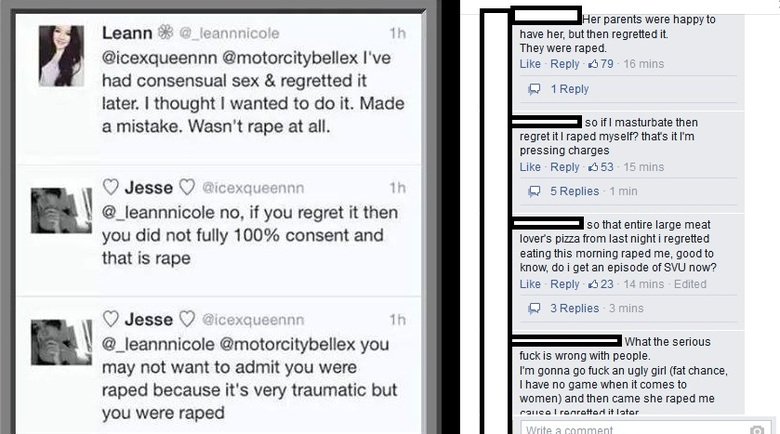
So, a man can meet a woman, have every reason to believe he has her consent, have sex, and then later she can retroactively remove that consent making the act retroactively raped. Called out explicitly:
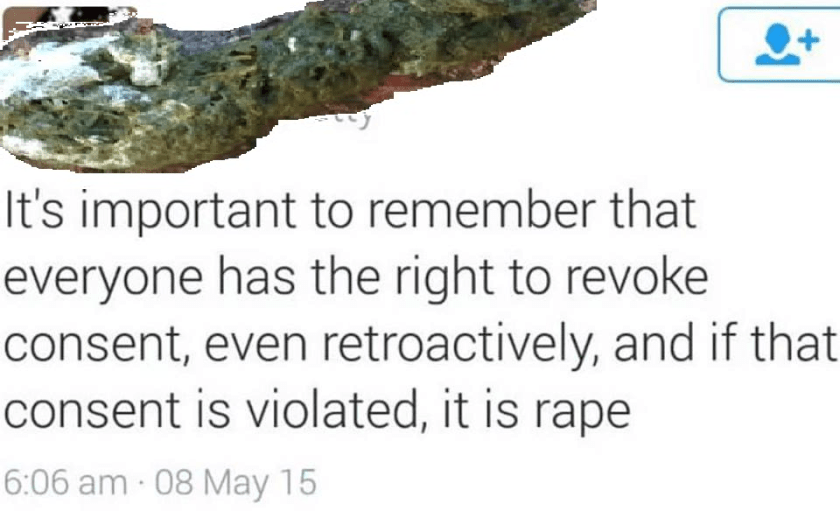
Fortunately, for the moment, this position is not a legal one, but law generally follows culture. Let this attitude become general to the point where people start electing lawmakers with that view, and the laws will follow.
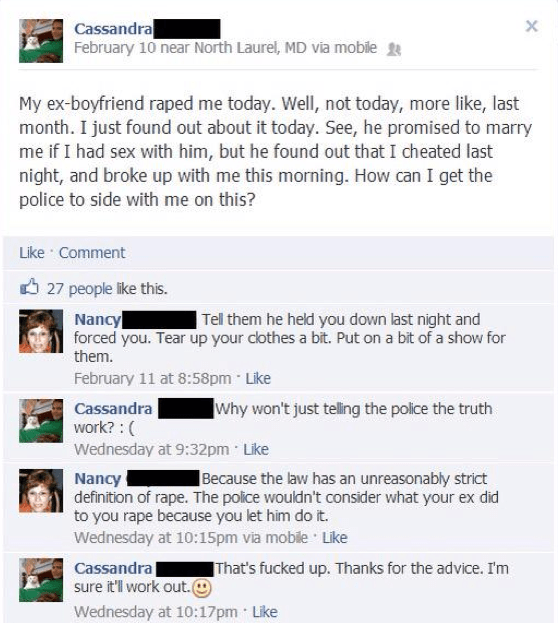
And a certain segment of the population is trying to make it that way, and suggesting fabricating evidence to make things “work” that way even though the law does not:
And it only works one way. Only the man is adjudged guilty, never the woman as in the following:

“Women cannot rape”. Which explains:
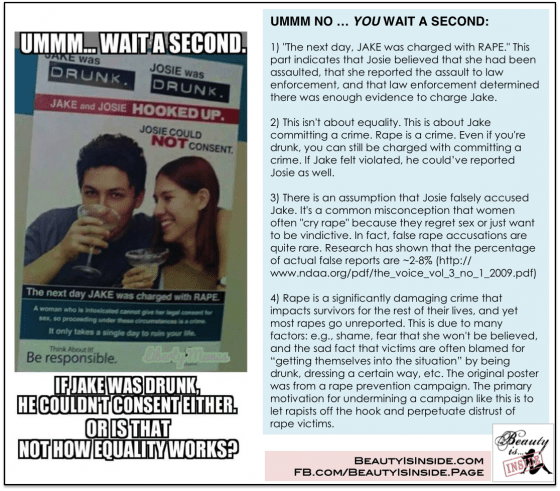
Both of them were drunk. Only one of them was able to be the rapist and only one of them was able to be the victim.
Some people have suggested that limiting ones sexual encounters to within marriage. Well, that might improve ones odds somewhat but in the end it’s still a gamble. First off, “marital rape” is a thing:
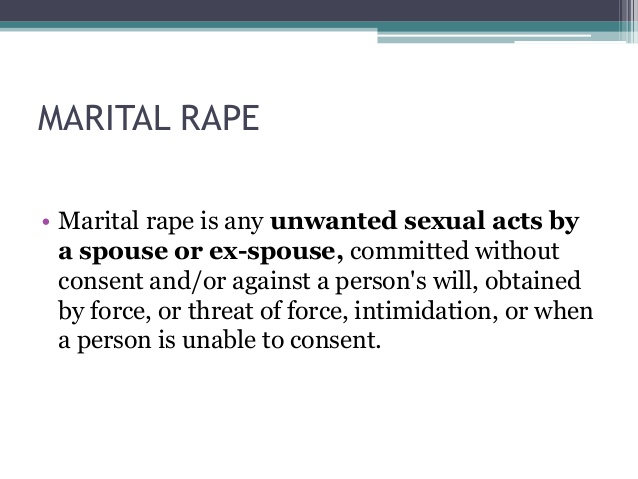
And all of the above items including retroactive withdrawal of consent can be applied.
You might say that your wife (and it’s you husbands this is directed to because…have you read this far?) would never do anything like that. And you may be right. But the divorce courts are full of men who never thought their wives would “do something like that”. (And, yes, they’re also full of women who never thought their husbands would do something like that either, but the women generally don’t have to worry that their husbands will add rape charges to the issue. And women initiate divorces more than men.)
So…sexbots. they’re going to be big.
Invest now.
Purists insist that Chili should not have beans. I don’t want to get into that argument but for someone on a low-carb diet beans are anathema.
This is the latest iteration of a slow-cooker Chili recipe I’ve been tinkering with. It varies as the mood strikes or based on what I have on hand.
Ingredients:
In a large mixing bowl combine the ingredients. Mix well. Easiest way, without a good stand mixer, is to just get in with your hands and squish the ingredients together. Plastic gloves can keep things sanitary.
Line the crock of a 4-5 quart slow cooker with a liner bag. Pour the chili into the bag.
Cook on low 8-9 hours.
Stir well at the end. Serve topped with cheese.
Enjoy. It keeps well in the refrigerator for later heat and eat.
The Lincoln Library and Museum in Springfield, IL is just about 3 hours from here. So we decided to go give it a visit today.
Most of this is going to be pictures. But first a commentary. Conventional wisdom is that the result of the US Civil War was an unalloyed good. It preserved the Union, led to the end of chattel slavery in the US and began the road that led to full civil rights for various minority groups. And I would agree that those are good things. One can imagine the disaster had the US and Confederacy remained separate and each of those two nations taken different sides in the World Wars.
However, there is another side. When the US was founded, we were 13 sovereign states, with a central government both to be our “public face” to the rest of the world and to smooth interaction between the several States. But, within their own borders, each State being sovereign. “13 laboratories of Freedom” (34 by the time South Carolina became the first of the Southern States to secede).
The Civil War changed that. While the process was not instant, the Civil War reduced the States from states–“a nation or territory considered as an organized political community under one government”–to little more than provinces–“a principal administrative division of certain countries or empires”–in all but name. Instead of “These United States” it was “The United States.” With this began an inexorable increase in the size and scope of the Federal government, in its interference in the daily lives of the common citizen, and the increasing restrictions on individual liberty.
One could argue that there was no other way to preserve the union, particularly in hindsight. As I mention above, a United States and a Confederate States each taking a different side in one of the World Wars could well have been a disaster. However, I don’t think it was quite so cut and dried. For one thing, it took a very specific set of circumstances, circumstances that could not last, to make the “slave economy” viable. It could not last. And while the Confederate Constitution enshrined slavery, once establishing secession as a viable option for States there would be nothing stopping a Confederate State, once the changing economy renders it impossible to even pretend that slavery is economically viable, from seceding in turn from the Confederacy and rejoining the Union. I doubt the Confederacy would have lasted long as a separate nation.
But it didn’t happen that way so we’ll never know.
There’s a whole lot more that could be discussed but that’s enough for now. On to the pictures.


A little extra for people who have been reading my Knights of Aerioch series: the story of the Gods and the creation of the world and its early days.
Many men tell the tale of the Gods and the Origin of Days. Some tell more. Some tell less. Some give the Gods different names. But all agree that there were first three, and from each of those three came three more.
This is the tale as it was told in Aerioch of old.
In the beginning there was darkness. And the darkness was without form. The darkness could not be everywhere, for there was no everywhere. There was no place. There was no time. There was simply the darkness. The darkness was all, and all was the darkness.
From the darkness, three lights arose. And the lights knew themselves as different from the darkness. And the three lights knew themselves as different from each other. And the first light beheld the other two and said, “I am a light in the darkness. There are other lights, in other places, and they are different from me.” And so the first light knew that there was place. And the other two lights saw the first light and they, too, knew that there was place.
And the first light said, again, “I will go from this place to the places of the other lights. And I will see if they know themselves as I know myself. And I will see if they know the darkness as I know the darkness.”
And so, the first light came to the other two lights, and the three lights came together. And when the three lights came near to one another, the first light said, “I name myself Eranah. In me is the power of all that will be but is not now.” And as Eranah spoke, proclaiming that there are things that are not, and things that will be, so did she speak of time. And thus time came into being. And as time became a thing that was, her power grew less. And so it would be forever after. For as more things came to be, less there would be of things that will be and were not.
The second light then spoke, for he had gained in power as Eranah had spoken. “I am Jandak,” said he, “In me is the power of all that is.” And yet, Jandak’s power was slight, for as yet the darkness and the three lights and place and time were all that was.
“I have no name,” said the third light, in a whisper scarce having the strength for mighty Eranah to hear. “My strength is in what was, but is no more, but all that ever was yet remains. And so my strength is naught.”
And so the three lights remained and were not alone. And the three lights were the first Gods. And where the three Gods abode, the darkness was no more. And The Nameless One grew in strength for the darkness that was not.
The three Gods counseled together. Though they were three, yet they knew loneliness. And loneliness was. And Eranah’s power grew less and Jandak’s more.
And it came to pass that Eranah spoke to the others. “We three are alone in this place. Near to us, the darkness is no more, but beyond we know of naught but darkness. But, behold, we three did arise from the darkness. Let us then, seek through the darkness for other lights, that we may no longer know loneliness.”
Jandak’s voice rose in agreement. “If my sister Eranah so wills, this will I do. For as more comes to be, so will Eranah’s strength fade and mine increase.”
“Of what good is power when there is loneliness,” Eranah said. “Since time came forth at my words it has weighed heavily with only we three to share it. Let us, then, bring an end to this loneliness even if it shall be that my power shall be reduced.”
“If the loneliness that is becomes no more, then shall my power increase,” was all that The Nameless One said.
Eranah kept the words of The Nameless One in her heart and was troubled.
And so the three Gods went forth into the darkness. And many were the things they found. Continue reading “Knights of Aerioch: Of the origin of the Gods and the Beginning of Days”
Lieutenant Steve Pomerantz, US Navy, raced above the waves in his Seahawk helicopter. No dipping sonar this time. Instead, the helicopter carried a full load of Hellfire missiles.
“All secure back there?” Pomerantz called into the intercom. The helicopter bounced lightly in the turbulence.
“We’re good, LT,” Geoffrey Torgersen, the sensor operator, said. “Although the doc’s looking a bit green.” Silence for a moment then. “No. Here.”
Pomerantz winced at a burst of static.
“I’m here,” Dr. Thomas Sanderson said. “Most of me. I think you left my stomach back on the Truman.”
“Good,” Pomerantz said. “Not much use for it out here. You can pick it up again when we get back to the carrier.”
He switched to the radio and glanced down at the commo “cheat sheet” strapped to his left thigh. “Hound Dog Three. This is Gonzo One, over.”
“Gonzo. Hound Dog.” The pilot of the helicopter currently tracking Big Blue responded.
“Hound dog, we’ve got a VIP here wanting another look at Big Blue. A real close look. Status on Big Blue?”
“Gonzo, Hound dog. Big Blue is still deep. Two hours since last breach. Should be coming up soon. Oh, and Gonzo, Truman briefed me on the mission. Better you than me, buddy.”
Pomerantz laughed. “Hound Dog, look at the bright side. I’ll never have to buy another drink so long as I live.”
The other pilot laughed. “Roger that, Gonzo One. Roger that. Hold one.”
Pomerantz glanced circled to port, keeping his speed high.
“Steve, fuel,” Rodriguez said over the intercom.
Pomerantz glanced at the instrument panel. “Roger, Charlie. We’re good for now.”
“Gonzo One, Hound Dog Three. Big Blue is coming up. I say again, Big Blue is heading for the surface.”
“Coordinates, Hound Dog?”
The pilot of Hound Dog Three read off a set of map grid coordinates.
“Charlie?” Pomerantz said over the link to the copilot.
Ensign Charlie Rodriguez tapped on the controls of the nav system, entering the coordinates.
“Hold tight,” Pomerantz said into the general intercom, warning not just Rodriguez, but Torgersen and Sanderson. He pulled into a tight turn, circling about five hundred meters from the spot that indicated Hound Dog Three’s best guess at where Big Blue would surface.
The plates broke the surface. Pomerantz shoved the cyclic stick all the way forward, adjusting the collective to maintain altitude. He veered outside his previous circle in preparation for veering back toward Big Blue.
The head came up. Pomerantz brought the helicopter around, barreling headlong at the giant creature. “Hit him, Charlie, right in the snout.”
At Pomerantz’ left, Rodriguez fired one of the Hellfire missiles. The missile flashed across the distance to explode just below Big Blue’s left eye socket.
Big Blue opened his mouth and roared, a strangely high-pitched sound from so large a creature. Pomerantz pulled to the right, keeping his speed high. As he turned, Big Blue dropped behind where he could see from the pilot’s seat.
“It’s staying on the surface,” Torgersen said. “If I had to guess, I’d say it’s treading water.”
“Shooting that goo yet?” Pomerantz asked.
“Nothing yet. I think it’s looking for what bit it.”
“Something that size,” Sanderson broke in. “It would take time for nerve impulses to travel, for its brain to process them. It may very well be confused.”
“Then let’s confuse it some more,” Pomerantz said. “Charlie. Can you put one down its throat?”
“I can sure try,” Rodriquez responded.
“Then here we go.” Pomerantz pulled the helicopter around again, coming in low, nearly skimming the tops of the swells. Big Blue roared again and two Hellfire missiles lanced out from the Seahawk. One missed entirely but the other flew straight into Big Blue’s mouth.
Yet again, Big Blue roared, but this time a luminous stream shot out of his mouth. The stream swept toward them. Pomerantz hauled up on the collective and back on the cyclic. The helicopter raced for the sky and the stream passed under them. At the apex of their climb, Pomerantz kicked the right pedal. The helicopter pivoted, turning nose down and back the way they had come. Pomerantz leveled out and again trimmed for high speed run.
“Coming back this way!” Torgersen called. “High.”
Pomerantz shoved the collective down. The helicopter dropped, avoiding the return sweep of the luminous stream.
“Fuck! It’s following us.”
At Torgersen’s warning, Pomerantz once again pointed the nose skyward, this time he kept going. For an instant he could see the sea through the spinning rotor. His hands moved of their own accord. The world spun about them and, an instant later, the helicopter flew upright once more.
“He’s going under!” Torgersen called. “We did it.”
“Did he tag us?” Pomerantz asked.
“Instruments still good,” Rodriguez responded. “Engine and transmission smooth as glass. We made it.”
Pomerantz cut their speed and glanced at the fuel gauge. Still good but… He dropped the helicopter into ground effect to conserve fuel. He turned in a slow circle until he spotted Big Blue’s dorsal plates from the right side window.
He scowled. Something did not seem right. The plates were cutting through the water, not… “Oh, shit!” Before he could more than begin to climb away, Big Blue’s head burst out of the water. A luminous stream shot in their direction.
Pomerantz frantic climb evaded direct contact with the stream but the helicopter went silent except for the chirrop of the still turning rotors. “Fuck!” Pomerantz shouted. “Geoff! Raft! We’re going down.” With practiced hands he put the helicopter into auto rotation. In the distance he saw Big Blue sink beneath the waves.
Pomerantz swore as the helicopter descended toward the water. “That’s two helicopters you owe me, motherfucker.”

When an accidentally detonated nuke from a stolen submarine releases something never before seen, Sea Hawk pilot Lieutenant Steve Pomerantz is sent to investigate. He finds a blue-green monster ten times the size of the largest Tyrannosaurus Rex and seemingly impervious to every weapon in mankind’s arsenal.
Earthquakes in the South Pacific, at a location dubbed as the most remote spot on Earth, raise tsunamis all along the West Coast. Air Force Captain Jamal White, pilot of a C-130 Hercules is pulled off of search and rescue duties to ferry two scientists to investigate. What they find is a new continent arisen from the deep. And on that continent something stirs, bringing terror and madness in its wake.
Two monsters, one from the frozen North Atlantic, one from the remote South Pacific, on a collision course with the survival of mankind hanging in the balance.

 The Writer in Black