Health insurance and pre-existing conditions

There is much talk about “pre-existing conditions” and their effect on health insurance.  One of the reasons that politicians find it so difficult to replace, let alone repeal the “Patient Protection and Affordable Care Act” (and how many untruths are in that title?  Every word, including “and”) is that covering pre-existing conditions is popular.  Very popular.

Here’s the problem.  It doesn’t matter how popular it is.  It doesn’t matter how many people want it.  It doesn’t matter how great the idea sounds.  Requiring insurance to cover pre-existing conditions without allowing that insurance to charge for that coverage commensurate with the extra cost destroys health insurance.

Let me break that down for you.

In statistics there’s a concept called the “expectation value.”  It’s simply the “numeric value multiplied by the probability of it happening.  It’s also the average that would happen over many, many cases.  Like this.

The probability of getting “heads” in a fair coin toss is 0.5 or 50%.  Suppose you got a dime every time the coin came up heads.  The expectation value would be $0.10 * 0.50 or $0.05.  One nickel.  Flip the coin a thousand times and you would expect to get pretty close to $50.00 averaging that $0.05 per flip.

If you have multiple things that could you simply sum up the expectation values of each of the things that can happen to get the total expectation value.  For example, a standard die can give you a number from 1 to 6 with each face having a probability of 1/6.  So for the total its 1*1/6+2*1/6+3*1/6+4*1/6+5*1/6+6*1/6 (please remember your PEMDAS, particularly the MDAS portion). That’s 21/6 or 7/2 or 3.5  Roll the die a million times and expect a total of about 3,500,000.

Well, that’s how insurance works.  Each of the things that insurance has to pay for has a cost–how much insurance will have to pay to treat it.  And each of those things has a probability of happening.  Different people will have different probabilities of various things.  A person who’s young and healthy will have low probabilities of most things.  An older person will have a higher probability of many things than a younger person.  A smoker will have a higher probability on some things than a non-smoker.  A heavily overweight person will have a higher probability of some things than a person of normal weight.  A biological male (worded so to avoid arguments some people will raise) will have a higher probability of certain things than a biological female.  And vice versa, a biological female will have a higher probability of certain things than a biological male.

Insurance, actual insurance, basically pools that.  You, as an individual, might hit the medical “jackpot” where the “prize” is a really expensive medical condition.  You don’t know that in advance.  What insurance does is allows the expectation value of many people to be averaged.  Each person pays for their risk, the insurance company invests the money in the meantime.  And by simple statistics, some people at the end will find that they didn’t have any expensive medical expenses and others will.  Some will get more in benefits than they get in premiums.  Others won’t.  But that’s okay because they were paying for the risk.  They did not know ahead of time which category they would fall into.

I don’t know about you, but so long as the premiums are commensurate with the risk, I hope the insurance company wins that bet and I don’t have any major medical expenses.

That’s actual insurance.  It’s balancing the risk that something might happen against the cost of it happening.

Of course, insurance companies don’t sit down and try to figure out each individual risk factor in each individual and calculate that against all the possible things that might affect them.  They use “actuarial tables” as a shortcut.  A person in this age range, with that weight range, of this sex, and non-smoker will likely cost so much on average.  When I first got private insurance I had to pay a bit more because I was heavier than the insurance company liked.  I was okay with that because my weight made my risk higher.  Fortunately I was always a non-smoker so I had that going for me.

It’s like car insurance for young people costs more because they’re more likely to make expensive claims.  Your particular kids might not (in which case good for you for teaching them well) but in general, that’s how it works.

But now we come to the other aspect that gets rolled into “insurance” when it comes to health.  That’s not “insurance” per se, not risk sharing, but rather analogous to a maintenance contract:  you agree to pay a certain amount and routine stuff is taken care of.  Annual exam.  Glasses.  Birth control if you use it.  Stuff that isn’t so much risk as certainty.  In this case you’re simply arranging payment in advance to cover this stuff, or most of this stuff since there’s almost always a copay (always in my experience, but there might be some plan out there that doesn’t).

There’s no risk sharing here.  The premiums have to cover the cost of these routine items completely over and above the cost of any actual risk sharing coverage.  When everybody has similar costs here, well and good.   Everyone has an annual exam, that sort of thing.

But then there are pre-existing conditions.  A pre-existing condition–something you had before getting insurance–is not a risk, but a certainty.  There are three ways to deal with that.  The first is simply not to cover the pre-existing condition.; you can be insured for other things, but things related to the pre-existing condition are on your own.  You can charge more for coverage of that condition, make it a “maintenance contract” issue, where you have a fixed payment rather than paying for each treatment, specialist, or what have you piecemeal.  Or you can raise everyone’s premium to cover the cost of your pre-existing condition.

That last one is that the PPACA does.  It’s not risk sharing like standard insurance.  It’s wealth transfer taking money from those who got their insurance before they had expensive medical conditions and using it to provide for those who waited.

And that’s the problem right there.  It provides an incentive for people not to get insurance until they have an expensive medical condition.

Consider auto insurance.  Imagine if auto insurance covered “pre-existing conditions”.  A person could eschew insurance, wait until they have an accident.  Then, while waiting for for police and emergency crews to come in, call an insurance company and get the liability insurance since it will cover the “pre-existing condition” of the accident you just had.  Then, later, when you’re ready to get your car fixed (or totaled out) you get the collision coverage and have that pre-existing condition covered.

In such a case, why would anyone do anything else?

So some people start to drop out of insurance figuring it’s cheaper to just wait until they have something that needs coverage to get it.  This just means that the costs of covering folk with pre-existing conditions is split between fewer people.  Meaning that the cost per person goes up.  The increased costs encourage other people to leave, raising the costs still further.  And so on.  And so on.  Until all that is left is people with pre-existing conditions and the premiums are such that there’s no point in having insurance anyway.

In an attempt to mitigate that we have the various mandates.  Employers must provide insurance.  If your employer does not you must have your own coverage.  But that has its own problems including the fact that it simply doesn’t work.  The fines (excuse me, tax) simply are not enough to outweigh the rapidly growing cost of insurance and it’s simply not politically feasible to raise the fines enough to do so.

And so something has to give.  Mandated coverage means that other coverages, those not specifically required, get cut back or dropped, deductibles go up to try to mitigate the cost, premiums go up to try to recover revenue.  Insurance becomes more expensive with less coverage for everyone, not just those with pre-existing conditions.

But, hey, free birth control is worth it, right?

Cover for my forthcoming novelette: Oruk Means Hard Work

Just a brief one.  I’ve got a cover now for my upcoming novelette:  Oruk Means Hard Work.  Look for it soon from Amazon:

18296901_10209594948338758_1898162098_o (1).jpg

Young elven princess Elara is capture by an Orc war party.  Without hope of rescue or escape she must learn to survive among her new taskmasters.

Work is.


The Handmaid’s Tale?

It’s apparently a thing where people are panicking over The Handmaid’s Tale and saying how “relevant” it is and “we’re living it now.”

What an utter piece of crap.

The whole thing is based on two, and exactly two points:

  • Some folk think abortion is morally wrong and should, at best, only be allowed in extreme circumstances (with considerable disagreement on what extreme circumstances would qualify)
  • People should not be forced to pay for other people’s birth control.

Really.  That’s it.

Nobody is suggesting that women should not be allowed to work.  Nobody is suggesting that women should not be allowed to own property.  Nobody is suggesting that women should not be allowed to read (a feature of The Handmaid’s Tale).

You might find a few fanatics who would want to actually prohibit birth control or criminalize sex outside of very narrow bounds (and, again, quite a bit of variation where those bounds are, usually “within marriage” but sometimes with further strictures within).  You’ll find more people who think those things are wrong but few of those people actually want to criminalize them.  I know.  I know.  It’s a strange idea to disagree with something, to think it’s morally wrong, and yet be willing to let other people do it anyway if that’s their choice.

It’s called “Freedom”.  It’s a provocative concept, I know.

But there’s a flip side.  It’s called “Responsibility.” It’s up to you to take care of your own wishes in that side.  If you want to have sex without risking pregnancy, then it’s up to you to provide your own birth control.  It’s up to you to ensure that you’re not bringing children into the world that you cannot provide for.  It’s not like birth control is expensive.  Even the expensive birth control pills are on the order of two McDonald’s meals per week in price or less than one daily Cafe Latte (Tall) at Starbucks.  The cheap ones are like one McDonald’s meal a month.  Then there are plenty of places that hand out free condoms. (Hint:  unless you’re in a committed monogamous relationship and can trust that your partner is also monogamous, then use a condom.  It’s safer that way.) And they do it with private money.

You’re not going to lose your birth control.  You may have to make some choices if you want it, but you’re not going to lose it.  Those choices?  That’s part of that “responsibility” thing.

But if you must worry about something, consider the following scenario:

  • All women must have a male guardian and they need the guardian’s permission for
    • Marriage and divorce
    • Travel (if under 45)
    • Education
    • Employment
    • Opening a bank account
    • Elective surgery
  • Special police to ensure that women are properly covered (everything except hands and eyes)
  • Women forbidden to drive cars
  • Women must have a man to swear for them in a court of law
  • Must have guardian’s explicit permission to work outside the home.

Sound like what you think Conservatives want for women in the US?  Well, actually, it’s what women face today in Saudi Arabia. And yet, the UN just elected Saudi Arabia to the Women’s Rights Council.

If you’re worried about The Handmaid’s Tale becoming reality, then rather than building illusionary fantasies about the Republican Party, you might want to take a look there.  It would seem a more productive approach.

Coming Soon: Oruk means Hard Work

After a long march through the day the orcs put Elara, young princess of the Elves and now their captive, in one of the tents, tied hand and foot, where she drifted between fitful sleep and groggy waking.  In the morning they fed her again, more meat and some kind of spongy bread, took her out to relieve herself and left her under the guard of one of the shorter orcs while they struck the camp.

Finally they struck camp, packed the tents and ropes away and extinguished the last coals of the fire.

“Azg!” the orc guarding Elara said.

“Azg, yourself,” she said looking up at the orc.

The orc grasped her shoulder and pushed. “Azg.” He pulled at rope that poked from his pack. “Azg shek tak gorug shet.”

“I don’t understand you!  I don’t speak orc!”

The orc stared at her for a moment then walked a few steps. “Azg.” He pointed at her. “Azg.”

Tears welled up in Elara’s eyes. “I don’t want to ‘azg.’ I want to go home.  Can’t you let me go home?”

The orc waited while she cried, terrible in his patience then pointed at her once more. “Azg.”

Sniffling, the last of her hope  dying within her, Elara walked.

For three days they walked, each night’s stop being a repeat of the first.  On the fourth day, before the sun had reached its zenith, they reached a narrow sinkhole.  At the rim of the sinkhole iron spikes protruded from the rock.  To these the orcs tied ropes, the free ends of which they dropped into the dark.

Elara barely had time to scream as one of the orcs wrapped a hairy arm her around her waist, grabbed one of the ropes, and leapt into the darkness.  Her breath caught in her throat as they fell, stifling her scream.  The rope hissed and smoked as it slipped through the orc’s hand.  She kept expecting him to let go of the rope and the two of them to plunge to their deaths but their descent slowed.  By the light of the dwindling circle of sky above them Elara could see the orcs descending other ropes.

A yelp burst from Elara’s throat when the orc carrying her hit bottom with a painful thump.  He released her and Elara sat on the damp stone floor and moaned.  It was dark. The only light came from the sinkhole far above them.  She could see that they were in a cavern but its size was lost in the murk.

“Why are you doing this?” she asked. “Are you going to kill me?”

The orc bared his teeth and pointed. “Azg.”

Tears running down her cheeks, Elara got up and tried to walk in the direction the orc had indicated.  She had not gone three steps before her foot caught in a rock unseen in the gloom and she fell, bruising her cheek painfully since her hands were still tied.

The orc grunted and grabbed her arm with a calloused hand, a hand still hot from the descent down the rope, and pulled her to her feet.  She could then feel his hands working at her wrists.  Shortly, the ropes around them fell free.  The orc stood back and pointed again, “Azg.”

Untied now, Elara could possibly run, but where could she go?  “Azg,” she said and walked in the direction the orc had pointed.

#

A tunnel led from the large entrance cavern.  Elara stumbled along in the dark guided by the orc’s hand on her shoulder.

As she walked, she began to see deeper shadows in the gloom, then more detail.  There was light in the cave, not much but enough to see.  Streaks of soft light glowed from the walls and ceiling of the cave.

The orc removed his hand and simply pointed the way.  When the cave branched the orc said nothing, simply grunted and pointed.  Mutely, Elara followed his directions.

A brighter light marked an opening ahead of them.  As they approached, Elara could see that the light came from fires in a larger cavern.  Many small tents dotted the cavern floor, each with a small fire before it.

The orc directed Elara to the center of the cavern where a smooth area formed the floor.  A larger fire burned in a pit in the center of this floor.

When they reached the fire, the orc took Elara’s wrist and lifted her hand high over her head. “Arnak te gimbtul!” he shouted.

Other orcs, tending cooking fires and other tasks looked up at that.

“Arnak te gimbtul!”

The other orcs started to gather around the fire. “Arnak te gimbtul.”

From somewhere several orcs produced drums and began to beat a complicated rhythm.

Numb with fear, Elara follwed as the orc led her to the fire.  She screamed when the orc drew a long dagger from his belt and held it, point up, in front of her face.

“Arnak te gimbtul” he said, then in a quick stroke, drew the point of the dagger across her palm.  Her hand burned as the dagger carved a bloody furrow across it.

Still holding her firmly by the wrist the orc pulled her hand and held it over the fire so that blood from her hand dripped onto the burning wood.  He held her there for a few seconds then released her hand.

Elara stared at her hand transfixed.  Blood continued to well from the cut and ran down her arm.  Her hand hurt.  It throbbed.  But she was still alive.  They had not killed her, not yet.

The orc knelt in front of her he reached out with one finger and almost gently tapped her in the chest. “Bak te gimtul gem.” He said more then but Elara scarcely heard him.  She did not understand anything that had happened since being taken from her home.  She stared numbly at her captor as another orc placed a folded piece of wet cloth against her hand — a cloth that burned as it touched the cut — and bound it in place with a leather strap.

The orc led her from the fire to one of the larger tents and pointed at a thin blanket and a small pillow.  Nodding, she rolled herself in the blanket.  Lying there, she cried herself to sleep.


That’s it for now.  Look for the novelette soon from Amazon.  In the meantime, you might enjoy some of my other fantasy, including The Hordes of Chanakra

Pulled into an alternate world mired in the middle ages, Kreg finds allies in Kaila, a rough swordmistress, and her wizardly father. He’s also found their foes – an unending horde pouring forth from the small nation next door.

Now, he’s in a race against time to find the true source, before everything he cares about ends in fire and death!

Big Blue: A Snippet

Jovan Crncevic swore softly. Next town, he promised himself. Next town he’d get the bus’ radiator fixed. For now he had his sleeves rolled up while he poured water into the radiator.

Flashing blue and white lights drew his attention away from the radiator. He set the water can down and rolled down his sleeves. After wiping his hands on a rag, he adjusted the celluloid collar at his throat. He scowled. The ecclesiastical garb defiled him. But needs must in the Dread Lord’s service.

The crunch of gravel on the shoulder of US Highway 12 heralded the deputy’s approach.

“Afternoon, Padre.”

Crncevic pasted a smile on his face. “Deputy.”

The Deputy looked the length of the bus, an old school bus painted a neutral gray. White lettering spelled out “St. Sebastian’s Cloister” on its side. He peered into the engine compartment. “Trouble?”

Crncevic waved at the engine compartment. “Radiator. If I can just get us to the next town…Roundup, isn’t it?”

The deputy nodded.

“Well, then, I can get it fixed and we can proceed on our way.”

“You’re a bit off the beaten path, aren’t you? What brings you out this way?”

Suspicion, Crncevic wondered, or just curiosity?

“The tsunami, of course.”

The Deputy cocked his head to one side, the question plain on his face.

“We’re on our way to help with the relief effort.” Crncevic waved down the road. “We didn’t want to interfere with the official relief convoys so we stuck to back roads and—” He spread his hands, indicating the stopped bus. Looking up at one of the acolytes looking out the windshield at him, he made an unobtrusive gesture with the fingers of his right hand before dropping his hands to his sides. “—here we are.”

The Deputy nodded and leaned in to take a closer look at the radiator and its overflow tank. “It’s a piece yet to Roundup and you’re still awfully dry. I’ve got a water can in my cruiser. Let’s get you topped up and back on the road.”

“That would be most kind, Deputy.”

While the deputy went back to his cruiser, two of the acolytes, dressed in simple black robes, emerged from the bus. “Eminence?”

Crncevic raised a finger in warning. “Brother Padraic, Brother Simon, is there a problem?”

The acolyte to whom Crncevic had assigned the name Brother Padraic, caught his breath then said, “No, Father. We simply wished to stretch our legs for a bit while we’re stopped.”

“Of course.”

The two walked toward the rear of the bus as the deputy returned with a five gallon can. They nodded amiably as they passed the deputy who nodded in return.

At the front of the bus, the deputy popped the cap on the can and started pouring it into the radiator.

While the water glugged into the radiator, the two acolytes returned.

“How can I thank you, Deputy?” Crncevic said.

“Oh, my pleasure, Father.” The deputy shook the can as the last of the water ran into the radiator. “Glad to help.”

The first genuine smile of the encounter spread across Crncevic’s face. “Oh, you have helped indeed,” he said as the two acolytes stepped up to the open door of the bus, “more than you can possibly imagine.”

As Crncevic’s nod, “Simon” pivoted and pressed a stun gun to the back of the deputy’s neck. As the deputy stiffened and fell, the two grabbed his arms while other acolytes boiled out of the bus.

From within his own clothing, Crncevic removed a ceremonial dagger. He held it out to one of the acolytes.

“Over there,” he said, nodding in the direction of a hollow that would not be visible from the road.

“The Dread Lord rises!” The acolyte whispered as he took the dagger.

“Dash cam,” Crncevic said to another acolyte. He pointed to the police cruiser. “Pull the memory completely. Don’t just erase the file. Then soak everything with gas. We’ll burn it with the deputy when we’re done.

The acolyte nodded.

From the hollow, the deputy’s screams began.

[ Later ]

One swift slash of the knife in the dim glow of a single lamp. Blood sprayed from the severed carotid artery.

“Sh’fath dulakh k’lathna vah. Djebdu methakha vektha K’t’rahl,” the acolytes of the Dread Lord chanted as Crncevic held up a bowl to catch the spurting blood.

The spurting stopped along with the heart of the sacrifice. The flow of blood slowed to a trickle, then a drip. Crncevic turned to face the wall, holding the bowl of blood before him. A fresh-dried coat of whitewash covered the wall. Gouges through the whitewash at each of the corner formed letters in the script of the Old Ones.

The acolytes continued their chant. “Shev’kha ezekhadja tredzkhan’th. Sh’fath dulakh k’lathna…”

Crncevic lifted the bowl high and stepped toward the wall.

The lamp blinked. Crncevic frowned. The lamp continued to blink. Crncevic turned to the acolyte at the front of the group and held out the bowl. “Continue the ritual.”

The acolyte bowed and took the bowl. Crncevic strode to the door of the small room, sparing a glance for the corpses, each with their throats slashed, piled in the corner.

In the hallway outside the room, Crncevic removed the hood and mask that covered his head. He stripped off the polyethylene rain suit and nitrile gloves. A quick glance showed no trace of blood on his priest’s garb.

With a sigh, he opened the door to the stairwell and climbed from the basement where the Order’s work proceeded to the ground floor where their public face waited.

“Father!” another acolyte, who had remained here to tend the lost and wounded that came to them, called as he entered the main foyer of the abandoned building in which they had set up housekeeping, “I was just about to call you.”

Crncevic looked from the acolyte to the two police officers who stood in the doorway.

“I’m sorry, Father,” one of the policemen said, “but could you come with us, please?”

“Is there a problem?”

The officer shook his head. “One of the search teams found someone and, well, he asked for a priest. I remembered you setting up an aid station here and…”

“Of course, Officer. Let me get my things.”

“Thank you, Father,” the officer said. “Truth is, I don’t think that guy’s going to make it.”

Crncevic forced a friendly smile to his face. “Then we had best hurry.”

Crncevic collected his bag, which contained the things a priest would have in ministering to the sick and dying. He pulled on a jacket against the chill outside then extended his hand toward the door. “Shall we?”

A big SUV with police insignia stood in the street, its engine running. One of the officers opened the back door for Crncevic and he climbed in. The two officers got into the front seats. “Shouldn’t take long, Father.”

Crncevic said nothing as the police officers pulled out. He ran his hand over his bag while affecting a serene expression while inside he wanted to scream. Two days. The pause before the final rise of K’t’rahl had continued for two days. It was time to receive the Dread Lord’s word. He should have been there to complete the ritual. Instead, the charade forced upon the order required he be here instead.

Very well, he would give that doomed fool his Last Rites, but in his heart he would dedicate his soul to Dread Shev’kha, one more to prepare for the rise.

You can find the full novel here:

When an accidentally detonated nuke from a stolen submarine releases something never before seen, Sea Hawk pilot Lieutenant Steve Pomerantz is sent to investigate. He finds a blue-green monster ten times the size of the largest Tyrannosaurus Rex and seemingly impervious to every weapon in mankind’s arsenal.

Earthquakes in the South Pacific, at a location dubbed as the most remote spot on Earth, raise tsunamis all along the West Coast. Air Force Captain Jamal White, pilot of a C-130 Hercules is pulled off of search and rescue duties to ferry two scientists to investigate. What they find is a new continent arisen from the deep. And on that continent something stirs, bringing terror and madness in its wake.

Two monsters, one from the frozen North Atlantic, one from the remote South Pacific, on a collision course with the survival of mankind hanging in the balance.

Confessions of a Viking Goth

I have often described as Goth, although maybe “Goth Lite” or perhaps “Entry Level Goth” is a better description.  Part of it is “personal branding”–having a distinctive “look” that can be distinctive and recognizable.  For instance, there are other writers out there who wear black almost exclusively but when I started on my personal branding efforts I searched and no one was styling himself or herself as “The Writer in Black”.  So I did.

But it was more than just a branding effort.  It was also a matter of recognizing who I am.  In the early eighties, I was out of my home, in the Air Force, out of training, and at my first duty assignment in Great Britain.  Basically, this was the first time where I was positioned to make my own choices for style and clothing.  Oh, sure, on duty it was all Air Force uniforms but off duty was my choice.  I found myself choosing black clothes and a style that, in retrospect were kind of “Goth-ish”.  The someone told me that if I wanted to be attractive to young women I should wear bright colored clothes.  Being unreservedly heterosexual, young, and single this was an important issue to me.

Worst.  Advice.  I’d.  Ever.  Got.

For one thing, it didn’t work.  But the clothes I was wearing just weren’t “me”.  Oh, over time I convinced myself they were, but…no.

Fast forward many years later.  I get introduced to music that I hadn’t been exposed to before.  Power metal, Symphonic/Gothic metal, darkwave.

Music like this:

Or this:

Or this:

Oh wow.  That was some exciting stuff.  It called to me in a way that the stuff I’d heard before, even my very favorites from before, hadn’t.  And it broke through the wall I had built.  I looked at my bright colored shirts and khaki and beige pants and said “this isn’t me.”

So I start wearing darker colors, mostly black.  I feel more comfortable than I ever had before.  I dye my hair black (beard too sometime later when I started growing that), bleach a streak above my right eye (which I dye purple for cons and the like).  And I feel more comfortable in my own skin then I ever have before.

Now, one thing I did learn is that there are different subgenres of Goth.  There’s Trad Goth, Industrial, Pastel Goth, Cyber Goth, Cowboy Goth, and so on.  Similarly in metal:  Power Metal, Death Metal, Symphonic Metal, Viking Metal, and so on.

And wait a minute I thought.  Back up.  Viking Metal?  Could there be Viking Goth too?  I look.  There’s no Viking Goth that I could find.

Cool, thinks I.  I can try something new.  The trick is to get a “Viking look”  like, say this:

what-vikings-really-looked-like-women

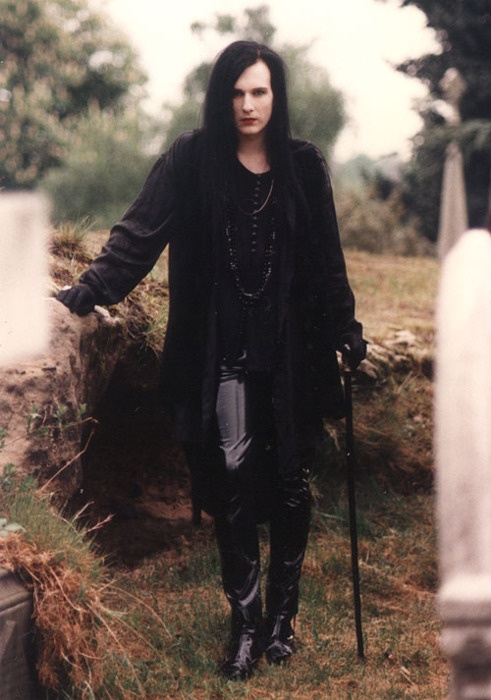
And blend it with a Goth look like, say, this:

1b687892494fd07ac111b38083f0aaf5

So far my results are looking more “Viking Biker” than “Viking Goth” but working on it.  Biker would be a perfectly fine look, but it’s not what I’m aiming at.

In the meantime, if you like stories about Vikings and perhaps Viking women, perhaps you would like my story “The Spaewife”, a fantasy novelette set in pre-Viking age Scandinavia.

A young mother hears the Norns. They tell her of terrible things to come. When Ulfarr wants her gift of prophesy to serve him, he takes her and steals away her children. Can the young mother escape from Ulfarr’s clutches and save her children from him? Only the Norns know.

(As always,

The tale of the infected computer

This is going to be brief.  For the last several days I’ve been dealing with computer woes.  The problems had been going on for some time but lately I’ve been working on getting it fixed.

Basically, I’ve been having two problems.  The more serious was that from time to time programs on my computer would freeze and report “Not responding”. And generally, when one went, everything went.  I’d have to sit and wait for several minutes for the computer to respond again, then I could use it as normal until the next time it froze.  Sometimes, I could go days with no problems.  Other times, every ten minutes.  In the latter case, it essentially rendered the computer unusable.

Needless to say, this was interfering with things like writing.  I’m working hot on a story then…”not responding”.  A few minutes later it’s back, but I have no idea what I was going to say next.

I could, of course, have gone to a computer shop and gotten help but 1) I didn’t want to spend the money (I would if I had to, but I didn’t want to) and 2) I’ll be honest; I’ve got things on the computer I really don’t want people pawing through.  Yes, yes, I know, I won’t have anything the professionals at Geek World (or wherever) haven’t seen before, but still…

Fortunately, there was another avenue.  There are sites on the Internet where people will help you with computer problems.  One of these is SpywareInfo Forums.  That’s where I went.  First I had to run some programs to check the current status of my computer.  they check what’s running, what processes are running, do an initial look for malware, and generally provide information for the knowledgeable geeks at the site to begin to know how to help.

So, I head over there and I find that, yes, I’m infected with malware. (I do a lot of research which can take me to strange corners of the Internet and, well, I don’t know what I’m going to find until I go.) But also a number of important Windows services aren’t running.

First we get the malware off my system.  The person helping me at Spywareinfo forums walks me through several procedures.  Eventually we get the computer clean.  Then we begin working on restoring the missing services.

And finally we get my system back to a working configuration.  Not quite fixed yet entirely but it looks like the “Not Responding” only happens when one of the Mozilla products–FireFox or Thunderbird–is running.  I had Chrome as my backup browser and am using it right now with Firefox uninstalled.  Normally I always kept Thunderbird running in the background and just switched in to check the latest messages from time to time but for the time being until I can either get that problem fixed or until I replace it with something else I figure I’ll just only open it periodically to grab and read emails which might mean having to wait through periods of “not responding” while Thunderbird catches up on whatever it’s doing.

But that’s why I haven’t been able to get any writing done lately.  Still not quite fixed, but I can see the light.  Now if it’s not just an oncoming train.

When is it science?

There’s a lot of talk these days about people being “anti-science.”  The problem is, a lot of people making those claims either are a bit unclear on the idea of what science is or know full well what it is but are hoping you don’t.  Just because someone calls something science doesn’t mean that it actually is.

First off, science is not a collection of “facts”.  It’s not a set of conclusions.  And it most certainly is not ultimate Truth, forever and ever, amen.

Science is a method.  And the core of that method can be summed up in one simple question:

“How would we know if we were wrong?”

The late Richard Feynman described it this way:


First, we guess what we think our new law will be.  Then we calculate what must happen if that law is right.  Then we compare the result of that calculation with experiment.

And here’s the most important part.  If the calculation from our guess does not match experiment, it’s wrong.  Period.  Yes, there can be experimental error.  Yes, if the data is variable sometimes just from chance you’ll get a result that is atypical.  But once you account for those, once you’ve gotten your measurements nailed down precisely enough  to differentiate from your calculated result, once you’ve got enough measured data for the statistics to say whether it matches calculated results or not, then if they do not match, they’re wrong.  Period.

It doesn’t matter how “common sense” your proposed law of nature/theory/hypothesis (various terms which science uses to label proposed explanations of how the world works) is.  Doesn’t matter how much you want it to be true.  Doesn’t matter how good, or bad, the results will be for you.  Doesn’t matter how many people, how many scientists, say it’s true.  If it doesn’t match experiment, it’s wrong.

The only reason, the only reason to accept or reject some scientific law/theory/hypothesis is whether or not  it agrees with experiment. And any such law/theory/hypothesis is always subject to being amended, or outright rejected, as further data comes along.  Science is never settled.

Let me give you an example.  Back in the early days of optics as a science there were two schools of thought on what the nature of light might be.  One was the “corpuscular” theory, that held that light consisted of really small particles that bright objects emitted.  The other was the wave theory, that light consisted of waves, like sound.  Now, waves and particles behave differently in certain circumstances.  In particular, waves will tend to diffract and interfere and particles will not.

Someone looked at that diffraction and did the math and found that in certain circumstances light, if it were a wave, would behave in ways that was just patently absurd.  In particular it was found that in some very specific circumstances the shadow of a small object illuminated by a point source light of a single wavelength on a screen behind it, certain combinations of size of object, distance to the screen, and the wavelength of light, the shadow would contain a bright spot in its center.  Contrariwise, light shining through an aperture would have a dark spot near the center of the light spot.  This, of course, was completely ridiculous so of course light had to be a particle.

The science was settled.

Then, someone actually found a combination of object and screen distance, paired with monochromatic light (a sodium flame was useful for this, it’s two spectral lines are close enough that it can be treated as a single wavelength for the purposes of many experiments).  And the bright spot in the shadow, the dark spot in the light disk, was there.  Once this was seen, it was utterly clear that light had to be a wave.  Couldn’t be anything else.  Only waves act like that, produce the diffraction and interference that would make that happen.

The science was settled.

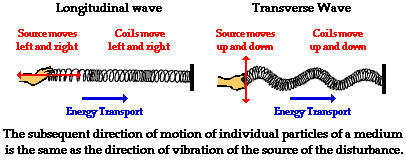
And then, once more, experiments started finding oddities.  We learned that the light had to be “transverse” waves rather than “longitudinal waves”:

u10l1c5


Bu that led to some puzzling aspects.  If it was a transverse waves, what was “waving”?  Transverse waves aren’t carried through a liquid or gas, but only through a solid (the ocean waves you see on the shore are a different phenomenon and can only happen when there’s an interface between two materials).  Furthermore, experiments in interferometry had given us the wavelengths of light–very, very short wavelengths–and the speed of light suggested that whatever material was “waving” had to be very stiff indeed.  This led to the conclusion that the Universe was filled with something both extremely tenuous but also extremely stiff to allow light to pass through it.  But this material wasn’t dragging on the planets as they circled the sun so it had to be infinitely elastic.

Then folk started finding out other things.  They discovered that light didn’t quite, or didn’t always, act like a wave.  The photoelectic effect, the “ultraviolet catastrophy” of black body radiation (you heat something and it glows, but for a wave, the higher frequencies should carry most of the energy so that instead of glowing red, or even white, most of the energy should be in ultraviolet, x-rays, and gamma–but it wasn’t).

The science was becoming unsettled.

Then a certain Swiss Patent Clerk (I won’t keep you in suspense; it was Albert Einstein) suggested that light was waves that came in discrete “packets” called quanta.  Under certain circumstances they behaved as waves.  Under others, as particles.  This was the foundation of what is now called Quantum Physics.

And the science is settled.

This Time For Sure.

Or until someone else comes along to unsettle it with some experimental results that just don’t fit.

To the Shores of Tripoli

In the early 19th Century pirates from the Barbary States, Morocco, Tripoli, Algiers, and Tunis, started raiding the merchant shipping of the newborn United States.  They would take the ships and crews and hold them for ransom, ultimately wishing to extract tribute from the United States.

When the Brigantine Betsey was captured by Moroccan pirates, diplomatic channels were first tried.  Spain’s recommendation was to pay tribute to the Barbary states to get them to leave us alone. Then US Minister to France Thomas Jefferson decided to send envoys to Morocco to try to  purchase treaties.  The attempt was apparently successful in that Morocco agreed that if any ships were captured and brought into Moroccan ports they would come under the protection of Morocco and be set free.

This did not help when Algeria seized the schooner Maria and then Dauphin.  Diplomatic talks failed.  Envoys were authorized to pay up to $40,000.  The four Barabary Coast states wanted $660,000 each to free the crews and ships (Morocco apparently forgetting its existing treaty, or perhaps simply not considering it to apply when it was another of the Barbary states that did the actual pirating).   It took a decade, during which time other ships were taken and their crews enslaved, before the US won their release at the cost of $1 million (out of a total Federal budget, for all purposes, of about $6 million).

This continuing demand for tribute led to the first rumblings that America had had enough with these people.  The US formed the Department of the Navy in direct response in 1798.

Thomas Jefferson, then Vice President of the United States along with President John Adams once more tried to negotiate with them going to London to negotiate with them, a much more serious move than a similar trip would be today.  The response they received was disheartening in the extreme:

It was written in their Koran, that all nations which had not acknowledged the Prophet were sinners, whom it was the right and duty of the faithful to plunder and enslave; and that every mussulman who was slain in this warfare was sure to go to paradise. He said, also, that the man who was the first to board a vessel had one slave over and above his share, and that when they sprang to the deck of an enemy’s ship, every sailor held a dagger in each hand and a third in his mouth; which usually struck such terror into the foe that they cried out for quarter at once.

It was clear at this point that paying tribute was a losing game.  However, then President John Adams believed we needed a stronger navy before we could stop.  The US agreed to pay $1 million a year (still a substantial portion of the US Federal budget) for the next 15 years for safe passage of US shipping through the Mediterranean.

However, when Jefferson took office as President in 1801, Tripoli demanded an additional $225,000.

This was enough.  Jefferson refused.

Frigates were sent to protect American shipping. Congress never voted a declaration of war but they did authorize the President to instruct American vessels to seize all vessels and goods of the Pasha of Tripoli “and also to cause to be done all such other acts of precaution or hostility as the state of war will justify.”  The US ships, joined by a Swedish flotilla, blockaded Tripoli.

This undeclared war continued for several years before the battle that is the reason for today’s post.

On March 6 of 1805 Lieutenant William Eaton of the United States Marines starting at Alexandria Egypt with a force of 600 marines and 400 locally recruited Arab and Greek mercenaries and began a 600 mile trek across the Libyan desert.  In the course of this trek friction arose between the Muslim Arabs and Christian Greeks.  There were several mutinies among the Muslim forces.  Eaton quelled the mutinies and finally reached the port city of Bomba in late April where the ships Argus, Nautilus, and Hornet waited under the command of Hull.

On April 26 Eaton sent a letter to the Governor of Derne asking for safe passage through the city.  This request was, of course, denied with the Governor reportedly writing back “My head or yours.”

So on April 27, Eaton attacked.  A cannon from the Argus had been shipped ashore and the Hull began a naval bombardment.  Eaton divided his forces in two, sending one group under Hamet to cut the road to Tripoli and attack the city’s weakly defended left flank.  He led the attack against the harbor fortress himself.

When his mercenary forces wavered under musket fire, Eaton led the charge himself being seriously wounded in the wrist.  Hull, seeing the charging forces, ceased fire.

So successful was the charge that the defenders in the fortress fled, leaving their cannon loaded and ready to fire.  Eaton turned the guns on the city.  This attack, in combination with Hamet’s flanking maneuver, led to the city being completely taken by mid-afternoon.

And this battle provided the young United States with the leverage to win back the captured Americans and end the First Barbary War.

At it added an important line to the Marine Corps Hymn.


Where the DC movies went wrong.

This is going to be a bit of a ramble.

Lately there have been two battling Superhero franchises:  The Marvel Cinematic Universe and whatever mess DC has been putting out lately.

That wording should tell you what fandom camp I fall into.  And what makes that ironic is that I grew up on DC comics.  While I was fond enough of Marvel Comics, it was DC that was my true superheroic love.  Superman, Flash, Wonder Woman, Batman, Supergirl, Batgirl, Teen Titans, Green Lantern, yes, even Aquaman.  I couldn’t even pretend to be a collector because I would read and re-read them until they were falling apart.  No “mint” copies in my collection.

Then Frank Miller did the Mini-Series “The Dark Knight Returns.”  It was a good story.  It was a great story, as a story.  As a stand alone, as one particular take on Batman and his future, it was marvelous.  But it was not the Batman I’d grown up on.  And when DC started making the Darknight Detective more “Dark” and less “Knight” let alone “Detective”, well, that was the beginning of a downhill slide for me.  Your mileage, of course, may vary.  For a while there he was almost a split personality.  A more well-rounded, sane individual when working with the pre-Crisis Jason Todd (back when Todd was, like Dick Grayson, a circus performer whose parents were murdered–as one letter writer said “Where else are you going to find a young man with that kind of acrobatic training?”), then a completely different and far darker individual when working on the West Coast with the group he formed the “Outsiders.”  Gradually the cowled psychopath would take over the character.

Meanwhile, over in the Superman Comics, Superman was still the Big Blue Boyscout.  And I loved it.

Then came the movie “Superman”.  Oh, wow.  Christopher Reeves nailed it.  As Reeves said in a interview (quoted here among other places):

“What sets Superman apart is that he has the wisdom to use his powers for good. He has all these powers, but he’s got the mind of maturity – or he’s got the innocence, really – to look at the world very, very simply. And that makes him so different.

When he says, ‘I’m here to fight for Truth, Justice, and the American Way,’ everyone goes: *snicker* *cough* *ahem*.

But he’s not kidding.” 

 Reeves totally got it.  The movies may have been over the top silly in parts but Reeves understood the character and was true to him.

Well, years passed and we had Keaton’s Batman.  Very Milleresque, but as a stand alone “different take” it was pretty good.  Kilmer’s wasn’t too bad.  And the less said about Clooney’s the better.  There was the Brandon Routh version in Superman Returns that fell like a dud.

Then there was Nolan’s version of Batman.  This one actually lightened up a bit on Batman himself.  Okay, I think he was wrong in The Dark Knight.  Gotham could have handled that, given what had happened to him, Dent had gone nuts there at the end.  Batman as a heroic figure  would have had more value than was lost in seeing that their idolize DA had human failings.

Then along came Zack Snyder to direct the new Superman movie, “Man of Steel”.  Okay, look, I’ve heard arguments on both sides regarding the collateral damage from the fight in Metropolis and the killing of Zod and how Superman “had no real choice.” This may be true, Superman had no choice.  But that was Snyder’s choice.  In the comics, Superman has killed, yes.  However, that falls into two different categories.  One is the very early development of the character when the writers and editors were still figuring out what the character was going to be.  Then, once they did that and we had the “Big Blue Boy Scout” those rare instances were where he was forced to at extremis, and gain their dramatic power because he is deeply committed to preserving life, not taking it.

Snyder’s Superman, as portrayed by Henry Cavil, does not have that.  One could argue that they’re returning to the roots of Superman, the very first stories where he was a bit more casual about things like that, but that Superman was far less powerful, far less of a god among mortals.  “Faster than an express train” “Nothing less than a bursting shell could penetrate his skin” “Leap an eighth of a mile”. Compare that with any of the modern versions. The more “relaxed” attitude toward use of lethal force, combined with the far greater powers of the modern Superman is not, IMO, a good combination and breaks the character.

What we end up with is an invulnerable, super strong, super fast bull in a china shop.  Those people concerned about what this incredibly powerful alien is going to do are right to be concerned.  He has given them no reason to allay their fears.

They worry that he’s a threat for the very good reason that he acts like a threat.

And this is not just a matter of putting Superman into a difficult spot that he’s going to have to dig his way out of and show that despite how things look he’s really that Boy Scout.  This is a different, darker, interpretation of the character.  As indicated by Snyder’s complaint that people don’t like this version:

“The thing I was surprised about in response to Superman was how everyone clings to the Christopher Reeve version of Superman,” he told Forbes. “How tightly they cling to those ideas, not really the comic book version, but more the movie version. … If you really analyze the comic book version of Superman, he’s killed, he’s done all the things. I guess the rules that people associate with Superman in the movie world are not the rules that really apply to him in the comic book world because those rules are different. He’s done all the things and more that we’ve shown him doing, right?”

First off, he shows here that he does not understand the comic book version.  Yes, Superman has done “those things”.  But they were exceptional things, not, frankly, the only things we’ve seen from the character.  When the first thing we see about how the character deals with a difficult challenge is killing the challenger we don’t have “this is something he was forced to in extremis”.  We have “this is how the character deals with challenges”.

I don’t think he “analyzed” the comic books.  He went through cherry picking what he wanted to do, the character he wanted to make, regardless of whether it was actually true to the iconic character or not.

Even the outfit.  Superman’s costume was inspired by circus costumes.  The muted colors are just plain wrong on the Man of Tomorrow.

The people who are complaining are fans of the comic books.  They generally have read the comic books, probably a lot more thoroughly than Snyder ever did.

Look, I’m the last person to say that nothing can be dark. “If you want to paint pictures like that, you need to use some dark colors.” But it can’t be all dark.  And in a comic book superhero world of all places–especially when it comes to characters like Superman of all things–the purpose of dark is to make the light seem all the brighter.  When all you have is dark, you just have a muddy, bleak landscape, what some folk call “gray goo”.  I know that appeals to some people, but those people generally aren’t Superman fans.

And, so far, with the new DC movies, that’s really all I’m seeing:  unremitting dark with nary a bright spot to be seen, as far as the eye can see.