In all the trials that we have, today is a day to reflect on the good things we have in life and the things we are grateful for
I am thankful for my wonderful daughter.
I am thankful for my dogs, unconditional love that money really can buy.
I am thankful that I have a comfortable house, a comfortable place to sleep, and food on the table when so many around the world have none of those thing.
I am thanful to live in a country where Freedom is still a thing. It may be under attack daily by enemies but that freedom still exists more here than anywhere else and there are still people willing to fight for it.
I am thankful for my friends, both those local to me and those scattered around the world.
I am grateful for modern communication which is why I can have those friends scattered around the world.
I am still working on several specific things going forward. In addition to the things I noted in my “2 1/2 years progress” video, I’ve been working on several things in specific.
First thing is that I note that when I finish Adult 6 and move forward into the “Free Skate” track I’ll need to be very confident with my backward skating. And, so, during those public skate sessions where there’s little enough traffic that I can safely practice, I’m spending a lot of time doing simple backward skating:
However, in order to finish with Adult 6, I have to get that two-foot to one-foot spin down. And in order to do that, I have to get the basic two-foot spin to a much higher level than I had been. Unfortunately, there are problems:
Instead of spinning in place, I “spin” while moving across the ice (completely out of the frame in that first attempt here). That’s called “travelling” and is a decided flaw. Since I took the above video I’ve been doing better but…still need to work on it. I’ve only felt solid enough to try doing the one foot spin twice. One time I got about two rotations on one foot before I had to step down from the spin. The other time I, well, I may have felt solid enough to try it but I wasn’t there yet. I managed to avoid falling anyway.
Part of the backward skating that I need for more advanced work is holding back edges. One of the elements that I have to learn for the first test to qualify for “entry level” at United States Figure Skating Association competitions requires continuous edges on a line, forward and backward. That’s basically alternating edges, one foot for half a circle, switch to the other foot, and proceed across the ice in big “S” curves. There are four you need to do: Forward Outside Edge, Forward Inside Edge, Backward Outside Edge, and Backward Inside Edge. Well, I’ve been able to do the forward edges adequately for level for some time. The backward edges, however? Not so much. So, recently, I’ve started working on them, having that exercise take the place of my backward edges on a circle work:
I did surprisingly well with the backward outside edges. The backward inside edges, however, were a different matter. I had a lot of difficulty getting a good “push” to generate momentum in the edge. I’ve been working on it since taking the above video and…it’s slow. Still, I can remember when I was at that point with the forward edges so I have confidence that with some time and effort I can get there.
And that’s where I am with my skating right now. We’re close, really close, to completing Adult 6 and I have a good start on a number of techniques in the Free-Skate series. There remains work to do, but we’re getting there.
One of the things I noticed about figure skating. Back when I was in martial arts (a couple of traditional striking arts and judo) is that I always had what I thought was pretty good proprioception, that’s the ability to “feel” what your body’s doing so you can get good control over it.
Figure skating, however, was a whole different world. What was good enough to seem me through Isshin-Ryu, Chinese Kempo, and Judo (among others) is totally inadequate for figure skating. The margin of error is much smaller and, unlike many techniques in martial arts you can’t compensate for imperfect form by muscling through. It’s been an eye opener and makes for an exciting challenge.
People, including people who are pro-2nd Amendment and pro self defense, have been making this claim. I just have to shake my head.
“He shouldn’t have been there” is a stupid argument. As a free citizen in a free country on publicly accessible property he had every right to be there. As a free citizen in a free country he had every right to be armed for his own protection. As a free citizen in a free country he had every right to move to stop an incipient disaster (a burning dumpster on its way–never mind how for the moment–to a gas station where it might well set off a conflagration that could kill hundreds).
Other folk, however, did not have every right to offer violence in “retribution” for that act of extinguishing a burning dumpster–that they lit on fire and were pushing toward that gas station. Being a free citizen of a free country doesn’t extend quite that far.
Let’s look at that. A dumpster had been lit on fire. It didn’t spontaneously combust. It was lit on fire. It wasn’t rolling of its own accord into the gas station. People were pushing it there. A large fire in a gas station. Folk don’t want lit cigarettes in gas stations for fear of starting a fire. How much worse is a burning dumpster?
If that gas station had gone up–and what other possible reason than setting that off was the purpose of folk pushing a burning dumpster into it–the fire would have spread. Burning gasoline doesn’t stay in one spot. It spreads. And gas stations have a lot of gasoline, almost like it’s their reason for existing.
Oh, wait, nothing “almost” about it. It’s exactly their reason for being.
Good luck getting the fire department to respond promptly in the middle of a riot.
How many people would have died in the resulting fire? For that matter how many of the rioters? Had Kyle not been there, that fire would not have been extinguished because there was nobody else to do it, nobody but the rioters who set the fire.
Kyle shouldn’t have been there? Thank whatever gods you worship that he was. He probably saved more lives than he was forced to take in self defense…because the rioters were upset that he extinguished the fire they started.
Going further, what argument that Kyle shouldn’t have been there does not apply to anyone else? His age? This infantalizing of older teens is kind of ridiculous. 17-year-olds can join the military with parental consent (at least they could when I was that age). But, really, the argument that he shouldn’t have been there is an argument that folk rioting, looting, and committing arson should have free rein. They should be allowed to destroy and kill (arson kills, maybe not every time but often enough that it’s considered a very serious felony) with no one to stop them? Is that really the society you want?
Was it, on some level, unwise for Kyle to be there? Perhaps, on a personal and short term level, yes. After all, if he weren’t there, then he wouldn’t have been forced to shoot three men in self defense, he wouldn’t have been wrongfully charged with murder, and he wouldn’t have been dragged through this long court battle, and he wouldn’t have the target on his back that the Left is putting there.
And the rioters would have lit that gas station on fire.
Society functions because of people who are willing to put their own short term advantages aside for the benefit of others. Society functions precisely because of people like Kyle. Were his actions wise? Again, on some level perhaps not. They were more than wise. They were laudatory.
Not a particular single event, but I noticed one time when looking through “On this day” in Wikipedia that October 19 seems to be a particularly bad day for empirs.
202 BC
At the end of the 2nd Punic War, after taking major losses at Utica and Great Plains, the Carthaginian’s recalled Hannibal from Italy. Confident in Hannibal’s forces and leadership, they broke the armistice imposed on them after the preceding two defeats and confronted the Romans. Roman general Publius Cornelius Scipio Massinissa. The Carthaginians had a somewhat larger army of 40,000 men and including 80 war elephants compared to the Roman 35,100 men.
The result was disaster for the Carthaginians with 20,000 men killed and 20,000 captured, wiping out the Carthaginian army and ending the 17 year 2nd Punic War.
1453 AD
Three months after the Battle of Castillon, England finally loses the last of its possessions in southern France, thus bringing to an end the Hundred Years war.
1781
With French ships blockading both resupply and evacuation, Lord Cornwallis is forced to surrender to George Washington, ending the battle of Yorktown, the last major battle of the American Revolutionary War and making American independence a fait accompli although it would be another two years before Great Britain officialy recognized that independence.
1812
Napoleon’s invasion of Russia comes to an end as he is forced to begin his retreat from Moscow. This would mark the furthest extent of the French Empire under Napoleon.
1813
Once again, Napoleon faces a major defeat in the battle of Leipzig. The Sixth Coalition, consisting of troops from the Russian Empire, the Austrian Empire, the Kingdom of Prussia, Sweden, and the Grand Duchy of Mecklenburg-Schwerin at 257,000 men outnumbered Napoleon’s 177,000 men. In particular the Sixth Coalition had 1400 guns to Napoleon’s 700. This ended the French Empire’s presence east of the Rhine.
1866
The Austrian Empire, in accordance with the 1866 Treaty of Vienna which ended the Third Italian war of Independence (and a theater of the Austro-Prussian war), handed Veneto and Mantuo to France, which immediately gave them to the new Kingdom of Italy as payback for previous concessions of Savoy and Nice.
1935
Italy, attempting to build itself into an empire, had just invaded Ethiopia, leading to a war that would last until February of 1941. On this date in 1935, the League of Nations would place economic sanctions on Italy which would prove about as effective as such sanctions usually are, that is, not to speak of. While these sanctions caused alarm in Rome, they served to strengthen Musollini’s position as the Italian people saw him as being strong in standing up to the League of Nations and so helped to cement Fascist power in Italy and more strongly drive Italy into the German camp for the coming war.
2005
Not exactly an empire or even a nascent empire (although Iraq did have pretensions of being a leader of the “Arab world”, so perhaps a nascent empire after all) but on October 19, 2005, Saddam Hussein went on trial for Crimes against Humanity.
Near the end of class yesterday, after working a bit on spins, I had a bit of a talk with the coach. This week was kind of a pre-test and “technique tuning” with next week being testing (last class of the 8 week session).
On balance, I’m probably OK to pass Adult 6–not quite really “there” with the two-foot to one-foot spin (shown in the video above). If I were just doing Adult 6 and out which is typical for recreational Adult skaters (if they even go that far) what I just need is the practice to get it to “come together”. Thus, I could be considered passed for level.
However, since I do plan to continue with free-skate (the actual “figure skating” curriculum, as for competition) my thought to stay in Adult 6 a bit longer is probably a good one.
I do need to have my spins a bit better to continue with the more demanding standards of the free-skate classes. Also, there are a few things not covered in the Adult curriculum that are part of the “Basic” curriculum that younger skaters, aiming at free skate, take. Things like toe taps and bunny hops (preliminaries for the jumps with rotation you learn in free-skate), spirals, and pivots being the main ones.
One of my coaches has been willing to work with me on those since the classes at this level are small and they can be flexible with curriculum. Harder to customize curricula in larger classes. Still, it’s been a while since we did any work on those and I may need to take a few private lessons to “fill in the gaps.” The trick there is, as always $$$ as well as being able to work out a schedule.
One thing I am a bit unhappy with is that I still look a bit “clunky” out skating (see the progress video posted last week, but also here…)
Figure skating should be “pretty” and, well, I’m not quite there yet either. I actually mentioned that to the coach and some of the things I have been working on since doing the above video–pushing “out” in my crossovers rather than back and getting down lower in my knees (which also allows a deeper cross) is helping with that. Also need to work on not “breaking” at the waist which is not only bad form (and part of my problem with spins) but also looks bad.
Finally, I left my skates with the coach who also does sharpening (has his own sharpening machine). I do not have the folk at the rink sharpen the blades. They are all hockey guys and can ruin figure skate blades really quickly by putting a hockey profile on them. That’s why I had to replace the blades on my skates a couple years ago (not long after I bought them). I’ll be able to pick them up Tuesday.
Forward! (And backward…because…you do that in skating.)
So it’s been just over two and a half years since I started skating…well, not counting the time when I was 18 or so and did a little self-taught skating. After all, when I started again in March of 2019, I had lost all of that earlier stuff and was essentially starting over from scratch.
I’ll admit that progress has been a bit slow compared to most of the folk I see on YouTube doing their “one year progress videos” or the like. And, well, there are reasons for that. When I started, foot pain was a major issue. In public skate, I’d skate half a lap then take a break to allow the pain in my feet to fade a bit. Then another half lap and do the same. Two laps of the rink and I was done for the day. For several months I counted progress by how many laps I was able to complete. In classes, I’d spend half or more of the class time sitting on the sidelines, again letting foot pain fade slightly. The lack of being able to fully use class time and get much practice in meant that progress was slow. And the simple truth is, talent is a thing. There are aspects of body mechanics, proprioception (the ability to accurately “feel” what your body is doing–I used to think I was pretty good in that aspect from martial arts but, frankly, figure skating is a whole other level entirely), balance, coordination, and so on that combine so that some people learn faster than others. That’s the reality.
Still, even without much talent, even with the challenges I had going into it, I’ve come pretty far in the two and a half years I’ve skated. I’m nearing the end of Adult 6. I’ve recently gotten the forward inside three-turn adequate to pass level (which doesn’t mean that there’s not a whole lot of improvement to be made) which leaves the two-foot to one-foot spin before I graduate to pre-free-skate where things get really exciting.
There is one aspect in which the early skating when I was 18 or so did help me. When I was struggling with the early classes, when skating was work and not a lot of pleasure, I did remember how much fun it was when I was younger. Thus, I knew that if I could just get past the immediate challenges it would be fun again.
And that’s exactly what I found. More, as I learn a new element and it finally clicks, I come out of practice of that element with a big grin on my face. It’s a major dopamine hit. 😉 And, since there are so many things to learn in figure skating, I can always count on there being new dopamine hits awaiting me. I got my inside three? Well, there’s still the two-foot to one-foot spin. Then there’s the Waltz 8, Waltz Jumps, and direct entry into one-foot spins. And when I have that, well, there are toe-loop jumps, Backward inside edges on a line. Actual-for-real-power pulls and, somewhere down the line, the Axel jump.
I’ll never run out of new things to learn. That’s one of the beauties of figure skating as a performer. There’s always something new.
The idea of the “friendzone” came up recently and, well, while no expert on relationships (What? No!) I have some thoughts on the matter.
First, and most commonly, “friendzone” is simply a whiny way for someone to complain that someone they are interested in romantically is not interested in return. Well, here’s an unpleasant truth for such people: Your interest in someone else is not an obligation on them. They don’t “owe” you interest in return. You’re not entitled to their romantic interest just because you are interested in them.
If you’re in that situation, pull on your big-boy manpanties and deal. Get over it and move on. If you can do that by dint of personal fortitude, great. If you need to work through it with others: friends (not the “friendzoning” person), your bartender, your therapist, whatever, then do that. But get over it and. move. on. Remain friends if you can. The world can always use more good friendships. Indeed, in my opinion the world needs more friendships than it needs lovers. If you can’t, be honest about it and move on. Pretended friendship with an ulterior motive is not friendship at all.
That should cover the large majority of “friendzone” cases, but there are a few others.
One other is a much more toxic version of “friendzoning”. In this case the “friendzoning” person is deliberately stringing along the friendzoned individual. They’re “plan B” or, worse, someone they’re keeping hoping in order to get concessions or gifts with no intention of ever giving them any consideration.
I don’t know how common it is, but it does exist. I don’t have links to hand but I’ve seen videos of women bragging about doing this. So, yes, it does exist and it’s despicable. And in this case “friendzone” is something of a misnomer. Friends don’t treat friends that way. The “friendzoning” person was never the friend of the person being friendzoned.
The third category is kind of a special case of the first one. In this case, the woman has a list of things that she says she wants in a romantic partner yet, strangely, can’t seem to find them. And the reason she can’t find them is that she keeps focusing her attention on men she finds “exciting” and the traits she finds exciting are things that simply do not make that person a good prospect for a long term relationship.
In such cases, it does no good to point out the disconnect. If you’re the one in the friendzone it does no good to point out that you have the very traits she’s looking for. First off, most people have a remarkable lack of self-awareness (and I include myself in that–which makes for a kind of meta self awareness of a lack of self awareness). Do you really have the very traits she’s looking for or is that your ego talking? Most men think they are great lovers, great drivers, and great warriors and are wrong on all three counts. (Don’t get upset, guys; there’s one for the women too.) And if you think she owes you anything, then you pretty much demonstrate that, no, you are not the “nice guy” she’s looking for.
In this third case, the woman in question needs to sit down and really think through what she really wants and decide what’s really important to her and start focusing her attention there rather than chasing bright, flashy, “exciting” stuff.
But until she does, for the one in the friendzone, you’re back to case one: pull up your manpanties and deal. Indeed, that’s really the answer in all three, because there’s no percentage in pining after someone who’s just not interested or, worse, is playing games with you.
Several times in fiction I’ve seen the case of some hard-driving businessman getting a report from a subordinate on his investments. Often, in the midst of an otherwise upbeat report, one stock slipping a few points in the market will be mentioned. In such cases, the hard-driving businessman says words to the effect of:
“Sell. I don’t back losers.”
This is patent nonsense. Look, any publicly traded company that hangs around for a while will have ups and downs in its stock market. Any “hard-driving businessman” who followed a policy of selling anything that ever slipped would, in rather short order, be without a portfolio. No stock price always increases in price.
While that’s a fictional case, we see similar effects in the real world. Opponents of an economic policy, no matter how well that policy might be working for the economy as a whole, can always find examples of companies doing poorly under it. Similarly, fans of a policy, no matter how disastrous for the economy as a whole, can always find companies doing well under it. That’s why you’ve got to cast your nets wide when attempting to judge the effect of an economic policy. You can’t just rely on a handful of businesses or a small subset of the population.
You also can’t look at the very short term. The market, while the most efficient way to allocate resources for maximum value in the long run, can be…somewhat volatile (okay, a lot volatile) in the short run. They say water seeks its own level but part of “seeking its own level” includes waves, tides, rivers, waterfalls, avalanches, and hurricanes (among many other things). So it is with the economy. As prices tend to a “market clearing” value (a price where the amount of a good or service people are willing to provide exactly matches the amount of the good or service people are willing to buy–at that price) that does not mean the path to that market clearing price is a smooth one. Things can vary wildly on the way to that price. Fads occur. People see others buying and so buy themselves, a momentum builds up and people keep buying until a lot of people realize they have more of the good or service than they really want at the price they paid for it and then turn to sell it back to the market, causing the price to crash. This is the very definition of an economic bubble.
A lot of people end up spending a lot of their resources to acquire something that they end up selling again for a lot less resources than they first expended with the result that they end up with less resources than when they started with nothing to show for it. A classic example is the Dutch Tulip Market Bubble.
This kind of volatility is behind many of the complaints against the market and there is some validity to them. An argument can be made that trading a bit of efficiency for a bit less volatility can be a good thing. That was one of the arguments for establishing the Federal Reserve. And, indeed, for a while it worked. Then, in 1929, the Federal Reserve, after having had a change of leadership and several structural changes managed to take the wrong move every. single. step. of. the. way. The result was what could have been a sharp, but relatively short, economic downterm (a “readjustment”) turned into the Great Depression.
As Thomas Sowell is wont to say, just because the government can do better than the market in some respect does not mean that it will. Any such meddling must be looked at with a jaundiced eye and, if taken, taken with a great deal of trepidation with cutouts to stop it if it does not produce the desired results if, indeed, it makes matters worse.
In short, exactly the opposite of the way we handle government meddling in the economy today.
And so, this ended up drifting quite a bit from where I was thinking it would go when I started, but there it is.
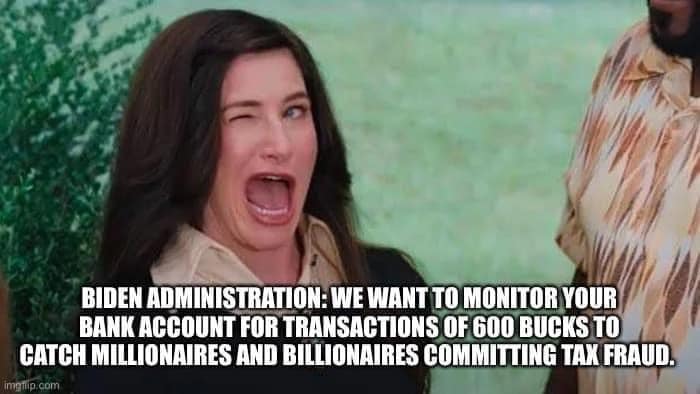
Saw this “meme” on the Book of Faces, one of several:
The meme is wrong, actually. What’s being proposed isn’t reducing the reporting requirement from transactions of $10,000 or more down to $600. No, what’s being proposed is far, far worse.
What’s being proposed is reporting all transactions if the balance in the account exceeds $600 within some particular period (a year, I think).
So, let’s say you get paid biweekly. When you get paid, you deposit your paycheck in your bank account (either by Direct Deposit or going old-school with a paper check). Well, guess what? If you make a rather modest amount more than minimum wage then that deposit, even if the balance is zero on the day you make it, will put you over that $600 mark. That means the IRS would now have access to every transaction you make.
Every transaction. Every purchase you make using a debit card. Every check you write (or have the bank make if you use online banking). Every electronic funds transfer. All of it.
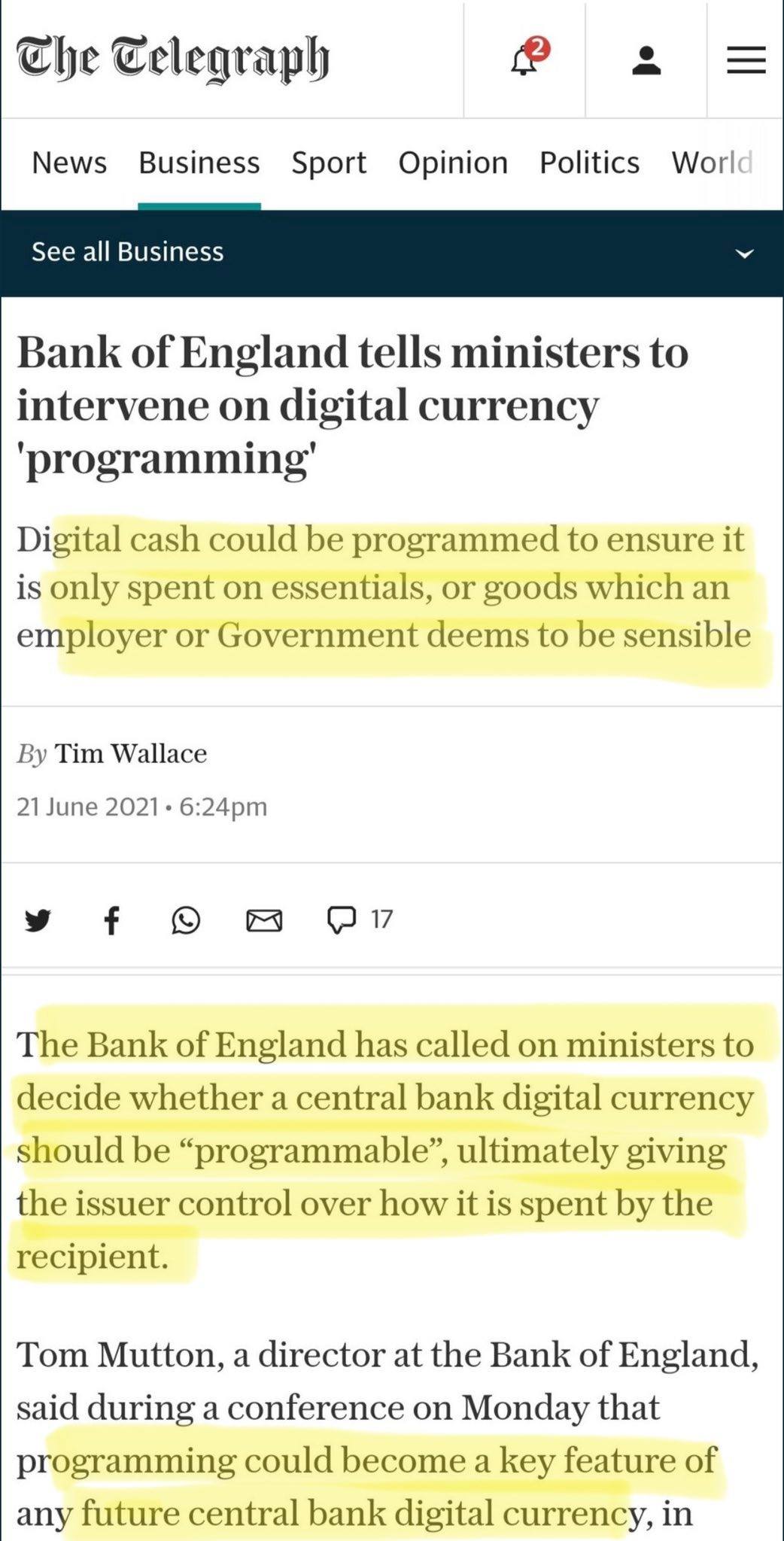
This isn’t quite as comprehensive in its totalitarianism as the “programmable” digital currency I described yesterday but it is bad enough.
I am trying to imagine a way this could possibly pass constitutional muster (I’m looking at you, Fourth Amendment), but, well, I also have difficulty with how “no fly lists”, “Civil Asset Forfeiture”, and Red Flag Laws pass Constitutional Muster. And yet, the courts have allowed them so the need to pass Constitutional Muster is…not so great as it would seem.
The Left isn’t even trying to hid their desire to run a totalitarian dictatorship. This is just one of many “wouldn’t it be great if…” things that have been coming out.
So, “digital currency” would give the government or your employers complete control over what you can buy. This isn’t some made-up conspiracy an “oh, look what they could do with that” but someone actually advocating for it.
Yesterday, I talked about mileage taxes on cars and how, depending on how it was implemented (GPS tracking of all vehicles licensed to use on the public streets), it would give the government complete tracking of your movements–everywhere you went, how long you were there, where you went next, and so on. The only way to avoid that would be to walk or ride your bicycle (if that–want to bet that bicycles, since they use the public roads too, would not also eventually have a tax imposed once the precedent is set?).
Seriously, this would mean complete control of your life by some bureaucrat somewhere. As I said yesterday, the corpses of every tyrant in history has suddenly got a raging erection from excitement at the level of totalitarianism that this means.
People like those referenced in the piece above are actually advocating for a level of oppressive dystopia worse than any in history. Worse, indeed, than any in fiction. Brave New World and 1984 are pleasant libertarian allegories by comparison.
And people are cheering for it.
This cannot be allowed to continue. This must not be allowed to continue. And in the end, it won’t be. But the longer it takes for this dystopic train to be derailed, the more devastating and bloodier the eventual crash.
It needs to be stopped and it needs to be stopped now.






 The Writer in Black