Mileage Tax?

So I saw this:

Okay, this isn’t confirmed, but a “mileage tax” has definitely been floated as a proposal and 8 cents a mile is not beyond the pale. If you have seen another figure proposed for it, then, please, do the math yourself.

26,000 miles? How quaint. Between my commute and getting too and from skating (you, know, ice skating, which is the Goth on Ice’s primary exercise and means of maintaining physical and mental health) I put in close to 100 miles, on average, a day, or 3000 miles a month. At $0.08 per mile that comes to $240 per month.

I don’t know about you but $240 a month would be a big hit in my monthly budget. Put it into annual terms, 100 miles a day, $8 a day, 365 days a year? $2920 a year. A single dad, trying to do on one income what used to be done on two makes things tight. As things stand, I manage but this could easily break that budget. But, I guess, those in Washington have no real experience with having to keep to a budget. After all, look at the government’s spending vs. its income.

And I’m not alone. There are a lot of people who would be seriously hurt by something like this. And it’s not the wealthy who would be hardest hit by it. No, it would be the middle class and working poor who would be most hurt by any such “mileage tax”, whether 8 cents or a single cent a mile.

That leaves aside how it’s going to be managed? How are all those miles driven going to be counted? Are cars going to be required to carry GPS locators which record their every movement with some central data system counting up miles driven by cars and send bills to the cars’ registered owners?

Look at that carefully: a national system that tracks every movement of every person’s motor vehicle. That tracks every move you make if it’s made in a car. The corpses of every tyrant in history is having a raging erection at the thought of such population control.

And what happens when the computer glitches and someone gets a bill for a round trip drive to the Moon? Won’t happen? Come on. Everyone reading this is on a computer. Have you ever seen a computer that never glitches? Ever?

Or perhaps instead of GPS locators we’ll have a million “mileage reading stations” around the country where people will have to bring their cars to get the odometer read. I’m sure they will be as efficiently run as your local DMV. So people have to take time out of their day on a regular basis, to go have someone read the mileage on the car in order to present them with a tax bill? And if someone has more than one motor vehicle, say, a car with good gas mileage for a daily commute, a truck for hauling stuff, and maybe a beater for Junior to use to go to the community college? That’s three trips to the mileage reading station, racking up more mileage because the cars have to be driven there.

Or perhaps it will just be the honor system. You write down your current mileage on a form and send it in and you get a bill based on what you sent in. I’m sure that will work very well indeed. I’m also sure there will be a lot of accidents, car fires, or mechanical failures that require replacing an odometer which just by chance will prevent double-checking the mileage reading against the accumulated self-reported values when the car is sold and an “odometer reading” must be put on the title form.

The simple truth is, any such scheme is totally unworkable. It would pretty much end the ability of most people to own and drive a car. And let’s not get started on the trucking industry and the effect it would have on the price of anything that is shipped by truck.

These are totally predictable first order effects of a “mileage tax.” Blatantly obvious effects. And when effect are that obvious and so easily predictable, then one has to wonder if, perhaps, the effects are not the purpose of the proposal in the first place.

Never let a man leave your house…

So this showed up in my feed:

In a similar vein, Robert Heinlein put in the mouth of one of his character: “A man wants a mother of his children. He wants a willing and available concubine too. If you are not she, he will seek one elsewhere.”

Now, those statements aren’t universally true, but there is nevertheless a lot of truth to them. But, there are a few points to remember.

The most important thing to remember is whether or not the man in question is a man of integrity. Yes, if he’s unhappy in his relationship then he’s got a strong incentive to “look elsewhere.” This, however, does not provide an excuse for “cheating”. There are different ways one might “look elsewhere.” It’s a dishonest man of low moral character who will decide that he’s unhappy with his current partner and then go looking for affairs, for “side pieces.” That’s dishonest. That’s dishonorable. “Hungry and horny” does not make cheating excusable. It simply is not a valid excuse.

A man of integrity, if he’s unhappy with his partner will first bring his concerns to his partner. He will attempt to come to a mutually satisfactory resolution of the issue with his partner. Perhaps she also has something she’s unhappy about and they can work it out between them. Maybe, in more difficult cases, they can go to a third party for counseling to help resolve the difficulties.

If, however, the problem cannot be resolved, the man has two choices. He can decide that the problem is one he can live with. That things are good enough elsewhere that he can accept this area of less than perfect satisfaction chalking it up to the fact that we live in an imperfect world. That’s one possibility.

The other possibility is that the problem is one the man just cannot live with. He’s not going to have a satisfying relationship with this individual without resolution of this problem. And if resolution of the problem is not possible then he still doesn’t have a valid excuse to cheat.

In such a case, the man of integrity will end. the. relationship. with the current partner before seeking a new relationship where he can attempt to have those needs and desires met. This is better all around. While both the man and his original partner will, no doubt, be hurt in the process, at least they are not deceived. They know where they stand. And the man doesn’t have to hide his new relationships. He doesn’t have to worry about others finding out about it. He can be open and up front about it.

Better for everybody.

And, yes, all of this works the other way too. I simply looked at it from a male perspective because, well, that’s my own perspective.

So if you truly find yourself in a relationship that does not suit your needs and you simply must have those needs fulfilled elsewhere, then break off the current relationship cleanly before seeking another.

It’s the honorable thing to do.

Goth on Ice: A Typical Training Log

Some months back I realized that keeping what my results were from sessions on the ice, where I was making progress, what problems I was having, and what I needed more work on were getting to be too much to keep in my head. Well, to be honest they probably had been too much to keep in my head for long before that but I couldn’t really pretend any more. So I got a little bound 5″ X 7″ notebook that fit nicely in the pocket on the side of my skate bag and have been using it to keep notes of my training. Something similar to these (these are on Amazon–I bought mine locally not wanting to wait for a shipment):

So, here are some examples of my own notes from the past week, from last Sunday through yesterday.

Sunday, Sep 20, 2021
1/2 hour practice session then 1/2 hour class. Practice: FI3, both on the wall and free; 2-1 foot spin, backward stroking, continuous FOE and FIE, extended one foot glides into forward edges; forward stroking and FX; close footed slaloms. Class: Forward and backward stroking, T-stops (both sides), FI3, Lunges, 2-1 foot spin, and Mohawks.

I use several abbreviations. as follows:

  • FI3 = Forward Inside 3-turn
  • FOE = Forward Outside Edge
  • FIE = Forward Inside Edge
  • FX = Forward Crossover
  • 2-1 foot spin = 2 foot to 1 foot spin.

The particular techniques I am most concerned about are the FI3 and the 2-1 foot spin. Those are the techniques that I need to master to complete Adult 6 and progress on to Pre-Free-Skate.

Wed Sep 22, 21
1 hr 30 min
Not bad again. FI3 10 step Combo, FX, BX, 2-1 Foot spin, Toe tap, Bunny hop, FIE, FOE, all OK.
Spins — got to work on staying off the toe pick. That’s the big thing, I think.
Getting the FI3 right sometimes, but only sometimes.
Back stroking getting better.
CW FX my right ankle tends to “collapse” so I lose the push as the side of the boot touches down. Got to work on that.

The additional abbreviation here is BX for Backward Crossover. Some of these notes make sense to me but could use some explanation for the reader.

I spin counterclockwise, as do most right-handed skaters (more on that at another time because…I find my personal case complicated). That means the left skate is moving backward in the spin in tight circles while the right skate is moving forward. I’ve seen some online coaches advocating keeping weight distributed between the two feet but my coaches have advocated keeping most of the weight on the left foot (CCW spin) this makes it easier when picking up the other foot for the 2 foot to 1 foot spin, which is what we’re aiming for. Now, there’s a “sweet spot” right under the ball of the foot on figure skates called a “rocker” or “spin rocker” (latter term is used to avoid confusion when also referring to the overall curve to the blade which is also is called the “rocker”). If you get your weight too far forward on the weight-bearing leg, then the toe picks drag the ice slowing down the spin and also disrupting your balance. However, if you get the weight too far back, the tail of the blade bites into the ice, pretty much stopping your foot from rotating. Since your body keeps rotating, the result is generally a fall where you land flat on your back. Well, I tend to get my weight too far forward. Maybe that’s just the way my biomechanics works but, to be honest, I think it’s an instinctive reaction to avoid falling. The note here was a reminder that I need to do a lot more work on just getting my weight on the right part of the blade. As a result, my spin work is usually one or two brief “blocks” during my ice time where I work the two-foot to one foot spin and in further blocks I just do the two-foot spin while focusing on getting weight placement correct.

The issue with the crossovers is another one that needs more expansion. When I’m doing crossovers in the clockwise direction, the way it works is I push out to the left with my left leg, then when it lifts from the ice I cross it in front of my right leg which is skating on an outside edge and place it to the right of my right leg. I then push out to the left with my right leg, under my body (called the “push under”), lift it from the ice (leaving my left leg skating on an inside edge), and bring it back just to the right side of my left leg, then repeat the process. Done right, it’s a smooth and elegant move while allowing you to get speed and power on the ice. The problem I’m having is that when I’m pushing under, my right ankle rolls to the outside causing the boot to land on the ice and the blade to lose contact. Because this loss of contact is not fully controlled, I’m still trying to push when it happens and I generally stumble although I’m usually able to avoid a fall. Now a certain amount of rolling of the ankle is normal to keep the blade at the proper angle on the ice, but this excessive roll is a fault. I don’t do it going the other direction (CCW) so it’s probably simply that since the normal flow of traffic in public skate sessions is CCW, I don’t get as much practice going CW.

Sat Sep 25, 21
2 hours
Practiced all the usual stuff except spirals & lunges (protecting pulled groin muscle). Some notes:
I think I’m almost there on the FI3. So very close.
Out of practice on the FO3 so started working on that a bit more.
2.5 rotations on the 1 foot portion of the 2 foot to 1 foot spin. New personal best. Getting close. However, later in the session had trouble with the 2 foot spins. The “pumping” foot just didn’t want to come in. Not sure why. I was, however, much better on weight placement–much less toe pick dragging.
Maybe some incremental improvement on the BOE. “Best” isn’t really improving but the average is coming closer to that best. More consistent.
The “ankle collapse” on the CW FX is a bit better but still needs work.

BOE here is Backward Outside Edge. I put in a lot of time working on my backward edges because so much of the stuff coming later in figure skating starts from backward edges.

The thing with a lot of figure skating techniques are there are something like 15 things you have to control to do them right. When you focus on one (like “weight placement” in the spins), then you start to lose control of the others. And I think that’s part of what’s happening here with the issues I’m having with the 2 foot spin. Working on weight placement so something else is slipping. Eventually, however, things start clicking and the various pieces start working together and the the element starts happening. That seems to be what’s happening with the FI3. The various pieces-parts that I’ve been practicing separately are finally starting to “gel” into an actual technique.

I didn’t get a lot of ice time this week, only the three sessions, because I had a lot of other things (like medical appointments) that needed to be dealt with and they ate up the “flex time” that I use to get ice time. Still, progress is being made and that’s what counts.

And 4 1/2 hours of pretty intense exercise in a week is not bad at all.

The Tragedy of Loki: A Blast from the Past

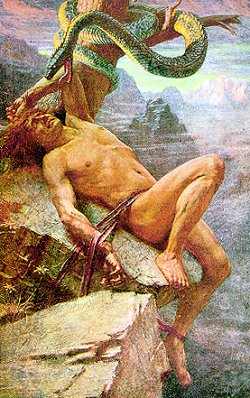
loki_bound

Most people think of Loki as one, of if not the, major villains of Norse myth.  And while there’s some truth to that, like with many things in Norse/Germanic myth, the “reality” within the stories is much more complicated.  If anything Loki is, I believe, a tragic figure.

Loki was always, first and foremost a trickster god.  He played a role similar to that of Coyote, and many others in various mythologies.  As a trickster, to some extent, he was at least a bit of a physical coward.  This goes hand-in-hand with the trickster role.  After all a strong, courageous forhtright warrior-type (like, maybe, Thor) is hardly going to be one to resort to trickery and deception (although even Thor has been known to do so–see Thor’s tricking of Alvis).

Loki’s position among the gods was complicated.  He wasn’t Aesir or Vanir, but a giant.  As a Trickster, he was often somewhat on the outside looking in, as it were, but he was also often the “go-to” guy for solving problems.  And while much of the time it was his pranks that caused the problems, that was not always the case.  An example is when the gods hired a giant and his horse to build a wall around Asgard with the provision that if the giant did not complete the wall within a certain time, the gods would not have to pay.  Odin didn’t want to pay so he had Loki come up with a plan to delay the giant’s work so he would miss deadline.  Loki did so by shape changing (one of his specialties) into a mare and leading the horse away.  Little did Loki know that the horse would catch him (or “her” since Loki was in the form of a mare).  The result, some time later, was Sleipnir, Odin’s eight legged steed.

The role of Loki as active villain rather than a trickster who was, nevertheless, mostly on the side of the gods, came very late in his story cycle, with events moving swiftly from the first act of true “villainy” to his binding as depicted in the image at the top of this post.  It started with Frigg’s dream of doom coming for her favored son Baldr.  Baldr was generally considered the most beautiful of the gods.  Everybody loved him.  He was beautiful, he was brave, and from the way the poets gushed over him his bowel movements smelled of lilacs.

As you might guess, I’m not a big fan of Baldr.  He reminds me too much of the pretty and popular of my childhood who made my life hell growing up.  Perhaps if more of his story survived and I had a more complete picture of the god I would feel differently.  But, that aside, the gods loved him and Frigg’s dream foretold doom for him.  As a result of this, Frigg went through the nine worlds getting everything to promise not to hurt Baldr.  She only skipped the Mistletoe plant, deeming it too small and helpless to be a threat.  This done, the gods then thought it great fun to throw things at Baldr and see them divert to avoid hurting him.

Loki, on seeing this disguised himself (shapeshifting being one of his attributes) and wheedled out of Frigg the one thing that had not promised not to harm Baldr.  He then went to the mistletoe and used his magic to make it grow and fashioned it into a dart.  He then got the blind god Hodr to take the dart, and with Loki helping him aim, Hodr threw the dart at Baldr, which struck and killed him.

With Baldr’s death, a representative was sent to Helheim to beg Hel to release Baldr back to life.  She said she would do so only if every thing living and dead wept for him.  So once again Frigg went around the worlds begging every thing to weep for dead Baldr.  Only the giantess Þökk refused to do so.  According to the Edda it was presumed that the giantess was actually Loki in disguise.

With Baldr’s death things moved pretty fast.  Loki went on the run.  He ended up crashing a feast held in Aegir’s hall where he and the other gods exchanged insults (Loki’s Flyting). He escaped from there (basically driven off by Thor’s arrival) and was soon caught while hiding in a stream in the form of a salmon.  He was then chained to a rock, with a snake dripping caustic venom on him which his wife, Sigyn would catch in a bowl.  Only when the bowl filled and she went to empty it, the venom would drop directly onto Loki and his writhing would cause Earthquakes.

That is the story, in brief, that we have, and certain aspects of it have troubled me.  For one thing the final bits, from the death of Baldr denote a considerable change in Loki’s character.  It’s possible, of course, that the tales are collections of various deities that got combined into the tales told of Loki, but supposing these tales actually did refer to a single individual, what might cause that change?

I think, in the surviving lore, there are indications of what do mark that change.

First consider the latter part, where Þökk is the individual responsible for keeping Baldr in Hel’s realm.  The Lore says the gods presumed it was Loki, a remarkably coy statement given that the Lore is never shy about saying “but it was really Odin in disguise” or anything like that.  Can we take this presumption as truth, even within the context of the myth itself?  I think not.  We might speculate on who Þökk might actually be, including that it really was a giantess named Þökk.  But we do not know.

As for killing Baldr in the first place, Loki was not stupid.  Indeed, cleverness and outsmarting opponents was his primary attribute.  And given his history as something of a physical coward consider the opening to the tale of Geiroddur’s Castle, where Loki was captured and intimidated into convincing Thor to come, leaving his hammer behind.   So why put himself at such risk, risk he could not have been able to talk his way out of, for such a prank?

Well, consider that as the death of Baldr proves along with many another tale, the gods of Germanic/Norse myth are not invincible.  This sets them apart from many another mythology.  They can be slain by weapons, they can be affected by magic, and even age can bring them down if not forestalled by Idun’s apples of youth.

Perhaps, the death of Baldr was not Loki’s intent.  After all, could Loki count on blind Hodr inflicting a lethal wound with a thrown dart, even with Loki himself to guide his aim?  Doubtful.  Simply attempting to bring Baldr down a peg, by having him wounded would be more in keeping with Loki’s previous character.  And only horrible luck–or fate perhaps, as the gods were as subject to the pronouncements of the Norns as any mortals-led instead to Baldr’s death.

Or maybe not luck or fate, but a curse.  And this leads to the part of the surviving Lore that I believe explains the change.  In the Volsung saga, Loki kills an otter with a thrown stone.  That Otter turns out to have been a shapeshifting dwarf named Ótr.  The dwarf’s father claimed blood-price for his slain son equal to enough gold to first fill the skin, then cover it completely.  Loki is sent to fetch the gold, which he accomplishes by robbing another dwarf, Andvari.  Andvari tried to hold onto his last piece, a ring called the Andvarinaut as it could allow him to regain his wealth.  When Loki demanded the ring as well, Andvari cursed it so that it would bring misfortune to all who possessed it.  Much of the latter part of the Volsung saga details the working out of that curse in all it’s horrific awfulness.

However, the first individual who would be affected by the curse is Loki himself.  The Lore does not seem to go into this but as the lore has shown, the gods are vulnerable to things like magic.  It would be clear that Loki would be equally as much under the curse as would Hreimdar, Fafnir, Regin, Sigurd, and the Nibelungs.

So, Loki, intending merely to deflate Baldr’s ego a bit, instead inadvertently kills him.  This sets in motion a series of events that in the end will bring about the end of the world at Ragnarok.

This makes Loki, although not a “good guy” in any sense of the word, not so much as a villain as a tragic figure, complete with tragic flaw in his own hubris at his own cleverness.


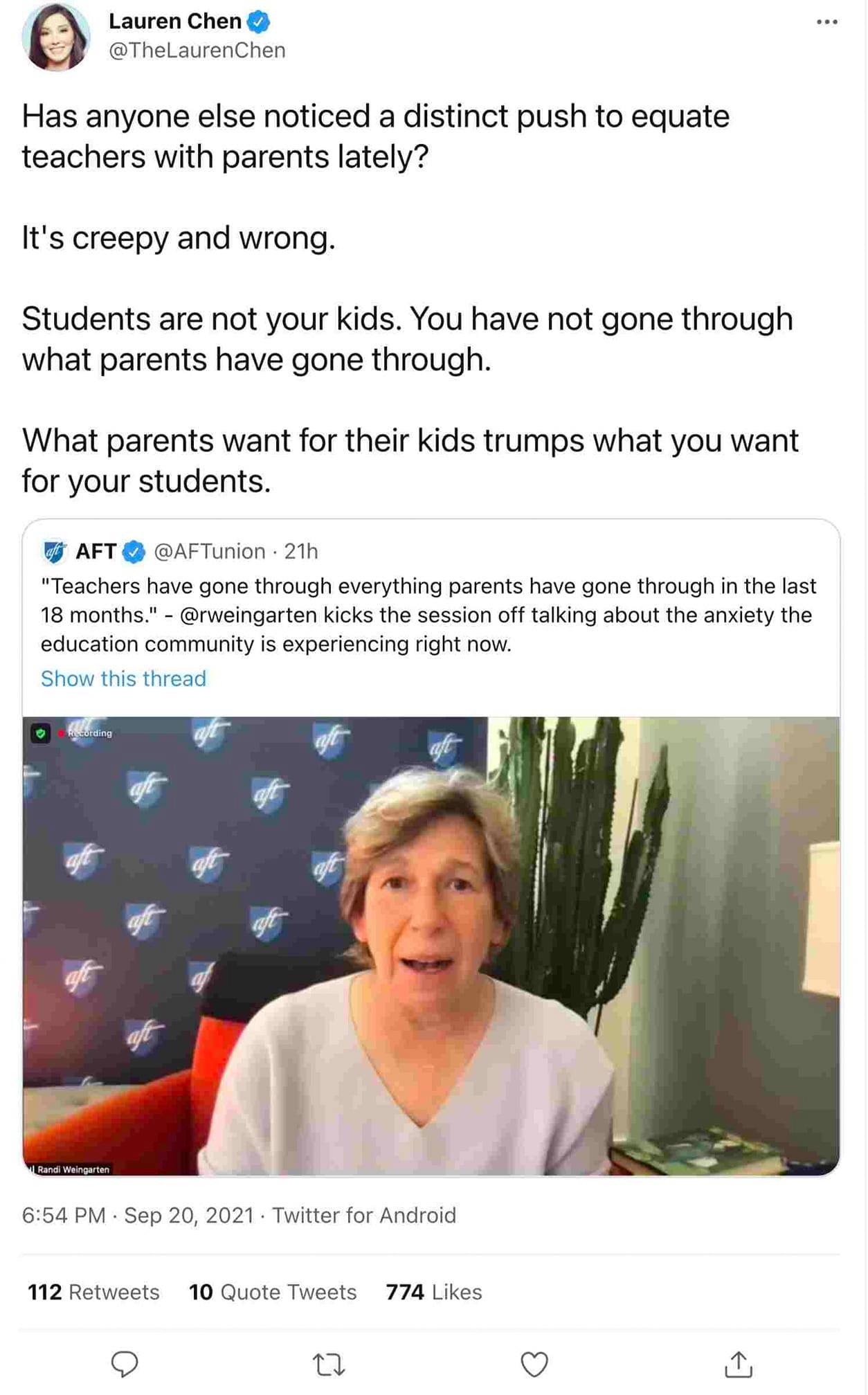
Teachers go through the same things parents do? Excuse me?

So there was this:

Have to agree with Ms Chen in response to the tweet by “AFTunion”. Still, let’s look at it a bit more.

Yes, teachers or there administrators, have fought to get legal recognition as being “in loco parentis”–basically authority to act as if they were parents to the kids when the kids are under their care. This allows them to do things like authorize medical care if a child becomes sick or injured. Fair enough. However being “in loco parentis” does not make you the same as the kid’s parent. It just doesn’t.

I have yet to see one of my daughter’s teachers sitting with her in the ER in the wee hours of the morning waiting for test result to see if she was going to be admitted of if the problem was nothing major and we could go home and maybe laugh about being over-cautious the next day. I have yet to see one there biting their lip when she is admitted (I had been hoping for “it’s nothing; go home”), calling their boss saying, “nope, not coming in today.”

I have yet to see one of my daughter’s teachers staying up worrying because she’s late coming home and her phone goes immediately to voicemail. Was she just being rebellious or had something happened to her? I hadn’t seen a teacher worrying about it.

I have yet to see one of my daughter’s teachers combing the neighborhood looking for a pet that had gotten loose and we’re trying to find it. I have yet to see a teacher wondering how to console the inevitable heartbreak if the pet never turns up or if it’s hurt or killed. (Turned out okay in this case–having a grand old time running around the neighborhood.)

I’m sure that sometime, somewhere, some teachers have done those things and others like them for some of the kids they teach. After all, it’s a big country. Some pretty low probability things happen from time to time. After all, between public and private schools there are close to 4 million teachers in the US. That means there are 4 that are “one in a million.” But none of my daughter’s teachers were ever there for any of that stuff or the thousand and one other things that I, as a parent, deal with at any given time.

So, no, being a teacher does not mean you “go through the same things as parents.” The idea is absurd. This is not to say that some teachers are not parents but, well, if they really think that as a teacher they go through the same things in relation to students that are not their own children as they do with their own children, then I have to wonder just what kind of parent they actually are.

But, of course, it wasn’t an actual teacher who wrote that risible tweet. It was a union hack. And the purpose wasn’t to educate or enlighten. It was to boost the importance of teachers, and in particular the teachers’ union, and downplay that of parents.

They want to overrule the power of parents, with none of the responsibility.

Goth on Ice: Progress report

I’ve been working on a number of techniques lately at various levels.

First there are my backward outside edges. I “passed”, demonstrating them sufficient for level some months back but looking ahead one uses them a lot and so I have been working on getting them better, trying to hold them longer, with proper form, and without dragging toe-picks (a perennial problem with my backward skating):

Next there’s that inside three turn. It’s continuing to be a challenge, that’s for sure. Main problems are getting my hips around far enough and I tend to get onto my toe pick after completing the turn (see above about getting on toe picks with backward skating.

Then there’s my two-foot to one-foot spin. There are numerous problems here. One is that I’m not entirely stable in the spin and tend to “fall out of it” (not actually falling usually, just ending up setting down the foot breaking the spin). I also tend to drag the toe picks of my left foot. You see, if you drag the toe pick, that slows the spin. However, if you get your weight too far back, you catch the edge at the heel and that’s when you do fall, and I mean actually fall. So, my instinct is to keep my weight forward, too far. So that’s one thing I’m working on. Other issues are dropping the left hip or shoulder as I go into the spin or staying in a slight crouch rather than standing tall. There are like about 15 things you have to coordinate to make the spin happen and when you focus on one of them you tend to lose control of the others. So, progress feels slow, but I’m told at some point it will “click”. Fingers crossed on that.

Next we have backward stroking. I can’t often practice this because I really don’t feel comfortable when there are too many people on the ice. However, going forward there’s so much stuff that’s done from backward skating that I really need to get comfortable skating backward. That means skating with control and confidence and…no toe picks! Backward stroking is shown near the end of the lesson in this video. Coach Julia does them straight back. My own coaches want me to do them gliding on a back inside edge rather than the flat so I proceed in graceful swoopy curves rather than in a straight line:

I am continuing to practice my continuous forward edges along a line. The incomparable Coach Julia shows how to do them here. Pro tip: They’re a lot harder than it looks like they’d be:

In addition, there are various combination moves. Most of them are relatively simple: alternating crossovers (front or back) doing one to the left then one to the right, moving in “s” curves down the ice. But the more complicated one is the 10 step “Combination move”. In the Learn to Skate USA materials it’s just called “combination move” but, try doing a search for that on YouTube. Lots and lots of “false positives.” Fortunately somebody pointed me at this video which shows how it’s supposed to look: Supposed to.

And, last but not least, there are my two jumps: the Side Toe Hop (also called the Toe Tap Jump) and the Bunny Hop. I had first done the Bunny Hop just on one side but was advised I need to do this both ways. And, so, I’ve started working the other side and…it’s not going well.

So, those are the things I am working on. A long way from when I started and “forward marching” without ending up flat on my back was a challenge.

Teach Men not to Rape

Saw the claim yet again on the Book of Faces that instead of teaching women how to protect themselves we should teach men and boys not to rape or be abusive.

That’s a great idea. There’s just one problem. There are over 3.9 billion men and boys in the world. That’s a lot of individuals to teach. And how effective can we expect that teaching to be? If we are 90% successful with a mere 10% not being willing to get the message, that’s still 390 million abusers and rapists out there. If we are 99% effective, with only one person in a hundred proving resistant to our efforts, that’s still 39 million abusers or rapists. If we’re 99.9999% effective, that’s still 3900 abusers or rapists.

We’ve been trying to teach people not to murder since Moses supposedly came down from the Mount and yet…here we are. Some people just can’t be reached that way, not by any means we have now.

Don’t think so? Point me to the program. Point me to one that you really believe works. And by “really believe” I mean one you trust well enough that we could take all the rapists in our prisons and all the ones on the sex offenders registry, put them through the program, and then let them go free and removed from the registry because you’ve made them not rapists any more.

Any takers? Anyone? Buehler?

Didn’t think so.

But let’s suppose that someone comes up with such a program. That some expert or group of experts in cognitive science and neurochemisty and all the myriad other things that go into why one person does X where another person would do Y, figures out the solution. That after sufficient testing and validation it’s demonstrated to work with 99.99999999% effectiveness. And that the program has no negative downsides that will turn around and bite us in the ass. (Anybody who knows me knows how likely I find that–but let’s suppose for argument’s sake.)

The fact remains that we don’t have such a program now. It doesn’t exist. And so until it does exist and has been implemented and proven successful (good luck with that), then we have to deal with the reality that there exist people out there who will continue to hurt other people if it suits them to do so. And that includes rape and abuse. Just like we have to deal with the reality that cars crash and make sudden stops, which can be highly hazardous to the occupants of said cars.

And so, just like we have seatbelts and airbags and other things in an attempt to keep us safe when auto accidents happen, so too do we need to have ways to keep ourselves safe from those who don’t get the “thou shalt not rape” and “thou shalt not abuse thy partner” messages. That can be personal self defense in the form of various weapons (readers of this blog should know my preference). It can be shelters one can go to in order to escape an abusive partner (and I use the gender neutral term there deliberately). It can be long incarceration for those caught and convicted in order to keep them away from “decent people” who they might victimize.

And it can be a combination of methods. Indeed, embrace the power of “and.”

Goth on Ice: A retrospective

Just saw another “one year progress” video over on YouTube. Now, if I let myself these kinds of videos bother me, they would be very frustrating because they’re doing so much better at one year than I am doing at just under two and a half. But there are, let’s call them extenuating circumstances.

And note that my intent is not to criticize the folk making those videos, nor to complain that I’m not doing better. That’s why I’m not naming the video in here. Everyone’s situation is different. Everyone faces their own challenges and has their own talents and abilities. That means people progress at different rates and that’s okay. I love those videos. They give me something to aspire to. And occasionally I can find something to take away from their videos that I can use to help my own skating and that’s awesome. Same thing with other people posting their stories and videos. And I would hope that maybe someone can find a takeaway from my posts and videos.

The point is that everyone progresses differently. Everybody does face different challenges. And there are reasons why my progress is not as swift as some other people. And there’s no reason to be down or upset about them.

The first is the simplest: I am older than most of the folk making those videos, especially the videos by the kids who are growing up through the ranks. I’m older than even most of the adult skaters posting. For that matter, I’m older than most of the coaches at my rink. I think there might be two older than me. And I’m certainly older than most of these people posting these videos. Younger bodies respond quicker to training than older bodies. That’s just biology. On the other hand, doing the training helps slow the ravages of advancing age, so there is that.

When I started, skating seriously (as opposed to some half-hearted, self-taught skating when I was in my teens and early 20’s) was miserable. I have major foot issues (pretty bad plantar fasciitis) and my skating at first would be like, skate halfway around the rink, sit on the sidelines to let foot pain fade, then skate the rest of the way around and stop again to let pain fade. Make about twice around the rink that way and done for the day. In class, I’d spend 1/2 to 2/3 of the time sitting on the sidelines letting foot pain fade. It’s hard to make much progress when you can’t spend time on the ice.

Over time I figured out ways to alleviate the foot pain. Properly fitted skates with, perhaps, more ankle support than was appropriate for my level (Riedell Motion skates), supportive insoles (my custom orthotics made things worse because of the rise of the heels compared to my regular shoes), and later the Riedell “R-Fit” insole system. Not tightening across the instep too much (and cranking down on the ankle to compensate), and just simply getting used to it. I could skate longer, which translated to more ice time.

Then there was COVID and the rink being closed for months. Then there was the auto accident which put me off the ice for yet another couple of months. Again, it’s hard to make progress when you can’t skate.

And, much as I love skating, there are things that make up “talent”–how well one’s vestibular system works, bone and muscle conformation, and so on, which I really don’t have on my side in this. Let’s just say, if I’d started skating religiously at 4 then lets just say that generations Olympians still would have had nothing to fear from me. But that’s okay. Not everyone has to be an Olympian. Even if one likes the idea of competition as a personal challenge there are lots of things one can do where effort and dedication can overcome not being the most talented.

So, yeah, after just under two and a half years I’m 5/7 of the way through Adult 6 in the Learn to Skate USA curriculum. (Really. We tested in class today and I passed 5 of the 7 elements. 5/7.) But when you add up all the various factors involved–what I started from and things that have happened along the way–that’s really not too bad. I’ll never be a “great” skater. I’ll certainly never be in the class with those kids doing their triples and quads. But I might be competitive in my class and age group. And that’s a plenty challenging goal in its own right.

And one thing I’ve found is that I love teaching. I love skating and helping someone else, so perhaps they can come to love it too, is something I really enjoy. I’m only really “qualified” to teach the very basics (although I’ve maintained instructor credentials in LTSUSA since the time I was assisting with the Snowplow Sam courses in the local rink) but being able to help someone in their first time on the ice, who wants the help, is a pure joy.

My point here is that we all have our own challenges. Someone else might be doing “better” by some standard in their own way, but in the end what matters is what we as individuals get out of the skating, whether that’s just recreational skating, teaching youngsters, or Adult competitions in any of a number of categories.

All that really matters is the love of skating and finding some way to express that love.

Annual Tribute to Sophie Lancaster

As someone who is goth(ish) I run into people who have all sorts of strange ideas about goths.  I’m a big ugly guy so most of that doesn’t get directed at me.  Others, however, are accused of being “dangerous” and “juvenile delinquents” or otherwise criminal because of a lifestyle we have adopted as fitting our “inner selves.” The truth is we’re more often abused than abusers (in my case “big ugly guy” shields me from much of that) and even when it doesn’t rise to the level of physical abuse we see the fear, the hatred, and the locked doors.  There’s this delightful “Hornbach” advertisement that illustrates it to a somewhat exaggerated effect but which makes the point (while showing the young lady has an absolutely great dad):

The case of Sophie Lancaster is not just a cute advertisement.  It is a real-life tragedy.  Today is the 12th “anniversary” of the death of her death at the hands of a group of violent thugs.

collect-picture-of-sophie-lancaster

Sophie was a “Goth” girl in Lancashire England.  While walking home on August 11, Sophie and her boyfriend Robert Maltby were attacked by a group of youths.  The only apparent motive for the attack was that Robert and Sophie were attired in Goth fashion.

They started by attacking Robert.  When he was knocked unconscious Sophie tried to protect him by cradling him in her arms.  The mob continued their assault, now focused on Sophie.  According to witnesses, members of the mob would run over and kick Sophie in the head and jump up and down on her head.  So severe were the couple’s injuries that emergency services arriving on the scene were unable to immediately determine which was male and which was female.

At least one of the attackers actually bragged about the attack as if he’d done something noble, saying to friends, “There’s two moshers nearly dead up Bacup park – you wanna see them – they’re a right mess”

Sophie and Robert were taken to the hospital, both in comas.  Robert gradually improved with some memory loss of the attack and events leading up to it.  This is not uncommon for traumatic injuries that involve unconsciousness.

Sophie, however, was not so fortunate.  It was eventually determined that so severe was her brain injury that she would never recover.  Her family agreed to cease life support on August 24, 2007 and the life of Sophie Lancaster passed from this world to whatever, if anything, may wait beyond.

Five youths involved in the attack were eventually arrested.  It is not known how many others might have been involved.  The five were first charged with “grievous bodily harm” but following Sophie’s death the charges were upgraded.  Of the five, two were convicted of murder and the other three had the murder charge withdrawn on a guilty plea of “grievous bodily harm”.  The five received sentences (after appeals) ranging from four years and four months to life imprisonment with a minimum (I presume, not being familiar with the British legal system, this means before eligible for parole) of fifteen years and six months.

Sophie, of course, is dead forever.  There is no appeal on her result.