A snippet

“Shillond,” Marek asked, “can you give me a wind from the west?”

Shillond raised a hand and peered into the distance.

“I can,” Shillond said, “but there’s a storm brewing in that direction.  Changing the wind will bring it here sooner.”

Marek frowned. “And we have to go in slowly to avoid… Can you not…”

“My Liege, there is only so much that weather witching can do.  A wind from the west will bring the storm. I can divert it away, but that would mean a wind from the east.”

Marek nodded.  He looked back at Keven still sitting by the tiller then to the front of the boat.  He then looked at Kreg and Kaila and shook his head.

“So be it.  With a trained crew perhaps, but…” He shook his head again. “We have what we have.  The wind, if you will, good Shillond.”

Shillond nodded and stretched his hands toward the sky.  Pale blue light limned him at the boat’s prow. The wind shifted.  Marek directed Kreg and Kaila to adjust the angle of the sail while Keven leaned on the tiller.  As the boat turned, Marek had Kreg and Kaila trim the sail until finally the wind blew from behind them pushing the boat before them.

“Watch me,” Marek said to Keven. “When I raise my right arm, or my left, turn the tiller in that direction.”

Keven nodded. “Yes, father.”

Marek indicated the ropes holding the sail in place. “Pay heed to these sheets,” he said to Kreg and Kaila. “On my command, haul in this one to spill the sail.”

“Aye, Sire,” Kaila said. “This we will do.”

Marek returned to the front of the boat.

“Light, Shillond.  As before, like a half-hooded lantern”.

As the boat progressed in the darkness, the only sound was the slap of the waves on the sides of the boat, the creaking of the ropes and sail.

The wind picked up.  The boat’s rocking increased as the waves grew in size.  Kreg glanced up.  Behind them, to the west, the approaching mass of clouds blotted the stars from the skies.

The ropes continued to creak, growing louder as the winds increased.  Kreg frowned and stood up, looking back. A different creaking, from their right, their starboard, side.

A deeper shadow loomed out of the darkness.  A ship, far larger than their boat.

“Your Majesty!” Kreg called.

Marek looked back. “Port, Keven, port now!”

A shout in a language Kreg did not know came from the approaching ship.  More shouts.

The fishing boat started turning to port, the ship to starboard, but not enough.  The side of the prow of the ship rammed the starboard leeboard of the fishing boat.  The impact hurled Kreg off his feet. Wood splintered. Seawater gushed through the ruptured side of the boat.  Kreg staggered upright, already ankle deep in water.

The ship continued its turn, tearing out a section of the side of the boat as it did so.  Kreg tumbled over the side, plunging into the sea.

The water closed over Kreg’s head, leaving him in pitch blackness.  He struggled for a moment, his lungs burning, then forced himself to stillness.  Bubbles foamed around him, invisible in the dark, but that he could feel. Air trapped within his clothes, caused them to bulge away from his back.

With those hints, he turned in the direction of the surface and began to swim.

When Kreg’s head broke the water, Kreg drew in a great lungful of air, half choked with salt spray.  He coughed as he tread water, drawing in more air and less water.  He struggled to remain afloat in the churning sea until his choking coughs subsided enough for him to look around.

The sea was dark around him.  Shouts in the distance gave him his first hint of direction.  Looking up, he could see the stars and the blackness that marked the line of clouds.

Someone on the ship lit lanterns.  Kreg could see it, already more than a hundred yards away.

“Hey!” Kreg shouted. “Help!”

The ship continued to recede.  Kreg could not see the remains of the fishing boat, nor any of his companions.

In the dimming light of the receding boat’s lanterns Kreg spotted some floating wreckage.  He swam toward it. A plank, probably remains of their boat. He hauled himself onto it, pushing the plank under the surface.  Still, it provided enough buoyancy that he could keep his head up despite the rising chop.

A blue light glowed on the ship.  Kreg shouted, hoping the wind would carry his voice to whoever was on that ship.

The ship continued into the distance, leaving Kreg alone in darkness.  The first drops of rain fell as Kreg clung to the section of planking.
Interest and Risk

As I discussed in previous posts (here and here) when someone provides means of production (capital) to someone else, they are foregoing any current benefit they could obtain from that capital (whether actual capital goods as was the plane in the original example or money as a stand-in for such goods).  If they are not compensated for that loss of use then, generally speaking, they will not make the goods available.  If John merely got the plane back at the end of a year, even if the plane was in perfect condition (George had made sure that any damage was perfectly repaired), he’s lost what he could have made from using the plane himself to improve his carpentry.  Likewise, if I loan somebody fifty bucks, I could have used it myself to have a really nice dinner at a restaurant tonight instead.  That same dinner six weeks from now is less valuable to me.  The difference between the value of having something now (present value) vs. having it at some future date (future value) is the interest.

However, all of the above assumes that the loan will be repaid, that there’s no risk.  Risk, however, is a very important part of actual calculations on such things.  Suppose, for instance that the difference between present value and value is five percent.  That is, someone would be indifferent as to whether they received $100 today or $105 one year from today.  But suppose that one time in ten when someone forwent the $100 today they would receive nothing in a year instead.  Nine times out of ten, it would be fine, but that tenth…

In that case, the person who was indifferent to $100 today vs. the certainty $105 in a year is going to be a lot more hesitant to make that deal.  Only by “sweetening” the deal would the person be willing to make it.  So on an average of ten such deals, the person making the loans would spend $1000 and would want to get at least $1050 back from it.  But one of those ten won’t pay pack (on average).  To get that $1050 back, he has to get it from the other nine deals, or $116.67 for each of them.  One person in ten not paying back the loan costs everyone else $11.67.

This, simply, is why some loans, even in the same economy, charge higher interest rates than others.  The person loaning at the “usurious” rate of 16.67% isn’t cheating.  It’s simply necessary to charge that much to cover the costs of defaults while still paying enough for the loan to happen at all.  The lender is only making 5%. The rest covers defaults.

When certain politicians complain about the high interest rates of student loans compared to mortgages they are ignoring the concept of risk.  Mortgages are generally offered where the lender is financially stable and even if the borrower defaults, the lender isn’t completely out because the building and land retain some value which the lender can use to get some return.  When it comes to student loans, half of students who enter college drop out within six years.  Then there’s the question of whether the student, even if they do graduate, will obtain a job that pays sufficient to pay off the loan.  The risk Of course government has long been involved in those loans, first with federal guarantees (assuring the lender that they would be paid something even if the student defaults) then taking over the program entirely.

The concept of risk is one of the reasons why stocks tend to pay higher returns than bonds.  Bonds are loans.  They have a set term and a set amount.  If the company goes bankrupt (as most do–2/3 of new businesses failing within the first 10 years and even large and well established companies can end in bankruptcy) the bond owner can generally get something, even if it’s pennies on the dollar, as they are creditors to be paid out of the liquidation of the businesses assets.  Stock holders, however, can end up with nothing but the paper their certificates are printed on.  Only the promise of greater returns from those companies that do succeed induces them to invest at all.

Look up above at how much extra has to be charged on a five percent loan to cover a default rate of even one in ten.  Now look at new business failures.  Two thirds within ten years.  The same source reports thirty percent failing within two years and fifty percent within five.  Let’s look at that in numbers.  That investment of $100, over two years would mean it would have to return $110.25 to make five percent annually.  One hundred such investments, then would have to return $11025.00 to be “worth it” (again presuming 5% per annum represents the difference between future and present value).  If thirty percent of the businesses fail (thirty out of one hundred) the remaining 70 have to return that entire $11025.00 between them or $157.60 each on that $100 investment.  That works out to a 25.6% annual rate of return average among the surviving businesses.  Twenty point six percent simply covers the risk, the loss due to the businesses that fail, so that the investor can get an overall five percent rate of return on his total investment.  Risk.

When people complain about the “unfairness” of returns people get from highly successful investments they are looking only at the successful investments in hindsight.  People generally did not know in advance which investments were going to be successful.  When Ronald Wayne sold his 10% share in Apple for $800 after a mere twelve days, he was not acting irrationally.  It was an entirely rational decision given what he knew at the time.  In Sam Walton’s early days few, if any people realized what an international giant his modest chain of stores would become.

Those complaining about people getting large returns from investments are not seeing that those people are both willing and able to manage the risk inherent in the process.  There are a number of reasons why those people might be able to do so.  They may have accumulated (by forgoing immediate benefit in favor of future benefit) sufficient resources either individually or by aggregating from many others (mutual funds are an example of this) so as to be able to invest widely thus spreading the risk so that successes outweigh failures.  They may be able to judge individual risks more closely so that more of the entities in which they invest succeed and fewer fail than the average.  In both cases, resources are made available to produce goods and services to the betterment of the economy as a whole, resources that would not be made available if the returns were insufficient to cover the cost of risk.

Ignoring risk, and the ability and willingness to manage it, is behind most, if not all, criticisms of the “unfairness” of capitalism.  In the words of John Paul Jones (not that expression, his other one): “He who will not risk, cannot win.”

You just have to do it intelligently, and make sure the reward is worth the risk.

“You owe to society” A Blast from the Past

Saw somebody making that claim.  Yep.  Here we go again.

There is a certain element that uses the “you owe to society” or worse the “social contract” to claim obligations on you that you had no say in.

One might argue that there are certain responsibilities.  Most of those responsibilities are negative in nature:  Don’t hurt other people.  Don’t take what other people own.  Essentially, don’t infringe on other people’s rights.

And even a pretty strongly libertarian leaning individual such as myself can recognize that a certain amount of “law and order” actually improves my liberty.  As I have noted elsewhere, being able to get up on my roof with a rifle to defend my home from ruffians is liberty.  Having to spend all my time on that roof because the ruffians are so ubiquitous that I don’t dare do anything else is not.  So having a police force that through deterrence and administering at least theoretically impartial justice to keep those ruffians in check improves my liberty.  I can come down from the roof and go shopping, or playing in the park with my children.

And nobody has been able to demonstrate a scalable method of creating that “law and order”, one that will work on any but the tiniest of societies for long, without the use of coercive force.  The problem, of course, is that once you start using coercive force in a society for the purpose of increasing the net liberty of that society, there’s always the temptation to increase the use of that force.  And there are plenty who are more than willing to give in to that temptation.  It’s a constant battle to prune back the uses, one that is generally unpopular and so doomed to ultimate failure.  So the use of force increases from liberty to overstructure to tyranny until something happens to light a fire under people to make the efforts necessary to prune back government and restore at least a semblance of liberty.

So even when one accepts that ironically some use of coercive force is necessary to maintain a civilized, and free, society, (and, yes, I know that some argue that it’s not–that’s a discussion for another day) one nevertheless must cast a jaundiced eye at increases of that force.

That’s where the advocates of “social contract”and “you owe society…” come in.  They say that because we have police helping to keep crime down so I can come down from that roof, that we have fire departments so that I have less worry that a fire at my neighbor’s house will also burn down my property, that we have courts so that interpersonal disputes don’t turn into generations long blood feuds with the collateral damage they bring, that we have roads so that travel and trade are easier, that we have a military so some foreign power cannot come and take it all away…that because we have all that I have an obligation, a contractual one, to provide whatever it is that person wants provided.

The fact that I pay for that police and fire service, that I pay for those courts, that I pay for those roads and that military isn’t enough to fulfill the contract.  Oh, no.  It’s not enough.

It’s never enough.

The problem with “social contract” and “you owe society” is that they’re open ended.  No matter how much stuff you decide to “pay” on that contract, there’s always something else.

No, I am not obligated to pay for your social program because I use roads.  I paid for the roads in the first place.  That is the sole extent of my “obligation” for use of the roads.  Yes, it’s nice to have police keeping at least a partial check on crime.  I paid for those police.  Obligation for that ends there.  The same for the other.

The fact that I “make use of” or benefit from something that I. paid. for. (or a portion of according to law as it was written) does not obligate me to anything else.

If you want to sell me on why I should pay for something you want, sell it on its own merits.  Don’t hand me a line about “social contract” or “owing” because of things I’ve already paid for.

On This Day: First Hot Air Balloon

As I’ve mentioned before, I grew up on comic books.  And out of all the powers the various super-heroes in those books had, the one I wanted more than anything has been the power of flight.

Human flight has been a dream of mankind since its earliest history.  We have the story of Daedalus and Icarus from Classical Mythology of Wayland/Völund the smith from Norse.  Pictures of winged humans have been found in cave paintings dating back thousands of years.

There are accounts of people attempting to don wings and fly dating back to about 850 BC. (Hart, Clive. “The Prehistory of Flight.” University of California Press. September 1985.) None of these, so far as we know, were ever successful, at least so far as we know.  It is, perhaps, not impossible that some early Lilienthal managed a set of fixed, glider wings that carried him through the air for a while but who has been lost to history (perhaps after suffering Lilienthal’s fate).

Leonardo Da Vinci drew several concepts for flying machines.  In retrospect, none were at all functional.

And so, the dream of leaving the surface of the Earth and travelling in the skies remained just a dream until…

One of the two Montgolfier brothers was watching laundry drying by a fire.  Pockets of the damp cloth would occasionally billow upwards.  He made later experiments trapping the smoke from a fire which he thought contained something which he called “Mongolfier gas” which he believed possessed a property he named “levity” causing it to rise.  He built a box-like chamber of thin wood covered on the sides and top with taffeta cloth.  Underneath, he lit some crumpled paper.  The box quickly rose and collided with the ceiling.

Joseph recruited his brother into the balloon making endeavor and began making larger balloons with more carrying capacity.  Indeed, one of their experiments had sufficient lift so that they lost control of it and it came down two kilometers away where it was, unfortunately, destroyed “by the indiscretion of a passerby.”

Eventually, the brothers were ready for their first public demonstration.  For this demonstration they constructed a globular balloon of sackcloth lined with three thin layers of paper.  Fishnet over the outside reinforced it.

They took their balloon to Annonay, in Southern France and, on June 4, 1783, in front of a group of dignitaries filled the balloon with “Mongolfier gas” (smokey hot air to us) and let it rise in front of a group of French dignitaries.  Like their earlier, lost balloon, this one traveled about 2 km in a flight lasting about 10 minutes.  It rose an estimated 1.6 to 2 km into the air.

The dream of flight had taken its first real step.

A few months later, on September 19 1783, a balloon first carried living cargo, a sheep, a duck, and a rooster.  And, still later, probably on October 15, a much larger balloon carried the first human passenger, Jacques-Étienne Montgolfier on a short, tethered flight.

Other flights, including the first free flight (on November 21 carrying Pilâtre de Rozier, and the marquis d’Arlandes) quickly followed.

Humanity had taken its first steps beyond the surface of the Earth.  It would be more than a century before Otto Lilienthal became the first known person to successfully pilot a heavier than air flying vehicle and another decade after that before the first heavier than air powered flight.  But the first steps had been taken.

High Flight
by
John Gillespie Magee, Jr.

Oh! I have slipped the surly bonds of Earth
And danced the skies on laughter-silvered wings;
Sunward I’ve climbed, and joined the tumbling mirth
Of sun-split clouds, — and done a hundred things
You have not dreamed of — wheeled and soared and swung
High in the sunlit silence. Hov’ring there,
I’ve chased the shouting wind along, and flung
My eager craft through footless halls of air . . .

Up, up the long, delirious burning blue
I’ve topped the wind-swept heights with easy grace
Where never lark, or ever eagle flew —
And, while with silent, lifting mind I’ve trod
The high untrespassed sanctity of space,
Put out my hand, and touched the face of God.

Processes and Intentions

All too often people define institutions in terms of their intentions (or at least their stated intentions), their hoped for goals.  However, the hoped for goals may have little to do with the actual results.

Consider “profit making enterprise” or “for-profit business.” The hoped for goal is to make a profit.  However, two thirds of start-up businesses fail within the first ten years.  And three quarters within 15.  And while one might consider that small, start-up businesses might be particularly vulnerable, even giant corporations are not immune.  Consider some of these giants that eventually went out of business:

  • Compaq (computer manufacturer)
  • E. F. Hutton (broker and investment advisor: “When E. F. Hutton talks, people listen.”)
  • MCI Worldcom (long distance carrier)
  • Eastern Airlines
  • Pan Am Airlines
  • TWA (another airline)

So, while the intention may be to make a profit, the actual processes involved in operating a business is no guarantee of doing so.

So it is with other institutions.  Consider the following proposition of a process (courtesy of Thomas Sowell in “Knowedge and Decisions”)

Once the legal authorities have defined, combined, and assigned property rights the subsequent recombination or interchange of those rights at the discretion of individuals shall be illegal.

Do you think that would be something most people would support, would even fight for at great risk to themselves?

How about instead, if we take that same proposition and put it in terms of the hoped for goals that is commonly used instead of the process:

The means of production must be controlled for the good of society as a whole and not for the enrichment of a few wealthy one percenters.  We must end the exploitation of the working class and share the wealth of society more fairly.

That’s socialism.  In the first case, stripped of obfuscatory rhetoric, is the process.  The second is the usually stated hoped-for goals.  History has shown that a lot of people have been willing, even to risking imprisonment or death, to support the hoped-for goals as stated by the proponents.  The problem is that there is nothing in the process that necessarily leads to those goals.  And, indeed, there’s nothing in the process, once established, that creates incentives to further those goals.

Historically, once established, socialism has been captured by people seeking not the good of the people, but instead by people seeking personal power and aggrandizement:  Lenin, Stalin, Mao, Pol Pot, Castro, Hitler.  The list goes on and on.

The reason for that becomes clear once you look at the process itself.  That process is going to be extremely attractive to folk desirous of power for its own sake.  Historically, such folk have always taken over that process because there’s nothing in the process itself to stop them.  There’s no correction mechanism.

If a private “profit making” business fails in its goal, the profit and loss statement provides a clear proof that something is wrong (if only that some other business is more efficient at providing commodities to the customers than they are).  If losses mount, they either have to change or they’ll be forced out of business, making room for someone else.  When it’s a government institution feedback mechanisms are much weaker.  Most people are usually unable to associate negative repercussions to a particular policy which was often instituted years before the repercussions became noticeable.  Even more rare is to associate the policies with particular policy makers, particularly when those policymakers have gone on to different or higher office.  As a result, there is little incentive for the policymakers to consider the longer term, second or third order effects of their policies.  So long as they are popular “now” (for any given “now”), the rest can be left for others (hopefully the opposing party) to deal with.

Intentions, hoped-for goals, make fine rhetoric.  But policies aren’t actually made up of intentions.  They are made up of processes.  It’s the processes, and the incentives that those processes create, that need to be considered when judging policies.

After all, we know what road is paved with those good intentions.

My LibertyCon 2019 Schedule

LibertyCon at the Chattanooga Marriot, June 28-30.  I’ll be at these programming events:

Day Time Name of Event
Fri 04:00PM Ask A Scientist – Kids Edition

Dr. Robert E. Hampson moderates this Q&A for kids across a broad array of sciences.

Fri 05:00PM Opening Ceremonies

Take advantage of the opportunity to meet the LibertyCon Guests and Staff and listen to our Guests of Honor speak!

Event
CC: Meeting Rooms 4 & 5
(90 min)
Fri 06:00PM Author’s Alley (Burkhead, K & K Evans, J. & HP Holo, Lowery, Schantz)

Come by the Author’s/Artist’s Alley to chat, buy a book or get an autograph!

Autograph
Author’s Alley (M: Plaza Ballroom Mezzanine)
(60 min)
Sat 02:00PM Author’s Alley (Burkhead, Carpenter, C. Kennedy, Tinney, James Ward)

Come by the Author’s / Artist’s Alley to chat, buy a book or get an autograph!

Autograph
Author’s Alley (M: Plaza Ballroom Mezzanine)
(60 min)
Sat 03:00PM Autograph Session (D. Burkhead, W. Webb)

Autograph sessions will be located in the Dealer’s Room. Authors will cycle through hourly, except for the author’s that have their own tables who will be available when they are not scheduled in the program. Limit 5 books (if you bring more, get 5 signed and go to the back of the line.)

Autograph
Dealer’s Room (M: Plaza A/B/C Ballroom)
(60 min)
Sat 06:00PM 500 Vampires, No Waiting

500 Vampires, No Waiting: How many vampire types are out there? Do you prefer the supernatural? The aliens? The Wesley Snipes movies? Declan Finn moderates this panel on the many varieties of Nosferatu.

Sat 09:00PM Nuclear Weapons 101

Ken Roy moderates this panel discussion on Nuclear Weaponry, Radiation and nuclear effects.

Sat 11:00PM Mad Scientist Roundtable

Roundtable discussion of various and timely science topics moderated by Les Johnson. This is a remarkable panel dating back to the earliest LibertyCons. Everyone gets a say but no one gets to say too much.

Sun 10:00AM Kaffeeklatsch

Have coffee / continental breakfast and chat with the pros.

Event
M: Tennessee River Room
Michael J. Allen
Quincy J. Allen
Arlan Andrews
Griffin Barber
Jim Beall
J. D. Beckwith
Rick Boatright
David Bogen
Karen Bogen
Scott Bragg
Robert Buettner
Douglas Burbey
David L. Burkhead
Daniel Allen Butler
David (D.J.) Butler
Anna Grace Carpenter
David Carrico
Julie Cochrane
David B. Coe / D. B. Jackson
Jason Cordova
Jim Curtis
Doug Dandridge
Dr. Ben Davis
Jonathan Del Arroz
Jeff Duntemann
Karen Evans
Kevin Evans
Robert S. Evans
Kacey Ezell
C.S. Ferguson
Declan Finn
Stephen Fleming
Marina Fontaine
Monalisa Foster
A. M. Freeman
Karl Gallagher
Melissa Gay
Amie Gibbons
Jeff Greason
Valerie Hampton
Michael H. Hanson
John Hartness
Jonna Hayden
Louise Herring-Jones
Taylor S Hoch
Dan Hollifield
H.P. Holo
Jacob Holo
Teresa Howard
Daniel M. Hoyt
Sarah A. Hoyt
Daniel Humphreys
James Hunter
Jamie Ibson
Kevin Ikenberry
Steve Jackson
Les Johnson
Bryan Jones
Paula S. Jordan
Chris Kennedy
Tom Kratman
R. J. Ladon
D. Alan Lewis
Doug Loss
Tamara Lowery
Terry Maggert
Amanda Makepeace
Ian J. Malone
T.C. McCarthy
Edward McKeown
Joseph Meany
Anita Moore
Morgon Newquist
Russell Newquist
Chris Oakley
Jon R. Osborne
David E. Pascoe
Gray Rinehart
William Joseph Roberts
Natalie Rodgers
Cedar Sanderson
Hans G. Schantz
James Schardt
Dave Schroeder
Julia Morgan Scott
Lydia Sherrer
Martin Shoemaker
Stephen J. Simmons
Benjamin Tyler Smith
Chris Smith
Kal Spriggs
Tom Tinney
Melisa Todd
Tiffany Toland-Scott
John Van Stry
Mark Wandrey
James Ward
Justin Watson
William Alan Webb
Rich Weyand
Benjamin Wheeler
Marisa Wolf
Chris Woods
Matt Wyers
James Young
(60 min)
Sun 11:00AM Reading: Tamara Lowery & David L. Burkhead

Come out and have a seat as our author guests reads passages of their works

Reading
M: Lookout Mountain Room
(60 min)
Sun 02:00PM Author’s Alley (Burkhead, J. Hunter, T. Lowery, J. Osborne, William Webb)

Come by the Author’s / Artist’s Alley to chat, buy a book or get an autograph!

Autograph
Author’s Alley (M: Plaza Ballroom Mezzanine)
(60 min)

“There has to be a better way.”

You hear that a lot.  Explain scarcity, that wants (often called “need” even when “wants” is the correct term) will always outstrip availability and someone comes back with “there has to be a better way.” Explain that while it’s “reasonable” to believe that peaceful trade is far more beneficial economically and in every other way than war and conquest, not everybody in every nation is “reasonable” and so it is necessary to maintain a strong military to cause those unreasonable folk to at least hesitate and “there has to be a better way.” Explain that this same principle applies on the personal level and that, furthermore, no matter how much the police might want to protect you (if they want to protect you) they can’t–they can’t be everywhere–so you have to be responsible for your own protection and, sure enough, “there has to be a better way.”

No.  There doesn’t.

Oh, you might want there to be a better way.  I might want there to be a better way.  But nowhere is it writ that the Universe must, or even can, conform itself to what we want.

This is not to say that there is never a better way.  After all, that’s what progress is all about:  finding the ways that are better (for sufficient values of “better”).  Mind you, not everyone agrees whether these new ways are actually better.  I find the speed and convenience of email a vast improvement over handwritten letters.  There are some who bemoan letters written in neat script on thick, textured paper becoming largely a lost art.

There is a passage from an old novel set in the late twenties (1920’s), where one character, stopped at the side of the road with car trouble, bemoans the change from horse and buggy to the motor car.  Before, you see, he could have just taken a nap. “The horse knows his way home.”

So, yes, often there is a “better way” for many things.  But, that is no guarantee that there must be for any particular problem.  And while the search for better ways is a worthwhile pursuit, the thinking that there must be one, particularly when it comes to social institutions and the human condition, is fraught with danger.

When one insists that there must be a better way, there’s a dangerous tendency to dismiss current ways as bad, and to ignore what has been learned from long experience.  And so the old is tossed out in favor of the “new” without sufficient consideration about whether this new thing will work at all, let alone whether it will be better.  And sometimes people cling to these “new things” long after any newness remains.

An example of this is centrally controlled, planned economies.  They were “sold” on the idea that they would be more efficient than voluntary exchanges in a free market.  And time and time again, they have been demonstrated to simply not work.  And yet people remain so enamored of the idea of planning to reduce waste, increase “fairness” (as they see it), and eliminate the chaos and uncertainty that comes with freedom, that they keep trying to sell it again.

Another example is the repeated effort that if we just “understood” folk who mean us harm, if we just “extend the hand of peace” to them, if we were just nicer to them they would be nice to us or, at least, leave us alone.

Well, Rudyard Kipling put well where that thinking leads:

When the Cambrian measures were forming, They promised perpetual peace.
They swore, if we gave them our weapons, that the wars of the tribes would cease.
But when we disarmed They sold us and delivered us bound to our foe,
And the Gods of the Copybook Headings said: “Stick to the Devil you know.”

In the Carboniferous Epoch we were promised abundance for all,
By robbing selected Peter to pay for collective Paul;
But, though we had plenty of money, there was nothing our money could buy,
And the Gods of the Copybook Headings said: “If you don’t work you die.”
“Gods of the Copybook Headings” 
Rudyard Kipling

So while it remains worthwhile to look for better ways, one needs to take care not to throw out the proverbial baby with the proverbial bath water.

And remember that not all “better ways” are actually better.

Probabilities and Creationism.

First off, let me be utterly clear.  If someone believes that the deity of their choice created the Universe either recently or far in the past, created life in it, or any such thing I don’t have a problem with it.  Believe that God created the Universe in six days about 6000 years ago?  Knock yourself out.  Believe that Izanagi shagged Izanami and the “drippings” made the islands of Japan.  Okay, whatever.

I really am a near absolutist on religious freedom, including the freedom to believe things that I find…let’s just say “questionable” and leave it at that.

However some people go beyond having it as their religious belief and try to claim it as science.  This without meeting even the most fundamental of scientific standards. (Quick:  what evidence, if seen would lead to the conclusion that ones flavor of creationism or “intelligent design” was wrong?  To be scientific it must be falsifiable, there must be some possible observation that would lead to the conclusion that the idea is false.  And, yes, there are other things that people try to call “science” even “settled science” which fail to meet that standard.  I call them on it too.)

I’m not going to go into the whole long series of arguments which justify the scientific basis on current theories of evolution and the origin of life (two separate things–evolution deals with what happens once you have living things while where life came from in the first place is a different set of theories).

First, we have the origin of life itself.  Some people point to Pasteur’s work rebutting earlier theories about the “spontaneous generation” of life and say that “scientific principle” “proves” that life cannot appear from lifelessness.  What they neglect is that Pasteur’s work, while important, was limited to the experimental apparatus of the time.  A more accurate statement of his results would be “withing the space and time constraints of these experimental apparatus under these conditions life does not spontaneously arise.” It’s a little vaguer than the first and is sufficient to refute the then existent theories of spontaneous generation.

However take a much bigger “experimental apparatus”–either the entire primordial Earth, or even larger–all the planets similar to Earth in the entire Universe–and a much longer time span of millions to billions of years?  What then?

Well, given enough time and a large enough sample size, some remarkably unlikely things can happen at least once.  Rolling twenty 1’s in a row on a fair standard six sided die is a 1 in 3.66*10^15 probability–just under four million billion.  At that likelihood Most people would say “impossible.”  Roll a hundred million billion times though (big Universe) and you would expect it to happen about 27 times.

What likelihood are we looking at here?  Well, consider what the simplest “life form” might be.  At the most basic a “life form” is something that can replicate itself using stuff available around it.  So, at the most basic, life would be something like a ribosome–a strand of genetic material (RNA or DNA for instance) carrying the “pattern” and a cluster of proteins that duplicate the genetic material and the proteins themselves.  We know, for instance, that things like lightning and UV radiation can create amino acids and similar organic molecules from methane, ammonia, water, and hydrogen–all readily available in the universe.  And, indeed, this has been experimentally verified. While there is not current single accepted theory on the origin of life, this does show that the “building blocks” of life as we know it can be produced by simple, natural processes from non-living source material.  Once you have those “building blocks” and enough stimulation–through solar and cosmic radiation, lightning and other natural processes, they start interacting and it’s only a matter of time working on enough material before something self-replicating forms from pure random chance.  How much time and how much material (maybe it takes a billion worlds of appropriate type to have enough material for life to form on one, or maybe every world with appropriate conditions develops life sooner or later) depends on how likely the particular combination that’s self-replicating can come up.  The combination that makes “life” would be exceedingly, mind-numbingly unlikely.

But it’s a big Universe.

Once you have life, then, evolution comes into play.  The replication is not “perfect” (pretty close, actually, amazingly so, but not quite).  Differences from the original pattern will creep into it.  Most of the times those differences will be lethal.  But on rare occasions they’ll be beneficial.  Accumulate enough differences and you have something that’s no longer even recognizable compared to the original pattern.

How much time?  One person, in an effort to dismiss the idea of evolution being able to create the vast spectrum of life on Earth asked “how long does it take for a new species to arise?” He completely misunderstood the situation.  It’s not “x years” and one new species, then another X years an a second new species, and so on.  It’s rather, how long (on average) does it take for one species to split into two.  You have one species, after X years you have 2.  Then x years more each of the two splits and you have four.  Then x years more and each of the four splits and you have eight.  If X is a a million years, then in ten million you’d have over a thousand species.  In twenty million years you’d have over a million.  In a thirty million years you’d have a billion species.  In about three hundred million years (which barely takes us out of the paleoarchaean era*) you’d have more species than there are particles in the Universe.  Obviously, we never reach that point.  Most of those species would never happen.  However it serves to demonstrate that even a very slow rate of speciation–taking a million years for a new species to arise from an old one–is adequate to explain the vast diversity of life on Earth.

Now that steady rate of speciation is a horrible oversimplification.  In reality a species could be adequately suited to its environment and change little over a long time indeed, then something changes in the environment makes it less fit and changes happen more rapidly until a new mostly steady state is achieved.  A large population with enough cross fertilization so genes spread well through the whole population would change slowly, but a portion of that population, reproductively cut off from the main group would change faster so where once there was one species, eventually there becomes two.

None of this says that this must be the way it happened.  And if you believe that it didn’t, that some god or gods (or aliens or whatever other “intelligence” your “intelligent design” calls for) managed things, then more power to you.  But none of that is necessary to explain the observed data.

And the arguments about “impossibility” or “unlikelihood” fail simply from considering the scale in which that “unlikelihood” has in which to happen.

*Using 3.5 BYA as the earliest generally undisputed time for life on Earth.

Rough Men

“We sleep soundly in our beds because rough men stand ready in the night to visit violence on those who would do us harm.”

That statement is often misattributed as a quote by George Orwell. (I’ve done it myself.) The origin, however, appears to originate in a 1993 essay (43 years after Orwell’s death) as a distillation of things Orwell said, not an actual quote.  And, indeed, it is a fair expression of things Orwell did say.

It doesn’t really matter who said it.  It remains an essential truth of the human condition.

It is popular among some people to try to wish away the problem of violence.  “If only we ‘understand’ we can avoid violence.” “If we just ‘redistribute’ wealth, there will be no need for violence.” “Just make things ‘fair’, then violence will go away.”

Nice dreams, but nothing more than a maiden aunt’s fancy.

The problem isn’t “fairness”, “inequality”, or a lack of “understanding”.  The problems are deeper and more fundamental.  Some people, no matter what you do, are just fundamentally broken.  They may tell themselves they “deserve” something they don’t have, that they have been “unfairly” deprived, and so use force and violence to take it. (And thus convincing some that “fairness” will prevent it, except the “unfairness is purely imaginary–or certainly no greater than the “unfairness” experienced by people who do not turn to violence.) They may claim, even to themselves, that they have been “wronged” and thus have the “right” to harm others as some kind of displaced justice.  And, people will see that claim and decide “understanding” will allow that wrong to be corrected.

Oh, sure, there can be some truth to it.  Upbringing, situations, and, yes, culture can lead to more or fewer people being prone to violence against others but despite thousands of years of the effort of human civilization to teach folk not to do wrong to their fellows no one has been able to completely eradicate it.  Some examples have done better than others, but none has completely managed to eradicate the impulse in some people to do harm to others for their own perceived benefit (which can extend, in extreme cases, to simple pleasure in hurting someone else).

You cannot make violence go away completely.  Philosophers of all stripes, religious and otherwise, have tried to discover some means of doing it.  All have failed.  Despite the efforts of some of the brightest, most knowledgeable people over the centuries there still remain some who would prey on their fellow human beings.  It can’t be stopped, not completely.

And so long as that remains true, then someone has to step up to the plate to protect people from those predators.  The “rough men” of quote.

But it doesn’t stop there.  A handful of “rough men (and women)” cannot be everywhere.  And the predators have the choice of time and place.  They can act where the protectors are not.  And so, it behooves each of us to, at least to an extent, to be our own “rough man” ready to stand up against the predators in our society.

And yet, strangely enough, the tendency in most of the world is to put more and more of people’s protection into the hands of fewer “rough men” while removing from the individual the expectation of standing in their own defense.  And along with the expectation, they also tend to strip from them the ability, in the hopes that will somehow make the predators less predatory.  And when it fails, it fails big.

What many people don’t even consider is that a major way in which that approach is that all too often the predators find ways to take control of the “rough men” who are set up to protect the rest of society.  Indeed, this taking over of the “protectors” and turning them into the predators has shed nearly an order of magnitude more blood in the last century than all the criminal activity combined.

History has shown that you cannot make violence go away.  The predators you will always have with you.  Creating a separate class of people to handle the violence for you, allowing you to not deal with it and pretend it doesn’t affect you, has all too often backfired, creating worse problems.

Therefore, one has to accept that whatever we do there will be violence.  We can reduce it, to an extent, but not eliminate it.  We have to own that truth.  We also have to own that “outsourcing” the dealing with that violence only works to a point.  In the end the responsibility lies with each one of us.  We can, and certainly should, choose not to initiate violence.  But we need to be prepared to deal with other people choosing otherwise.

We need to be our own “rough men.”


The NRA, or How the Mighty have Fallen

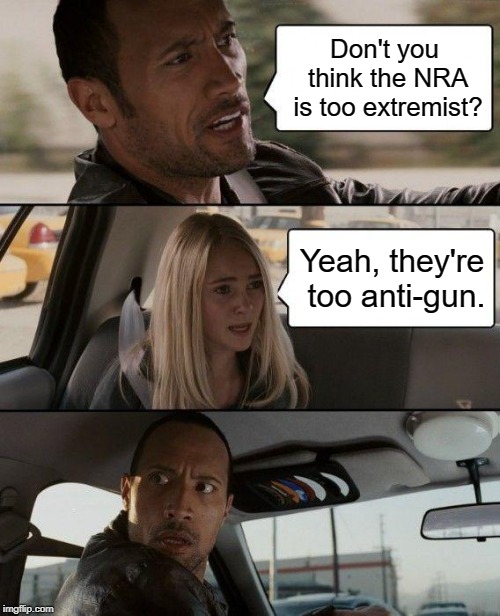
There’s a joke that goes around in a number of forms about how the NRA is actually “anti-gun”.  Here’s one:

nraantigun

There’s a lot of truth to that, unforunately.

Back before about the mid-80’s, we were generally losing on gun rights. Then Florida became national news with their “Shall-issue” CCW law (they weren’t the first, but theirs made national news) and that started spreading. The “high water mark” federally was mid-90’s with the AWB and “Brady Bill.”

Before that “tide change” it was entirely reasonable to attempt negotiation to slow a decline that many, even among folk who favored gun rights, thought was inevitable–a “put off the end as long as possible” type thing. Give up a little bit in the hope that it will satisfy them for a while longer made sense in those circumstances.

There’s a scene in the late Jerry Pournelle’s book “Jannisaries” where the defenders of a castle are invested by a far larger army.  They did not have enough men to mount a sufficient defense so, when the siege train of the attacking army rolls up, the “Eqetassa” (think “Countess”) tells her military commander to “Make a good bargain for our people.” That, for a long time was where we were when it came to gun rights.  We were losing and it made sense to make the best bargain we could to retain what we could.

The problem is, the tide has turned. Overall, we’ve been winning on the gun rights side for decades now. There are only a very few holdouts to “shall issue” and “constitutional carry” is spreading. (I’m waiting, Indiana.) More people are being allowed to carry more guns in more places than ever before. And while the very blue states continue to pass more restrictions, the rest of the country has been relaxing them right and left.

And in those places where the new restrictions have been passed?  We’re seeing massive non-compliance.  Whether it was magazine capacity limits or bump stocks (<sarc>thank you, President Trump, for implementing more gun control than Obama managed in eight years</sarc>), a lot of people are neither turning them in nor destroying them.

The NRA, however, is still in that earlier mindset, the “eventual loss is inevitable so we’re just trying to slow it down” approach. They’re wrong and they can’t seem to wrap their institutional mind around the change.

Kind of sad, really.