Creating synthetic languages–my way

I’ve done some work with synthetic languages for use in my fiction.

J. R. R. Tolkien made that popular with his various varieties of Elvish, Dwarvish, Black Speech, and other languages in his Middle Earth stories.  Other writers hint at synthetic languages with select words and phrases, sometimes including a glossary in their stories showing what those words and phrases actually mean.  A few actually build something approximating a complete language, with grammar and vocabulary.

It’s this latter that I’m going to talk about here, using examples from some of my own writing (forthcoming works).

Languages, at least spoken languages, are made up of sounds.  This may seem trivial, but the choice of what sounds are, and are not, used within a language determines to a great extent how the language sounds.  Consider two of the languages constructed by Tolkien.

First Quenya:

“Ai laurie lantar lassi surinen”
Now the Black Speech:
“Ash nazg gimbuktul”
The two languages have a very different sound to them.  Real languages are the same in that way.  German sounds quite different from Latin which sounds quite different from Thai, which sounds quite different from Japanese.
So I start with the sounds and how they are put together.
In the appendixes for The Silmarillion, there’s a table for Elvish script that ties in to how the sounds are produced.  Generally speaking consonant sounds were categorized by where they were produced in the mouth and how open that portion of the mouth is.  Consonants were produced either at the lips, the teeth, the hard palate, or the soft palate.  There were four levels of “openness” and then voiced or unvoiced (using the vocal chords or not).  This led to a total of 32 separate sounds that could be written in Elvish script.
There are other characterizations possible for the sounds the human throat and mouth can produce but I found this one useful and adapted it to my own ends.
Vowels were a separate matter.  May years ago I took choir in high school.  Our instructor spent a great deal of time on vowels because vowels are what you sing.  They’re what you use to produce notes.  He characterized vowels by whether they are produced in the front or back of the mouth and how open that portion is.  This process produced nine basic vowel sounds, plus some “blended” versions (mixing production in front and back of the mouth) which are normally written as “umlauted” vowels. Note that many of what we think of as vowels would be, in this system, diphthongs.  The long-i sound would be “ah” followed rapidly by “ee” and so forth.
Most languages do not use all the sounds that can be produced.  English doesn’t use umlauts nor several of the consonant values except in borrowed words. (But then, English borrows, or outright steals, so many words that’s not so much of a limit.)
So, the first step is to select sounds from the list.  Which ones does your language use, and which ones does it not use.  This choice helps determine the overall sound of your language.
As important as which sounds are included is how frequently the specific sounds are used.  Look at the two Tolkien examples again.  Largely the same sounds and if you looked at larger passages of Quenya you’d see that all the sounds in the passages of Black Speech are present.  What differs is the frequency.  In Quenya, “l”, “r”, “n” and so on feature heavily.  In Black speech, “full stops” (g, t) and fricative/sibilant sounds (sh, z) are prominent.  This gives the two languages a very different sound.  Quenya has a very “flowing” sound.  Black Speech is harsher on the ear.
So pick what sounds are more common.  Rank them.  This will help determine what your language sounds like.
From sounds you have words.  Words are made of syllables.  Syllables are collections of the sounds you’ve selected for that language.  Different languages build their syllables differently.  Japanese is very strict consonant-vowel (or simply vowel) and sometimes with an “n” at the end of the syllable.  Russian, on the other hand, tends to string consonant sounds together in ways that frustrate native English speakers and cause native Japanese speakers to figuratively throw up their hands in despair.
So how does your language build syllables?  As an example for “Old Aeriochi” I decided that syllables would use the following pattern:
[C][C]V[C]
Where “C” is “Consonant”, “V” is “Vowel”, and brackets indicate an optional item.  Using the sounds I’d selected, and all the possible combinations of consonants and vowels in that pattern, I had all the possible syllables in the language.
Problems arise, of course when you try to combine consonants.  Not all combinations work well.  So I needed some rules for combining consonants in order to keep the words pronounceable.  For Old Aerioch the rules were as follows:
  1. When a syllable starts with two consonants, the first consonant must be a full stop (p, b, k, or g in this language).  The second consonant must be an “approximate” (w, r, l, or y).
  2. When a trailing consonant in one syllable is followed by a leading syllable in a second, the second syllable’s leading consonant moves to the mouth position of the first and if it’s a stop it opens to a fricative (p becomes f, and so on).

This gives me the tools now to build words.  As an aid, I did some programming in Excel to create a list of all the possible syllables, assign a numerical value to them based on the frequency I’d assigned for the sounds they contain, and then sort them so I have a large table with the syllables using more frequent sounds at the top and the less frequent at the bottom.  When building common words, I can pick from the top of the list, less common words from farther down.  And so my vocabulary reflects the linguistic sound I determined in setting up the sound system.

It makes more than just words to make a language.  It also takes grammar and syntax.  And this is where a lot of people who create synthetic languages for use in fiction fall down.  Here, having studied formal grammar is quite helpful.  When I was in the Air Force, before being assigned to foreign language school the Air Force put me through an intense, six week, English grammar course.  The purpose of the course was not to ensure we used “good grammar”.  That wasn’t how the course was structured.  It was so that when we encountered “dative case” or “subjunctive mood” or “perfect tense” in the _foreign_ language class, we’d know what it meant.

For Old Aeriochi, I used a fairly common pattern:  inflected language with loose word order. Tense and mood were determined by suffixes on the verb.  Roll that nouns play in a sentence (declension) was determined by suffixes on the noun.  This is a good system to use for synthetic languages because it’s easy to define.  It’s also easy to expand.  For instance English has “Imperative” for verbs.  In Old Aeriochi” there are “strong imperative” and “weak imperative”. (The difference is illustrated in that the weak imperative is used in a spell to help someone sleep despite pain from injuries while the strong imperative is used to send an opponent into slumberland in the middle of a fight and make sure they stay that way despite all that’s going on around them.)

For the Oruk language I used in another forthcoming piece, I used an abbreviated version of the above process.  I didn’t need as much language (Old Aeriochi was written for a series where I anticipate using it quite a bit, the Oruk language was written for a single short although I may re-use it at a different time.) I simply went “by ear” in selecting sounds and creating syllables and words.  For syntax I made it a word order language.  The word order is defined as follows:

[Interrogative particle] Verb [verb modifiers][te direct object[object modifiers]][subject [subject modifiers]]

That’s a very simple pattern but then I don’t need much for this story.  The interrogative particle is a short “word” that indicates that the sentence is a question.  “Te” indicates that the noun that follows is a direct object.  If I need more for future stories (no reason I can’t use the same language elsewhere), I can expand on it.

And that’s the basics.  It’s a pretty involved process, but even simple languages are pretty complex.  To make the language more real you should have multiple types of verbs and nouns that follow related but slightly different rules, and a few irregulars that follow rules all their own.

So, do you need a language for your stories?  Now you have at least a basic primer on one way to create one.

Flyers for my ebooks

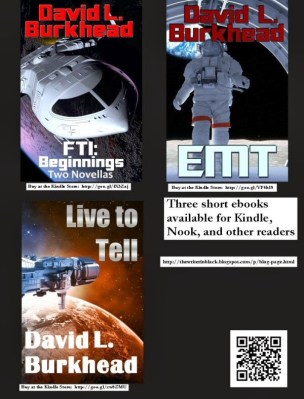
Just recently went to a small, local, SF con.  I have some paper books to sell at these things (anthologies that include stories of mine), but I was wondering how to sell ebooks at a venue like a science fiction Convention.  What I came up with was these fliers:

Front side:


Back side:

FTI Beginnings (Two novellas):

The Future is Now:  Richard Schneider has a dream, a dream of cheap access to space not just for the few but for the world.  He founds a company to build that dream with a simple philosophy, when problems arise don’t cut corners, find better ways.

Match Point:  Inflicted with a neurological disease that slows his reflexes, Tom Striker’s career as a top-ranked professional tennis player is over.  But when Steve Bradshaw, number one player in the low-G version of tennis played in the space colonies makes snide comments about his play even before the disease Striker decides to try the low-G version of the game, a slower version where his ruined reflexes would be less of a handicap.  Would this new environment give him a second chance at success, and maybe a chance to put Bradshaw in his place?

EMT:

William Schneider continues in his father’s footsteps, but not everyone within that organization shares that philosophy.  Meanwhile, Kristine, an EMT on the moon, learns that not all the problems she faces comes with the territory.  Their different problems lead them on a collision course in an attempt to avoid disaster.

Live to Tell:

Staff Sergeant Mike Yamada is the only person who has ever been recovered from captivity by the Eres, and the only one who truly understands the true horror that captivity entails.  When the hospital ship carrying him is captured by the Eres, can he find some way to rise above his fears and avoid the horror that awaits?

Heinlein’s Juveniles still relevant?

Elsewhere the suggestion was made that Heinlein’s Juveniles were not, in some way, valid, or maybe relevant is a better word, any more because, “children aren’t like that any more.”

I don’t know about that.  My daughter, age 9, loves them.  It started when I read them to her in installments a year or so ago as “bedtime stories”.  She kept saying “More!” and I kept having to insist “No, it’s time for you to go to sleep, sweetie.” This year, she has a school reading assignment where she gets to pick a book, read it (10 pages at a time for the assignment), and write something about what she read.  She picked Have Space Suit Will Travel. (Finished that and went to Piper’s “Little Fuzzy” but that’s another story.  She wants the other Heinlein juveniles but I only have the one in dead tree at the moment.  The rest are in e-format only.)

I don’t think it’s so much “Kids are different today” as it was more OK then to write about exceptional kids, ideals to aspire to rather than the mush of “everyday life.”

And, as it happens, “Have Space Suit, Will Travel” remains my all-time favorite book–not just science fiction, not just juvenile, not even just Heinlein, but book.

To emphasize, even when I was growing up, the kids in Heinlein’s Juveniles (or in the Tom Swift Junior books which were among my first introduction to science fiction) weren’t what I was.  They were what I wanted to be.  And I wanted to be that because they showed me something better, something worthy of being.

Maybe I’d never acquire a space suit of my own, but man if I did, I certainly hoped that I’d be as hot as Kip at getting it working and maybe, just maybe, that would get me into space.

There were no “junior” let alone “senior” prizes for rocketry back then* but even so I tried to be like the kids in Rocket Ship Galileo because, well, they were kids doing things worth doing.

And there was no “Space Patrol” to join, and chances were I’d never be able to make the cut if there were, but oh, how I wished there was so I could at least try.

And so on.  These people did things, made things happen, and sometimes . . . saved the world.

*As it happened, years later there was a prize, something that probably would have been one of the “senior prizes” in the world of Rocket Ship Galileo, the Ansari X Prize.  And, as fate would have it, it would appear that I actually helped make that happen.

And so let us end once again with a musical interlude:

Millenicon Schedule

I’ll be attending Millenicon in Cincinatti this weekend.  My schedule is:

Sat         6 PM        MR 1216        Then All the Scientists Groaned
              7 PM        Hotel Lobby    AUTOGRAPHS
Sun        11 AM      MR 1216         Atomic Force Microscopy
              1 PM        Reagan           READING
 
Come see me there.  I’ll have books (Sword & Sorceress and some of the Heroes in Hell books) for sale and flyers for my e-published stuff.

"The Kinmar", a snippet

I don’t generally snippet works in progress, partly because I don’t want to screw up any rights that a publisher may wish to acquire (say, for instance, if a magazine counts the snippet as a “prior publication” when they want First Rights), but I plan to release this one indie.

The story is set in a world I’ve used before.  I have a novel manuscript, currently sitting at a particular publishing house having been “pulled from slush for a closer look” (and the waiting continues).  “Time for Tears”, in Sword & Sorceress 26 is also set in this world.  It uses one of the characters and references the other.

Enjoy:

The Kinmar

by

David L. Burkhead

Kreg knelt to examine the trail.  Hard to say how many raiders rode ahead of them.  Enough to have slaughtered the people of Three Oaks.

Shadows from the birch trees waving in the slight breeze dappled the ground.  Kreg reached out to touch a hoof print, measuring it with his hand.  Unshod.  That meant either Eastern raiders or a very poor band of bandits.

Tracks overlaid each in the packed dirt.  Kreg’s eyes narrowed as he tried, and failed, to count how many raiders were in the party.  That little girl–Kreg did not know her name–had been taken in the throat with an arrow.  A kindness of a sort putting her beyond pain when the raider swords had hacked her body to pieces.

Kreg  had recognized her tiny, mutilated corpse.  She had given him flowers the last he rode through Three Oaks.  She had given him flowers and he didn’t even know her name.

“Meritha,” Kaila said from her horse.

Kreg looked up at her.

“Her name,” Kaila said. “The girl.”

Despite his fury, the corners of Kreg’s lips twitched.  Kaila was in his head, much like she always rode I’m her heart.  He did not fully understand it.  The Knightbond did not work so for anyone else, but the bond was still new-forged and they were all still learning what it did.

“Bandits,” Kreg said as he stood up. “Some ponies, some larger horses.  Raiders would be more consistent.”

“Your counsel, Your Grace?”

Kreg’s lips twitched again.  Kaila loved to twit him about the new title, granted by king Keven, making Kreg a Duke in his own right instead of merely Kaila’s consort.

“They’re just hours ahead of us.” Kreg swung into his saddle.  He conjured a vision of a map in his head. “we’d lose days riding to…Zhaivan, I think, to raise the army.”

“You and me?”

“You and me.”

“Risky.”

This time the smile escaped from Kreg’s lips. “Fear not for us.”

Kaila’s return smile, as she finished their old challenge, warmed Kreg to the core of his heart. “Fear rather for the evil we face.”

And yet…. Kreg let his gaze drop from Kaila’s eyes to her still-slender waist, then back to her eyes.  There were risks and risks.  But there was also duty, and that little girl … Meritha.  Let there be no more Merithas.  Please let there be no more Merithas.

#

As they trotted down the trail, Kaila watched Kreg from beneath lowered lids.  He nearly glowed black with his pain and anger over the destruction of Three Oaks.

She understood.  When they first met, she didn’t but now?  Now she did, perhaps better than Kreg did himself.

The Gods had brought Kreg to them.  This Kaila believed with every beat of her heart.  Shillond might speak of powerful magics but Kaila knew the truth.

Kaila had grown up facing  raiders and bandits and villages ravaged.  And Kreg, well Kreg had not and there was the end of it.  And while Kaila’s heart ached for the slain no less than did Kreg’s, long experience taught her to temper her fury until she could unleash it at a just target.

Kreg raised a hand.  Kaila reined her horse to a stop.  Kreg’s hand stabbed toward the ground three times, indicating where the trail had split.  Kaila’s eyes widened as she saw the third trail.  Just to the side of the main trail a single track bid fair to leap from the ground at her.  A heel pad, four oval toe marks, no indents from claws dimpling the ground.  Some form of cat, but larger than any cat should be, larger and deeper.  A cat that walked on two legs.  She looked up and met Kreg’s eyes.

“Kinmar,” Kreg said, echoing her own thought.

“I thought they were gone.”

“So did I.  So did everyone.  But…” He waved at the track.

Kaila scowled. The Kinmar, the half-men.  When Schah had invaded with armies that kept growing, seemingly endlessly, she, Kreg, and her father Shillond had discovered that the armies were changelings, animals transformed by magic into human warriors.  In the end, Kreg discovered a way to break the spell but the changeling warriors had not changed completely back into their animal forms.
They had thought in banishing the demon Baaltor once more from the world that the Kinmar likewise vanished.

“Perhaps,” Kaila said, “we should gather the army after all.”

Kreg shook his head. “Still take too long.  This doesn’t change that.  Although perhaps you could….”

“Think not of sending me back,” Kaila said, “not this day nor any other.”

Once again, Kreg’s gaze dropped from Kaila’s face, then returned.

“Would you have our child be born to a coward?  No, Kreg.  We fight together, as we always have since you came to this world.”

Kreg nodded. “Together then.”

“Which trail?”

Kreg pointed to the cat track. “The cat.  That is the greatest danger, I think.”

Kaila looked from one trail to another.  Neither she nor Kreg were a truly skilled tracker although Kreg followed a trail a bit better than did she.  Just this one print, distinct from the churned up dirt from where the other creatures–no longer was she so sure that these were mounted riders–had passed. “A single mistake, Kreg,” she said. “Mayhap they disguise their trail?  Hooved kinmar in the rear to trample the others’ tracks.”

“Could be.  But one cat form, at least, went this way.”

“And mayhap it is a deception,” Kaila said. She waved at the print.  A single print, clear in the dirt when everything but a few hoofprints was too obscured for either of them to read.

Kreg spread his hands, palms up. “We don’t have anything else to go on.”

Kaila thought for a moment then nodded. “You speak sooth.  And it would not be the first time we two had ridden, eyes open, into a trap.”

Kreg turned his horse to continue down the trail.  Kaila followed.  She frowned.  Kreg had always been the clever one.  To ride all-knowing into a trap, trusting to break it when it closed?  No, not without great need.  Three Oaks had struck him more deeply than she had surmised.

Movement in the trees caught her eye.  Her hand fell to her sword and closed about its grip. “Kreg!”

Ahead, Kreg twisted in his saddle.  His hand dropped to his own sword and he started to snatch it from its scabbard.

The kinmar leaped from the concealing foliage above.  Cat form, Kaila saw.  She finished drawing her sword.  The kinmar tackled Kreg and drove him from his horse.  As they hit the ground, the kinmar drew its legs up and raked, its claws scittering across the rings of Kreg’s mail tunic then across, and through, Kreg’s leather boots.  Blood spurted from Kreg’s torn thigh.

“Kreg!”

Kaila dropped her sword.  It had scarcely struck the ground before she had snatched her bow from its saddle-sheath and fitted an arrow to string.

The arrow flew true, striking the kinmar just beneath the left shoulder, but it struck bone rather than penetrating deeply.  The kinmar turned for an instant to look at her as Kaila prepared another arrow.  It snarled, with a face that blended human features and cat.  Kaila lifted the bow and started to draw. The kinmar turned and leaped into the surrounding woods.  Before Kaila finished her draw, it was gone.
Kreg lay very still.

“Kreg,” Kaila moaned as she dropped the bow and leaped from her saddle.  Blood continued to pour from Kreg’s thigh.  Kaila scooped up her sword in passing as she ran to Kreg.

Kreg struggled to rise, his breath coming in short pants.  Kaila knelt by his side.  She shook her head.  The experience of a hundred battlefields seemed to have deserted her.  Blood.  Too much blood.

A wounded knight, Kaila told herself, one of many she had dealt with over the years.  The mental discipline calmed her.  For a moment, she could convince herself that it wasn’t her friend, her lover, her husband that lay bleeding before her, but just another knight that needed treatment.

First the bleeding.  Four parallel gouges in Kreg’s right leg, running from two-thirds of the way up his thigh down to just past the knee.  She placed the heel her hand against his thigh, where the artery crossed the bone and leaned into it.  The flow of blood slowed.  She drew her dagger with her other hand and cut away the remains of Kreg’s boot.

Kreg moaned. “Hurts.”

“Rest, Kreg,.  Rest.” Kaila said.

“Chest,” Kreg said. “Hurts.  Ribs.”

Kaila’s lips pressed into a thin line. As she worked, she cast quick glances at the forest around them.  Quick, but thorough.  The forest remained still.  Kaila berated herself.  If she had been watching the forest instead of brooding over her concern for Kreg she might have spotted the kinmar.

“Don’t,” Kreg said, his arm quivering as he lifted it in the direction of her cheek. “Please.”

The bleeding had slowed to a trickle.  Kaila whistled.  Her horse—Kreg’s had fled with the kinmar’s attack—trotted to her.  After a moment’s hesitation, Kaila released the pressure on Kreg’s leg and stood.  More blood flowed but less, much less, than before.  Moving quickly, she opened the pack strapped behind her saddle and pulled out a spare tunic and undershift.  She again knelt beside Kreg and folded the undershift into a long pad.  She tore the tunic into long strips and used them to bind the pad onto the wound in Kreg’s leg.

Kreg’s eyes were closed, his face slack, his breathing short and ragged.  She closed inside her and reached for the Knightbond.  The power resisted her efforts.  It always did.  She called it anyway, called it and shaped it.  Slowly, the power responded to her will.  A portion of the power she directed to Kreg’s leg.  Shillond, her father, could have stopped the bleeding with a thought.  She could only encourage it to stop on its own.  The flow of blood soaking into the bandage slowed and stopped.
Once the danger of bleeding to death ended, Kaila turned her attention to his chest.  Kreg’s breath continued short.  After casting another glance at the forest she reached out with the Knightbond.  The break, breaks, in Kreg’s ribcage glowed black in her head.  Tentatively, she touched the breaks with the power.  One rib had been driven inward, piercing the lung.  Already that lung was starting to collapse.
She wished Shillond were there instead of on a diplomatic mission in far-off Merona.  She felt his love for her through the Knightbond, love and power.  Keven, in his palace in Norveth.  All of them, all the Knights of Aerioch bent power her way.  The Knightbond joined the Knights of Aerioch, making all their powers one.

“A knight of Aerioch is never alone,” she whispered.  She laid a gentle hand on Kreg’s side, reaching with the power for the broken ribs.  Even with the power, she could do so little.  The rib gradually slid back into place.  Again she nudged the power.  The puncture in the lung contracted.  She could not close it but it would leak no more.  Kreg’s blood ceased leaking into the lung, and into the space between lung and ribs.

Kaila sank back, exhausted and released the power.  She could do no more.  Kreg’s own strength would have to complete the healing she had started.

She struggled to her feet.  She had another task.  The kinmar would be back.

Come to the Dark Side. We have STORIES.

Musing a bit here but back when I got started, late 80’s to early 90’s, the music I listened to was all of a piece (bear with me.  I’m going somewhere here).  Love songs and ballads, lightweight pop music, that sort of stuff.  The fiction I read was mostly, almost entirely, pretty upbeat as well.  As one example, I got so bothered, so freaked by the “danger” to the protagonist in the late Harry Harrison’s “The Stainless Steel Rat’s Revenge” that I nearly dropped the book.  I got through it and ended up reading it and the rest of the series, but it was a close thing.  I couldn’t really deal with the darker elements of life, not even in fiction and music.

This showed in my own writing.  I never really put my characters in jeopardy (EMT was probably the most “risk” I put my characters through at that time).  And when I tried, I tended to shy away from expressing it vividly.

The result was rather weak writing.  I was able to sell some stuff if I had a clever enough gimmick but that was about it.

More recently, I’ve gained an appreciation for the dark.  John Ringo’s books have introduced me to power and gothic/symphonic metal.  And that was really a catalyst.  The fear, the outright terror for the fate of the characters one is reading, is what makes for powerful fiction.  Back when I was in sunshine land I could not have written “Plague Station” (still looking for a few beta readers if anyone’s interested).  I had the idea for “Oruk Means Hard Work” years ago but I couldn’t have written it because I couldn’t have written the ending, the way it had to end.

There’s a great line from a movie that was otherwise, IMO, pretty lame:  if you want to paint pictures like that, you’ve got to use some dark colors.

Thus ends this musing.

And so let me end with this musical interlude:

What I want in a writer’s organization

There has been much debate of late about SFWA and how relevant to the needs of professional writers it may or may not be.

I write Science Fiction and Fantasy (mostly) and, as you might imagine, have an opinion on the matter.

So, let’s look at what I want in a writer’s organization.  I’m kind of working this out as I go along so it’s going to ramble.

Writers, by and large, are freelancers.  They may hold down a more conventional job at the same time, but as writers they are freelancers.  And a lot of writers who hold other jobs dream of being able to quit those other jobs and making their living from writing.  To do that, they would have to provide for themselves many of the benefits normally provided by their employer.

A key benefit of interest to writers is health insurance.  SFWA has its Emergency Medical Fund (EMF) which provides zero interest loans to members to help cover large medical expenses.  That’s great.  That’s wonderful  I don’t want to dispute its value.  But it’s not insurance.  For the folk who’ve qualified for and received payments from the EMF, it’s been a godsend.  For the rest of us, who just want insurance to cover that ER visit from when their child fell of the swing and split his head open, or the gall bladder surgery, or the MRI on that medial cruciate ligament injury, or the sleep study to find out why you can’t seem to stay awake during the day.  And that’s just health insurance.  There’s also life (if something happens to me, what about my family), disability, and others.

So, one thing I want from a professional organization is access to insurance.  As just one example of insurance via a professional organization, I present the American Chemical Society.

Another benefit from professional organizations is “professional education”.  Science related professional organizations share information on science, information that helps members become better scientists.  Medical organizations share information that helps physicians become better doctors.  And so on.

So one thing I want from a professional information is for it to be a source of information that can help me be a better writer, better able to craft stories, market them, and sell them.

Since writing is largely a freelance activity, aspects of importance to professionals include contracts, particularly Intellectual Property contracts, rights, royalties and payments.  Assistance in navigating this maze, in getting better terms, in making sure you’re actually paid what you are owed, when you are owed it, would be most welcome.

Speaking of payments, what’s up with pay rates?  Twenty years ago “pro rates” for short fiction were $0.05 per word (longer than that, actually–a lot longer–but that’s when I entered the business). Last year SFWA raised the qualifying rate, to $0.06 per word.

Now, maybe that’s all the field can support.  Maybe there isn’t enough readership to support paying more.  Which brings up another issue.  The science related professional organizations all have a strong “how to get people involved in…” which goes looking for ways to interest people in the field, to ensure the next crop of scientists will be out there but also to make sure that there are “consumers” willing and able to buy what they’re selling.  So the question that must be answered is “why aren’t people buying and how can we change that?”

So, I’d kind of like a professional organization that is looking out for the professional future, exploring new avenues, and working to ensure that there is a professional future.

And the field is changing.  Indy and self-publishing are becoming viable avenues for people to sell their work.  Some people doing those sell more than some following the “traditional” route.  Yet they don’t qualify for the “professional organization” because, well, tradition.

I’d like to see a professional organization that was at the forefront of new trends in the field and not dragging its heels against them.

As a writer, the ability to express ideas is my stock in trade.  All writers share that.  We may have different ideas to express but expressing our ideas is what we do.  When someone says “this idea you must not share” or “that idea you may not have” they hurt all of us.  Now, a private organization, which professional organizations like SFWA is, can choose to limit its membership however it wants within certain broad limits set by law.  But when an organization devoted to writing, to communication, decides to limit that membership based on the ideas some people express, however distasteful one finds those ideas to be, then that organization undercuts its very reason for being.  The question is, do you want to be an organization that promotes writing and the interests of writers, or do you want to be an organization that promotes certain political and social agendas only tangentially related (if that) to writing?  You can’t have it both ways because the latter undercuts the former.  If you are going to throw some writers “under the bus” because you don’t like their views, then you have no room to complain when others do the same to you.

So I’d like a professional organization that promotes the interests of writers and writing, regardless of the political or social positions of those writers and that writing.

So, if somebody could let me know where I might find such an organization, I would greatly appreciate it.

"Live to Tell", a Snippet.

LIVE TO TELL
by
David L. Burkhead

Staff Sergeant Mike Yamada saluted as he stood in front of the Captain’s desk.
“You wanted to see me, Sergeant?” The Captain returned the salute. “Well, here I am.”
Yamada winced inwardly at the tone of the Captain’s voice, a wince that he was careful to avoid showing as he stood at attention before the Captain’s desk.  He could understand why the Captain was upset, but that did not make what he had to do any easier.
“Yes, sir.”
“Well?  In case nobody’s told you there’s an Eres task force on our tail and it doesn’t look like we’re going to get away.  The crew of this ship, including me, is about to get very busy.”
“Yes, sir.” Yamada paused a moment.  Despite the Captain’s sarcastic comments, he could not have avoided hearing the announcement.  The hospital ship Mercy and her two escorting destroyers were currently running for the system’s jump limit at the maximum acceleration the Mercy could sustain.  And although there had been no general announcement of the assessment of the Eres fleet’s capabilities, he had also heard the scuttlebutt that gave the Eres longer legs–enough longer that the Mercy could not possibly reach the jump limit before being overhauled.  The destroyers could probably get away, but they would not both leave the Mercy.  The more seriously sick and wounded were being moved to the Soyokaze, the newer, and faster, of the two destroyers in the hopes that they, at least, could get out. “First off, Sir, I’m sorry about what happened….”
Since his rescue, Yamada had gone into screaming fits whenever anyone approached him.  One corpsman had tried to restrain him and received a dislocated shoulder for his pains.
“The corpsman’ll be fine.” The Captain sighed. “At ease, Sergeant.  Post Traumatic Stress.  I’ve seen a lot of it in this billet.  You’re not at fault here although I’m glad to see you’re finally getting past those panic attacks.  But I don’t think that’s all you wanted to see me about, was it.”
“No, sir.  Uh, sir–” Yamada shrugged– “whatever happens, you can’t surrender this ship.”
“Can’t I?” The Captain leaned back in his chair. “And since when do you tell a ship’s Captain what he can and can’t do?”
“Sir, I’m sorry, but you just don’t understand what will happen if you do.”
“The Eres are good about taking prisoners.  If they weren’t, you wouldn’t be here.”
“That’s just it, sir.  It’s better… better not to be taken prisoner.  Anything… anything at all is better than to be taken prisoner.”
The Captain nodded. “I’m sure you’ve had a bad time, but you’re here, now, in reasonably good health, when you wouldn’t be if you’d followed the advice you’re giving me now.”
“And a lot of the time I wish I wasn’t, Captain.  You have no idea, none at all, what it’s like.”
“Look, Sergeant, I haven’t got time for this.”
“Please, Captain.  Please listen to me.  You may have heard of an old story ‘The Most Dangerous Game’?”
“Can’t say that I have, but….”
“Well, I don’t suppose it matters.  Look, after Defender was captured and we were taken to a POW camp, or what we thought was a POW camp, we were treated well–good food, clean housing, exercise yards, excellent medical care.  It was only later that we found out why.”
#
“Move your ass, Lieutenant!” Yamada punctuated his statement with a shove.
Lieutenant Thompson responded by sinking to the carpet of leaves on the ground. His right leg bulged purple above the remains of his boot. “I’m done, Sergeant.”
Yamada squatted next to Thompson and grabbed his shoulder. “Done, hell!  On your feet and get shagging… sir.”
Thompson shook his head. “Not going to happen.  You’d better clear out before they catch up to us.  They can’t be too far behind.”
“Lieutenant….”
“That’s an order, Sergeant.  If you stay, they’ll just get both of us.”
“Sir, I….”
“Move your ass, Sergeant.  That’s an order.”
With a groan, Yamada scooped up the sharpened stick that served him as a crude spear and dashed into the underbrush.  Once through the nearest thicket, he hesitated, then turned and crouched behind a tree.  He could just see Lieutenant Thompson straightening his injured leg on the ground in front of him.
A noise from the far side of the clearing drew Yamada’s attention.  Two Eres appeared almost as if by magic from the shadows under the trees.  Instead of the standard issue magnetic slugthrowers, they carried long spears, the shafts of a local plant similar to Earthly bamboo and tipped with flaked stone.
Yamada’s grip tightened on his own, cruder, spear as he watched Thompson wait for the approaching Eres.
Adult Eres stood just under 2 1/2 meters tall.  Their smooth skin varied from a pale olive green to a straw-amber to a deep russet brown.  Their heads, perched on the ends of half-meter long flexible necks, had rounded skulls that stretched forward into blunt snouts, giving them an egg-shaped appearance.  Tall, narrow ridges, the crests whose height was the only visible different to Yamada’s eyes between male and female Eres, ran from just over the eyes back across the skulls to join just above the back of the neck.
A lipless mouth bisected the snout horizontally where knife-edged serrated teeth were constantly exposed in a mirthless grin.  The upper and lower teeth overlapped, producing a shearing action to cut through flesh or the Eres could thrust forward their lower jaws, turning upper and lower teeth into pairs of saws that could carve the stoutest bones.
The Eres bodies were rounded, almost bulbous, with arms that seemed short in comparison to their full size but were, in fact, about the same size as humans and no human could match the strength of an average Eres arm.  The legs were about a meter long, with elongated, clawed feet.  Eres walked on their toes, with a spine from their heels pointing backward.  The hips had a second, locking joint that allowed the Eres to either stand and walk fully upright like humans or to shift into a forward-leaning position where the weight of their heads and bodies were counter balanced by a thick, muscular tail.  In this position they could run at great speeds for seemingly unlimited distances.
One of the two Eres–a female by the crests above its eyes–stopped.  The other took two more steps then stopped as well.  He–the smaller crests indicated a male–raised the arm that held his spear.  The arm whipped forward and the spear flew in a near invisible blur to bury itself in Thompson’s chest, just to the left of his sternum.
Yamada screamed.  Without conscious thought, he charged from his own place of concealment straight at the Eres who had killed the lieutenant.  The Eres turned to face him, the male who had cast his spear blocking a clear throw from the female.
In another instant, Yamada reached the Eres.  His own spear, driven by the full momentum of his charge, caught the Eres in mid-torso.  Yamada found himself tangled with the Eres’ body as it fell.
#
“I thought I was dead then,” Yamada told the Captain. “An adult Eres masses more than 200 kilos and that world had a little bit more than one standard gravity.  I was pinned as the female walked up to me.  I expected her to spit me just like they had the Lieutenant.  But all she did was club me unconscious so that I woke up back in the camp.”
The worst part of that episode had been learning that the Eres he had struck had survived.  His spear had pierced one of the Eres’ hearts, but while that was a serious debilitating injury it was not necessarily fatal.  Given time, an Eres would recover and the heart heal, weakened perhaps, but not fatally so.
The Captain leaned back in his chair. “You made an escape attempt on a planet held by the Eres?  That took guts.”
“You don’t understand.  It wasn’t an escape attempt.”
“It wasn’t?”
“They let us out so they could hunt us. That’s what they do with prisoners–feed and care for them so they’re at the peak of health and strength, then hunt them down and kill them.”
“My God,” the Captain whispered.
“They love a challenge,” Yamada continued, “I came to learn that if you’re good enough, or lucky enough, if you wound or kill one of the hunting Eres, or avoid being caught long enough, they often won’t kill you.  Instead they’ll bring you back in, nurse you back to health, and send you out there again for another hunt.
“We weren’t prisoners, we were livestock.  I think this whole war is just a great hunt to them.”
“Thank… thank you for your report.  Now, if you will return to your quarters, I have a ship to run.”
Yamada saluted and left.
#
“Ohgodohgodohgodohgod.”
The “honor,” such as it was, of being the only prisoner so far recovered from the Eres had earned Yamada his own small cabin and he paced within it.  His gaze kept darting to the door as if some deeply buried corner of his mind expected an Eres stalker to burst through it.
Activity on the ship had changed after Yamada’s conference with the Captain. Even more of the sick and wounded, and much of the ship’s company, were being moved to the destroyers–both of them this time.  To make more room in the destroyers, their marine detachments had been moved to the Mercy.
Yamada could well imagine the hurried conferences between Mercy’s Captain and the Captains of the other two ships.  He could as well imagine the terrible decision that had been reached, the decision to cut loose the Mercy and run with all speed in the two destroyers, to get out everyone they could and leave behind only those who could fight, who could sell their lives dearly when the Eres finally caught them.
But more than any imagined scenes he saw remembered faces: Lieutenant Rick Thompson waiting calmly while an Eres threw a spear through his body, Corporal Joe Anders caught in a snare while an Eres grabbed his hair and cut his throat with a flint knife, Colonel Alan Biancetti hurled bodily off a cliff to be dashed to pieces on the rocks below, Private Sandra McIntire, her face twisted in agony as an Eres wrapped powerful arms around her torso and squeezed until she couldn’t breath and continued to squeeze until her body sagged limp and lifeless in its arms.
And through it all somehow, Mike Yamada had survived.  Somehow, he had lived when the others had died.  He had survived through no virtue of his that he could see.  He had survived because he had been in some cases lucky, in others somewhat quicker off the mark with some makeshift weapon, in still others, to his shame, he had simply been fleeter of foot and so had evaded the Eres longer while they cut down his slower companions in the hunt.
Yamada caught his breath as the buzzer to his door sounded.  Not another hunt.  Dear God, not another hunt.  He looked first one way, then another, searching for someplace to hide so that they would choose someone, anyone, but him, but he was alone in the room and the visitors on the other side of the door would know that.  There was no place to hide where they could not find him and no other person for them to choose instead of him.
“Sergeant?” The voice came faintly through the closed door. “Are you okay in there?”
Yamada licked his lips.  There was one desperate chance.  He would have to strike fast and strike hard.  Eres were too big, too strong, for anything else.  He pressed himself against the wall next to the door.
His action had been not a moment too soon.  With a soft whine, the door slid open and someone stepped through, “Sergeant?  Come on.  Transport’s waiting.  It’s time to go.”
Yamada drove forward, putting his full weight behind a kick that struck in the side, just below the ribs, in the location that long experience had taught him an Eres was most vulnerable, though that not much.
Without waiting to see the effect of his kick he spun, sprinted out the door and down the corridor.  If he ran now, maybe they would come after him.  Maybe they would start the hunt early, before gathering up other prisoners.  And maybe no one else would die simply because he was a little faster, or a little luckier, than they were.
#
Yamada did not know how long he spent running, ducking and avoiding people, and hiding before rationality returned.  He had a vague recollection of an announcement that the destroyers had cut loose to make their run for the jump limit.
The destroyers were gone.  The Mercy was alone.  And, with a sick feeling, Yamada realized that his panic attack had thrown away his chance to escape, to leave with the destroyers.
The last announcement, the one that had finally broken through his terror, had been the call to stand by for emergency maneuvering.  The floor swooped under his feet as artificial gravity generators strained vainly to compensate for the ship’s acrobatics.
“I should find someone to report to,” Yamada said to himself as another pitch of the floor made him stagger into the wall.  Someone in authority needed to decide what to do with him–whether to assign him to an action station or throw him into the brig.
The pitching of the deck told Yamada that the ship was gyrating through intense evasive maneuvering, much as the cruiser Defender, caught alone, had maneuvered against an Eres task force an age earlier.  This time, however, there were none of the sharper shocks of kinetic weapon strikes that had accompanied the earlier battle.  Kinetic weapons had speared through the hull while those insane laser missiles of theirs–somehow the Eres had put single x-ray lasers into missiles without the need to bomb-pump them.  The missiles would come in and take an aimed shot at drives or weapons emplacements.  And then, and then, when the weapons on the Defender had been all but silenced, the Eres had closed in until their kinetic weapons could target the drives.  With the main drives gone, the maneuvering thrusters could not pull away from the Eres tractors, so with the ship held helpless they could only wait for the shuttles carrying boarding parties.
The Mercy lurched as the shock of a kinetic weapon strike reverberated through her then lurched again as the internal gravity shifted to accommodate a significantly reduced acceleration.  Drive hit.
“Not again,” Yamada said, “Dear God, not again.”

Amanda Green’s Nocturnal Origin, a review

Lions and tigers and weres, oh my!

I just finished Nocturnal Origin, the first book in the “Nocturnal Lives” series by Amanda S. Green.

The book is an urban fantasy, detailing the adventures of Police Homicide Detective MacKenzie Santos as she becomes exposed to, and a part of, a world of shapeshifting human/animal creatures.  The shapeshifters come in to basic types:  “pures” where the trait is genetic passed down through bloodlines (although recessive and subject to being “activated” later in life), and “lycans” where the trait is passed as an infection and a normal person can be “turned”.

This particular volume does not indicate how “turning” is done although there are indications it involves more than simply biting someone (without killing them) and that it can happen accidentally.  At least, one character considers the possibility that he has accidentally turned someone.

Mackenzie, Mac, is investigating a brutal, and bloody, murder, one that seems more like the mauling of a wild animal than the result of a human murderer.  She soon comes to realize striking parallels between that attack and the one she had survived not long before the story opened.

At the end of the day, she goes home.  The moon is full.  While she’s home, pain rips through Mackenzie’s body and, well, so far as she is concerned she blacks out until she wakes exhausted, naked, in her back yard.

And I’m sure most everyone reading this knows what happened.  Well, not quite.  MacKenzie is promoted to Lieutenant, put in charge of the Homicide division, and gets a new partner.  She is also soon introduced to a “pride” of “pures.” As you might imagine from the name the “pride” consists of feline shapeshifters.  The Lycans, old enemies of theirs, are wolves.  Note that, although except for a brief appearance by someone described as changing into a rat we only see wolves and felines in this story we are told that other animal types are also represented.  Pride, pard, pack, and herd are mentioned.

And yes, Mackenzie is a “pure” who shifts into a jaguar.  And so she has three tasks . . . four.  She has to bring a killer to justice, keep the secret of pures and weres, learn to deal with her new-found nature, and somehow find the balance to keep her humanity in the process.

The story had some elements that might seem cliched but they flowed naturally from the characters and situation and did not interfere with the story.

I enjoyed it and can recommend it to others who might like urban fantasy with a law enforcement twist.

amzn_assoc_ad_type = “product_link”; amzn_assoc_tracking_id = “coldserv09-20”; amzn_assoc_marketplace = “amazon”; amzn_assoc_region = “US”; amzn_assoc_placement = “B004QO9Z2K”; amzn_assoc_asins = “B004QO9Z2K”; amzn_assoc_show_border = true; amzn_assoc_link_opens_in_new_window = true;

Asking others to step aside?

Recently, Lynn Shepherd wrote a piece suggesting that JK Rowling should stop writing and step aside to make room for other writers, so others can have their chance.

Others have thoroughly deconstructed that piece.  Amanda Green in a guest post over on Sarah Hoyt’s blog, Larry Correia, a blogger at the BBC.  It’s not my intention to do so here.  No, my intention is to look at what such an attitude can do to ones writing.

Writers write.  They create worlds in their head and set them down in tangible form for other to read.  Because of this, ones attitudes and beliefs about how the world works find their way into the story whether one wants them to or not.  Oh, some writers are good enough that they can write a convincing tale contradictory to their own beliefs, but it takes extra work to do so.  So what effect does a belief that the successful should just step aside so that others can “take their turn” have?

Stan Schmidt, then editor of Analog, once gave me the most important writing lesson I ever received, and he did it in six words: “The essense of story is conflict.” That lesson, incorporated into the manuscript he had just returned (which, as you might imagine, lacked that conflict, thus his comment), led to its being my first professional sale. (“The Future is Now”, currently available as one of the two stories in FTI:  Beginnings.)  Conflict can be external, (Beowulf against Grendel’s mother) or internal (Hamlet against his own self-doubt).  The character can win their conflict (Beowulf again), or not (Hamlet).

“Please, sir or madam, will you step aside so that I can have what I want” is not conflict, not unless the answer is “No” and the protagonist, instead of whining about how unfair it all is, goes out to attempt to win what he or she wants anyway.

From the dawn of time, the heroes in literature have always challenged the powerful.  Sigurd did not ask Fafnir, “Please sir, would you stop hoarding gold and allow others a chance?” No, he killed the dragon and took the gold for himself (and thereby took on Andvari’s curse, but that’s another story).  Frodo and company didn’t ask Sauron to please step aside and allow others to rule.  No, they raised an army and set out to destroy Sauron’s ring and, not incidentally, Sauron himself.  Hipomenes did not ask Atalanta to please stop running so fast so that he could catch up.  He used Aphrodites’ golden apples to distract her so he could win.

If “please step aside so others can have a chance” is really how you think the world works, or should work, then you need to take a close look at your fiction because that can lead to very boring fiction or fiction that causes readers to scream, then hurl the book across the room.

Your characters need to climb mountains, metaphorical if not real.  They don’t need the mountains to step aside for them.  And one of the best ways to have characters climb mountains is if you, yourself, go out and climb your own mountains, metaphorical or otherwise, and however it works out–win, lose, or draw–you can use it as fuel for your stories.  Whatever happens, in the words of Neil Gaiman, use it to make . . . good . . . art.