Vaccinate Your Kids People (Combining my “Anti-Vaxers vs. Math” posts)

Sigh.

Over on the book of faces, the subject of vaccines has come up and the usual suspects are screaming about how they’re a scam designed only to get money for “big pharma.”

So let’s look at that.  Let’s use “measles” which is often dismissed as a “harmless childhood disease” and so would be one of the more routine (and therefore cheaper) things to treat. (Please note:  I am just dealing with the ” vaccines are a scam to make money” argument here.  Other anti-vax arguments can wait for another day.)

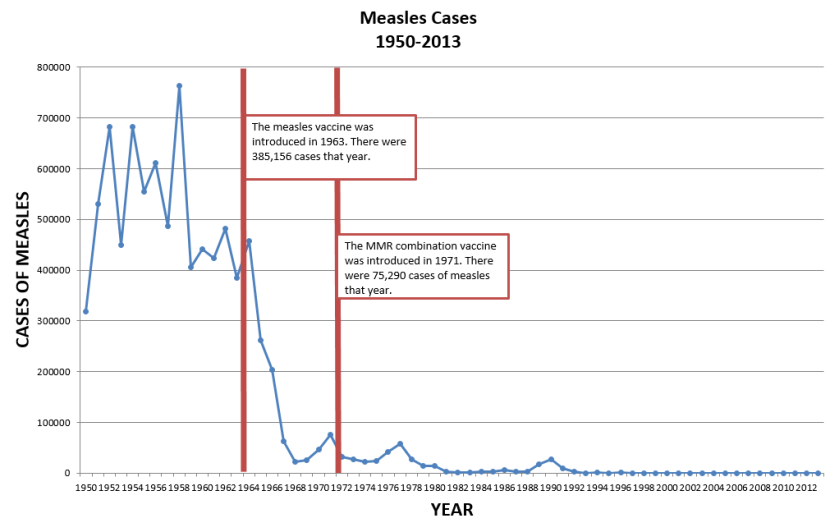
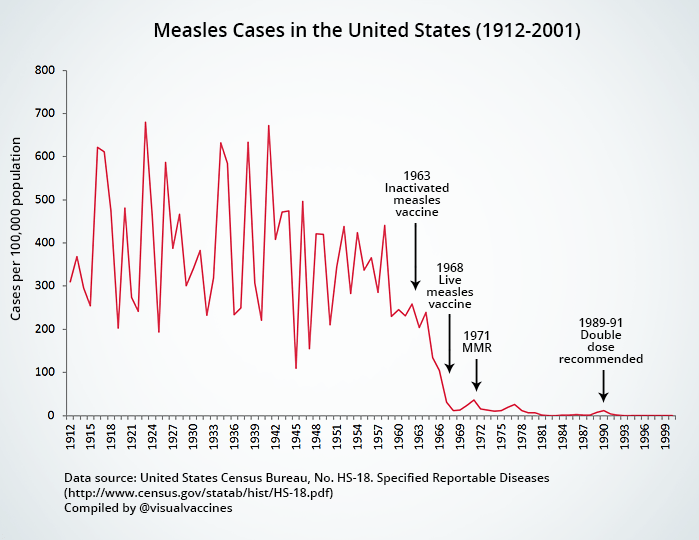
Before the vaccine came out, the US averaged about 400 cases of measles per 100,000 citizens per year:

measles cases2

That’s per 100,000.  Looked at in total numbers:

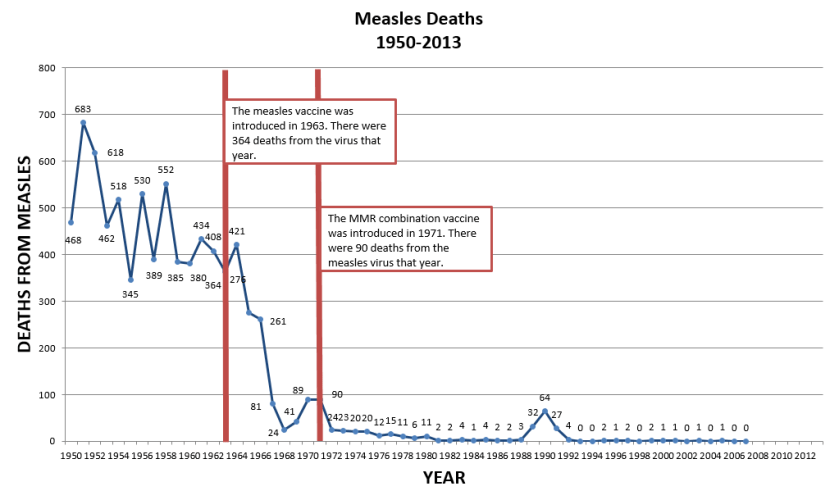
Now, this “harmless, childhood disease” was perhaps less harmless than people may have thought.  Looking at deaths per year we get the following:

Before the vaccine an average of about 450 per year died from measles.  I will note that a number of sites out there have charts that show the “mortality rate” for measles going down, way down, long before the vaccine was introduced.  However, what the naive reader might miss is that they are looking at the mortality rate of measles cases.  I.e. what chance someone who got measles had of dying.  The chart says nothing about the likelihood of getting measles in the first place.

Comparing the death numbers with the total number of cases and we get a death rate of about one in a thousand or 0.1%. (Other sources give a rate of 3 per 1000 or 0.3%–for purposes of this post I’ll use the lower number.)

In addition to the death rate, measles can require hospitalization.  In the years 1985-2002 an average of 757 patients per year were hospitalized for measles (total 13621).  The low was 19.  The High was 5856 in 1990.  For comparison, over that period 147 patients died (above chart).  So for every death there are 93 hospitalizations.

So with modern medicine and standards of care, if we had the same number of measles cases as before the vaccine was introduced the number killed (correcting for current US population, 1.8 times what it was in 1960) would be 810 per year (about 30 per 100,000).  And the number hospitalized would be over of 75,000 or just under 4300 per 100,000.

A typical hospital stay is 5 days at a cost of $10,000 and that’s just for the bed and the most basic of care.  It doesn’t include actual treatment.  It certainly doesn’t include any time in the ICU.  That means the cost per 100,000 for treating measles, what “big pharma” could get from letting people get measles and treating those who require hospitalization is $43 million per year per 100,000 people at an absolute minimum.

So how does that compare to how much they make from vaccines?  Well, the MMR vaccine costs about $100 per dose.  That is for three diseases, but let’s leave that aside and only consider measles.  The standard is a dose and a booster in one person’s lifetime.  Considering an average lifespan of 75 years that works out to about a bit under 2700 shots given per 100,000 people per year assuming everyone gets the vaccine.  Or, $270 thousand per year per 100,000 people.

$43 million to treat.  $270 thousand to vaccinate.  Letting people get the disease and treating it grosses 160 times as much as vaccinating.

If they were really about selling out your health for money, they’d let you get sick.

But wait, there’s more!

The other point that is claimed is that the vaccines themselves cause injury and are more dangerous than “acquiring immunity naturally” (which is weasel wording for “getting the disease”).  And one of the things they like to point to is the Vaccine Injury Court and all the awards it’s granted.  There, proof positive that vaccines are dangers and so you should avoid them.

Well, not so fast.  First off, there’s very little actual science in this Vaccine Injury Court.  As ZDogg (a practicing physician with popular YouTube and Facebook feeds) points out, you don’t need to prove beyond a reasonable doubt like in a criminal trial.  You don’t even need a preponderance of evidence like in a civil court.  All you need is to spin a story that’s reasonably plausible to people who only have a layman’s knowledge (i.e. none to speak of) of immunology and biochemistry.

But let’s take the strongest possible argument.  Let’s presume that every case where an award was granted really was because of vaccines.  In the thirty years between 1988 and 2018 20,728 petitions were filed with the vaccine injury court.  Of these, 6,579 were determined to be compensable, i.e. that presented a case that sounded good to folk essentially ignorant on the subject.

6,579 over 30 years, or an average of 219 per year.  In my previous post I noted that, before vaccination, the number of deaths from measles alone averaged about 450 per year.

Without vaccines, more than twice as many died from a single “harmless childhood disease” than all the compensable injuries (even at that very low standard of evidence) from vaccines–even if the compensable claims all, every single one, represented real injuries from vaccines instead of “just so stories”–combined.

And I’m still not done.

A couple of things that people claim about vaccines which continue to fail, or at least ignore, basic math:

“Most of the cases of people who get X have been vaccinated.”

That’s simply because, at least for now, the vast majority of people are vaccinated.  Okay, let’s look at how that works.  Let’s take a population of 1000, all of whom are exposed to a disease.  Let’s say that the exposure is fifty percent likely to cause the person to get the disease.  Now, 99% of those people have been vaccinated with a vaccine that’s 90% effective in preventing infection.  So, let’s look at it.

First, the ten people who weren’t vaccinated.  Half of them get the disease (50% of those exposed).  That’s five unvaccinated people getting the disease.

What’s interesting, however, is what happens with the 990 who were vaccinated.  Half of them, or 495 would catch the disease except the vaccine prevents that in 90% of those cases (446–rounding up).  That leaves 49 who get the disease.

So, 49 vaccinated people got the disease but only 5 unvaccinated (total 54 sick people).  Per anti-vax logic this shows that vaccinating increases the risk.

Only without vaccinating, that number would have been 500–half of the entire population of 1000–not just 54.

This “most of the cases are people who have been vaccinated” simply means two things:  most people in the US are still vaccinated, and vaccines are not 100% perfect (which nobody claims except anti-vaxers in setting up straw men).

“The Mortality Rate from X fell long before we started vaccinating.”

This one is a little sneakier.  It relies on the fact that what the “rate” is not based on the total population but only on the number who actually get the disease.

It goes like this.

One year, you get 10000 cases of the disease and 10% of them die.  That’s 1000 people dying.

Supportive care improves.  We get better at keeping people who have the disease alive.  So, at a later year only 1% die.  That’s 100 people.  900 people still alive who would have been dead before the improvement in supportive care.  That’s great.  That’s absolutely wonderful.  No joke.  No sarcasm.  It’s an unequivocal win for medicine.

But now, at a later date that 90% effective vaccine is introduced and the population is vaccinated with it.  Now, instead of 10000 cases of the disease we get 100.  With the same supportive care and 1% mortality that means only 1 person dies.

Looking at mortality rate over time we see the big drop in mortality rate happening before the vaccine is introduced and the mortality rate didn’t change much when the vaccine was introduced.  And that’s where the anti vaxers stop. “See, the _real_ improvement had nothing to do with vaccines.”

What they miss is that when you look beyond just the folk who have the disease and look to the total population, there are a lot fewer dead people because fewer people get the disease in the first place.  The improvement in mortality rate for those with the disease certainly may have improved the odds of those who get the disease, but many more people don’t have to rely on that because they don’t get the disease–because they’re vaccinated.

Vaccinate your kids, people.

“The Lesser of Two Evils.”

I get so tired of hearing people tell me “The lesser of two evils is still evil.” This usually comes (in my experience–your mileage may vary) from the ideological purity types in the Libertarian party when I’m looking at the best candidate who actually has a chance in the election. (Yes, yes, I know, people don’t vote for the Libertarian because they don’t think he has a chance, but if the people who just didn’t think he had a chance would vote for him then…well, he still wouldn’t have a chance but he might poll a percentage point or two higher.  The Overton Window appears to be a remarkably good model for political processes.)

And yet, these same people, go all in and gush for the candidate of their chosen party.  But…well, consider this gem from the Libertarian Vice-Presidential candidate in 2016:

70537826_10213295585363900_9011222715679375360_n

As the expression I’ve heard goes, “every word in that is wrong, including ‘a’ and ‘the'”. I’d say more it’s gibberish too incoherent to rise to the level of “wrong.” It’s simply meaningless word salad.

Now, I’m sure my friends on the left would be quite pleased with the sentiment (because “guns bad”) however wrong or meaningless the actual statement is, but from the stated values of actual libertarianism this should be anathema.

But that’s just the vice-presidential candidate.  What about the Presidential candidate, Gary Johnson?  Well, Johnson agreed that the government should, indeed force the Oregon Christian baker to custom make and decorate a cake for a gay wedding. (The key words are “government” and “force”.) And, yes, my friends on the left will no doubt cheer this assertion but let me add to you that he also said in a debate that a Jewish baker should be forced to make a Nazi cake as well.

“Government” and “Force.” Anyone reading much on this blog should have a pretty good idea about how I feel about that in the vast majority of cases.  And yet, Libertarians keep voting for these individuals even though what they’re espousing is anything but libertarian.  It’s Drazi Politics all over again.

So, the people who tell me “the lesser of two evils is still evil” don’t seem to realize that the only thing adding a third candidate does is change it to “the least of three evils is still evil.”  A fourth candidate? “The least of four evils…” And so on.

And even if I did find one who actually did go all-in on liberty, enough to satisfy me, well, if they tried to implement those policies too quickly, without very careful planning, the result will be disaster as I wrote about in The Arrow is Plugging the Wound.  But if they are methodical, careful, and gradual, why the same “the lesser of two evils” people will be all over them as yet another “evil” because they don’t give them everything they want now.

However many candidates there are, I’m left with “the least of X evils” with X being the number of candidates.

Or perhaps, just maybe, I can find a “best candidate I have a reasonable chance of getting” and give that individual my support.

It seems, at least, worth a try.

Playtime at the Vet

We lost one of our ferrets (Udon) earlier this month.  She’d been sick and we had the vet check her out.  Since she wasn’t eating the dry food, the vet suggested some wet food, watered down even more until we could use a syringe to feed her.

After a while, she got better, not well but better.  Unfortunately, she soon began deteriorating again.  We made an appointment with the vet for the next day but…sadly…she didn’t make it through the night.  I found her dead the next morning.

My daughter was, as you can imagine, seriously broken up.  I didn’t want to suggest to her getting a “replacement” since, of course, you can’t just replace something you love that’s gone with something else.  So I snuck it in.

Ferrets, you see, don’t generally do well alone.  They can get depressed and get destructive.  Or they can literally mope themselves to death.  So, I suggested, for the other ferret’s (Soba’s) sake, we get another ferret–this one named Ramen.

It worked on both counts.  My daughter’s mood picked up.  She was still sad, because, yeah, a new ferret doesn’t make the loss of the old one go away and stop hurting.  But it did provide something else to lavish attention on.  And Soba seemed to get along well with the new ferret.

One thing we had to do was to have our exotic animal vet check out the new ferret.  So, after dropping my daughter off at school recently, I went home, picked up the ferrets (taking Soba along to keep Ramen company) and took them to the scheduled appointment.

Ramen needed a round of shots.  We’ll have to go back in about a month for the rabies shot.  Ramen is only about eight weeks old and that shot is supposed to be at 11-12 weeks.

After the shots, we needed to wait just to make sure Ramen wouldn’t have a reaction to it.  So I put them on the floor to play.  They had a nice, long play session.

And, yes, I have pictures.  Soba is the white one.  Ramen is the champagne.  Note that Ramen actually crawled under the scale in the corner of the room.  There’s a strip at the bottom of the door to the treatment room, closing off the gap between door and floor, that was added since the last time we were there (with Udon and Soba to see if they could help with Udon’s illness). In fact, it was our last trip that prompted adding that strip because Soba was able to get out that way.

So…pictures:

More Whining About CEO Compensation Again.

So there was this.

GM Manages to find $22 million to pay CEO as it closes 5 plants and lays off 15,000 workers.

Sigh.

I don’t know how much the average worker at those plants makes, but looking at the low end of pay scale for assembly line workers for GM ($12/hour) 15,000 full time workers comes to $7.2 million per week or $226 million over the course of a year, just from wages and not counting things like employer contribution to SS, Workman’s comp, insurance and other benefits, and so forth that the company is on the hook for. The actual total cost of that labor would be enough higher that, frankly, even if the CEO’s pay was reduced to zero and that money used to pay the workers it wouldn’t keep them at work another week.

OTOH, GM’s revenue for 2018 was $147 billion. Gross profit was $10.8 billion so expenses would be the difference between those or $136 billion. A CEO whose decisions can affect either revenue or expenses even a single percent Can cost, or save the company over a billion dollars a year. Given the value to the company of what a CEO does, $22 million is a bargain.

People make these kinds of comparisons as though there’s some kind of direct cause–workers have to be laid off because of high CEO pay. The comparisons are bullshit. CEO’s get paid what they do because the work they do is enormously valuable to the company. And labor is paid what it is paid because the value the individual worker brings to the company is what it is. Yes, all the workers together bring enormous value to the company. And all the workers together get paid a combined amount that dwarfs the CEO pay. (What I did up there for the 15,000 laid off? Do that for the entire 180,000 or so that GM employs in toto.)

Fun With Numbers

050718_EC_numbers_feat

On the way home today, my daughter told me she needed a scientific calculator for class.  After a heavy sigh on my part, we stop and get one.  Nine bucks.  I can remember when those things were in the hundreds of dollars.

As we head out, I ask her what class it’s for.

Algebra 2.

Wait, what?  Okay, maybe I’m an old fogie but what in the world would she need a calculator for for an algebra class?  I could see it for something like high school physics (which she’s also taking) where the numerical answer matters, but algebra?  This isn’t a graphing calculator which I could also see, but instead is there for simple number crunching.  It has nothing to do with the symbolic manipulation which is at the core of algebra as opposed to simple arithmetic.

I was tempted, really tempted to say all of that but, I refrained.  I am however rather disappointed that the algebra teacher feels the need to require a calculator in the class.  This suggests that the actual algebra has been watered down and is padded with numeric manipulation.  I mean writing the square root of two in symbolic notation should be a perfectly acceptable answer like this:

 
 2 

See?  They don’t need 1.4142… It’s a waste of time and a distraction from learning algebra.

Still, since complaining, especially to my daughter, will accomplish nothing I kept my mouth shut.  But it got me thinking about algebra and numbers.  Back when I was in sixth grade we learned a process for converting a repeating decimal into a fraction.  Now, I’d long since forgotten that procedure having used it exactly never in the intervening years.  But, since I now know at least a little algebra I thought I’d be able to derive it again.  And…as it happens.

First, understand that a rational number is one that is the ratio of two integers:  1/2, 2/7, 438/926 and so on.  One thing about rational numbers is that they always produce a terminating or repeating pattern of digits.  1/2 is 0.5 and stops there exactly.  2/7 is 0.285714 with the string “0.285714” repeated to infinity.  4/2 = 2 exactly.  You can think of terminating ratios as also being repeating decimals just that what’s repeating is zeros.  1/2 is 0.500000000… and so on with zeros to infinity.

Going from ratios to decimals is fairly straightforward.  You simply divide.  But what about going the other way.  Let’s try one.

Let’s start with a number.  Call it X, where X is oh something like this:

x = 76.4879838383…
with the “83” repeated out to infinity.

We can see that:

10000X=764879.8383838383…

We can also see that:

1000000X = 76487983.83838383…

Note that the points after the decimal point are now the same on the two.  Since we can subtract the same thing from both sides of an equation and still have the equation be true we can do the following:

1000000X – 10000X = 76487983.83838383… – 764879.8383838383…

Everything after the decimal point subtracts out leaving us with only:

990000X = 76487983 – 764879 = 75723104

Which means:

X = 75273104/990000

We can reduce that a little bit, dividing both top and bottom by 16:

X = 4723694/61875

And there you have it, a repeating decimal converted to a rational number in lowest terms.

Tolerance and Intolerance: A Blast from the Past

Not one word needs to be changed.

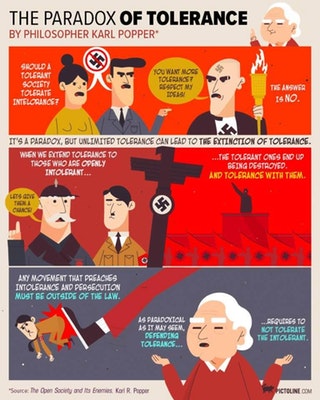
So there’s this going around:

popper paradox

A popular interpretation of this is that it allows the use of force to shut down people who aren’t using force but simply engaging in speech that the person finds objectionable.  Some of the common expressions of this is “bash the fash” and “punch a Nazi”. In neither case do they actually mean folk rounding up minorities or other “undesireables” and sending them to concentration camps or engaging in any other actual violence or use of force.  No, they mean people who simply speak in ways they find objectionable–arguing in favor of policies they don’t like or voting for and speaking in favor of politicians to whom they object.

When you use force to shut down others speech, however repugnant you may find that speech to be, you aren’t resisting intolerance.  You are the intolerance that needs to be resisted.

“But!” Some will say. “Free speech is limited!”

And, to a very limited extent that is true.  There are some very narrowly defined limitations on free speech.  We have slander and libel laws where speech (or print) that is

  1. defamatory
  2. false
  3. made knowing it is false (or with “reckless disregard for the truth”)

is illegal.  We also have laws against incitement to riot and similar laws which basically requires a situation where ones speech (it doesn’t only apply to speech, but speech is what we’re interested in here) can reasonable be expected to lead directly to violence.

Now take a look at who are making those kind of statements?  Going to a protest with a lot of angry people saying “Bash the fash” or “Punch a Nazi”?  Um, go read the preceding paragraph again.

History has seen any number of atrocities.  People by and large don’t commit atrocities because they think they’re evil.  They commit atrocities because they think the people they are slaughtering are evil.  The leaders of such movements may be coldly cynical in whipping up a frenzy for their own ends, but they do it by convincing the frenzied that the targets of that frenzy deserve it.

Using violence to shut down opposing ideas is the roadway to atrocity.  It’s broad and well-paved, with a downward slope that makes the trip really, really easy.  And with every step down that road it becomes harder to turn around because turning around would require admitting that you are the villain in the piece–an admission few have the moral courage to make.

As always, the proper response to odious speech is more speech.  If someone speaks out in favor of Nazi values, or Communist values, or Libertarian values, or whatever values you find most objectionable, speak out.  Say why their views are repugnant and why people should follow yours instead.

Don’t use violence to shut down opposing views.  All you do is show the world that you do not trust your own arguments.

And if you don’t trust them, then why in the world should I?

A Booming Good Time.

Recently went out to a big range trip organized by a friend of mine.  It was held as Bass and Bucks in Wabash, Indiana and is an annual event.  I haven’t been able to go for most years for a variety of reasons including scheduling conflicts and…let’s just say there were family issues.

I took several firearms with me:  three .22 caliber rifles and three handguns.

The firearms:

  • An M-4gery AR pattern rifle with a .22LR adapter.
  • My scope mounted Ruger 10/22.
  • My daughter’s (well, it will be hers when she comes of age) Glenfield bolt action .22 rifle.
  • My Hungarian clone of the Browning Hi Power
  • My daughter’s (when she comes of age) Ruger Model IV Lightweight.
  • My daughter’s (ditto) .22 single action Revolver.

Part of what we wanted to do was zero the M-4gery for my daughter.  So, she’d shoot groups of three while I’d watch the target through the 10/22’s scope.  Between groups we’d make adjustments to the sight.  Elevation was OK, but windage?  We ran out of adjustment range before we got the groups centered on the bull.  I’m not sure what the problem is.  Perhaps the rail-mounted rear sight is not seated properly on the upper.  I’ll have to look into it more.  My daughter shoots left-handed (left eye dominant) so that may be a factor.  She also noted that she’s out of practice.  We’ll try to work more on that.

Even so:  in a zombie apocalypse, I load for her. (And also take care of close in threats.) She’s good.

Unfortunately, I didn’t get many pictures–too busy “doing” to be taking pictures.  I did get one of my daughter shooting her bolt action rifle:

20190914_134755

While there, I got a chance to shoot a full auto Uzi.  “Short controlled bursts” they say.  Here’s the result of my first time ever shooting FA (range about 25 yards):

20190914_131108

I started with a pristine target.  You’ll note that most of my rounds are in the lower left.   That’s in part because my first rounds hit in that quadrant and once I had the bullet holes to provide a point of aim, that’s where I aimed.  However, it looks like the lower left part of a target is the place to aim when shooting bursts full auto.  The reaction of the gun from recoil with succeeding shots will then still be in the target.

On the pistols, I’m still having a bit of trouble with the Hi Power.  The trigger frequently doesn’t fully reset between shots.  I pull the trigger again and nothing.  I have to push the trigger forward to reset and fire.  When I first tried the gun, I thought maybe accumulated gunk (bought used) was interfering with the trigger resetting but after a thorough cleaning I’m still getting the problem.  I’m guessing at this point the problem is with the trigger spring.

You can see that the “trigger lever” goes up from the back of the trigger and pushes the sear lever up to release the hammer and fire the gun.  It remains up so long as the trigger is depressed and is pushed forward by the front end of the sear lever so that the gun does not continue to fire.  Once the trigger is released, it’s supposed to come forward, dragging the trigger lever down and allowing it to engage the sear lever so the gun can be fired again.  This isn’t happening.  The trigger isn’t coming forward properly to drag down the trigger lever.  I have to push it forward.  Once I do, everything’s fine.  Since the problem wasn’t accumulated dirt, I suspect that the trigger spring has lots its temper and isn’t strong enough to do its job.  Replacing it should resolve the problem.  If it doesn’t, I’m not sure where to look next.

On slightly better news, however, I managed to diagnose and fix a persistent shooting problem I had.  My groups when shooting handgun tended to fan down and to the left.  There are several possible causes for that–finger position on the trigger, anticipating recoil, grip issues–but spending some time with the Hi Power, I finally figured it out.  What I’d been doing is while squeezing the trigger also tightening the other fingers on that hand.  This pulls the gun slightly off the line of aim with the results seen.  With some more focus on moving only the trigger finger, my groups started clumping more in the center of the target.

Go me.

After the shoot there was food and drink.  A large chunk of smoked brisket along with some vegetables made a nice, hearty meal.  They had beer but I passed.  Even if beer did not spike my blood sugar, I was driving. (Okay, at my weight, I could have three beers and still be legal, but I prefer not to take even that chance.)

They had a drawing for a “White Elephant Gift Exchange.” I got a “hook and loop” patch from it. “Wolverines!” My daughter got a coffee mug modeled on a shotgun shell.

All in all, a good time was had by all.

On This Day: Harriet Tubman Claims Her Gods Given Freedom

Okay, On this Yesterday, not today.  Close enough. 😉

Accounts differ on just when the woman we would come to know as Harriet Tubman was born.  One report, based on a midwife payment and reports made at the time of Tubman’s escape suggests sometime in March of 1822.  Other dates given include 1815, 1820, and 1825.  In any case, the woman we would come to know as Harriet Tubman was born Aramenta “Minty” Ross to parents Harriet “Rit” Green and Ben Ross, who were slaves in the American South.  No one really knows what part of Africa her ancestors came from or from what ethnic groups.  Tubman was once told that she looked like an Ashanti person (from the Ashanti region of modern-day Ghana) but this was purely conjecture based on physical appearance.

Tubman grew up with her parents on a plantation near the Blackwater River in Dorchester County, Maryland.  There, her mother faced the struggle of attempting, and often failing, to keep her family together.  One by one Harriet’s older sisters–Linah, Mariah Ritty, and Soph–were sold.  A Georgia trader approached the owner about buying Tubman’s youngest brother, Moses.  Rit hid him, with the assistance of other slaves and free blacks in the community, for a month.  Eventually, the owner and the trader came to Rit’s dwelling to seize the boy.  Rit is reported to have told them that she would split the skull of the first one through the door.  The owner backed away and abandoned the sale.

Historians generally agree that this event instilled in Harriet the idea that slavery could be resisted.

While Rit worked in “the big house” Harriet had responsibility for a younger brother and a baby, as was typical of large families of the time.  By the time she was five or six, she was hired out as a nursemaid to “Miss Susan.” There, she was given charge of the care of an infant and, among other things, to rock its cradle while it slept.  When the baby woke and cried, as babies are wont to do, Harriet was whipped.  On one occasion she was whipped five times before breakfast.

Harriet carried the scars of those whippings all the days of her life.

Harriet did not simply accept these indignities as her lot in life.  She found ways to resist, wearing extra layers of clothing as some protection against beatings, once running away for five days, even fighting back.

After her period with “Miss Susan”, Harriet was given other tasks.  These included checking muskrat traps, and as she grew older and stronger, this included field work, driving oxen, plowing, and hauling logs.

When Harriet was an adolescent, another slave attempted to flee.  The overseer threw a two-pound heavy weight at the fleeing slave and, missing, hit Harriet in the head.  The blow reportedly fractured her skull.  The bleeding and unconscious Harriet was carried inside and left on the seat of a loom.  For two days she lay there, without any kind of medical care.

Harriet recovered from the injury but suffered permanent issues.  She suffered lifelong frequent headaches and a tendency to fall into a state where she appeared to be asleep but, according to her own reports, was aware of what transpired around her.  She also started particularly vivid dreams and visions which she interpreted as revelation from God.  And while she was devoutly Christian, she rejected the interpretation many had of New Testament teachings that slaves should be obedient, preferring instead Old Testament tales of deliverance from bondage.

The owner of Harriet’s father had promised to manumit Ross at age 45 and, when the owner died, his son and heir followed through on the promise.  Ross hired a lawyer to look into the legal status of Rit.  The lawyer found a similar provision for her, that she too was to be manumitted at age 45 and that any children born after that age would be born free.  Unfortunately, Rit’s owner ignored those provisions.  Thus, Rit and her children remained slaves.

Aroung 1844 Harriet married free black man John Tubman.  Such marriages were not uncommon in that region, where about half the black population was free.  Sometime after the marriage Harriet changed her name from her birth name of “Araminta” to the one we all came to know her by, “Harriet.”

In 1849 Harriet fell ill once again.  Since this reduced her value as a slave, her owner tried to sell her but could not find a buyer.  The attempt to sell her away from the family she had in Maryland along with keeping her other relatives in bondage justifiably angered Harriet.  However, with her Christian ideals she started with praying that the owner would change his ways.  When her owner continued to try to sell her she changed her prayer, that if he wouldn’t change his ways, then she asked the Lord to kill him.

A week later, her owner died.

Unfortunately, the death of her owner did not end Harriet’s problems.  The handling of her late owner’s estate increased the risk of Harriet’s family being broken up as individuals were sold off to others.  And while her husband tried to dissuade her, she made up her mind to flee.  Echoing the words of Patrick Henry, she is reported to have said, “There was one of two things I had a right to.  Liberty or Death.  If I could not have one, then I would have the other.”

On September 17, 1849, one hundred and seventy years ago as I write this, Harriet and two of her brothers, escaped.  Strangely enough, her owner did not appear to note that the absence was an escape attempt at once.  It was two weeks before a runaway notice was posted, with a $100 reward for each slave returned.

Apparently, some time after they left, Harriet’s two brothers had second thoughts–perhaps because Ben had just become a father–and returned to the plantation, forcing an unwilling Harriet to return with them.

Despite all, Harriet was unbowed.  She soon escaped again, this time without the brothers who had brought her back before, and making use of the Underground Railroad organized by many anti-slavery individuals, many members of the Religious Society of Friends (commonly known as Quakers) who had long been opposed to slavery on religious grounds.

Hariet never discussed that perilous journey in later life.  At first, she dared not because it would have exposed those still active in helping others escape.  Later, no doubt, she had other things on her mind.  The journey would have taken several weeks but in the end she crossed into Pennsylvania and freedom.  Never again, would she be slave.

Unfortunately, the safety of the northern free states proved ephemeral.  Congress soon passed the Fugitive Slave Acts, requiring escaped slaves found in the North to be returned to their owners in the South.  However, that risk must have seemed small indeed to Harriet Tubman as far from simply taking her own freedom, her thoughts turned to those of her family, and others, still enslaved in the South.

In 1850, learning that her niece Kessia and Kessia’s two daughters were to be sold at auction in Cambridge, Harriet snuck back into Maryland to be hidden by her brother-in-law.  When Kessia’s husband, a free black man, made the winning bid for his wife, they managed to sneak away and meet Harriet in Cambridge and Harriet brought them with her to Philadelphia.

The next spring, Harriet returned to Maryland once again to guide members of her family away to the yet uncertain safety of the North.

On her third trip she went to get her husband John Tubman but he had remarried in the interim and did not want to leave.

Thus began her long career.  Again and again she would return to the slave-owning south and help slaves escape to the North, and beyond to Canada (where Fugitive Slave Laws did not reach).

As remarkable as the heroism involved in venturing into the South to help slaves escape to freedom, Harriet did far more.  She aided John Brown in gathering support for his own abolitionist movements.  No one knows where Harriet Tubman was when John Brown made his attack on Harper’s Ferry.  Different historians have ventured different ideas.  Some historians suggest that by this time she had come to share Frederick Douglass’ doubts about Brown’s methods.  And, as we now know, Brown’s raid on Harper’s Ferry in the end failed to bring about the general slave revolt he had hoped for and Brown was charged, tried, convicted, and executed for treason.

And Tubman still was not done.  During the American Civil War she served as a scout for the Union, even accompanying Union forces during the Combahee river raid.

She continued to serve until after the war ended then returned to Auburn, NY where she had a modest home.  In 1869 she remarried to Nelson Davis whom she had met previously while guiding a group of black soldiers in South Carolina.  She lived a relatively quiet life then until her death of pneumonia in 1913.  Well, relatively quiet except for her activism on behalf of women’s suffrage.

She just would not be stopped.

All in all, entirely worthy of being on the $20 bill.  I just wish they would hurry up and release it already.

On This Day: The United States Constitution is Ratified

We the People of the United States, in Order to form a more perfect Union, establish Justice, insure domestic Tranquility, provide for the common defence, promote the general Welfare, and secure the Blessings of Liberty to ourselves and our Posterity, do ordain and establish this Constitution for the United States of America.

Article. I.
Section. 1.
All legislative Powers herein granted shall be vested in a Congress of the United States, which shall consist of a Senate and House of Representatives.

Section. 2.
The House of Representatives shall be composed of Members chosen every second Year by the People of the several States, and the Electors in each State shall have the Qualifications requisite for Electors of the most numerous Branch of the State Legislature.

No Person shall be a Representative who shall not have attained to the Age of twenty five Years, and been seven Years a Citizen of the United States, and who shall not, when elected, be an Inhabitant of that State in which he shall be chosen.

Representatives and direct Taxes shall be apportioned among the several States which may be included within this Union, according to their respective Numbers, which shall be determined by adding to the whole Number of free Persons, including those bound to Service for a Term of Years, and excluding Indians not taxed, three fifths of all other Persons. The actual Enumeration shall be made within three Years after the first Meeting of the Congress of the United States, and within every subsequent Term of ten Years, in such Manner as they shall by Law direct. The Number of Representatives shall not exceed one for every thirty Thousand, but each State shall have at Least one Representative; and until such enumeration shall be made, the State of New Hampshire shall be entitled to chuse three, Massachusetts eight, Rhode-Island and Providence Plantations one, Connecticut five, New-York six, New Jersey four, Pennsylvania eight, Delaware one, Maryland six, Virginia ten, North Carolina five, South Carolina five, and Georgia three.

When vacancies happen in the Representation from any State, the Executive Authority thereof shall issue Writs of Election to fill such Vacancies.

The House of Representatives shall chuse their Speaker and other Officers; and shall have the sole Power of Impeachment.

Section. 3.
The Senate of the United States shall be composed of two Senators from each State, chosen by the Legislature thereof, for six Years; and each Senator shall have one Vote.

Immediately after they shall be assembled in Consequence of the first Election, they shall be divided as equally as may be into three Classes. The Seats of the Senators of the first Class shall be vacated at the Expiration of the second Year, of the second Class at the Expiration of the fourth Year, and of the third Class at the Expiration of the sixth Year, so that one third may be chosen every second Year; and if Vacancies happen by Resignation, or otherwise, during the Recess of the Legislature of any State, the Executive thereof may make temporary Appointments until the next Meeting of the Legislature, which shall then fill such Vacancies.

No Person shall be a Senator who shall not have attained to the Age of thirty Years, and been nine Years a Citizen of the United States, and who shall not, when elected, be an Inhabitant of that State for which he shall be chosen.

The Vice President of the United States shall be President of the Senate, but shall have no Vote, unless they be equally divided.

The Senate shall chuse their other Officers, and also a President pro tempore, in the Absence of the Vice President, or when he shall exercise the Office of President of the United States.

The Senate shall have the sole Power to try all Impeachments. When sitting for that Purpose, they shall be on Oath or Affirmation. When the President of the United States is tried, the Chief Justice shall preside: And no Person shall be convicted without the Concurrence of two thirds of the Members present.

Judgment in Cases of Impeachment shall not extend further than to removal from Office, and disqualification to hold and enjoy any Office of honor, Trust or Profit under the United States: but the Party convicted shall nevertheless be liable and subject to Indictment, Trial, Judgment and Punishment, according to Law.

Section. 4.
The Times, Places and Manner of holding Elections for Senators and Representatives, shall be prescribed in each State by the Legislature thereof; but the Congress may at any time by Law make or alter such Regulations, except as to the Places of chusing Senators.

The Congress shall assemble at least once in every Year, and such Meeting shall be on the first Monday in December, unless they shall by Law appoint a different Day.

Section. 5.
Each House shall be the Judge of the Elections, Returns and Qualifications of its own Members, and a Majority of each shall constitute a Quorum to do Business; but a smaller Number may adjourn from day to day, and may be authorized to compel the Attendance of absent Members, in such Manner, and under such Penalties as each House may provide.

Each House may determine the Rules of its Proceedings, punish its Members for disorderly Behaviour, and, with the Concurrence of two thirds, expel a Member.

Each House shall keep a Journal of its Proceedings, and from time to time publish the same, excepting such Parts as may in their Judgment require Secrecy; and the Yeas and Nays of the Members of either House on any question shall, at the Desire of one fifth of those Present, be entered on the Journal.

Neither House, during the Session of Congress, shall, without the Consent of the other, adjourn for more than three days, nor to any other Place than that in which the two Houses shall be sitting.

Section. 6.
The Senators and Representatives shall receive a Compensation for their Services, to be ascertained by Law, and paid out of the Treasury of the United States. They shall in all Cases, except Treason, Felony and Breach of the Peace, be privileged from Arrest during their Attendance at the Session of their respective Houses, and in going to and returning from the same; and for any Speech or Debate in either House, they shall not be questioned in any other Place.

No Senator or Representative shall, during the Time for which he was elected, be appointed to any civil Office under the Authority of the United States, which shall have been created, or the Emoluments whereof shall have been encreased during such time; and no Person holding any Office under the United States, shall be a Member of either House during his Continuance in Office.

Section. 7.
All Bills for raising Revenue shall originate in the House of Representatives; but the Senate may propose or concur with Amendments as on other Bills.

Every Bill which shall have passed the House of Representatives and the Senate, shall, before it become a Law, be presented to the President of the United States; If he approve he shall sign it, but if not he shall return it, with his Objections to that House in which it shall have originated, who shall enter the Objections at large on their Journal, and proceed to reconsider it. If after such Reconsideration two thirds of that House shall agree to pass the Bill, it shall be sent, together with the Objections, to the other House, by which it shall likewise be reconsidered, and if approved by two thirds of that House, it shall become a Law. But in all such Cases the Votes of both Houses shall be determined by yeas and Nays, and the Names of the Persons voting for and against the Bill shall be entered on the Journal of each House respectively. If any Bill shall not be returned by the President within ten Days (Sundays excepted) after it shall have been presented to him, the Same shall be a Law, in like Manner as if he had signed it, unless the Congress by their Adjournment prevent its Return, in which Case it shall not be a Law.

Every Order, Resolution, or Vote to which the Concurrence of the Senate and House of Representatives may be necessary (except on a question of Adjournment) shall be presented to the President of the United States; and before the Same shall take Effect, shall be approved by him, or being disapproved by him, shall be repassed by two thirds of the Senate and House of Representatives, according to the Rules and Limitations prescribed in the Case of a Bill.

Section. 8.
The Congress shall have Power To lay and collect Taxes, Duties, Imposts and Excises, to pay the Debts and provide for the common Defence and general Welfare of the United States; but all Duties, Imposts and Excises shall be uniform throughout the United States;

To borrow Money on the credit of the United States;

To regulate Commerce with foreign Nations, and among the several States, and with the Indian Tribes;

To establish an uniform Rule of Naturalization, and uniform Laws on the subject of Bankruptcies throughout the United States;

To coin Money, regulate the Value thereof, and of foreign Coin, and fix the Standard of Weights and Measures;

To provide for the Punishment of counterfeiting the Securities and current Coin of the United States;

To establish Post Offices and post Roads;

To promote the Progress of Science and useful Arts, by securing for limited Times to Authors and Inventors the exclusive Right to their respective Writings and Discoveries;

To constitute Tribunals inferior to the supreme Court;

To define and punish Piracies and Felonies committed on the high Seas, and Offences against the Law of Nations;

To declare War, grant Letters of Marque and Reprisal, and make Rules concerning Captures on Land and Water;

To raise and support Armies, but no Appropriation of Money to that Use shall be for a longer Term than two Years;

To provide and maintain a Navy;

To make Rules for the Government and Regulation of the land and naval Forces;

To provide for calling forth the Militia to execute the Laws of the Union, suppress Insurrections and repel Invasions;

To provide for organizing, arming, and disciplining, the Militia, and for governing such Part of them as may be employed in the Service of the United States, reserving to the States respectively, the Appointment of the Officers, and the Authority of training the Militia according to the discipline prescribed by Congress;

To exercise exclusive Legislation in all Cases whatsoever, over such District (not exceeding ten Miles square) as may, by Cession of particular States, and the Acceptance of Congress, become the Seat of the Government of the United States, and to exercise like Authority over all Places purchased by the Consent of the Legislature of the State in which the Same shall be, for the Erection of Forts, Magazines, Arsenals, dock-Yards, and other needful Buildings;—And

To make all Laws which shall be necessary and proper for carrying into Execution the foregoing Powers, and all other Powers vested by this Constitution in the Government of the United States, or in any Department or Officer thereof.

Section. 9.
The Migration or Importation of such Persons as any of the States now existing shall think proper to admit, shall not be prohibited by the Congress prior to the Year one thousand eight hundred and eight, but a Tax or duty may be imposed on such Importation, not exceeding ten dollars for each Person.

The Privilege of the Writ of Habeas Corpus shall not be suspended, unless when in Cases of Rebellion or Invasion the public Safety may require it.

No Bill of Attainder or ex post facto Law shall be passed.

No Capitation, or other direct, Tax shall be laid, unless in Proportion to the Census or enumeration herein before directed to be taken.

No Tax or Duty shall be laid on Articles exported from any State.

No Preference shall be given by any Regulation of Commerce or Revenue to the Ports of one State over those of another: nor shall Vessels bound to, or from, one State, be obliged to enter, clear, or pay Duties in another.

No Money shall be drawn from the Treasury, but in Consequence of Appropriations made by Law; and a regular Statement and Account of the Receipts and Expenditures of all public Money shall be published from time to time.

No Title of Nobility shall be granted by the United States: And no Person holding any Office of Profit or Trust under them, shall, without the Consent of the Congress, accept of any present, Emolument, Office, or Title, of any kind whatever, from any King, Prince, or foreign State.

Section. 10.
No State shall enter into any Treaty, Alliance, or Confederation; grant Letters of Marque and Reprisal; coin Money; emit Bills of Credit; make any Thing but gold and silver Coin a Tender in Payment of Debts; pass any Bill of Attainder, ex post facto Law, or Law impairing the Obligation of Contracts, or grant any Title of Nobility.

No State shall, without the Consent of the Congress, lay any Imposts or Duties on Imports or Exports, except what may be absolutely necessary for executing it’s inspection Laws: and the net Produce of all Duties and Imposts, laid by any State on Imports or Exports, shall be for the Use of the Treasury of the United States; and all such Laws shall be subject to the Revision and Controul of the Congress.

No State shall, without the Consent of Congress, lay any Duty of Tonnage, keep Troops, or Ships of War in time of Peace, enter into any Agreement or Compact with another State, or with a foreign Power, or engage in War, unless actually invaded, or in such imminent Danger as will not admit of delay.

Article. II.
Section. 1.
The executive Power shall be vested in a President of the United States of America. He shall hold his Office during the Term of four Years, and, together with the Vice President, chosen for the same Term, be elected, as follows

Each State shall appoint, in such Manner as the Legislature thereof may direct, a Number of Electors, equal to the whole Number of Senators and Representatives to which the State may be entitled in the Congress: but no Senator or Representative, or Person holding an Office of Trust or Profit under the United States, shall be appointed an Elector.

The Electors shall meet in their respective States, and vote by Ballot for two Persons, of whom one at least shall not be an Inhabitant of the same State with themselves. And they shall make a List of all the Persons voted for, and of the Number of Votes for each; which List they shall sign and certify, and transmit sealed to the Seat of the Government of the United States, directed to the President of the Senate. The President of the Senate shall, in the Presence of the Senate and House of Representatives, open all the Certificates, and the Votes shall then be counted. The Person having the greatest Number of Votes shall be the President, if such Number be a Majority of the whole Number of Electors appointed; and if there be more than one who have such Majority, and have an equal Number of Votes, then the House of Representatives shall immediately chuse by Ballot one of them for President; and if no Person have a Majority, then from the five highest on the List the said House shall in like Manner chuse the President. But in chusing the President, the Votes shall be taken by States, the Representation from each State having one Vote; A quorum for this Purpose shall consist of a Member or Members from two thirds of the States, and a Majority of all the States shall be necessary to a Choice. In every Case, after the Choice of the President, the Person having the greatest Number of Votes of the Electors shall be the Vice President. But if there should remain two or more who have equal Votes, the Senate shall chuse from them by Ballot the Vice President.

The Congress may determine the Time of chusing the Electors, and the Day on which they shall give their Votes; which Day shall be the same throughout the United States.

No Person except a natural born Citizen, or a Citizen of the United States, at the time of the Adoption of this Constitution, shall be eligible to the Office of President; neither shall any Person be eligible to that Office who shall not have attained to the Age of thirty five Years, and been fourteen Years a Resident within the United States.

In Case of the Removal of the President from Office, or of his Death, Resignation, or Inability to discharge the Powers and Duties of the said Office, the Same shall devolve on the Vice President, and the Congress may by Law provide for the Case of Removal, Death, Resignation or Inability, both of the President and Vice President, declaring what Officer shall then act as President, and such Officer shall act accordingly, until the Disability be removed, or a President shall be elected.

The President shall, at stated Times, receive for his Services, a Compensation, which shall neither be encreased nor diminished during the Period for which he shall have been elected, and he shall not receive within that Period any other Emolument from the United States, or any of them.

Before he enter on the Execution of his Office, he shall take the following Oath or Affirmation:—”I do solemnly swear (or affirm) that I will faithfully execute the Office of President of the United States, and will to the best of my Ability, preserve, protect and defend the Constitution of the United States.”

Section. 2.
The President shall be Commander in Chief of the Army and Navy of the United States, and of the Militia of the several States, when called into the actual Service of the United States; he may require the Opinion, in writing, of the principal Officer in each of the executive Departments, upon any Subject relating to the Duties of their respective Offices, and he shall have Power to grant Reprieves and Pardons for Offences against the United States, except in Cases of Impeachment.

He shall have Power, by and with the Advice and Consent of the Senate, to make Treaties, provided two thirds of the Senators present concur; and he shall nominate, and by and with the Advice and Consent of the Senate, shall appoint Ambassadors, other public Ministers and Consuls, Judges of the supreme Court, and all other Officers of the United States, whose Appointments are not herein otherwise provided for, and which shall be established by Law: but the Congress may by Law vest the Appointment of such inferior Officers, as they think proper, in the President alone, in the Courts of Law, or in the Heads of Departments.

The President shall have Power to fill up all Vacancies that may happen during the Recess of the Senate, by granting Commissions which shall expire at the End of their next Session.

Section. 3.
He shall from time to time give to the Congress Information of the State of the Union, and recommend to their Consideration such Measures as he shall judge necessary and expedient; he may, on extraordinary Occasions, convene both Houses, or either of them, and in Case of Disagreement between them, with Respect to the Time of Adjournment, he may adjourn them to such Time as he shall think proper; he shall receive Ambassadors and other public Ministers; he shall take Care that the Laws be faithfully executed, and shall Commission all the Officers of the United States.

Section. 4.
The President, Vice President and all civil Officers of the United States, shall be removed from Office on Impeachment for, and Conviction of, Treason, Bribery, or other high Crimes and Misdemeanors.

Article III.
Section. 1.
The judicial Power of the United States, shall be vested in one supreme Court, and in such inferior Courts as the Congress may from time to time ordain and establish. The Judges, both of the supreme and inferior Courts, shall hold their Offices during good Behaviour, and shall, at stated Times, receive for their Services, a Compensation, which shall not be diminished during their Continuance in Office.

Section. 2.
The judicial Power shall extend to all Cases, in Law and Equity, arising under this Constitution, the Laws of the United States, and Treaties made, or which shall be made, under their Authority;—to all Cases affecting Ambassadors, other public Ministers and Consuls;—to all Cases of admiralty and maritime Jurisdiction;—to Controversies to which the United States shall be a Party;—to Controversies between two or more States;— between a State and Citizens of another State,—between Citizens of different States,—between Citizens of the same State claiming Lands under Grants of different States, and between a State, or the Citizens thereof, and foreign States, Citizens or Subjects.

In all Cases affecting Ambassadors, other public Ministers and Consuls, and those in which a State shall be Party, the supreme Court shall have original Jurisdiction. In all the other Cases before mentioned, the supreme Court shall have appellate Jurisdiction, both as to Law and Fact, with such Exceptions, and under such Regulations as the Congress shall make.

The Trial of all Crimes, except in Cases of Impeachment, shall be by Jury; and such Trial shall be held in the State where the said Crimes shall have been committed; but when not committed within any State, the Trial shall be at such Place or Places as the Congress may by Law have directed.

Section. 3.
Treason against the United States, shall consist only in levying War against them, or in adhering to their Enemies, giving them Aid and Comfort. No Person shall be convicted of Treason unless on the Testimony of two Witnesses to the same overt Act, or on Confession in open Court.

The Congress shall have Power to declare the Punishment of Treason, but no Attainder of Treason shall work Corruption of Blood, or Forfeiture except during the Life of the Person attainted.

Article. IV.
Section. 1.
Full Faith and Credit shall be given in each State to the public Acts, Records, and judicial Proceedings of every other State. And the Congress may by general Laws prescribe the Manner in which such Acts, Records and Proceedings shall be proved, and the Effect thereof.

Section. 2.
The Citizens of each State shall be entitled to all Privileges and Immunities of Citizens in the several States.

A Person charged in any State with Treason, Felony, or other Crime, who shall flee from Justice, and be found in another State, shall on Demand of the executive Authority of the State from which he fled, be delivered up, to be removed to the State having Jurisdiction of the Crime.

No Person held to Service or Labour in one State, under the Laws thereof, escaping into another, shall, in Consequence of any Law or Regulation therein, be discharged from such Service or Labour, but shall be delivered up on Claim of the Party to whom such Service or Labour may be due.

Section. 3.
New States may be admitted by the Congress into this Union; but no new State shall be formed or erected within the Jurisdiction of any other State; nor any State be formed by the Junction of two or more States, or Parts of States, without the Consent of the Legislatures of the States concerned as well as of the Congress.

The Congress shall have Power to dispose of and make all needful Rules and Regulations respecting the Territory or other Property belonging to the United States; and nothing in this Constitution shall be so construed as to Prejudice any Claims of the United States, or of any particular State.

Section. 4.
The United States shall guarantee to every State in this Union a Republican Form of Government, and shall protect each of them against Invasion; and on Application of the Legislature, or of the Executive (when the Legislature cannot be convened), against domestic Violence.

Article. V.
The Congress, whenever two thirds of both Houses shall deem it necessary, shall propose Amendments to this Constitution, or, on the Application of the Legislatures of two thirds of the several States, shall call a Convention for proposing Amendments, which, in either Case, shall be valid to all Intents and Purposes, as Part of this Constitution, when ratified by the Legislatures of three fourths of the several States, or by Conventions in three fourths thereof, as the one or the other Mode of Ratification may be proposed by the Congress; Provided that no Amendment which may be made prior to the Year One thousand eight hundred and eight shall in any Manner affect the first and fourth Clauses in the Ninth Section of the first Article; and that no State, without its Consent, shall be deprived of its equal Suffrage in the Senate.

Article. VI.
All Debts contracted and Engagements entered into, before the Adoption of this Constitution, shall be as valid against the United States under this Constitution, as under the Confederation.

This Constitution, and the Laws of the United States which shall be made in Pursuance thereof; and all Treaties made, or which shall be made, under the Authority of the United States, shall be the supreme Law of the Land; and the Judges in every State shall be bound thereby, any Thing in the Constitution or Laws of any State to the Contrary notwithstanding.

The Senators and Representatives before mentioned, and the Members of the several State Legislatures, and all executive and judicial Officers, both of the United States and of the several States, shall be bound by Oath or Affirmation, to support this Constitution; but no religious Test shall ever be required as a Qualification to any Office or public Trust under the United States.

Article. VII.
The Ratification of the Conventions of nine States, shall be sufficient for the Establishment of this Constitution between the States so ratifying the Same.

The Word, “the,” being interlined between the seventh and eighth Lines of the first Page, The Word “Thirty” being partly written on an Erazure in the fifteenth Line of the first Page, The Words “is tried” being interlined between the thirty second and thirty third Lines of the first Page and the Word “the” being interlined between the forty third and forty fourth Lines of the second Page.

Attest William Jackson Secretary

done in Convention by the Unanimous Consent of the States present the Seventeenth Day of September in the Year of our Lord one thousand seven hundred and Eighty seven and of the Independance of the United States of America the Twelfth In witness whereof We have hereunto subscribed our Names,

G°. Washington
Presidt and deputy from Virginia

Delaware
Geo: Read
Gunning Bedford jun
John Dickinson
Richard Bassett
Jaco: Broom

Maryland
James McHenry
Dan of St Thos. Jenifer
Danl. Carroll

Virginia
John Blair
James Madison Jr.
North Carolina
Wm. Blount
Richd. Dobbs Spaight
Hu Williamson

South Carolina
J. Rutledge
Charles Cotesworth Pinckney
Charles Pinckney
Pierce Butler

Georgia
William Few
Abr Baldwin
New Hampshire
John Langdon
Nicholas Gilman

Massachusetts
Nathaniel Gorham
Rufus King

Connecticut
Wm. Saml. Johnson
Roger Sherman

New York
Alexander Hamilton
New Jersey
Wil: Livingston
David Brearley
Wm. Paterson
Jona: Dayton

Pennsylvania
B Franklin
Thomas Mifflin
Robt. Morris
Geo. Clymer
Thos. FitzSimons
Jared Ingersoll
James Wilson
Gouv Morris

Capital and Delayed Gratification

marshmallow

There is a tale told about how to teach children about delayed gratification–“depriving” one in the short term in order to reap longer term rewards.  In this tale it is suggested to offer a child a marshmallow (or some other modest treat that they enjoy).  Only, if they can wait just one minute (it’s for a child after all) they can get not one but two marshmallows.

A little bit of patience, simply waiting, can get them more than if they grab the benefit right now.

Now, go back to my earlier post on “the plane”, Bastiat’s argument why interest is justified.  A moment’s reflection will show that John, in taking the time and effort to make that carpentry plane, exercises delayed gratification.  He is putting off benefits he could make “now” (by engaging in rough carpentry) in return for the possibility of future benefits by being able to do fine carpentry using that plane.

Resources spent in the present–in John’s case, the time and effort he could have spent otherwise–in return for a future payoff.  Whether it’s simply the “resource” of sitting on ones hands not to eat that marshmallow in front of one, or the time and effort to manufacture capital goods (that plane) in return for better income in the future, or simply investing in a business hoping that it grows.  All of these are exercises in delayed gratification.

A common criticism socialists make of business is that the profits paid to investors, to managers and executives, is “taken” from the workers, the existence of profits payed to executives or shareholders is pure exploitation of the labor that in a “fair” system (by which they invariably mean some form of socialism) labor would share all the income from the sale of goods and services and the “parasites” of stockholders and others would be eliminated.

The problem is the labor would be far less valuable without the capital* brought to the table by those stockholders and their proxies who accumulate the finances to acquire the capital equipment and who have the human capital to organize and run the business.  They may not be on the factory lines turning out widgets but their contribution makes it possible for the workers to turn out more widgets for a given amount of time and energy and makes sure that the widgets they turn out are something people want enough to be willing to pay enough to both keep the employees paid and provide a profit for the investors.  If they fail to do that, they’ll either need to change or they’ll go out of business to free up the resources for somebody who will. (Or, these days, a third “option” is to be declared to be “too big to fail” and have the government bail you out.  That this leads to the continuation of uncompetitive enterprises that use more resources than the value they produce to the detriment of the long-term health of the economy as a whole should be readily apparent.)

Socialist and Communist philosophies tend to discount the value of bringing capital to the enterprise, organizing it, and managing it.  They just kind of assume the capital is there.  They don’t concern themselves with where the capital came from and how to create more of it.  At most, they claim that “you didn’t build that.  Labor built that” and so the capital is simply the product of a previous round of labor.

Well, I didn’t build my shoes either but I still own them.  Don’t think shoes are capital?  Try doing any job that involves a lot of time on ones feet, or out in inclement weather.  I can produce a lot more under those circumstances with good shoes than without.  Or my car.  I might, possibly be able to make a pair of shoes (for sufficient value of “shoes), but there’s no way that I’m making a car by myself.  I may not have built it.  I may not be able to build anything like it.  But I still own it and even discounting its value in getting me to work every day, should I choose to work at Uber or Lyft, or simply hire out as a courier to haul small packages it’s definitely capital.

My car and my shoes were both built by labor.  And that labor was paid to do so in order to make shoes and cars available for sale to people like me.  Similarly the people that made the shoes and built the car used machine tools in factories that other people were, other labor was, paid to produce.

This capital wasn’t produced because labor spontaneously got together and decide to produce capital.  Oh, at some point you get back to someone like John, making a piece of capital equipment to improve his own productivity, but as soon as you get out of the level of handicrafts, you get beyond such things.  Someone had to decide to hire people to manufacture the capital equipment that others would use to make either finished goods or still more capital equipment.  And the people they hired would need to be paid.

Let’s go back to John and his plane.  Suppose instead of making the plane for himself he hired someone to do it.  The person making the plane would certainly expect to be paid for it.  So he and John come to an arrangement.  For X dollars (or, since Bastiat, who originated the example of the plane was a Frenchman, we should use Francs) the workman would make a plane for John to use.  Now, John is still depriving himself to some extent because instead of spending his income on things to make his life nicer now (better cuts of meat for his dinners, nicer clothes, more fuel for heating his house, whatever) he’s instead paying the other guy to make the plane in the hopes of making more income later.

Eventually, the plane is made, John gets it, and turns his hand to finer carpentry (or rents it out to George as described in the above linked article). John starts reaping the benefits of delayed gratification.  Because he was willing to deprive himself somewhat in the short term, he gains longer term benefits.

Do we argue “you didn’t build that” because someone else built the plane from which he is benefiting?  He paid to have it built.  The person who built it got paid for his labor.  What John brought to the table was the foresight to see that having a plane would lead to greater rewards down the road.  And he brought the willingness to sacrifice what else he could have done with the money used to have the plane built.  As result, the plane maker benefited by being hired to make a plane.  The public benefited by their being more fine carpentry made available from that plane being made and put into use.  George benefited by being able to use that plane, rented from John, for his own work allowing him to make more money.

But suppose John had been wrong, that the market for finer carpentry wasn’t as strong as he thought it was?  Well, the plane maker would still have been paid.  There would still be the plane available increasing the availability of finer carpentry for the public.  George might end up defaulting on the terms of the loan through not being able to use that plane to its fullest advantage.  And John?  Well, John’s sacrifice would not lead to the future benefits he expected.

So, whether he “built that” or not, John is the one taking the risk that comes with delayed gratification.  If John has an idea of the risk, then the return he will expect before he’ll be willing to make that sacrifice, to produce the capital that can be used for future production, must also be sufficient to compensate for the risk.  If it doesn’t, he doesn’t make the sacrifice, the investment, and the capital is not produced.

And that is why those who bring capital to the table are deserving of a return on that investment.  Whether they “built that” or not, they paid for it, they made the sacrifice of present benefit in return for future returns.  Denial of that future return by “seizing the means of production” (nationalizing, confiscating, or simply taking control while leaving an on-paper private ownership) removes the incentive to make the immediate sacrifice, and stifles economic growth.


*Capital, as I use it here, means the means of production.  Money is not capital, although it can be used to acquire capital.  Capital includes the machinery and facilities used to manufacture goods.  It also includes, as “human capital” the particular skills involved in producing goods and services, in making sure that the raw materials are available in sufficient quantity, in ensuring that the goods and services can get from where they’re produced to the people that use them.