Let the Sun Shine In

Solar scientists are predicting the next Solar Minimum, the one we’re entering now, to be long and deep. (Yes, I see the entendres in that wording.  Go ahead and get it out of your system.  Done?  Okay, let us proceed.)

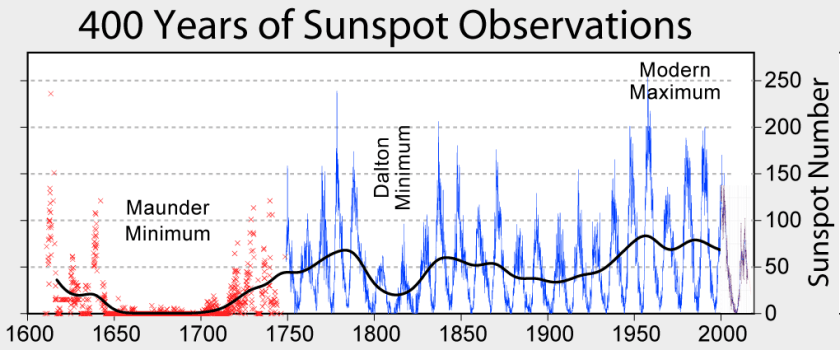
However, I want to note this particular image from the article:
sunspot_numbers

Notice that we had a really low period pretty much over the seventeenth century to the middle eighteenth century.  Then we had a dip during the early part of the 19th century, not as low as that Maunder Minimum, but still pretty low.  Then things came up from there, and then we had another upswing during the 20th century and we’re finally starting to see a fall off in the 21st.

Note that the end of the Dalton Minimum coincides pretty closely with the end of the Little Ice Age.  Yes, solar activity, as measured by sunspot activity, went up before then but climate will tend to lag solar changes because it takes time for the world to warm up once you “turn up the fire” so to speak.  Just like if you turn up the heat on your stove, it takes time for the pan to reach full temperature and heavy pans like cast iron skillets take longer than thin, stamped steel or copper.

Now, “Climate change” is getting a lot of press lately.  There are a series of questions that need to be asked on the subject of “climate change.”

First:  Is the Earth warmer now than it was in times past?

That one’s easy.  Of course it is.  There have been times where the city I’m writing this in have been under a mile thick sheet of ice.  There have also been times when it has been warmer than it is now.  There is nothing the least bit controversial about this.

When it comes to more recent times it’s almost as certain.  As just one example, the Green Mountain Boys were able to drag captured cannon across the frozen Hudson river on the way to break the siege of Boston.  Try doing that now.  Yes, it is warmer these days than at the tail end of the Little Ice Age.  Few people dispute that.

Second: How much warmer?

This one’s a little harder.  For one thing, any measurement has a certain level of uncertainty.   Measurement instruments may be off. (Old saying:  a man with a watch knows what time it is. A man with two is never sure.) My fever thermometer never agrees with the one at the doctor’s office.  And even with the “professional” instrument, they can measure my temperature three times and get three different readings.  My blood pressure cuff recognizes this.  It measures my blood pressure five times and produces an average.

That’s a complication with even a simple, single measurement of one value taken at one particular location.  Now take the entire world, all sorts of different locations from the coldest Antarctic plain to the hottest Libyan desert. Each measurement having some uncertainty.  What the “real” average of the “real” temperatures compared to the values you measured, with all their uncertainty, becomes more open to question.

Then add in how much of the Earth you don’t have measurements for.  Walk around your neighborhood.  How many thermometers do you see whose measurements end up being included in these studies?  Any?  If there aren’t any then your neighborhood’s temperatures are not being included in the measurements.  Given the size of the world there are vast areas that are simply not included in any given set of measurements.  IF the unsampled areas are, on average, hotter or colder than the sampled areas, that will be a source of error in the final reult.

This is not to say that measurement is valueless, but one has to remember that a reported value is only an approximation of the “real” value.  The “real” value will generally be some value close to the reported value.  How close depends on how accurate the individual measurement are, how well the sampling matches the distribution of actual temperatures, and so on.  And any reported change in temperature that falls within that error margin is meaningless.  It could be no more than that your error fell on one side of “real” this time and fell on the other side the other time.

Third:  What is the cause of the temperature rise.

And things get still fuzzier here.  The conventional answer is that the rise of industrialization, with the burning of fossil fuels, releasing carbon dioxide into the atmosphere traps more heat causing temperatures to rise.

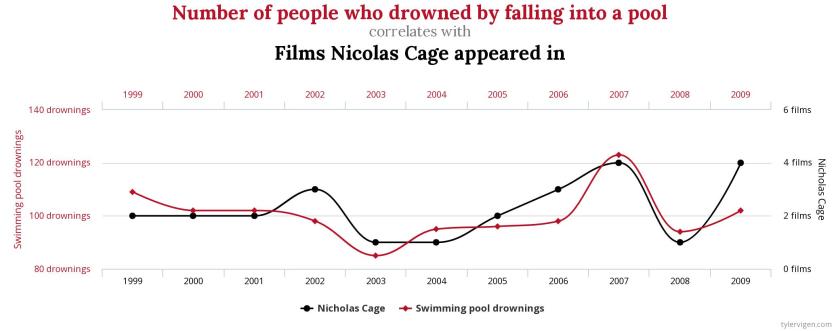
That’s the claim any way.  And people can show a correlation, certainly. (Although if you want to look at correlations, go look at that first picture up above.) The problem is that correlation does not, in and of itself, mean causation.  If you keep looking, there are all sorts of spurious correlations out there. I especially like this one:
chart

Stop Nick Cage before more people drown!

How do you tell the difference between a spurious correlation and a real causation?  Well, the late Richard Feynman gave the answer to that in his lectures, in this case in how to discover a new law of nature.  It’s a three step process:

  • You guess at what the actual relationship is so that you can express it mathematically. (For instance building a computer model of what you think is happening.)
  • You calculate what must happen if your guess is correct. (Running your computer model does this)
  • You then compare the results of your calculation to experiment/observation. (Say, you generated a computer model using 20th century temperature and CO2 level numbers, see if what it predicts for the 21st matches what has happened so far.  Oh, and just to be safe, run it backwards and see if it retroactively “predicts” what happened in the 19th century.  In any case, you must run it against new data, not data that was used to create the model in the first place–that would simply be an exercise in how good your curve fitting was.)

And in the end, if the results of your calculations do not match experiment/observation within measurement error then your guess was wrong.  It doesn’t matter how smart you are.  It doesn’t matter how “qualified” you are.  It doesn’t matter how beautiful your theory is, or how much “sense” it makes, or how “intuitive” it is.  It’s wrong.

Fourth, what are the consequences of the temperature rise?

This, I think, is where it breaks down.  It seems that “global warming”/”Climate change” has become an excuse for every alarmist to point to every dire thing they can predict.

And it’s always dire things.  Nobody ever suggests that, say, longer growing seasons could lead to improved food production or expanded range for tropical and semitropical species–many of which are threatened or endangered because of other reasons.

And they don’t seem to have any restraint.  They also don’t seem to let the fact that they’ve been fairly consistently wrong (“ice free arctic by 2013” being one example).  If you throw out enough “predictions” of enough different things some will happen by sheer chance.

And if you ignore the cases where you’re wrong?  Well, see that bit where Feynman explained how to find a new law of nature.

What mostly happens, though is that something unpleasant happens–a destructive storm, colder than normal weather, hotter than normal weather, excessive rain, drought, pretty much anything “Unusual” (and there’s always something unusual somewhere–the world is a big place)–people point and say “see? Climate change.”

This, my friends, is a classic example of the Texas Sharpshooter Fallacy, where the guy shoots at a wall, then draws the target around where the bullet hit with the bullet hole right in the center then calls everyone over to show them what a great shot he is.

In the end, the “climate change” thing looks a lot like every other set of “environmental doom” predictions dating back to Malthus that have consistently failed to materialize.  They remained nothing but the occasional oddity until folk learned that they could use the predictions for political gain, that they could use them to evoke fear sufficient to stampede people into given the doomsayer’s cause greater political power.

It’s a modern day witch hunt, the rousing of the masses in pursuit of heretics, with a new clergy calling themselves “scientists” (while missing that key element of science:  if your theory doesn’t match reality, then it’s the theory that’s wrong, not reality).  Which, I suppose, makes me a modern day heretic.

Are those torches I smell?


Value

People talk about “value” and what something is “worth” all the time.  It’s a deceptively simple concept and yet one that is so often misunderstood.

The first thing that one needs to understand about value is that it is subjective.  It’s different for everyone.  Let me give an example.

Once upon a time, when I was able to eat fruits freely (Can’t now.  Diabeted, dontcha know.) if I had an apple and someone offered me a grape in trade I’d think they were joking.  After all, an apple is worth much more than a grape, right?  Offer two grapes?  Same thing.  Three?  Same.  However at some point, at some number of grapes, I would be willing to make the trade.  That collection of grapes would be worth more than the one apple.  Presumably, there would be some number of grapes, possibly including a fractional grape, where I would be utterly indifferent about making the trade.  I would be equally pleased whether I had the one apple, or the handful of grapes.

That would be the case where the grapes and the apple had equal value.

If someone else liked grapes less than I do, or liked apples more, he would only be willing to trade his apple for more grapes.  In that case, for him, the apple was “worth” more grapes than it would be for me.

One might ask, which of us is right?  Who’s “value” of the grapes is the correct value?  The answer is “both of us”. His value is right for him.  Mine is right for me.  Now, this doesn’t mean that the person with grapes to offer will get fewer from me than from him.  We’ll get to that in a bit.

So, we’ve established that different people can have different “values”.  In this case, using grapes as a measure of value, I value the apples more highly than the other guy.  But there’s another factor.  How much I’ll value an apple will depend on how many apples I have.  If I have a hundred apples, I would be willing to trade that hundredth one for fewer grapes.  After all, I’ve still got 99 apples after the trade.  That hundredth apple has less value to me than if I only had one.

The other side, of course, is the guy with the grapes also has a value assessment.  If I, for instance, would be willing to trade one apple for ten grapes and the other guy would be willing to trade one apple for sixteen grapes (he really loves grapes) and the guy with the grapes wants one apple for 14 grapes (he likes grapes more than me, but not as much as the other guy) the grape guy and me could make a trade for, say, 12 grapes for one apple.

So what’s the result of that.  The other apple guy doesn’t make the trade.  He’s not going to give up 16 grapes worth (as he sees it) of apple for 14 grapes.  He would lose value.  The grape guy an me, however?  I get 12 grapes for an apple which I value at 10 grapes.  I come out two grapes ahead in the transaction.  The grape guy?  He gets an apple he values at 14 grapes only for two grapes.  He comes out two grapes of value ahead as well.

This is that happens in voluntary transactions:  the transaction only happens if both parties, by their own values, see themselves as gaining value.  It’s the very definition of a “win-win” transaction.

Of course there are more than just two people with apples and one person with grapes.  There are lots of people with grapes to sell and lots of people with apples who want grapes.  This is where “market price” comes in.  A person may assign a particular value to something–like I assigned 10 grapes to an apple. But they’d be more than willing to accept more if offered–like that deal of 12 grapes for the apple.

So, if you take all the people who have grapes and sort them in increasing order of how many grapes they’d be willing to trade for an apple (and note how many grapes each has to trade).  And you take all the people who would trade apples for grapes and how many grapes they would accept for apples (again noting how many apples they have to trade) then look at what happens as the grapes to apple price changes.

At a high value of grapes (few grapes for one apple), anyone who would accept an apple at that price or higher will want to make the trade.  Thus, almost all the people with grapes would be willing to trade.  On the apple side only those willing to make the trade at that price or lower will be willing.  Thus very few people with apples would be willing to trade at that price.  The amount of grapes supplied at that price is far outstripped by the number demanded.  On the flip side, the number of apples supplied at that price far is far outstripped by the number demanded.  That’s what economists call a surplus of grapes (or a shortage of apples).

The result of this is that the apple guys can insist on more grapes per apple.  Fewer people with grapes will be willing to trade at this new value, but more people with apples will be willing to make the trade.  Fewer grapes supplied.  More apples demanded.

At some value of grapes to the apple the number of grapes supplied equals the number demanded, and likewise for apples.  This is the “market price.”  It is not some arbitrary decision made by a third party.  It has only secondary relationship with the amount of time and effort that goes into producing a good or service.  It is the result of every individuals decisions through a system of voluntary exchanges.  And it automatically changes as people’s values change.  If people decide they like grapes more and applies less, the grape guys won’t be able to sell some of their grapes at the current price.  The leftover (a surplus in economic terms) serves as in indicator that prices need to come down (or something needs to be done to raise the demand for grapes, or maybe grapes can be diverted to alternate uses–more jams, jellies, and wines perhaps?)

It is the operation of individual voluntary exchanges as part of a society that sets “value”.  No more.  And no less.

When the State Corrupts Rule of Law: A Blast from the Past

Our nation was founded on certain principles.  One of those principles was that the fundamental purpose of government is to secure fundamental, unalienable rights.  Yet, as so often happens, government is the largest threat to those rights.  I wrote the following after a particularly egregious example of that.


The Washington Post recently had an article about a State drug chemist (responsible for various drug tests) was not only a user of the drugs but had been falsifying drug test results which were instrumental in many peoples convictions and incarceration.

The article asks the question about whether the cases for which she provided evidence should be thrown out.

This shouldn’t even be a question.

(Bear with me for a minute, I’m going somewhere with this.) Some years back there was a column in one of the magazines for fans of comics “The Law is a Ass” by Bob Ingersoll, an attorney and public defender. In that column he dissected use of law in comics and along the way gave introductions to the history and reasons behind many of the things we take for granted in law now.
One of those things was exclusionary rules for evidence. This is actually of far more recent vintage than many people realize. AsBob Ingersoll wrote:

For well over one hundred years, the Fourth Amendment existed without the Exclusionary Rule, the rule which makes evidence taken during an unreasonable search and seizure inadmissible at trial. Basically, the amendment depended on the good faith of the government not to violate it for its enforcement. In much the same way–and with much of the same success–that Blanche DuBois depended on the kindness of strangers. Then, in 1914, the Supreme Court of the United States realized that not everyone scrupulously adhered to the Fourth Amendment. Abuses actually occurred. So did sunsets, but not as often.

The Supreme Court ruled that a right without a means to enforce it is no right at all. To remedy this, it enacted by judicial fiat the Exclusionary Rule, as a means of enforcing the Fourth Amendment.

The Exclusionary Rule says the government cannot be allowed to profit, when it breaks the rules with an unreasonable search, so any evidence seized can not be admitted. To use a somewhat simplistic analogy (I like simplistic analogies. If more law school professors used simplistic analogies, I might have passed a few more courses.), the Exclusionary Rule is like calling back a touchdown pass for a holding penalty. The scoring team would not have achieved its goal, but for the fact that it broke the rules. So, rather than allow it to prosper from cheating, the team is penalized by having the play nullified. The Exclusionary Rule was established to enforce compliance with the Fourth Amendment.

In 1961 the Supreme Court ruled that the Exclusionary Rule was applicable on the states through the Fourteenth Amendment of the Constitution. Now, when state or local police conduct unreasonable searches and seizures, the evidence is not admissible at trial.

And that’s where we are here. These cases need to be thrown out to send a loud and clear message of “don’t do that” to prosecutors. And, yes, prohibition against double jeopardy should fully apply.  they cannot be allowed to succeed, to “benefit” from using such poisonous tactics.
The thing many people forget is that the most important aspect of “rule of law” is not punishing the guilty, but protecting the innocent. When people stop believing that their innocence will protect them from the law, that’s when rule of law collapses. That’s why “proof beyond a reasonable doubt”. That’s why prohibition against double jeopardy. That’s why we have trial by jury in the first place, why we have rules on discovery (where the defense gets to see the prosecution’s evidence), why we have all the procedures in place to protect the accused against the vastly greater might of the State.
And that’s why things like this are so very troubling. What it does to society dwarfs even the horrible injustice to the individual falsely convicted on falsified evidence.  It undermines the very concept of rule of law.

On This Day: Lee Surrenders

I have in the past expressed some mixed feelings on the American Civil War.  While I consider slavery deplorable, I do think the issue was handled poorly.  On the one hand, it would seem from a strict reading of the Constitution, particularly the Tenth Amendment, would seem to indicate that secession was within the States’ rights.   As the Tenth says:

The powers not delegated to the United States by the Constitution, nor prohibited by it to the States, are reserved to the States respectively, or to the people.

Without language expressly permitting the Federal Government to retain a State against its will or prohibiting States from leaving the union it would seem that leaving the Union would be a power “reserved to the States respectively, or to the people.”  Generally speaking, when people make arguments that there was no right to secede, the arguments focus on why they think it should be the case and not on where the Constitution gives the Federal government the power to hold a State against its will or prohibiting a State from leaving.

On the other hand, the actual start of hostilities was when the South fired on the Union held Fort Sumter.  The usual argument by folk arguing the South’s side is that the Federal government should have left Fort Sumter to South Carolina since it was “their land.”

Well, perhaps.  But it was Federally owned as a fort well before the secession.  South Carolina individually, or the Confederate States as a group deciding to just confiscate it is no more morally valid than confiscating private property simply because you don’t like who the owners are.  If you complain about third world countries “nationalizing” businesses after foreigners brought in the resources and experience to develop them then apply that same logic to Fort Sumter.  They basically used force of arms to take it from its legal owners.

With that, then, the war was inevitable.  I would have preferred a recognition that secession was a valid States’ Right but that the attack on Fort Sumter amounted to a declaration of war and the “Civil War” then being a war of conquest. (Such wars were still quite fashionable at the time, whatever we may think of them today.) But, that isn’t the way it played out.  And the result is the assumption that States do not have the right to secede.

From April 12, 1861 to April 9, 1865, four bloody years almost to the day, forces of the Union and the Confederacy fought.  Lee, hoping to recover supplies at Appomatix Courthouse and continue the fight but Grant managed to get ahead of him and he found himself surrounded. After an unsuccessful attempt to break out, Lee requested a meeting with Grant at which he surrendered the Army of Northern Virginia.

This did not mean the fighting was over.  Other battles would be fought over the next few months (with the CSS Shenandoah finally surrendering on November 6) and it would not be until August 20, 1866 before President Andrew Johnson signed a proclamation declaring the war over.

Thus ended the bloodiest war in American history, leaving 620,000 Americans dead in its wake, almost as many as all other of America’s conflicts combined.

I don’t always roll a joint…

But when I do, it’s my ankle.

At ice skating class things were going pretty well.  For the most part, what I need is to develop both my balance and my confidence in my balance that I’m not always half afraid of my feet going out from under me and ending up in a painful drop on the ice. (It’s a lot worse at my age than when I was 18.)

I was doing a new technique today, “slaloms”.  Doing pretty well actually.  Only I was paying too much attention to the new technique and not enough on making sure I had sufficient room to stop comfortably (still rather weak on my stops) before I ran out of ice.  So I see I’m getting close to the wall and I try and stop short.  Only I lean back a little too much and…

Boom.  It wouldn’t have been too bad only  my right leg was folded under me and I landed my weight on my ankle.

Yeah, I was done for the day.  Got some redness and swelling.  And I’m sitting at home now with ice on it.  Hoping it’s just a minor twisting of the ankle and not a full-on sprain (although the swelling suggests otherwise).   If it’s not significantly better by tomorrow morning I’ll go in to have my doctor look at it.  I can stay mostly off my feet until then.

What would really, really suck is for it to be a serious sprain putting me out of action for several weeks.  I paid for eight weeks of classes.  So far, I’ve gotten two of them.  Hate to not be able to take the other six because of an injury.

Keeping the car running well

I recently had the wheel bearings replaced on my Explorer.  One set had gone bad–as in wheel was about to fall off bad–and the others were on their last legs.  The price was so low I merely screamed (one arm, one leg, two extra fingers).  Because of the cost of that, I’ve been doing some other required maintenance on my own to save a few shekels.

The first thing was new spark plugs. It had gotten a bit cranky on starting–sometimes requiring two or three tries to get it to fire up. However, once I thought about it, I realized I was still running on the original plugs–190,000 miles in service on the original plugs. I checked videos on spark plug replacement on the Explorer (what used to be utterly routine engine work is complicated these days because of all the other crap under the hood. The things you have to remove or work around to get access is…challenging. After viewing the videos I decided to ask the shop where I had the bearings done for an estimate to have them do a tune up–yes, access to the plugs looked that bad. I really didn’t want to do it myself.  However that number they quoted? Uh, no. So I bit the bullet and bought a new set of plugs and wires to do the job myself.

Turns out replacing the plugs weren’t as bad as I expected from the video. A couple of extensions and a u-joint for my ratchet drive and a 5/8″ spark plug socket (tools I already had) and I was good to go. It took time, but I got there.

The old plugs were in reasonably good shape. No carbon or oil fouling. Neither “hot” or “cold”. This suggests the internals of the engine are still in good shape. The plugs were just worn–gap had increased from the spec of 0.054″ to about 0.09″.

What I did not do this time around is replace the plug wires. That _is_ going to be a more complicated procedure. Looks like, at least, I’ll have to remove the alternator to get access.

The two things left from a complete “tune up” are an oil change–which isn’t quite due yet–and a fuel filter change. That’s another one that looks to be more of a production, particularly since there appears to be a special tool needed to release the fuel line from the filter.  The quick disconnect tool isn’t expensive it’s just–I hope to get another hundred thousand miles or so out of this car so I’ll probably only use that tool once and then I’ll be on to something that doesn’t use it.  It’s the principle of the thing, you know?

Still, after running some errands as a test drive, I found the hard-starting was gone and I think I’m getting a bit better gas mileage.  So I call that a win.


A Snippet

From a work in progress:


Kaila clung to the ladder just below the lip of the parapet.  She listened, straining to hear any sign that anyone or any thing waited on the wall above.  Silence.

Slowly, Kaila climbed one more rung.  She eased her head up, letting her eyes clear the edge.  Nothing. The wall was empty as far as she could see in the moonlight.

Haste replacing silence, Kaila scambered the remaining height of the ladder to drop onto the wall walk.  Moments later, Isemet joined her. Others followed, each swarming up the ladder in turn.

Working according to the plan, Isemet and one of the others crouched in the shadows, facing away from the gate house.  If any kinmar approached from that direction they would at least have warning.

Motioning for the others to follow her, Kaila trotted toward the gatehouse.  They moved silently, so many ghosts on the walkway. Kaila stopped at the steps leading to the upper level of the gatehouse.  A scuffing sound, barely at the edge of hearing, came from above.

Kaila lifted her sword to a high guard then sprang up the steps.

At the top Kaila saw two kinmar.  The first was standing at the parapet, looking out into the desert.  Kaila’s sword lashed out, catching the kinmar at the top of the neck, just below the jawline.  She turned, drawing the sword through the kinmar’s neck as she faced the other kinmar. This one was squatting near the inner lip of the gatehouse, gnawing on a bone.

The head of the first kinmar toppled from its neck as Kaila’s sword completed its slice.  Kaila spun the sword over and around, a near invisible blur. The first kinmar’s body started to collapse, blood spraying in a shower from the stump of its neck.

Kaila’s sword struck the second kinmar at the angle between neck and shoulder.  The sword cut deep. It passed half through the kinmar’s torso before, with a twisting jerk, Kaila pulled it free.  More blood fountained.

Kaila spat at the coppery taste of blood in her mouth.  She waved the others of her detail to join her on the gatehouse roof.

As the nomads of Kaila’s small band climbed the stairs, Kail looked out over the desert.  She saw no sign of movement. She glanced up. The greater moon was almost at zenith. Soon.

She had made little noise.  She had struck before either of the kinmar on the top of the gatehouse could raise an alarm.  With luck, no one would spot them before Bassum led his men to draw out the ready guard in the gatehouse.  With luck, they would be able to fall upon whoever remained within and prevent the closing of the gate. With luck.

Without luck, if Bassum did not arrive before they were discovered, if the kinmar within chose not to pursue the bait as they had before, then to Kaila’s group fell a harder task.  Then, they must fall upon the forces within, forces not depleted by chasing Bassum’s lure, and open the gates themselves, not just open them, but defend them against whatever other forces might come from the city.

Kaila glanced up again, measuring the height of the greater moon with her eyes.

Soon.

Claiming Sole Ownership of a Cultural Element

I have talked in the past about the ridiculousness that is the idea of “cultural appropriation”.  In that vein, there was this on Social Media:

55927989_2363144660570102_4959631596933087232_n

This Lauren Hunchar person appears to think that because certain “people of color” use the term “Spirit Animal” that somehow blocks others, particularly white people, from having a concept which can be described using the same term.

This is absolutely ridiculous.

Now, this Hunchar person (I would like to say “Ms. Hunchar, but I would never dream of assuming this person’s gender–this person would probably be most offended were I to do so) may be thinking that “white” is synonymous with “of Judeo-Christian belief” and, certainly, one could argue that Judeo-Christian belief is not a place where you’d find much room for “spirit animals”.  Or maybe not.  After all, the Holy Ghost is reported to have descended on Jesus in the sign of a dove.  Jesus himself is often described as “the Lamb of God”.  One might argue that these representations could be described as deity presenting as a “spirit animal” to lead people to salvation.

But leaving that aside, the Judeo-Christian religions are far from the only traditions found in the history of “white” people.  And a small but growing minority of people are turning in many ways to the folk religion of their ancestors.

My own ancestry is Germanic on my father’s side and Irish/Celtic on my mother’s.  Now, much of the original Germanic belief (as practiced by the tribes in what would become modern Germany) is long lost, but the other branch of that belief, that practiced in the Nordic countries, had a bit more survive to be recorded and reach us to the modern day.

One of the beliefs among the Germanic/Nordic people is the Fylgjur.  These were spirits that accompanied a person in connection to their fate or fortune.  Oft times these Filgjur would appear in the form of animals that were seen at the birth of a child, or which would eat the afterbirth.  Sagas report mice, dogs, foxes, cats, birds of prey, or carrion eaters as these fylgjur.  Other sagas report fylgjur that reflect the character of the person.

Spirits, that take the form of animals and that are connected to an individual.  Spirit animals.

That’s the Germanic side, but what about the Celtic?

Well, in Celtic belief the gods and godesses frequently had animal forms or at least animal associations.  As one example, the Morrigan was associated with crows, ravens, wolves, and horses.  Animals were often seen as guides, providing omens, sent by the gods/spirits.  So, once again, spirit animals.

As you can see, there is a tradition of spirit animals on both sides of my ancestry.  I have as much “right” to claim the term “Spirit Animal” as any Person of Color.  Just because they have that concept in their culture does not mean they can deny the concept to others which have it as well.

So I will thank you, Hunchar person, not to deny me my cultural heritage.