“You Scientists Can’t Just Appreciate Beauty. You have to Analyze it.” A Guest Post by Jason Fuesting

triple-rainbow.jpg

One of the motivations for the late Richard Feynmann learning to draw was so he could represent, artistically, the beauty he found in math and physics. Math and science does not reduce the beauty of the world around us. I can fully appreciate the beauty of a double rainbow. (And I’ve seen the occasional triple rainbow–glorious.) And I can also appreciate, the nature of the wave equations, how dispersion, the differential propagation speed of different wavelengths of light through a medium, separates the white light from the sun into different colors and how total internal reflection in spherical water droplets magnifies the effect to create the arc of color in the sky.

Knowing the science doesn’t take from the beauty. It adds whole new dimensions.

And so, the following guest post from Jason Fuesting.


I’ve been told before that because of who and what I am, I could not see the beauty in the world around me. That somehow, being a hard science and math type, a technologist, and a conservative amongst other things, that somehow those things have rendered blind me to the world while they themselves held superior vision and only they could appreciate what lay around them….

Why is it that the people who claim superiority never actually are? Why is it those loudest in their proclamation of the faults of others are nigh universally declaring their own faults and casting them upon others?

As a compulsive learner, I have never been in a position where at some level I did not ask myself “Why?” I’ve never been in a position where I did not try to answer that question and then question the answer, and then question that answer, ad infinitum. Only time has limited my search for knowledge and understanding.

When I step out on my front porch, I see beauty. Everything, everything is beautiful. Every. Last. Thing.

I see the trees… Their structure? The structure they have grown in to was dictated in real-time by localized conditions that skew protein expression, whose skew is in turn determined by its own set of rules encoded in each tree’s DNA, which is in turn dictated not just by inheritance but the subtle, fickle hand of the universe… The way they move in the wind? The interplay of time-variant, fluid dynamic forces fleeting variations of pressure density tugging with drag one moment, pushing the next as the cellular structures they affect bend and twist under their influence. The grass, no different.

I see the squirrels, the birds, the insects, every last living thing, and they’re all this time-slice’s ultimate expressions of their phylogenetic heritage. They are the tip of an unbroken chain reaching backwards in time all the way to the first organic structure that somehow managed to encase itself in hydrophobic proteins, thus preventing its immediate dissolution by the polar solvent we know as water. Yet, that same structure’s function is wholly dependent on the very things that will ultimately dissolve it anyway: water and oxygen.

I see the people. Our fates, our beginnings, they are no different, neither from each other’s, nor from those of the animals.

And yet, the unbroken chains of every living being I see represents is but a minuscule part of a larger chain, one that will remain unbroken, pushing forward through the barrier of time that drags us along. That chain stretches out toward a horizon none of us will ever directly experience in our current form, to a destination wholly unknowable and mysterious.

I see the sky, blue as it only appears to be, and marvel at the trillions of trillions of photons streaming into the atmosphere above me at any given moment. I see the blues from Rayleigh scattering that hide the blackness of space during the day, the Mie scattering that gives us the whites of the clouds, all the subtle scattering influences that give the world color, hue, verdant warmth, and chill pallor.

And when the sun has gone down, I see the universe laid bare before me. I see the moon looming overhead, tidal locked to the irregular spheroid I stand upon, with its linear and angular momentums, forced by the warp and weave of spacetime into an apparently circular path, much as our path circles the sun. Yet even that isn’t static, for as we move the moon, so must it too move us, and the same between us and the sun, and so forth for everything in our solar system, an endless precessional and processional dance of n-body orbital dynamics.

But that chain of influence does not stop there. I see the endless, unfathomable black stretching out, interrupted only by the twinklings of a past that took millions, if not billions of years to travel directly to my eye. I see the endless spheres, the endless layers of influence, our solar system and countless others orbit a central point, which in turn orbits something else, and so forth, each larger system influencing and being influenced by its children and its peers, a nigh limitless cosmic choreographing to a Great Song so beautiful we only experience it as the flow of time.

And yet, by seeing the vastness of eternity laid out before me, I see, hear and feel the infinitesimal, vanishing smallness that eternity is composed of, seemingly ignorable yet omnipresent and omnipotent in ways so easily missed, so easily misunderstood.

At human scales, one can see, touch, and feel without ever knowing of this smaller realm nor its rules. Yet knowing the rules, as ill-defined as we have suffered in our quest to define them, one stumbles upon uncomfortable truths. One does not ever touch a thing for the electromagnetic force stops you long before you come in contact with anything. In fact, the act of seeing is not seeing, nor is the act of hearing actually hearing. They are all electromagnetic interactions.

Hearing? Particles in the air move because other particles push on them. The structures of your ears focus this movement into a chamber where, in their moving, they disturb other particles, which in turn sets off a chain reaction that generates electric arcs that spiral deep into your brain. Those currents are what you eventually interpret as sound, and the quietest sound one can hear without undamaged hearing involves the movement of particles whose distance travelled is smaller than the diameter of a hydrogen atom.

Touch? Little different. The feeling of touch is merely the influence of other particles that excite certain nerves into firing their own currents that feed to different parts, different processing centers of the brain. Feeling heat? The same with the only exception that instead of long-term compression sensitivity, those nerves are sensitive to short term energy transfer, because heat is precisely and only the transfer of energy. It’s exactly the same thing as the energy transferred when a thrown ball strikes a wall, except the ball is a particle and you are the wall.

Sight? Sight is subtly different. One does not “see” the object. What one “sees” are photons emitted by the object. Much like hearing, structures in the eyes focus these photons onto sensitive tissues that trigger currents when struck, and those currents are passed into yet another neurological structure for interpretation.

Even our idea of what constitutes a thing doesn’t apply at this scale. One grips a ball and knows the ball is solid, but one does not know the ultimate truth. Particles are not solid. They are distributed into a cloud whose shape and perturbations are determined by the sum of influences at every given point of the cloud, and the influences are what most think of as forces. And yet, the shape and perturbation of one cloud dictates the sum of influences it has against neighboring clouds and vice versa. Thus, some clouds become bound to others so long as they contain less than a certain amount of energy. When one holds a ball, the electromagnetic force keeps the particles of your hand separate from the particles of the ball. When one squeezes the ball and it feels solid, the clouds that comprise the ball compress to a minimal volume as allowed by their joint sum of influences, beyond which the force so applied cannot compress further, and that incompressibility is fed into the sense of touch.

But more subtle than that, and lost on many, the particles that compose one’s skin do not form a uniform surface, much less a flat barrier. Much as one can grip a ball of sand and the sand emerges from between one’s fingers, so too do the particles of the ball, but on the quantum scale. As such, the particles of the ball necessarily squeeze into those gaps, and given the shape and density of all the clouds are dictated by the sum of influences, during this compression one will necessarily see some small number of clouds pass through others into places solid objects could not go. And in releasing the compression, not every particle, nor every structure of particles bound to other particles, will return to its original placement. Some of the particles of your skin will be left on and in the ball, just as part of the ball will be left on or in you.

And the apparent weirdness persists because that description only largely applies to what we have defined as bosons, as matter, as things. There are things that are not things in the way we think of things being, not even a little bit. Those? Those are gauge particles like photons.

Photons are things and yet not things. They are events that propagate like waves, yet their effects resolve like particles. They are the means of interaction, the ultimate expression of the electromagnetic force. And much like their cousins, gluons, who fill the same role for the Strong force, they carry momentum and energy yet have no mass. In being so, in being so they teach us the first of so many lessons: the universe is under no compulsion to make sense to us. We are the students, not the teachers. Just as students do not dictate the lessons, we must not presume to dictate terms to the universe when we are but motes of dust if we hope to learn from it.

And all that is just what I see before me as a man and physicist. My perspectives are many. The interactions between the people are laid bare through my explorations on Liberty and economics. Motives, actions, reactions, all are part of a consistent set of rules that explain every last knowable thing. The technology I can see, the cars, the street lights, power lines, all of them are expressions of humanity to manipulate the environment using the rules we know to achieve results we want using the resources we have, all of which are ultimately dictated by the influence of Liberty and economics. Everything mentioned, they’re all systems and those systems are fed by smaller systems while simultaneously themselves feeding into larger systems. They are a long, unbroken, spiral of chains of influence stretching from the smallest scales to progressively larger ones, each link influencing the link before, the link after, and the link beside it.

Even our own bodies and the neurological structure with which we parse the world beyond for us is not an exception this. We, however you want to define ‘we’, are embedded in running-state-based self-programming organic computers which in turn are embedded in a larger organic structure we use to manipulate and observe the world around us.

And here I am, gazing upon it all in biblical awe, and, in bearing witness to the same, I am not afraid. Instead, I want to know more. I want to know it all.

And there is so much to learn. We start this life unknowing and naïve. We learn the world around us by interacting with it, not knowing that in every interaction, our perspective, derived from our running state, dictates our interpretations. As we learn, we explain unknowns and populate the running state with expectations, gaining perspective in an iterative process where every layer of knowledge builds on previous observation, previous perspective. Eventually those expectations seem feature complete, but they’re not. Most learn only the lessons of the system that exists at the scale we live in, not knowing our system is merely the natural result produced by progressively smaller systems. Similarly, they do not necessarily learn that the results of our scale’s system project upward, directing the ebb and flow of systems ever larger than we are. Vanishingly few bear witness to the unbroken chain from the infinitely small to the infinitely large, an infinite sum of the smallest that ultimately describes the largest in such excruciating detail that the smallest influence is undetectable.

Those influences are all describable in one language: mathematics. Everything you see, everything you touch, everything you hear, from the most mundane object to your very self, they are, at their heart, nothing but math. All of them part of a larger yet unbroken and in this case unbreakable chain. An infinite sum of infinite sums, stretching in infinite directions across an infinite series of scales, connecting both the known and the unknown to a past we do not know to a future we cannot know and then to a future we will never see because all things are fleeting, not just us, but the stars themselves as well.

And despite our efforts and the cumulative efforts of those who have come before us, the unknown still looms, just beyond our notice. And we should, no, we aught necessarily seek to understand because in not knowing we are limited. And in our limitation, we err. On the personal scale, we harm those who should not be harmed, shelter those who should not be sheltered, aid those who should not be aided. We seek peace when we should fight and fight when we should seek peace. We fail to see our desire to heal only produces harm. On nearby scales, we lack solutions for problems that can and should be solved. At scales non-adjacent to our own we fail to find the knowledge that leads back to solutions at other scales, which in turn eventually loop back to provide solutions at our scale.

Those solutions and so much more lie in the unknown, just beyond our notice. We could have them if only we were curious enough, persistent enough to seek them.

But why? In seeking the unknown, what will we find? Why am I, like so many, driven to push against the night, to push the unknown back as our forefathers did before us? What were they searching for? What are we searching for? Why?

From the steps outside my house, looking at the beauty in the infinite complexity around me and the vastness of Eternity, I am find myself curious, as do many others. What do we see, peering forward in time with the tools we have? We know enough to know those predictions will always be imperfect precisely because the scales below us are so innumerable, but what if we could look backwards? The past has already happened, its influence laid bare in its totality around us. What would we see if we could but roll back the hands of time, rewinding the Great Song back to the beginning? What truth awaits us there?

What we see today when we attempt to do so certainly suggests much, but is our understanding sufficient such that by applying what we know, do we find what truly was? Or is what we currently find waiting for us at the beginning merely an expression of our ignorance, a defect in our knowledge? We do not nor cannot know for certain. And so we push forward, as did our forefathers. Standing on the shoulders of the giants that came before us, we are pulled along by the flow of time, searching, hunting for ever more knowledge. We hope to fill in the gaps, perhaps gaps we aren’t even aware exist. We hope, in the knowing of new things, we will recognize ever more subtle details in the picture, the great Infinite Sum, before us. And with that newfound clarity, we seek to forge what we hope is the final link of yet another unbroken chain that spans from the horizon behind us to where we stand today.

As it has in every one of their children since, when the first human gazed upon the stars for the first time so many eons ago, the sight stirred a need in their hearts, in their spirits. The sight before them evoked questions that have no answers and a need to answer them. Who am I? What am I? What does this all mean? What comes next?

And yet, bearing witness to all of this, when my heart aches at what I see, I am told I see not the beauty in the world around me by those who presume the superiority of their perspective. In making that presumption, they commit the gravest of fundamental errors: they presume to dictate to the universe what is and is not. Unseeing, they knowingly turn their back on the unknown and embrace their limited state along with everything that implies.

Not everyone who sees the world differently is blind, for believing so presumes one truly sees. Only in refusing to question what we see are we ever truly blind.

Be the bright mote in the darkness that lights the way for others, not the one who seeks to snuff it out. Be the shoulders upon whom future generations will stand upon to reach even further, not the hand that yanks them back into ignorance. Be the next link in the chain, not the destroyer. All scales affect the others. This need not be the end.

Romantic Goth

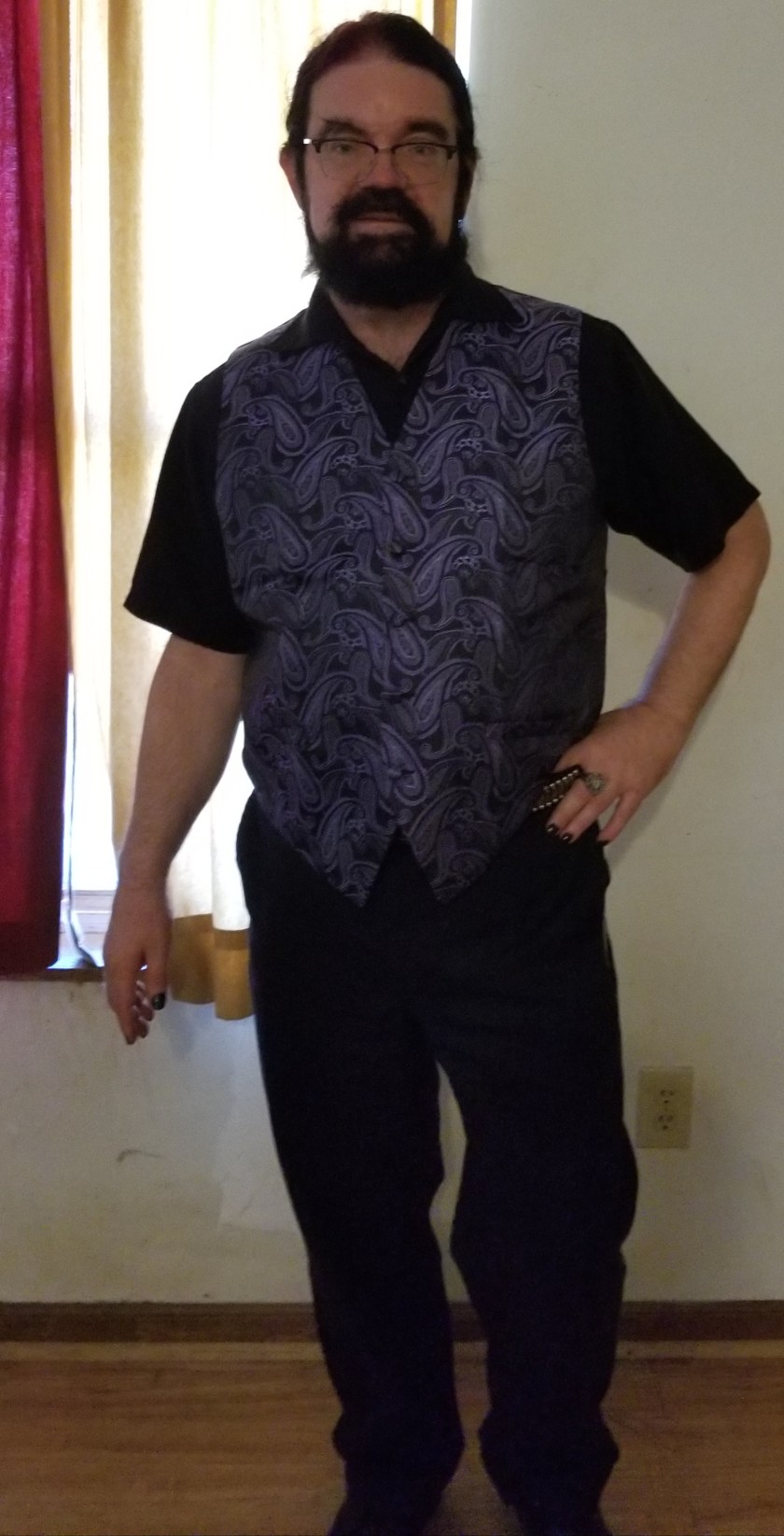
While I’m still wanting to make “Viking Goth” a thing, I’m starting to drift more toward a “Romantic Goth” look.

“Romantic” here doesn’t mean love, although that can certainly be a part of it, but rather the “Romantacism” of the romantic period of history.  Romantic goths focus on beauty in darkness: dead roses, moonlight illuminating a graveyard, ravens and wolves, and so forth.

Fashion tends to be flowing, lace and velvet are quite common.  Styles from the Victorian and Edwardian ages, or even further back to Medieval times, are popular.

“An elegant goth, for a more civilized day.”

Indeed, it’s the exact opposite of that silly screed I fisked before:

Goth deliberately crosses all the lines of proper dress, manners, refinement, and decency.

Stuff and nonsense.  There’s nothing the least bit indecent about any of this:

And, if I might be so bold as to suggest:

20190824_102522

I Guess I’m a “Statist”.

Short one.

gulag.jpg

I get that accusation from time to time.  It seems to center on four things.

First:  I’ll sometimes talk about what law currently is, rather than what it should be (or shouldn’t be).  Basically, “these are the constraints we have to work under at the moment.” Since I’m not immediately dismissive of any unjust law, or, well, let’s be honest, of any law at all, and advocating ignoring/disobeying that law I apparently “support” it.

This, in some minds, makes me a “statist.”

Second, I think that some small amount of government with the coercive force that implies, properly managed is necessary in all but the smallest societies to maximize liberty.  I call this the “paradox of liberty” and have discussed it more here.

That, in some minds, makes me a “statist.”

Third, I believe that given the gargantua our government has already become, great care is needed in pruning it back.  It can’t be done quickly any more than it was quickly built to its size and intrusiveness.  Attempting to do so can cause hardship which will cause the populace to push back hard against the reductions leading to a redoubling of the growth and intrusiveness of government leaving us worse off than when we started.  I’ve discussed that before too, most recently here.

That, in some minds, makes me a “statist.”

Fourth, I believe in looking at achievable goals, not some pie-in-the-sky utopian dream.  Furthermore, I have to deal with the reality that there are other people out there with their own utopian dreams that they are trying to reach and that will affect what goals are actually achievable.  And sometimes that might mean I’m going to lose and the best I can hope for is to minimize the loss.  But since I don’t throw all practicality and achievability to the wind and stand on unadulterated “principle” regardless of whether it actually helps achieve anything or not is a crime in some eyes.  I have discussed that before too here.

That, in some minds, makes me a “statist.”

In short, I work toward an achievable approximation of my ideal which will fall short of perfection in this imperfect world filled with imperfect people.  That makes me a “statist.”

I can live with that.

Think “Things” not “Words”.

Oliver_Wendell_Holmes_Jr_circa_1930-edit

Supreme Court Justice Oliver Wendell Holmes, Jr. said (among a great many other things): “Think ‘things’ not ‘words’.” Words can often confuse matters.  “Things” are often much clearer.  Thomas Sowell is wont to repeat this statement in terms of economics.  And there is much truth to it.

Consider, for instance, the much maligned “unfavorable balance of trade.” This comes from the old merchantilists.  At the time, (before Adam Smith and his treatise on The Wealth of Nations), a nation’s “wealth” was considered to be the amount of gold and silver, specie, that it possessed.  If one imports more than one exports, the result is a net flow of specie out of the country to the folk who were exporting.  More specie going out than coming in meant smaller reserves, less wealth as they saw it.

This use of specie as the measure of wealth was really only of importance to the upper classes of society.  The well-being of the population as a whole was not considered significant.  The nation could become “wealthier” so long as there was more gold and silver, even if that wealth was obtained on the backs of an impoverished population.  Adam Smith’s key insight–that it’s the goods and services available to a population, not the amount of specie, that’s the true wealth of a society and that trade increases that–made the term, as used, obsolete.

Where thinking “words” instead of “things” comes into play is that this outdated concept of “unfavorable balance of trade” remained in place and people take it seriously.  And yet, the US had a “favorable balance of trade” during every year of the 1930’s (also known as “The Great Depression”).  And some of our best “boom” times?  And the record “unfavorable balance of trade” in 1984?  That came in the midst of a huge economic boom averaging 4.3% GDP growth and 2.8% employment growth.

The “words” were “unfavorable balance of trade” but the thing was “more goods and services available to the American people”.  The thing promoted more prosperity, and with it more jobs and more wealth, exactly the opposite of what the words brought to mind.

Words, particularly in the political arena, are often used to mask the “thing”.  Words can be manipulated more easily than “things.” The “thing” doesn’t change, but it’s easy to use multiple meanings for a word, and to change the meaning one is using without notice (the Fallacy of Equivocation).

So look beyond the words to the things.  Think things, not words.

“Not True Communism/Socialism”

bone-pile-3614_640

Whenever one points out the horrors of communism and socialism historically, folk pushing the latest round always dismiss them saying they weren’t “true communism” or “true socialism.”  First let’s dispose of the difference which is mainly in how you get there.  They both involve seizure of control of the means of production for what they profess to be the “common good.” The only real distinction is communism generally involves armed overthrow of the existing system and socialism does so through lawfare.

But let’s go with the idea that it wasn’t “true communism/socialism”:

Lenin: “Let’s do Communism/Socialism.”
Russia: “Okay.”
Horrors follow.
“That wasn’t true Communism/Socialism.”

Mao: “Let’s do Communism/Socialism.”
China: “Okay.”
Horrors follow.
“That wasn’t true Communism/Socialism.”

Ho Chi Minh: “Let’s do Communism/Socialism.”
Vietnam: “Okay.”
Horrors follow.
“That wasn’t true Communism/Socialism.”

Castro: “Let’s do Communism/Socialism.”
Cuba: “Okay.”
Horrors follow.
“That wasn’t true Communism/Socialism.”

Kaysone Phomvihane: “Let’s do Communism/Socialism.”
Laos: “Okay.”
Horrors follow.
“That wasn’t true Communism/Socialism.”

Pol Pot: “Let’s do Communism/Socialism.”
Campuchea: “Okay.”
Horrors follow.
“That wasn’t true Communism/Socialism.”

Chavez: “Let’s do Communism/Socialism.”
Venezuela: “Okay.”
Horrors follow.
“That wasn’t true Communism/Socialism.”

Bernie Sanders: “Let’s do Communism/Socialism.”
USA: “?”

I don’t care if it’s “true” (however you define “true”) Socialism/Communism.  The pattern after “Let’s do communism/socialism” and “okay” remains what it remains.

How about “let’s not.”

Pure Sentiment: A Musical Interlude.


I have a playlist of love songs but given the state of my…personal life let us say, well, listening to them could be a hit or miss proposition whether they’d make me feel good or trigger a depressive bout.  I’d compare the music with my reality and…

Well, one of the things I’ve had to learn is that there are worse things than being alone.  Much worse.  As the late Robin Williams put it:  “I used to think that the worst thing in life was to end up alone.  It’s not.  The worst thing in life is to end up with people who make you feel alone.”

I’d kind of understood that intellectually, but until I actually grasped it on a visceral level it was just words.  But once I did, I learned to appreciate where I am.  If anything happens in my life, great.  If not, that’s okay to because there are far, far worse places I could be.  And once I really understood that, I could listen to the music without the need to compare the music with my life.  I could simply enjoy the music.

So here’s some of it.  The music tends to be simple, likewise the “story” of the song.  Evocative imagery and powerful use of metaphor is used to evoke unrestrained emotion.  The musical styles, indeed, are often not to my normal taste but the expression here makes them an exception to all my usual tastes.


I have heard it said that a good song is one you groove along to; a great song is one that grabs you, holds you so that you just sit there with goosebumps.  This is one of those songs.


Remember, I grew up in a religion where the very idea of heaven was the ongoing, eternal continuation of love and family.  I was still a believer in that religion when I first heard this one and it still has enormous power to move me.  “If love never lasts forever, then tell me what’s forever for?”


This is actually a medley from a religious musical.  I don’t have to believe the religion to enjoy the story–and the second part of this, the “Eternity is You” part?  Wow!


And let’s wrap up with two of the most powerful (in my opinion) love songs ever written:

https://www.youtube.com/watch?v=pXhKWWCCdk8


Now, excuse me while I go find some tissues. (Yes, I can be a sentimental softie sometimes.)

Feeding the Active Writer: Spicy Garlic Chicken

I have always liked the Spicy Garlic sauce on wings at Buffalo Wild Wings.  The problem with most sauces in most places is the amount of sugar in them.  BWW’s Spicy Garlic isn’t too bad (4 grams net carbs in a small order).  It is, however, enough that I want to carefully watch the rest of what I eat during the day (like I don’t do that already).

There are recipes online that purport to duplicate the taste of BWW’s recipe.  I’ve tried one or two and…frankly, they’re more trouble than they’re worth.  Fortunately, I’ve come up with something simple and quick that falls nicely in the “active writer” aspect–those of us who are crunched for time.  It’s also simple, with only five ingredients.

Ingredients:

  • Cooked chicken pieces (see description below)
  • 2 Tbsp mayonnaise
  • 2 Tbsp hot sauce of your choice (I like Cholula original)
  • 2 Tbsp garlic powder
  • 1/4 cup sweetener (any “measures like sugar” type–I use a store brand Splenda equivalent)  Yes, if you’re not low-carb/keto you can use sugar.

The chicken can be any chicken you’d like.  Or you could use pork, or really anything.  Since the sauce is strongly flavored this is a good choice or blander meats. I wouldn’t use it on more flavorful cuts of beef or anything like that.  If you’re a traditionalist, you can use sectioned wings.  I like to get boneless skinless chicken breasts (available for $1.99/lb in 4-6 lb packages at my local supermarket) and bake them until cooked through and store in the refrigerator until needed.  I cut off as much as I need at a time and cut into bite-sized pieces.  6 oz of the cooked pieces makes a nice base for a meal.  Heat it in the microwave and you’re ready for the sauce.

In a small bowl mix the other ingredients.  The amounts given are appropriate for about 6 oz. of small chicken pieces.Adjust as needed for however much chicken you’re coating.  Also, don’t be afraid to adjust the amounts.  If you like it hotter add more hot sauce and reduce the amount of mayonnaise.  Less spicy?  Reverse that.  Like more garlic?  Go ahead.  Do you prefer it sweeter?  Cut back on the hot sauce and add more sweetener. If need be you can add a small amount of water to thin the sauce.

Dump the sauce onto the cooked chicken pieces and stir until the chicken is well coated.

Enjoy.

“Not Today”

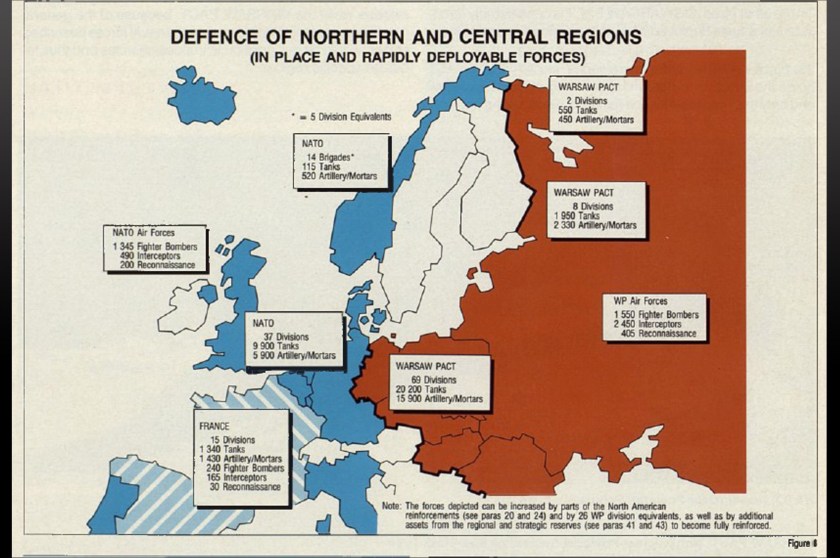
Defence of northern and central regions

Forces in Europe during the cold war were described to me once this way. Their job was to get the Warsaw Pact leaders to look across the border, look at their own disposition of forces, and decide “not today.”

They didn’t have to win to be successful, they just had to create enough doubt in the minds of the Soviet and Warsaw Pact leadership to get them to hesitate “today” (for any given “today”) and then do it again the next day.  It would be nice to be able to win a conflict, but creating enough doubt that the conflict doesn’t happen, at least not in the battlefield with direct war between the major powers, was sufficient.  As a result, the conflict moved to different venues–proxy wars and, most telling, economic competition.  It was this latter, economic competition, which brought about the downfall of the Soviet Union.  The greater efficiency of the market economy over anything centrally controlled meant that they were forced to open up markets “a little bit” (Gorbochev’s “Perestroika”) which turned into unexpected floodgates and led to the collapse of the Soviet Union.

That creation of uncertainty is the roll of an armed citizenry.  Get would-be tyrants to look at the citizenry, look at the forces they can count on to enforce their orders, and decide “not today.”

And it’s worked.  Because of that, would-be tyrants of all political stripes have been reduced to chipping away at the edges of liberty–a bit here, a bit there, but nothing great enough at once to trigger open revolt.

To this end, finding “soundrels” to use as excusses for new oppressive laws and regulations has been a remarkably effective tool.  As H. L. Mencken said, “The trouble with fighting for human freedom is that one spends most of one’s time defending scoundrels. For it is against scoundrels that oppressive laws are first aimed, and oppression must be stopped at the beginning if it is to be stopped at all.” All too many pro-freedom people are less willing to do so when it makes them look like they are defending bad actors.  Yet that is exactly what is needed.  If you want to defend Freedom of Speech at all you must defend it for people who say the most vile and despicable things or the very exceptions you make against those things will, not may but will, be used against you all too soon.  Libel, Slander, and direct and immediate incitement to violence is about as far as one can safely go in a restriction on speech and even those restrictions are not without their dangers to liberty.  Likewise for any other of the freedoms we used to take for granted.

The restrictions start to be applied, then, not on actual controversy but on things that have sweeping consensus as being bad.  Restricting “hate speech” by “Nazis” is not done because these beliefs have widespread support in the population, but because they have extremely little support.  The numbers get inflated (to increase the perceived “risk”) by including “white supremacists” with “white supremacy” having a very flexible and elastic definition to include anyone who argues that behavior is far more important than skin color in determining life’s outcomes in the US.  But actual Nazis are so few that they have little support and people are afraid to defend freedom when its restriction is applied to them because “defending freedom” gets described as “supporting Nazis” and almost nobody wants to be seen as supporting Nazis.

This is a war of words and ideas that must be fought as words and ideas.  The same reasons why defending liberty must include defending scoundrels also means that you can’t just go shooting folk who disagree with you politically.  Your reasons for restricting liberty against those you see as scoundrels will just as easily be turned against you as theirs.

So it becomes a war of incremental approaches, one those favoring Freedom have barely begun to engage in.  And so, in the course of things, the other side has gained almost total control of the warfighting forces of that particular battlefied:  Education, News media, and Entertainment.  Walter Cronkite was once described as “the most trusted man in America.” All that meant was that he could lie with impunity and no one would call him on it.  And those who did know that some particular statement was, contrary to fact let us say (example his reporting of the Tet Offensive and its aftermath in the Vietnam War), they’d go to his next statement and just assume its truth because “Most Trusted Man in America.” (Gell Mann amnesia has long been with us.)

For these and other reasons those opposed to human freedom been uncomfortably successful at that incremental strategy.  That they’ve been reduced to that approach is actually a major success of having an armed citizenry.

Fortunately, the order of battle on the words and ideas front has been changing.  The rise and increasing ubiquity of the Internet and “New Media”, indy publishing being able to get widespread dissemination, even things like this blog allow people to get ideas, information, and viewpoints out without being completely dependent on media controlled by the opposition camp.  So far it’s just a start, but it’s growing.  Keep the faith and keep the pressure on.

And keep your guns to hand so that, when it comes to forcibly cramming their tyranny down their throats, they keep deciding “not today.”

Why Falsifiability?

Some people have pointed to certain “theories” as being extremely “robust”, which means that they can fit any observations we make in the real world.  Far from being a strength of those “theories” this “robustness” is a fundamental flaw.

tautology

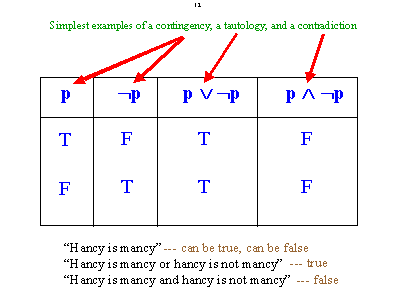
In formal logic there’s a kind of statement called a “tautology.” This is a statement where, no matter what the state of the various parameters of it, the statement itself works out as true.  Given the statement p OR NOT(p) the statement is true regardless of whether P is true.

One fact about tautologies.  They can tell you nothing about state of the variables involved.  Consider:  “either it is raining or it is not raining”. This statement is always true.  Either liquid water is falling from clouds in the sky making one side of the “or”, and thus the entire statement, true, or liquid water is not falling from clouds in the sky, making the other side of the “or”, and thus the entire statement true.  The truth of the statement tells you nothing about whether you need an umbrella or not.

To tell you anything about the world, a statement must have some possible conditions, at least in potential–whether they occur in the real world or not–where the statement would be true and others, again at least in potential, where it would be false.  In that case, the truth of the statement gives you information about the world.  “It is training” might be true, might not be, but if true than we know that an umbrella could be advisable.  In order to tell you anything about the world, a statement has to exclude possibilities.  It must also permit possibilities–a statement that is always false no matter the state of the elements in it is called a contradiction and is similarly useless in conveying information about the world.

These are simple examples and may seem trivial but the concept is extremely general.  Any statement, no matter how simple, or how complex, that is always true (or always false for that matter) regardless of the state of the various elements in it is a tautology and cannot actually convey information.

This is an important concept in the physical sciences.  There must be possible observational results that, if observed, would lead to the conclusion that the theory is wrong.  Without that, it’s a tautology and conveys no information.  It’s not right and it’s not even wrong.  It’s not meaningful enough to be right or wrong.  It’s just empty words.

The late Richard Feynman described this process in his famous physics lectures.  How to find new laws of nature.

  1. Guess what the new law might be. (Generally after much observation to try to discern a pattern.)
  2. Calculate what must happen if your guess is true.  This might be an individual result–a rock will fall when dropped–or it might be something of a statistical nature–half of the electrons emitted will be spin up and half spin down.  But either way the specific result expected must be calculated.
  3. Compare the results of the calculation to experiment.  Now, some people will object that some things you can’t do in a lab.  No, you can’t.  It’s rather hard to create a star and observe its evolution to test theories of stellar evolution.  However, you don’t need to do that.  You take the predictions of what we would observe from existing stars then look out with our instruments at the sky and see if what we see matches those predictions.  Same with other things that can’t be done in a lab.   Determine (calculate) what must happen in nature then go look.
  4. If experiment does not agree with the results of your calculations you’re wrong.  When observation and theory don’t match it’s the  theory that must go not the other way around.  Yes, observational error can happen.  You can have non-representative data where some other factor is affecting the results and it’s valid to check for that.  But not fitting your theory is not reason by itself to dismiss the data.  And you can’t use your theory to “correct” the data or even as a benchmark to say when to stop.  The data must stand or fall on its own and the theory either fits it…or not.  If you want to exclude “bad data” you’d better be able to justify it without appeal to your theory.  If you want to “adjust” the data for measurement error, you’d better be able to justify that without appeal to your theory.  And you’d better be prepared to show the original data, the exclusions and adjustments, and the justifications for them so that others can validate the work.
    1. It doesn’t matter how beautiful your theory is.  It doesn’t matter how smart you are or what degrees you have.  None of that matters.  All that matters is whether or not it agrees with observation.
    2. Note, though, that you make the calculation first.  You don’t go through all the data available and pick some that seems to fit your initial guess.   You need to make your testable predictions first, then look to see if they hold up.  If you simply grab on things that happen to agree you’re not doing science.  If your calculations say that A must happen and B can’t, and you look and see both A and B happening, well, guess what.  You’re wrong.  All of the predictions that come out of the theory must hold for the theory to hold.
  5. One thing that Feynman did not say was when you’d know the theory was right.  The reason for that is simply.  You can’t.  The most you can ever say is that it is consistent with available data.  There always remains the possibility of new data invalidating the theory and having to start over at “guess.”

In the end, a theory that can never be falsified, that no possible data can ever overturn is no theory at all.  It’s neither right nor wrong.  It’s too meaningless even to rise to the level of “wrong.” But it might well be very useful politically.

I’m sure we can all think of examples.

What Did I Want? (What Do I Want?) A Blast from the Past

interesting_life
https://xkcd.com/308/

Came across this recently:

The first person narrator Evelyn Cyril (Oscar) Gordon:

“What did I want?  I wanted a Roc’s egg. I wanted a harem loaded with lovely odalisques less than the dust beneath my chariot wheels, the rust that never stained my sword,. I wanted raw red gold in nuggets the size of your fist and feed that lousy claim jumper to the huskies! I wanted to get u feeling brisk and go out and break some lances, then pick a like wench for my droit du seigneur–I wanted to stand up to the Baron and dare him to touch my wench! I wanted to hear the purple water chuckling against the skin of the Nancy Lee in the cool of the morning watch and not another sound, nor any movement save the slow tilting of the wings of the albatross that had been pacing us the last thousand miles.

I wanted the hurtling moons of Barsoom. I wanted Storisende and Poictesme, and Holmes shaking me awake to tell me, “The game’s afoot!” I wanted to float down the Mississippi on a raft and elude a mob in company with the Duke of Bilgewater and the Lost Dauphin.

I wanted Prestor John, and Excalibur held by a moon-white arm out of a silent lake. I wanted to sail with Ulysses and with Tros of Samothrace and eat the lotus in a land that seemed always afternoon. I wanted the feeling of romance and the sense of wonder I had known as a kid. I wanted the world to be what they had promised me it was going to be–instead of the tawdry, lousy, fouled-up mess it is.”

Gordon was about to get that.  However, very few people get selected by Her Wisdom, Star, the Empress of 20 Universes to tread the Glory Road.

As a kid I wanted so very many things.  I wanted to be a super hero.  I wanted to walk on the moon and Mars.  I wanted to venture beyond the solar system and be the first to see some star and its planets up close with my own eyes.  I wanted to find a world of magic where I could help to defeat dark forces in the service of the light.

I wanted a lot of stuff that I couldn’t have.

I couldn’t have it, but I could at least write about it.  A lot of my early fiction was me imagining myself in these places what I hoped to do, what I hoped to accomplish in them.  Oh, I never went full “Mary Sue” (Marty Stu) giving “myself” unlimited abilities–the gallant hero, master of every form of combat, handsome, brave, wise, educated in all the arts and sciences, so wonderful that lesser men grovel at his feet.  Okay, I rarely went full Marty Stu.

It was a learning experience.

But always I had to come back to a humdrum existence.

But does existence have to be so humdrum?  I may not be the first to climb Everest but any slope I ascend for the first for me.  I’d never been there before.  I may not walk on the moon, but there are places I haven’t walked.  There are places where you can go and do a full three hundred sixty degree turn and not see one sign of human habitation from you to the horizon.

So maybe I have to be responsible, to see that my daughter gets to school every day, that there’s food on the table and a roof over our heads.  But that doesn’t mean I can’t find things to stretch myself, to challenge myself, a world beyond the humdrum.

So, while in between all the bills needing paid and dirty socks needing washed, find something exciting.

Go skydiving.  Challenge gravity and win.

Take a flying lesson.  You may not have the time and money to get a license but just once you can have your hands on the controls of an airplane and have it respond to what you do.

Leave the ordinary behind, if only for an hour.

Live.

Dum vivimus vivamus.

While we live, let us live!