Still Panicking over Winnie the Flu.

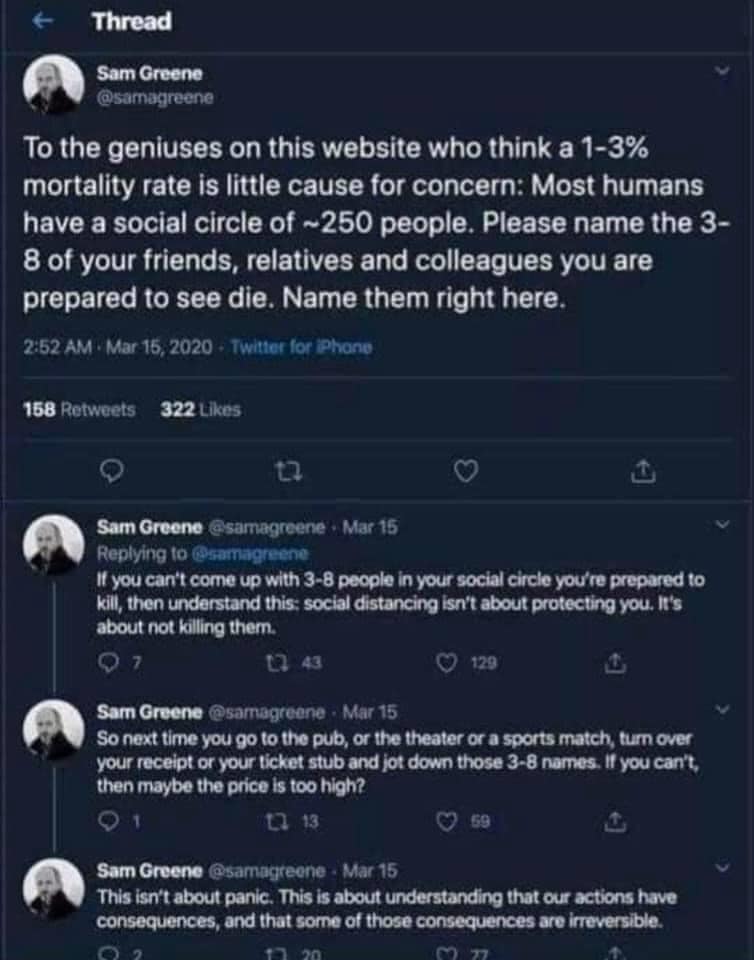
“Oh, no!” This person asserts. “Even 1-3% is too much!” (It actually appears to be much lower than that but…leave that aside for the moment.
93830640_3006998879322848_7898455925474721792_n

Most of those people dying of Winnie the Flu are folk over 80 with significant co-morbidities. You know what happens to people over 80 with significant co-morbidities? They die…frequently. About 7% per year starting at 80 and about 15% per year starting at 85 (both figures for males–slightly less for females). And that’s just from age, never mind “significant co-morbidities”.

But you know what else kills people, particularly people on the margins (like people over 80 with significant co-morbidities)? A faltering, let alone tanked, economy kills people.

There are numerous ways in which tanking an economy leads to more deaths. The thing is, those deaths are mostly “on the margins”–a person who’s already depressive might find being unemployed just that little bit extra to push him over the edge to “suicidal.” A person with anger issues might find the added frustrations of a bad economy just that bit extra to cause him to turn to violence. And people at the edges in terms of diet, nutrition, or health might find the lesser availability of things they need as just enough to make the difference between survival and death. There are all these boundary cases scattered in hundreds to thousands of different aspects of the economy, where a bit of change means the difference for some of them between living and dying. But since it was already close it just looks like the same kind of situations where folk die even in a “good” economy. Even in an economy that’s good people commit suicide. In an economy that’s good people die from health issues related to diet. In an economy that’s good people have frustrations that trigger anger issues which leads to them turning to violence. And so, the damage done, the deaths resulting from a faltering economy, go unremarked because they aren’t one big noticeable block. They’re thousands of little blocks, a few here, a slight increase there, unremarked and unnoticed except by their friends and loved ones.

But they are no less real for being unseen.

There are no ultimate solutions. There are only trade-offs. Your attempt to stop deaths one way, if it tanks the economy, simply causes more deaths elsewhere.

Now, politically, that’s actually an easy choice. “Unseen” may not make the deaths less real, but it does make them less likely to affect elections. If the voters don’t see them, but do see the folk being “saved” (or at least claimed to be saved) by the “actions” taken, well, people will generally vote what they see and not what they don’t.

And that’s why the more I study economics and related politics, the more “goth” I become. Might as well learn to appreciate the dark because it’s not going away.

Feeding the Active Writer: Smoked Pork Loin

I picked up a pork loin at the grocery yesterday.  Decided to run the smoker today.  In principle it’s pretty simple:  Coat the pork with a rub.  Heat up the smoker.  Put pork in the smoker and smoke on low heat until it reaches the target internal temperature.

However, with the side smoker that I have:

It does require a it of babying.

First there is the rub.  I used the following (amounts are approximate):

  • 1 Tbsp garlic powder
  • 1 Tbsp black pepper
  • 1 Tbsp onion powder
  • 1 Tbsp chili powder
  • 1 Tbsp paprika
  • 1 tsp Oregano
  • 1 tsp Parsley
  • 1 Tsp crushed rosemary leaves

Sprinkle the rub over the pork loin and rub it in well.

Let the pork sit while you start the fire in the grill and let it heat to about 225F (give or take–with a charcoal grill it’s hard to keep a precise temperature).

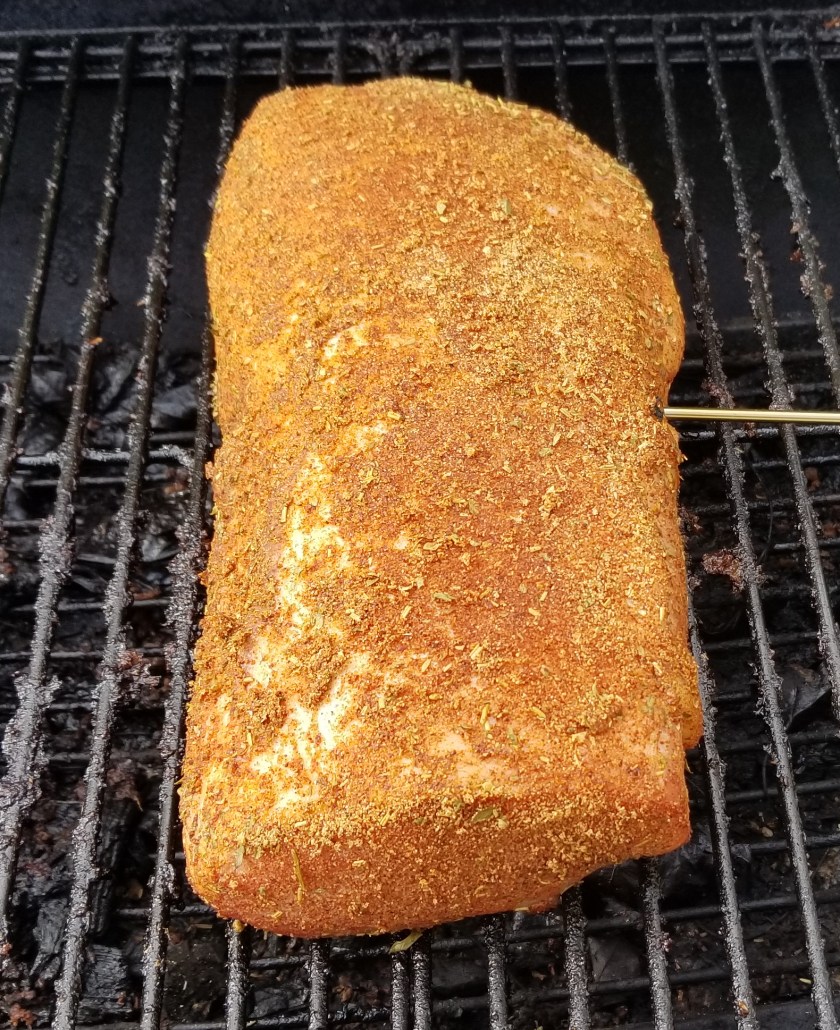
Place the pork loin on the grill.  I set it near the middle turned so its length was across the grill.  This made the temperature approximately equal so it cooks evenly.  In cross section the loin has a “tear drop” shape.  I put the wider side of the “teardrop” facing the firebox and the narrower farther away.  Again, this helped to make it cook evenly.  I inserted a “leave in/remote readout” meat thermometer.  Here’s what it looked like on the grill, ready to smoke:

20200416_105251 crop

Close the grill and add your smoking wood to the charcoal.  Now, normally I use apple wood but I used up the last of what I had on hand recently on something else and the local store was out of everything except cherry wood chips.  So…cherry it is.  These chips were intended for use with a gas grill or electric smoker which means they’re a lot smaller than the chunks of apple wood I normally use.  They burn up quickly in the charcoal.  That means you have to add small handfuls frequently to maintain smoke.

And now it takes time.  Charcoal grill so you have to check it frequently for temperature.  Adjust draft and/or add charcoal as needed to keep the temperature somewhere in the 200 to 250 degree Fahrenheit range.  225 is the goal, but realistically it’s going to vary.

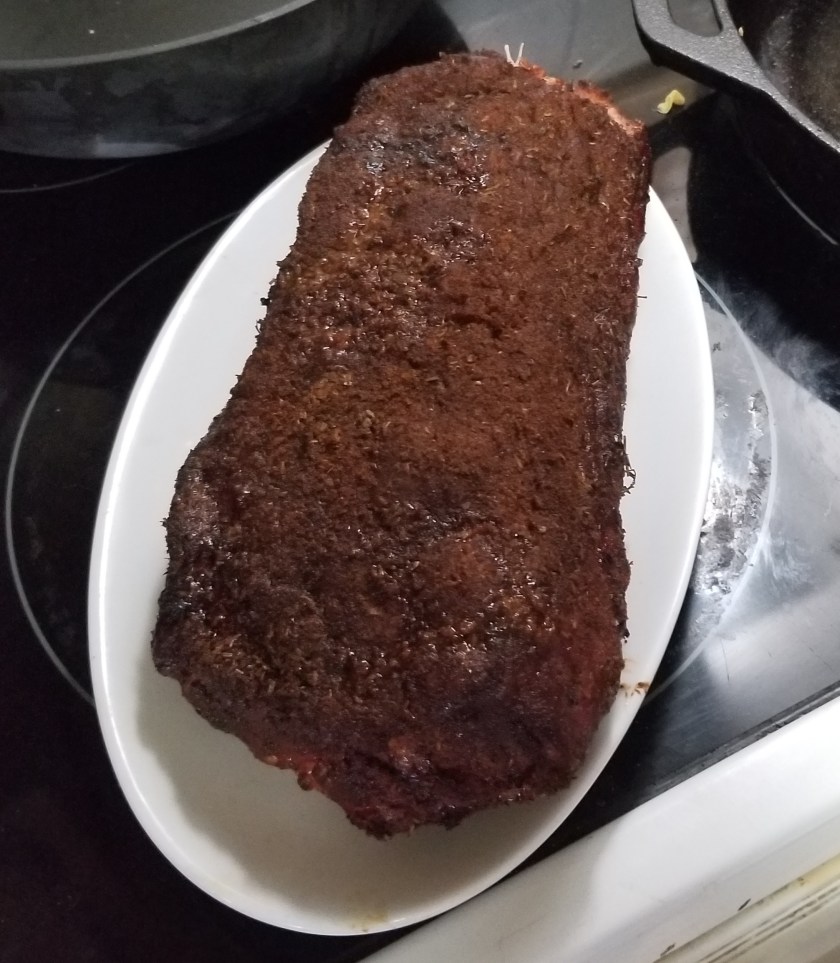
Cook until the core temperature of the meat is about 160F.  Take it out to rest.  Here’s what it looked like, fresh from the smoker, at the start of its resting period:

20200416_174321 crop

Let it rest about an hour before slicing.

Good by itself or in sandwiches.  It’s got a good “bark” and is tender and while not “dripping juicy” neither is it dry.  Nice and flavorful.


Amazon Prime: The Expanse and Carnival Row

https://amzn.to/2K51DKe

https://amzn.to/2XGF3j4

While I’ve been stuck home, I’ve been spending a lot of time watching videos on Amazon Prime. The current one up is The Expanse about which I’ve heard good things. It is interesting to compare it with the series I just finished (so far as it exists for now as a single season–and, dammit I want the rest)

Just finished the second episode of Season 1. And, let’s just say that it is not as engaging as the first two episodes of Carnival Row were for me. But then, Carnival Row started with some “thrilling heroics” and hinted that there was a love story in there. That had me sold and was enough to grab me until the worldbuilding and character development could completely rope me in. (Where’s the rest of it, dammit?)

The Expanse hasn’t really done that. I’m not fully engaged with the characters, at least not yet. The other thing is that we’ve got all these various threads which I’m having a bit of trouble following. Carnival Row had much the same issue but I think they tied them together a bit more tightly. While the plot thread involving Agreus Astrayon and the Spurnroses is off to the side, the other main plot threads tie together into a fairly cohesive whole. Admittedly, it wasn’t until the very end of the first season that they all came together but even before then they made part of a picture that had a bit more cohesiveness than the various threads in The Expanse–at least as I’m seeing them now. The overarching tie in The Expanse–the conflict between Earth, Mars, and the Belt–is a bit too diffuse at this point for it to pull the disparate elements together in my mind at this point.

Part of that is a matter of scope. While there is a bit of time spent elsewhere, the vast majority of the action in Carnival Row takes place within a single city, a single political entity, and a handful of cultures that are tightly bound together even when they’re in conflict. The Expanse spans the solar system with widely different polities with correspondingly less cohesiveness between them.

Both series show some truly excellent worldbuilding. In Carnival Row every main character went through major changes in some breathtaking character arcs. It’s too soon yet to see if the same can be said of The Expanse. There’s material there that shows promise but…we’ll see.

For the time being, I certainly plan to continue.

Musings of an Agnostipagan

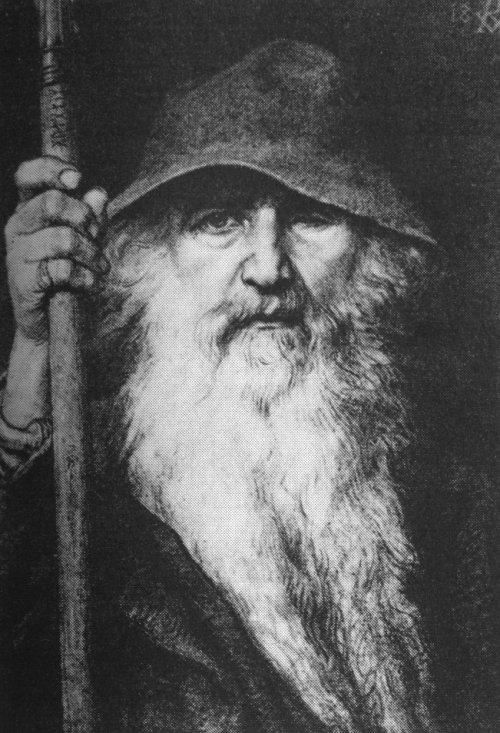
Georg_von_Rosen_-_Oden_som_vandringsman,_1886_(Odin,_the_Wanderer)

I have self-described as an Asatru Leaning Agnostic.  A friend of mine coined the term Agnostipagan.  Being “God blind” I don’t share experiences that others describe of their relationship with whatever deities may exist.  I do not, of of hand, dismiss the possibility of them, but it’s not something I can attest to.  Still, people have hard-wired into them a need for ritual, symbolism, and a search for larger meanings in the world.  What folk call “religion” fills that need for many people.  I am no different from anyone else in having the need and so, I sought a path, a “way”, that fills that need that suits me.  I find it in Asatru.  There are certainly others that can do it, but that’s the one that just “fits” best.  Whether the gods exist or not is above my pay grade (as the saying goes), but as far as what I get out of life and find my own way to meaning, it works for me.

In another forum someone asked the question about if one could “really” be Asatru if one wasn’t of Norse extraction.  Well, some folk pointed out that while much of what we know of it came from Scandinavia, Norse is simply a branch of a much larger Germanic religion.  The gods names change from region to region–Odin, Wotan, Woden, etc. or Thor, Thunor, Donner, etc–and the stories may have shifted in their telling over time and between regions but at heart it was all one religion.  Yet still, the question remained:  would one need to be of Germanic or Norse extraction to be “qualified” to follow the religion.  Now, I am of Germanic extraction on my father’s side (and probably no small amount of Norse out of my mother’s people from Ireland–considering the raiding that went on back in the day), but, still, I had my own thoughts on the issue.

My take, for what it’s worth. Whatever ultimate deities there might be in the Universe, they have presented themselves to, and been understood by, various peoples in terms those people could understand. The same basic powers would have appeared one way to the Germanic/Norse folk, another way to folk on the Siberian steppe, yet another way to folk on the African veldt, and so on. People in those cultures would follow the gods of their people in large part because that was what they were used to and what had meaning for them. Those various folk religions weren’t terribly interested in proselytizing. A group might think its gods were stronger than a neighboring group’s gods but they didn’t go out of their way to “convert” the neighbors to worship of their own. (That is, until certain monotheistic religions started running rampant.)

So, in times past, before those militant monotheists got involved, it just made sense for folk to follow the gods of their own people and tribe.

In the modern day, however, some of those old rules really don’t apply. Even in modern Scandinavia, few people could be said to be living the hardscrabble existence common when the Norse branch of Germanic religions were crystallizing. Likewise with most other folk religions. The situations and challenges faced by the folk are generally quite different. That does not mean that the old ways have nothing of value to those modern people, far from it. What it does mean, however, is that they are less tied to particular peoples in particular circumstances.

So the question becomes, whether a particular “way” resonates with you, personally. That’s what matters. If it resonates with _you_ more than other ways then I would say that it is right for you.

Other people may disagree but in the end, I would think it would be between you and whatever gods there may be. You may be guided by the counsel of others, but in the end the final decisions, and the final responsibility for those decisions, is your own.

Is Economics Science?

classroom-1209820_1280

In a response to a link to one of my economics posts over on the book of faces someone questioned whether economics was a science at all.  The question is a valid one because when you look at folk as diametrically opposed on pretty much every point as Paul Krugman and Milton Friedman, both Nobel Prize winning economists, well, you have to wonder if “there’s any ‘there’ there.”

The thing is, there is a science of economics. What makes something “science” rather than something else is falsifiability (something that, if seen, would indicate that a concept is wrong) and the related concept of making testable predictions.

Consider, for instance, from Thomas Sowell’s memoirs, when he was working for, I think it was the Department of Labor.  As I remember it (I have the memoirs on audio book–great for listening while in the car but not so good for looking up particular points to refresh ones memory) there was a question about the cause of increased unemployment in Puerto Rico. Two popular theories were proposed.  One involved minimum wage rates.  Another involved seasonal storms. Sowell figured that while either theory, if correct, might both lead to the specific problem under investigation (unemployment) there should be something, some result, different between one being the cause vs. the other. After much thought he figured one out (if I’m being vague, again, it’s because it’s been a while since I listened to the audiobook), something related to agricultural production. If theory A were correct then they’d also see this change in the particular agricultural aspect. If theory B were correct, then they’d see a different result.

Of course, there’s always the possibility of “C” something they hadn’t thought of yet, being the “real” cause.  But then, that’s true in other sciences as well.  After all, for along time there were two competing theories regarding the

That, right there, is science in all its purity. You formulate a hypothesis (as Feynman put it “you guess”), you determine what the results would be if your hypothesis is correct, and then you go look.

The problem was in that last step, the DoL didn’t have access to the relevant data. That would be the USDA. To get the information he would have to send a request up the chain in the DoL, at an appropriate level it would be passed over to USDA and then back down the chain to the particular branch which had the relevant data. So he sent in the request. As of the writing of the memoirs and long after Sowell had left the DoL, according to Sowell, the request still had not completed its journey.

So, yes, there is a science of economics. The problem is that the subject matter is complex enough that people will often simply skip the whole “testable predictions” thing.  Instead they’ll look through a vast sea of information, find something, anything that can be presented as supporting their particular view (and quietly sweeping things that refute that view under the rug), and go “Ah, hah!”, something Thomas Sowell called, suitably enough “‘Ah, hah!’ statistics.”

And while the “social sciences” are particularly prone to this phenomenon, the physical sciences are not immune.  People are all too often prone to letting their politics dictate their science.  Whether it’s the “Union of Concerned Scientists” and their “doomsday clock” which is nothing more than a measure of how much they dislike the current administration and its policies or the “Climate Change” peole who, instead of making testable predictions and abiding by the results simply point at any bad thing happening (and there’s always something bad happening somewhere in the world) and saying “See?  Human caused climate change.”

So, while there is a science of economics there are also a whole bunch of people out there attempting to hide that fact and use the cachet of science to justify their own “philosophy” which can be summed up as: “If A is false, I will be sad. Therefore, A is true.”

Freedom or Safety: A Blast from the Past

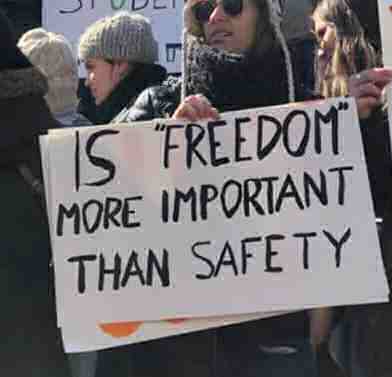
is-freedom-more-important-than-safety

Perennially on the subject of guns, people keep saying we need to give up the freedom of private gun ownership for “safety” from criminals.  However, in the current Winnie the Flu (Covid-19) we’re seeing the same dichotomy being put forward regarding infections disease.  I wrote the following about guns, but, really, it applies regarding anything where “safety” is given as a reason for giving up freedom.

This march of the children (yes, let’s let those that the law does not recognize as maturely responsible enough to drink alcohol, and who are trying to claim they are not maturely responsible enough to purchase even a .22 rifle for target shooting, make public policy) had a bunch of kids carrying signs.  One of those signs asked the question (at least I think it was a question–apparently “punctuation” had to make way for political indoctrination in the school this child attended) “Is freedom more important than safety”?

Yes.  Next question?

Okay, here’s a bit longer answer.  There are threats in the world.  Some of them are unintended and impersonal:  accidents happen, illnesses, things that don’t involve any malice directed toward you.  And some of them are very personal–people who mean you harm whether it’s directed at you specifically or if you just happen to be there and anyone would do.

The world can be a scary place.  We all want to be safe.

But couching the question in terms of Freedom vs. Safety they actually are choosing between two approaches toward achieving ones safety.  The first, is the “Freedom” approach.  Take personal responsibility for ones safety.  Take the personal actions that one believes necessary to achieve an acceptable level of safety.

The other approach is to eschew personal freedom and turn over the task of keeping one safe to someone else.  That person or persons will take authority over your safety and give you instruction on what you’re permitted and/or required to do toward that end.

Some folk reading this are already seeing the problem.  And that problem is a big one:  How do you ensure that the “someone else” given authority over your safety will actually make your safety his, her, or their primary priority?  How do you prevent them from dismissing, or even sacrificing, your safety for some other end?

And that’s not even addressing the question of what to do when the supposed guardians of your safety themselves become a threat.

It’s part of a larger question:  how can you guarantee that another person will place your interests first and not their own?

The answer people who clamor for safety over freedom don’t want to hear is:  you can’t.  The ones trusted with your safety, unless it is in their own interest otherwise, can decide to leave you to your fate at any time.  History has shown that while some few will put the safety of those in their care even against their own self interest (parents looking out for their children might be an exception to “few” and even that is questionable in the larger scope of history) that’s a pretty long-shot bet.  In the end, those you would entrust with your safety look out for themselves long before they look after you.

Look around.  Can the police (or fire departments, or other emergency services) save you?  They police have won court cases saying that they have no responsibility to protect you the individual, just “society” (which looks very much like “society” is just another word for “those in power”).  Most of the time, the police officer is not going to be on the scene when you face a threat.  Until the police arrive you are very much on your own.  And even if they are present, that is no guarantee they will be willing or able to help you.  The deputies of the Broward County Sheriff’s Department were not the first to refuse to put themselves at risk to protect others.  They will not be the last.

You must take responsibility for your own safety.  You need to have fire extinguishers and smoke detectors to help you stay safe in the event of a fire.  You need to have first aid supplies and knowledge in case of accidents or injuries.  And you need to be prepared to defend yourself against those who mean you harm.

No one else will do it for you.  No one else can do it for you.  No one can be as well positioned to take action to keep you safe as you are.  Even when they do come to your aid, you have only yourself to keep yourself safe until they do arrive.  And you need the freedom to do what is necessary both to protect yourself in the event, but to prepare in advance against the event.

Benjamin Franklin said famously:  “Those who give up essential liberty for a little temporary safety deserve neither liberty nor safety.” He said that because it’s a fool’s trade.  To give up liberty, to put ones safety in the hands of someone who almost invariably will put his own hide before yours, is to give up the very safety you seek.  It’s paying a con man for sweet sounding words that in the end evaporate to nothing.

If I may paraphrase Economist Milton Friedman, “The society that puts safety before freedom will end up with neither. The society that puts freedom before safety will end up with a great measure of both.” (The original contrasted Freedom with Equality rather than Safety, but the phrasing works here too.)

It isn’t perfect safety.  There is no perfect safety.  But it’s the only safety you’ve got and you get to make the choice of how much is enough, how far you’re willing to go to secure your own safety and the safety of those you care about.

Freedom vs. Safety?  Freedom is safety, the only safety you can trust, where the authority, and the responsibility, is in your own hands.

Worse than the Disease.

So I saw this.  There’s a key error in it, but I’ll get to that in a moment.

91479679_10156876400666746_5383955120029433856_n

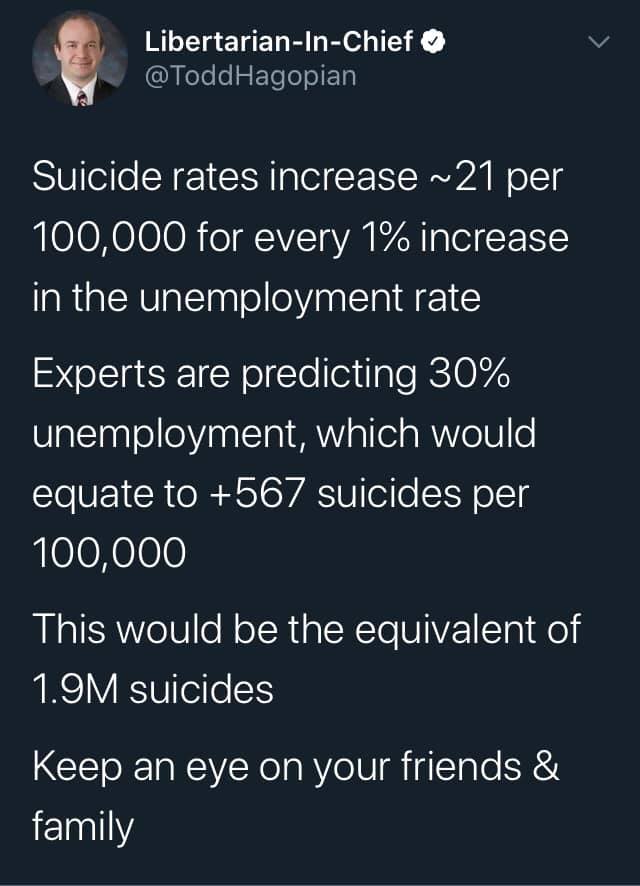
This contains a serious error that does not pass the sniff test.  After all, the suicide rate in the US, per, 100,000 has generally ranged between 10 and 24 per 100,000.  Looking at various online articles it appears that the correct relationship between suicide and unemployment is about 2 or so per 100,000. Now, I suspect that Mr. Hagopian misread whatever source he had for the suicide rate link and probably dropped a decimal point.

Still, 2 or 2.1 per 100,000 adds up in a nation of nearly 330 million.

The economic effects of the various quarantine/social distancing/shelter in place orders around the country has already increased unemployment about 2%.  If we run through the numbers, that’s about 1400 people who will die as a consequence from that one cause–suicide.  If things get as bad economically as predicted the cost in lives will be 190,000.

That’s just one of the ways that a faltering economy kills people.  That’s just a small part of the total damage that the efforts, however well-intentioned they might be (something I, frankly, am unwilling to just accept as the case), will have.  There are other ways that a faltering/crashed economy kills people.  And many more will have their lives blighted in various ways, creating suffering and misery that need not be there.

And that’s the price we’re paying to “curb” something that was shaping up to be a somewhat worse than average (although far from the worst we’d had recently) cold/flu season.

The cure is worse than the disease.


Unassailable: A Blast from the Past

knight-1283910_1920

“How dare you challenge this poor, oppressed (or victimized) person?”

Hear that a lot?  I do.  Whether it’s daring to contradict some member of a so-called “marginalized” group or challenge the statements of someone who was victimized in some way (or was just present when someone else was victimized), doing so will raise strident objections from certain groups of people.

Those people are wrong.

The late science fiction (and pretty much every other field) writer Isaac Asimov reported in one of his autobiographies (sorry, no link, I read them in “dead tree” years ago) a conversation in which he explained to someone that there is nothing about oppression that confers virtue on the oppressed.  Historically, people who have been oppressed are more than willing to oppress others when given the opportunity.

While the Good Doctor was speaking of tribes and nations, the same remains true on an individual level.  Being a victim does not make one good or noble or wise.  It does not confer expertise on any subject, not even the subject related to the victimization.  No more does my being in a traffic accident make me an expert on automotive design.

It’s possible that someone who is good and noble and wise can be a victim, certainly.  But the foolish and the vile can also be victims.  Having been a victim does not in and of itself change that.

So, no, someone or some group having been a victim does not make their positions unassailable.  It does not mean that no one could, or should, argue with them.  It does not make their motives unquestionable, their knowledge given, and their proposals the only acceptable ones.

And when victims lash out, especially when they lash out having been challenged, we might make allowances for their emotional response from what happened to them but, here’s the thing, sooner or later that excuse stops working.  It is not an unending license to attack everyone who disagrees with them while being shielded from any responses.

If a person is so emotionally damaged from the event that they cannot bear any contradiction, then that is all the more reason not to take them seriously.  Perhaps their time would be better spent seeking healing from their trauma than in trying to force public policy to fit their emotion-laden mold.

And if they are going to put themselves forward, or allow themselves to be put forward in an effort to drive that public policy, then they need to recognize and accept that it is right and proper for people to challenge both their positions, and their qualifications to put forward those positions.

And “something bad happened to me” is not a qualification for anything.

The Dismal Science

hallway-1245845_1280

Economics is the Dismal Science. Scarcity is the usual reason given for it being so. Personally, I find the most dismal aspect of it to be how many people don’t understand economics. It’s enough to make a man take off his hat, throw it on the ground, and stomp on it.

Does Winnie the Flu kill people? Yes. It does. However, you know what else kills people? A faltering, let alone crashed, economy. The thing is this is exactly the kind of thing you get with Bastiat’s “seen and unseen”. Those directly (or slightly indirectly through opportunistic infections) killed by Winnie are seen. Those who die because a treatment was delayed, or their heat was turned off because they were laid off and couldn’t afford it, or any of a host of other little things of people “at the margins” where the difference between “good economy” and “economy in the toilet” made the difference. Those are the “unseen.” Oh, sure, individually someone sees folk dying but mostly they’re the kind of folk who might well have died anyway. We just get more of the “might” turning into “did”.

They go unnoticed in the general scheme of things. There isn’t a single cause that people can point to saying “see, that’s killing people.” It’s a thousand little things where if things had been just a bit better they would not have died. People don’t make the connection to the the faltering economy, not until it gets truly awful (as in third-world poverty levels). But the connection remains. Hurt the economy and people die who would not have died otherwise.

However, attempt to raise this issue, to explain it to people, and sure as taxes, someone will tell you what a horrible person you are for putting money above people’s lives. They can’t seem to grasp that the money (or rather, the goods and services, and the economy that produces those goods and services) is people’s lives.

And that is pretty damn dismal.