Can You Get More Pedantic?

Short one today.

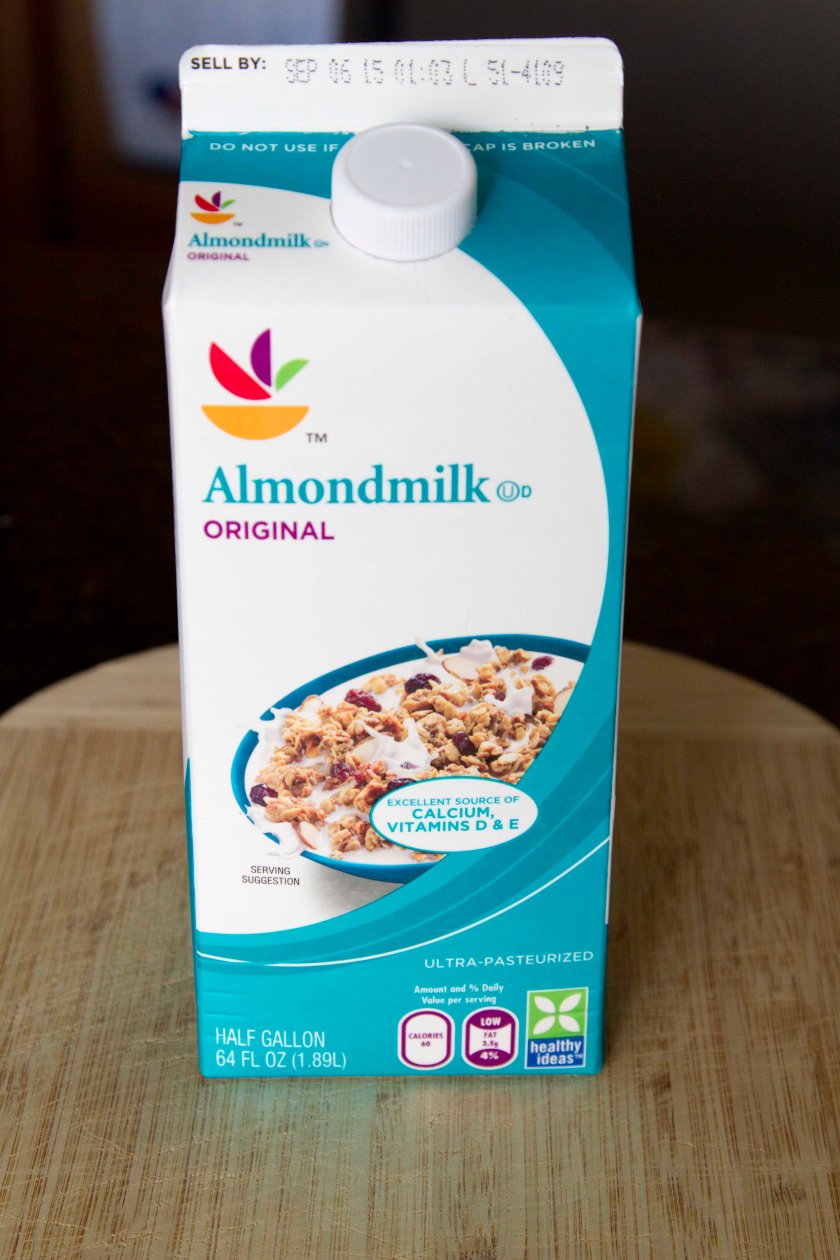
almond milk

Not long ago over on the Book of Faces a friend of mine got into a fine old rant about the various “milks” on the market today.  The claim was “nothing with an adjective before the word ‘milk’ is actually milk” (implied, of course, was that he wasn’t talking about “chocolate milk” or other flavored milks). Someone else made the comment about “if it doesn’t come from a mammal’s teats…”

Can you possible get any more pedantic?

First, do you actually think this is confusing to anybody?  Does someone see “Almond Milk” and think that somewhere on the almond plant is a mammary gland?  I don’t know of anyone except these pedantic types that think it does or should.

Also, the term “milk” has been used as a descriptor for things that resemble milk for a very long time and in common parlance.  The earliest recorded use of the term “coconut milk” goes back to 1698.  Almond Milk apparently goes back even farther to the 14th century.  In this parlance Milk of Magnesia (suspension of Magnesium hydroxide used as an antacid and laxative) is a latecomer from 1872.

And yet there are some people who want to ban the use of the word “milk” for anything that doesn’t come from a mammary gland because it’s”confusing.”

Again, do you know anyone who actually is confused by this?  I don’t.  A whole lot of people are engaged in high dudgeon on behalf of others who are supposedly confused.

Personally, I’m not a big fan of almond and other milks, or wouldn’t be except the sugar content of cow’s milk:  12 grams of sugar in a single cup of cow’s milk.  That’s about 2/3 of the sugar in a Hershey’s Cookies and Cream candy bar and about half of that in an Almond Joy or Mounds bar. (Fans of milk will say “yeah, but…”.  But nothing, it spikes my blood sugar just like any other source.) I can use Almond Milk to make hot cocoa, in various recipes, or with low-carb cereals.  Whereas one cup of milk and I’m more than halfway through my net carbs for the day.

Yeah, I’d prefer the taste and “weight” of “real milk” but that’s not an option for me in most cases.  With that limitation “almond milk” or “coconut milk” (the unsweetened varieties) are an inferior but adequate substitute.

And, like everyone else I know, I know it’s a substitute.  I don’t think there are little mammary glands on the nuts.

So stop with the excessive pedantry already.

This…Actually Works (An Auto “Repair” story)

I’ve never been a big fan of various “additives” for fluids in the car.  Most of them are pure “snake oil” in the metaphorical sense–the “cleaning” job they do is cleaning your wallet of any unwanted cash…and wanted cash as well.

Let me give a little background.  The grocery store I use most of the time provides “points” which can be worth a discount for fuel.  To get the most benefit from that, I tend to run the car to nearly empty then fill it up.  With a 22 1/2 gallon tank, if I run it down to the last couple of gallons each $0.10 per gallon off is worth a couple of bucks.  It adds up over time.

However, that requires that I have a truly reliable fuel gauge.  Now, a while back it started getting squirrelly.  Specifically, it would sometimes just drop to zero even though I had plenty of gas in the tank.  Now, this isn’t earthshaking.  I could use the odometer and a knowledge of how far I can get on a full tank .  But that depends on how what kind of driving I was doing.  More highway, less stop-and-go in traffic.  Carrying heavy loads or not.  That sort of thing can effect how far I can get on a tank of gas.  Which means I would need to leave more margin…which means I wouldn’t get all the benefit form the “cents off” that I could if I had a more reliable measure of remaining fuel.

It got to the point where I was considering replacing the fuel gauge sending unit (having eliminated other parts of the system as likely sources of the problem.  It wouldn’t be worth it to take it to the shop, but as a DIY project, the cost/benefit ratio looked good.  Researching it I found that it would be a pretty big project, and something I’d have to rope friends into since it did not look like a reasonable one-person job.

As it happened, while researching the procedure for dropping the tank to get access to the fuel pump/fuel gauge sending unit, I came across a video where someone described the very problem I was having and said that the cause was the “high sulfur” fuel in his area which gunked up the sending unit causing it to fail.  The “fix” was to run a couple of tanks worth with a detergent fuel additive, specifically Chevron concentrate with Techron.

I thought…”Worth a try.” So I bought a couple of bottles (12 oz size at local store–the above link is for the 20 oz size).  Two bottles of the 12 oz size or one 20 oz were appropriate for the size tank in my car.  I added them and filled the tank, ran it low, added two more and filled the tank and…

My gauge started working properly again.

I was seriously, seriously skeptical when I first tried it.  Like I said, most such products are snake oil.  However, for this particular application, this particular product does seem to work.

Saved me a wasted afternoon and a chunk of change swapping out the fuel pump and sending unit.

Pretending to Sleep

Available on Kindle

Read this story. It’s not long. I read it in a sitting last night. And frankly, I cannot recommend it highly enough.

There is no slap-bang action in this book.  No chase scenes.  No daring rescues.  No climactic battles.  It is no spy or resistance thriller.  It’s simply the baldly told tale of a girl, Renata, at the mercy of forces far beyond any control of hers, and her treatment for the “crime” of simply having the wrong relatives. Her helplessness in the face of those forces paints, in a few broad strokes, the grim nature of life in Communist Romania.

The book’s very understatement provides much of its power and provides a perennially topical warning about the danger of too-pervasive government, where every aspect of ones life is mandated by the State.

The author, Monalisa Foster, is a friend of mine.  She’s also a survivor of communist Romania under the tyrant Nicolae Ceaușescu.  Her own personal experiences provide a backdrop for the events in the book and provides a reminder of how important it is to retain our American freedoms.

Buy.  This.  Book.

Hockey vs. Figure Skating: An Ice Follies Post

I was looking for some instructional videos on a technique that’s giving me a particular challenge of late and I came across these two videos in the “related videos” section. (That my search contained both “figure skating” and “hockey” probably pushed them up high in terms of “related.”) It was interesting seeing athletes in each of the two fields, hockey and figure skating, trying out each other’s sport. (Spoiler, they’re both very good at what they do yet each finds the other’s a significant challenge.)

Review of Ice Follies to Date

I’ve continued to progress in the ice skating.

“Learn to Skate USA” has two basic skills progressions for people learning to skate.  For the children (6-14) they have the Basic 1 to Basic 6 progression.  For “Adults” (15 and up) they have the Adult 1 to Adult 6 series.  There are some differences between the two progressions, some things introduced at different levels in one compared to the other and some things included in one and not the other.

I’m currently working on things in the Adult 4 to Adult 6 range as follows.  Bold indicates things I’ve more or less learned.  Italics means things I’m actively working on.  Plain text means that I’m still working up to it.  In addition to the Adult progression ranking, I’ve listed here where the various things are introduced in the Basic progression.

Adult 4

  • Forward outside edge on a circle, R and L (Basic 4)
  • Forward inside edge on a circle, R and L (Basic 4)
  • Forward crossovers, clockwise and counterclockwise (Basic 4)
  • Backward one-foot glides, R and L (Basic 4)
  • Backward half-swizzle pumps on a circle, clockwise and counterclockwise (Basic 4)
  • Hockey stop, both directions (Basic 5)

Adult 5

  • Backward outside edge on circle, R and L (Basic 5)
  • Backward inside edge on a circle, R and L (Basic 5)
  • Backward crossovers, clockwise and counterclockwise (Basic 5)
  • Forward outside three-turn, R and L (Basic 5)
  • Forward swing rolls to a count of six (Not included in “Basic”)
  • Beginning two-foot spin (Basic 4)

Adult 6

  • Forward stroking with crossover end patterns (Not included in Basic)
  • Backward stroking with crossover end patterns (Backward stroking is Basic 6, the “crossover end patterns” is not included)
  • Forward inside three-turn, R and L (Basic 6)
  • Forward outside to inside change of edge on a line, R and L (Not included in Basic)
  • T-stop, R or L (Basic 6)
  • Lunge (Basic 4)
  • Two-foot spin into one-foot spin (Basic 6)

There are some additional skills included in the Basic progression, not included in the Adult progression.  Since I plan to continue with Free Skate once I complete Adult 6, I think it advisable to learn these as well:

Basic 5

  • Advanced two-foot spin — 4–6
  • «Bonus skill: Side toe hop — R and L

Basic 6

  • Moving backward to forward two foot turn on a circle — clockwise and counterclockwise
  • Bunny hop
  • Forward spiral on a straight line — R or L
  •  «Bonus skill: Shoot the duck — R or L

The hockey stop is my current bugaboo.

It looks so simple but in practice it’s…a challenge (at least for me).

On the other hand, I am just about ready…wanting a bit more stability on my backward edges…to start trying the forward outside three turn.

(Edit:  Wrong link in the clipboard when putting that video up.  Now fixed.)

I still find it kind of amazing.  A year ago I never would have imagined I would come so far.


“The Christian Left”: A Blast from the Past

Once again, I have been running into claims that to be “Christian” one has to be “Left” (politically, as the Left exists in America).  So, once again, here’s the rebuttal to that nonsense.


I keep running into this idea that Jesus was a socialist.  There was a meme going around during Christmas with various “Christmas Heroes”.  There’s a quote misattributed to former President Jimmy Carter about how you can’t say you want a Christian nation if you object to your tax dollars being used to help the poor.  All over the place people on the left arguing “Jesus was a socialist.”

Utter rot.

Now, full disclaimer.  I am not a Christian.  I grew up in a sort-of Christian religion (many dispute that characterization because of differences in the nature of what more conventional religions call the trinity and in the belief of ongoing revelation and prophecy, but I go with a more basic definition, summed up in Simon Peter’s declaration “Thou art the Christ, the son of the living God”) but I long since found I could not believe it any more and once I separated from that one, none of the other Christian sects appealed to me any more.

However, I understand Christianity far better than these “Christian Left” people.

Christ taught giving.  Giving means taking ones own property and passing it on to someone in need.  Nowhere did he advocate taking from others by force and “redistributing” it.  He certainly did not advocate taking from others, using what’s taken to fund a huge government bureaucracy, and pass out a pittance of the remainder to the poor (have to justify that bureaucracy somehow).

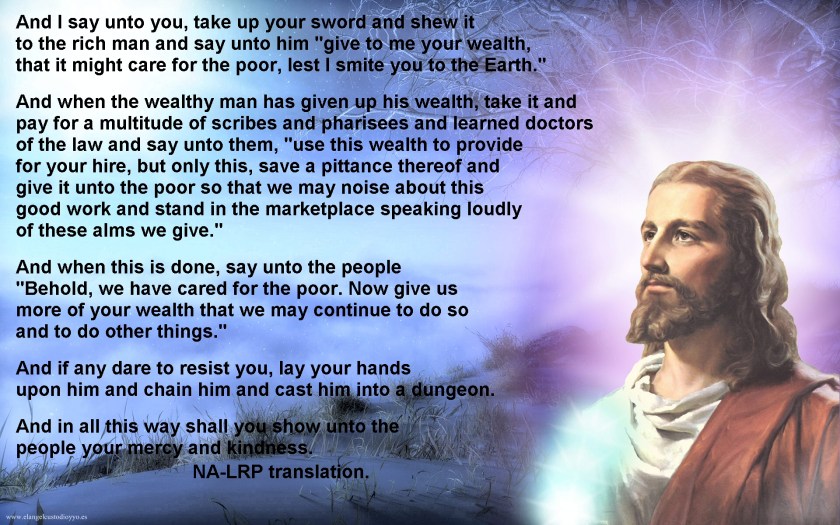
Nowhere in the Bible is there a passage similar to this:

NewAgeLittleRedProgressiveTranslation

When people advocate socialism enforced by government, they are advocating using force to take from some to give to others.  Nowhere in his teachings did Christ advocate that.  Nowhere.

This is where some people say “but Christ said Render unto Caesar.” Yes.  He did.  In response to a question intended to trap him.  Context matters.  Christ had rising popularity among the masses which concerned the Jewish leadership greatly.  So they planted the question of whether they should give tribute to Caesar.  If Christ had simply said “yes” he would have lost his popular audience and his ministry would have died right there.  If he had said “no”, he would likely have been arrested (“we caught him forbidding tribute to Caesar” was one of the charges the Sanhedrin laid against him when handing him over to the Romans for execution).  And his ministry would have died right there.  Instead, he asked for an example of the tribute money, asked whose picture was on it, and gave his famous answer.  And if people followed him in that, the Roman reprisal, destruction of Jerusalem, and diaspora would have occurred before much of Christ’s mission was fairly begun.  If you accept his divinity, you have to accept that he knew this and gave the answer that allowed him to complete his mission.

But did “render unto Caesar” mean an endorsement of everything that tax funds were used for?  Did he endorse gladiatorial games?  Wars of conquest?  The capture and importation of slaves?  The use of government troops to put down slave revolts?  Let’s not be absurd.  Just because the Roman government did something with tax monies, or modern governments do something with it, “Render unto Caesar” is not an endorsement of that use.

Government is force, pure and simple.  That’s essentially a definition of government:  the legitimizing of the use of force.  Socialism imposed by government has nothing to do with Christian charity.  It is, in fact, very nearly the exact opposite, wearing a mask to confuse the unwary.

Beware of Socialists who come to you in Sheep’s clothing but inwardly are ravenous wolves.

Woe to you agents of government and socialists.  Hypocrites!  For you are like unto whited sepulchers, which outwardly appear beautiful but within are full of dead men’s bones and all uncleanliness.

The Nail.

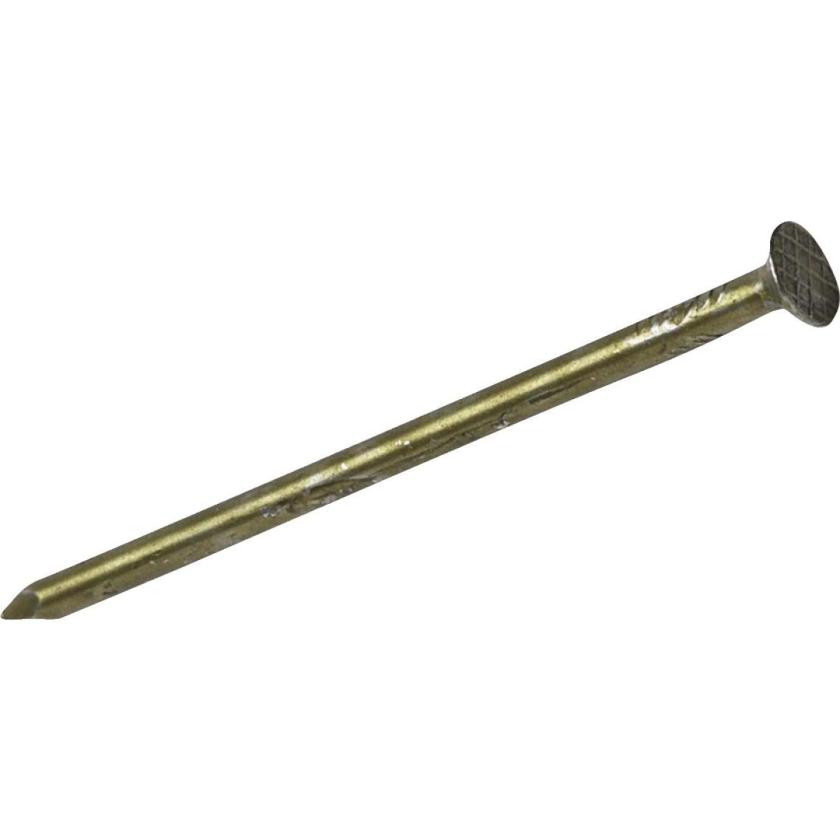
16d nail

Imagine you’re the Minister in Charge of Nail Production in a centrally planned (i.e. socialist–where the “means of production”, in this case nail making, are publicly controlled rather than privately owned and controlled).  Should be an easy job, you would think.  Nails, after all, are pretty simple.

You are now considering sixteen penny (16d) nails. (Side note:  “penny” as a measure of nail size derives from how much 100 nails would have cost “back in the day” and the “d” is simply an archaic abbreviation for a penny, deriving from the ancient “denarius.”) You have central control so that means you have to decide how many of these 16d nails to have made.  So, you look into it.

The 16d nail is a very common nail used in securing two-by-fours in wood-frame buildings.  There are other sizes that are sometimes used, but the 16d is popular for that role.  You want to be efficient (after all, one of the things supporters of socialism claim is that it’s more “efficient” than the anarchy of “the market”) so you call your buddy over in “Ministry of House Production” and ask how many houses are going to be built over the next year, oh, and by the way, how many nails are used in building an average house.  Well, your buddy doesn’t know yet.  He’s still working on figuring out how many houses to plan to build for the next year (we won’t here go into his particular problems in figuring that out), so give him some time and he’ll come up with a figure.  As for how many nails are used in constructing a house, he superciliously informs you that he deals with houses, not trivia such as nails.

So, while waiting for at least a number of houses from the Ministry of House Production, you call the Ministry of Shed Production, the Ministry of Garage Production, the Ministry of Doghouse Production, and every ministry which might involve people nailing two-by-fours together.  They all give you the same answer, they’re still working on their numbers.

Oh, and Ministry of Doghouse Production?  They turn back to you and ask how many nails you can make available to them so they can figure how many doghouses to make.  Doghouses, after all, are more flexible in their numbers.  If nails and wood are available, folk can make doghouses.  If not, well, the dog will just have to shelter under the porch. (And you make a note that you need to call the Ministry of Porch Production to get their numbers too.)

Oh, wait, you just remembered.  Schoolkids use nails as cores to demonstrate electromagnetism.  So you also need to call the Ministry of School Science Projects.

You have so many calls to make that you have a dozen assistants (provided by the Ministry of Administrative Personnel) making calls.

So, you’re sitting there and you don’t even know how many structures using the nails that are your responsibility are going to be built, let alone how many nails each one will need.  It’s enough to make a man snatch off his hat, throw his hat on the ground and stomp on it. (Has Ministry of Hat Production accounted for that loss?)

In the meantime, the Ministry of Steel Production is calling you asking how much steel you’re going to need for nail-making so he can figure how much steel to produce. (And Ministry of Pig Iron is calling him to see how much iron to produce for his steel making.  And the Ministry of Mining is calling them.  And…)  Ministry of Personnel is calling to see how many nail makers you need.  Ministry of Machine Tools is calling to see how many Wire drawing machines, cutters, and head stampers (whatever they’re called) you need for nail making.

And you don’t know because you still don’t know how many nails to make.

But you’ve got to come up with a number because if you don’t, then nobody’s making nails.  So you make your best guess and that, by God, is how many 16d nails is going to be made.  If it doesn’t match up with what the other ministries want, well, that’s just too damn bad.

And that’s just one particular size and style of nail.  You’ve still got to go through all the other varieties:  Box nails, finishing nails, all sorts of designs in all sorts of sizes, each for a particular purpose and how many of each is the “right amount” depends on a whole host of other choices made by others in the economy.  And not just nails.  Every single product, every single good or service in any kind of centrally planned economy must also be decided the same way.

It is simply impossible one person, or one small group of people to have the information necessary to determine just how much of not even nails but one particular size and style of nail is “needed” in an economy of any size (after all, in a medieval village the “minister of nail production” would be the village blacksmith, and he would make the nails as needed if he didn’t have something more important–meaning something for which people were willing to pay more–to do).

In a market economy, somebody makes nails.  If the nails are excess to “need” they’ll end up sitting on the shelf and the producers will see that their product is not selling, reduce the amount made and shift instead to maybe a different size that is selling better.  The ones that aren’t selling get their price dropped (“clearance sale”) and somebody decides to build that doghouse they had been putting off (after all, the porch had already been built) or maybe more kids make more electormagnets.  Or people start using 16d where before before they’d been using 12d.  I mean, it’s a little large, but it will still work and at that price…

And if they haven’t made enough nails, then the shelves get empty, the retailers clamor for more (because sales not happening because of lack of product means revenue not coming in).  Producers see that they can sell more nails and that means maybe running some overtime, or hiring more people so they can churn out more nails.  But that’s okay because the extra demand means they can charge more for the nails and still sell more–maybe not as many as they would sell at the current price but more than they had been making at the current price.

Unlike the Minister of Nail Production, these producers don’t need information on all the various uses to which the nail is put.  All they need is information on how well their nails are selling and what their raw materials cost (which speaks to the supply of same).  Sure, it’s helpful to look at what’s happening with housing or how energy costs affect steel prices so as to be positioned to take advantage of changes in both supply and demand.  The people who are good at doing that will be rewarded by higher profits–they’ve got nails on the shelves when everyone else is scrambling to catch up to the boom, or they’ve reduced production (and therefore their own costs) in advance of a downturn when others have unsold nails having to be unloaded at clearance prices (if only to make room on the shelves for something that is selling).

This is why market economies simply work better than command economies whatever one might call them (communist, socialist, fascist–all different flavors of centrally controlled command economy).

Freedom, including economic freedom, is not just preferable from a philosophic/moral point of view (since anything else is just some variation of slavery), it’s also superior from a practical point of view.

So, as for me, make mine freedom.


Magical Thinking about Electricity Production

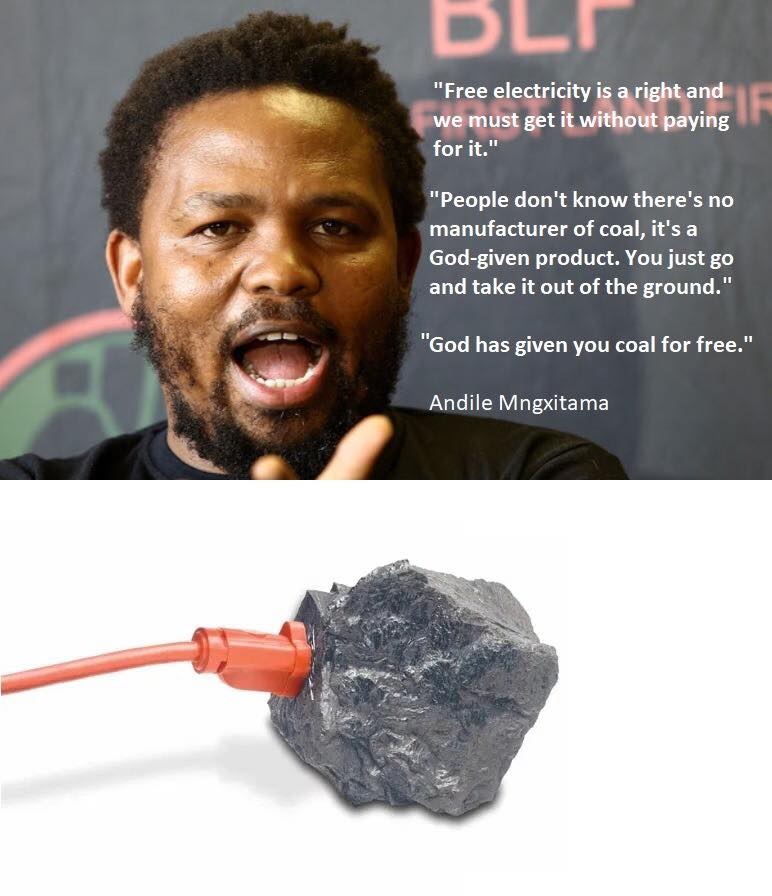
87515352_2665724093645489_3989282026728456192_n

Oh for the…

First you have to find where the coal is. It isn’t everywhere. That takes people (who want to be paid) with equipment (that has to be paid for) to do the searching.

Then you find that the coal is usually on land that someone owns. Digging it up will disrupt other uses of that land. The people who own it will want to be compensated for that. Most convenient way is generally to have the coal miners buy it–which means it will have to be paid for.

Then the coal isn’t just sitting there on the ground. It has to be dug up. That, once again requires people (who want to be paid) and equipment (which has to be paid for). Even if you find coal that is just sitting on the surface it still needs to be gathered by people who, once again, need to be paid, and getting useful amounts will require equipment that needs to be paid for.

Then the coal must be gotten to someplace where it can be used. This, once more requires people (who want to be paid) and equipment, chiefly trucks, trains, ships, and what not (that needs to be paid for).

Coal doesn’t magically produce electricity. Producing electricity requires equipment (that needs to be paid for) run by people (who still insist on being paid).

You have to get the electricity to the folk who are going to use it. This requires a distribution network of cables (which need to be paid for), installed by people (want to be paid) using equipment (that needs to be paid for).

All of this stuff will occasionally have breakdowns and will need to be repaired by, you guessed it, people (who want to be paid) using equipment (that needs to be paid for).

Now here’s the thing.  This guy is ridiculous.  He’s so ridiculous that even the Far Left (actually fully Marxist) “Economic Freedom Foundation” found him too ridiculous and expelled him, leading to him founding the Black First Land First organization.  And his “proposal” here is, as shown above, utterly preposterous.

But as preposterous as it is, it is no more preposterous than any other claims that things that require goods produced by others as well as the labor of others can ever be “free.” Even slaves have a cost–to acquire, to keep, and to keep working on what you want them to work on rather than what they would prefer to do for their own benefit.

All of the talk about something that requires the labor and goods of others being “rights”, and thus should be provided “free” may create a smokescreen of words to hide it, but they all come down to the same impossibility.  Everything that requires goods and services provided by others has to be paid for.

The only question is whether it will be paid for by people engaging in voluntary exchange, or whether it ill be taken by force.

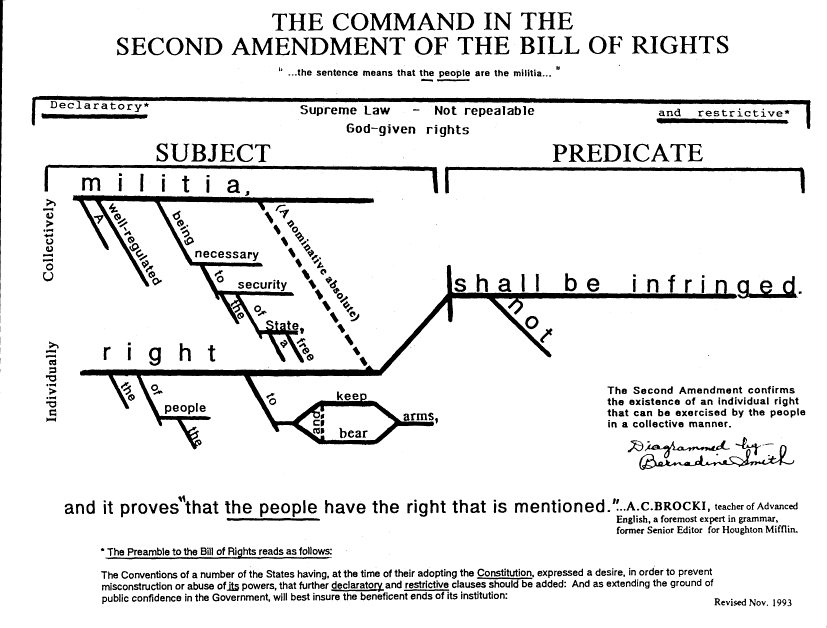
A Grammar Lesson: A Blast from the Past

2nd Amendment

Some people find this confusing:

A well-regulated militia, being necessary to the security of a free state, the right of the people, to keep and bear arms, shall not be infringed.

Mind you, the reason they find it “confusing” is because they desperately want it to say something other than its plain words arranged in a relatively straightforward declarative English sentence.

But for those people, let’s go over it, piece by piece, shall we?

Let’s start with “militia”.  What is the militia?  Put simply, the militia is the people when they take up arms to defend themselves, their communities, their States, and their nations.  Being part of the militia does not require being in a government-run organization.  It does not require drawing a government paycheck.  It is simply defined by what they do.

This was made quite clear by folk writing in the general time when the Second Amendment was written.  As just one example we have the following:

“Who are the militia? Are they not ourselves? Is it feared, then, that we shall turn our arms each man against his own bosom. Congress have no power to disarm the militia. Their swords, and every other terrible implement of the soldier, are the birthright of an American… The unlimited power of the sword is not in the hands of either the federal or state governments, but, where I trust in God it will ever remain, in the hands of the people.” – Tenche Coxe, The Pennsylvania Gazette, Feb. 20, 1788.

The militia are the people.  They are you and me and the person down the street.  To repeat, they are whoever might take up arms in defense of themselves, their community, their State, or their Nation.

“But,” some will say, “the meaning of ‘militia’ has changed since then.” That might be, but in a legal document, and the Constitution is a legal document, the ultimate legal document from which all laws in the US derive their authority, one does not unilaterally redefine terms.  The terms retain the meaning they held when the legal document went into force.

The militia is the people, neither more nor less.

Then there’s “well-regulated”, which, at the time the Constitution and the Bill of Rights were written did not mean controlled by the government.  And it certainly did not mean drawing government paychecks and under government orders.  After all, the people had just fought, and won independence from, their former government.  And it is quite clear from the Coxe statement above and from other writings (for instance, James Madison in The Federalist Papers 46 described the maximum possible standing army attempting to override the states and the people being met with a militia 500,000 strong; extrapolated to today’s population, that would be like a military about three times the size of the present day’s military being met by over a hundred million armed Amerians) that one of the purposes of the militia was as a check on government, particularly Federal government overreach.  This is not possible if the “well-regulated militia” is restricted to those under government orders.

If, however, you look in a dictionary with good historical usage notes you find that “well-regulated” is a term meaning not “government restricted and controlled” but rather “properly functioning”.  A “well-regulated clock” is one that keeps good time.  I “well-regulated individual” is one with good self control.  And so on.

Thus, “well-regulated militia” means simply a militia that functions property, that can do what needs to be done when necessary.

“a free state”. Not just any State, but a free one, one where individual liberty is paramount, where the rights of those individuals are honored and protected.  The thing to remember also is that “State” at the time wasn’t another word for “provinces”, divisions within a nation.  “State” was a term for a sovereign entity.  We have the term “nation-state”, usually shortened to “Nation” because that’s by far the most common form of statehood, but it’s not the only one.  There have been many an example of city-states in history.   The States that made up the United States were, in  a very real sense individual sovereign nations.  They individually delegated part of their authority–which authority they gained from the people rather than any “divine right of kings”, “mantle of Heaven”, or similar “government is always right” philosophy–to a unified central government.  And this is what made a “free state.”

Note where also the word “secure” appears in the Constitution:  in the preamble:  “to secure the blessings of liberty to yourselves and our prosperity.”  “Security”, thus, is not just the safety of the states from outside forces, but the security, the safety, of the very freedom for their people that made them “free states”.

He who would give up essential liberty for a little temporary safety deserves neither freedom nor safety–Benjamin Franklin

What must be protected is liberty itself.  As I discuss elsewhere, the giving up of freedom for safety is a fool’s bargain.  To prioritize safety over freedom is to end up with neither.  To prioritize freedom over safety allows you to end up with a great deal of both.

“arms” means weapons.  Period.  Law dictionaries written about the time the 2nd was written defined arms as “weapons of offense or armor of defense”. It’s open ended.  It’s very open ended.  Deliberately so.

“keep and bear”.  Not just ownership, but carrying.  “Keep” means to possess.  “Bear” means to carry with you.

There’s only one word, left that is subject to deliberate confusion.  “Infringe”.  From the Oxford English Dictionary we have:

infringe
VERB infringing, infringed, infringes
1 Actively break the terms of (a law, agreement, etc.)
‘making an unauthorized copy would infringe copyright’
2 Act so as to limit or undermine (something); encroach on.
‘such widespread surveillance could infringe personal liberties’
‘I wouldn’t infringe on his privacy’

Limit.  Encroach on.  These are things that happen at the edges.  Another word for “encroach on” is “trespass.” One trespasses at the border of a property.  You don’t have to wait until they’re sitting in your living room flipping through the channels on your TV before it’s trespassing.

So, let’s put it all together:

A well-regulated militia, being necessary to the security of a free state, the right of the people, to keep and bear arms, shall not be infringed.

Since, to having people ready and able to take up arms to defend themselves, their communities, their states, and their nation is necessary for both to protect those things and to keep their state and nation free, the right of the people to own, possess, and carry with them if they wish, weapons of offense or armor of defense shall not be encroached upon, limited, or trespassed on.

That sentence is longer, but it means exactly the same thing as the former.  It is not a new interpretation invented by the NRA or any other group.  It is what the 2nd Amendment meant when it was written and has always meant since.   The only way to change that is to properly amend the Constitution, which means either 2/3 of the Senate and 2/3 of the House (or a Convention of States called by 2/3 of State Legislatures) to propose an Amendment, and 3/4 of State Legislatures to ratify it.

Anyone telling you differently is either lying to you or uncritically repeating the lies that someone else told them.