Middle Men: A Blast from the Past

I don’t usually “blast from the past” such a recent post, but it fits so nicely after Sunday’s “Money (reprise)” post that I wanted to include it here.

Sunday I talked about how money, as a common medium of exchange, makes economic transactions easier and, as a result, reduces the opportunity cost.  We can have more goods and services (or more time to enjoy the goods and services we have) because we’re spending less time trying to find the exact trade of what we have for what we want.

“Middle men” serve the same purpose.  They bring things that are produced far away, they break down inconveniently large quantities from sources to convenient amounts for us, the end users, and they aggregate a bunch of different sources into one “market” so we can go one place for the various things we want rather than chasing all over creation for them.

That said, here’s last August’s post:


People often talk about wanting to get rid of the “middle man” in buying and selling in order to bring down costs.  There’s just one thing.  While the middle man may increase the price they generally bring down the cost.

Allow me to explain.

From time to time, I’ve gone to a “u-pick” farm to get fresh strawberries.  I could drive out there, get a box, and go down the row of strawberry plants picking fresh, ripe strawberries and when I’m done, I have the box weighed and pay substantially less than the same amount of strawberries would cost at my local grocery store.  And that’s not counting the ones I ate–everybody does it–while picking.

Cost saved right?

Well, actually….

Consider a few things.  The farm is about an hour’s drive from where I live.  So that’s two hours round trip in addition to the time spent picking.  Two hours, and gas money on top of what I spent at the farm itself.  Now maybe folk might want to discount that because…fresh strawberries generally better than I can get in most stores.

But you can’t just discount it.  Imagine your typical weekly shopping cart.  Consider every item in it.  Now imagine going to where that item is grown or made and buying directly from the grower/manufacturer.  And if you live in the Midwest, like I do–or anywhere far from the tropics, and that cart contains oranges, grapefruit, or anything that requires subtropical or tropical heat to grow that means driving/flying/boating to a place where it does grow.  And you’re going to have to go to dozens of different places, all to get the things that would fill that imaginary shopping cart.

While the price of the items would likely be less than you pay at the store, wow much would all that traveling around to get it cost?  How much of your time would be absorbed just going from farm to manufacturer to craftsman to a different farm and so on, all to get the basket of items that amount to your weekly shopping?

Instead, we have middle-men.  We have wholesalers who gather items from manufacturers around the world.  We have shipping companies that do nothing but carry goods from one location to another.  and we have stores which provide a variety of different items in one place from which you can select all at once.  Yes, each of those “middle men” need to be paid, and their pay adds to the price of the good when you buy it at the store.  But they do so by dramatically reducing the cost in terms of the time and effort (and gas) that it would take you to go and deal with each of the producers individually.  It might be fun or useful to do one or two but when it comes to everything a person might want?  The middle men make it not only cheaper (in total cost) but possible at all.

Another aspect is scale.  In college I took several art classes.  A lot of our practice work was done on newsprint.  And while newsprint was about the cheapest paper in the art supply stores, it wasn’t what I would call cheap.  Perhaps, if a paper mill was conveniently located I might go and get my paper there.  There’s just one problem.  Have you seen the rolls of newsprint as they come from the mill?  I have.  I have no idea how much one of those weighs but several hundred pounds at least.  As a college student, I could come up with a few bucks for a pad of newsprint from the art supply store.  Coming up with enough money for one of those gigantic rolls?  Not so much.

This is another thing that middle men do.  They take large units that come from suppliers and break them down into more manageable chunks for the consumer.

All too often people decry the middle man for “driving the price up” without recognizing that the middle man is actually reducing their costs.  They don’t realize that without that middle man they would be spending time and resources that could be put to better use elsewhere just to obtain the things they obtain now.  The most likely result would be to cut back on the things they purchase now–after all, how many people in the midwest really can drive or fly to Florida to buy a crate of oranges so they can have juice with breakfast?–with a commensurate drop in quality of life.

Problems arise when those middle men charge more than the value they add by reducing the total cost of acquiring the goods.  In a market economy, this provides incentives for people to seek alternate suppliers or simply use less of the products these particular middle men are dealing with and using alternate goods and services that provide better value.

And sometimes changing conditions change the relative value that a particular middle man provides.  In the modern era, for instance, the combination of electronic communication and fast shipping we have more people dealing either directly with manufacturers or regional distributors as opposed to dealing with local retailers.  The changing technology in some cases has lowered the cost of skipping one more more levels of middle-men enough that it no longer justifies the price those levels need to add to be able to function.

While this may be uncomfortable for those in the levels being “skipped”, who will need to find other ways to generate income if they are to maintain their own standard of living, the effect on the economy as a whole is to bring more goods and services to the consumers at lower cost increasing the standard of living of the population as a whole.


On This Memorial Day

FLANDERS FIELDS
BY JOHN MCCRAE

In Flanders fields the poppies blow
Between the crosses, row on row,
That mark our place; and in the sky
The larks, still bravely singing, fly
Scarce heard amid the guns below.

We are the Dead. Short days ago
We lived, felt dawn, saw sunset glow,
Loved and were loved, and now we lie,
In Flanders fields.

Take up our quarrel with the foe:
To you from failing hands we throw
The torch; be yours to hold it high.
If ye break faith with us who die
We shall not sleep, though poppies grow
In Flanders fields.


To absent friends.

Money (Reprise)

I have recently done three posts on Money, here, here, and here.

Someone in an online forum recently went on a long rant about how money, in particular modern “fiat currencies” (i.e. money that is not backed up by precious metals but is instead simply declared as existing by some organization–usually a government–that has authority to do so), are worthless, not real, nothing more than shared delusions.

I run into that a lot from people who bemoan the move away from “hard” currencies (currencies that are defined in terms of a certain amount of some particular physical resource, generally gold or silver) to “fiat currencies”.  Gold apparently has magical properties that makes it “real” money and the other is “fake.”

Here’s the thing though.  Those little pieces of paper, disks of cheap metals, and electronic records do have value, important value.  And that value is in their function as a common medium of exchange.

Consider a case in the absence of money.  Suppose, I made chairs.  Being pretty good at my craft I make some pretty decent chairs, a comfortable and attractive place for even the very well-to-do to prop their rear ends.

So I’ve got these chairs that I’ve made.  But, you know, I’d really like an omelet for breakfast.  And for that I need eggs.  Now, I can go down to the guy who raises chickens for some eggs only there is a problem.  One of my chairs is really quite a lot to trade for three eggs (I’m hungry enough that a three egg omelet would be just about right; after all, making these chairs is hard work), even for three dozen eggs (probably about as much as I can eat before they start going bad. (I like eggs, but not that much.)

Even if I’m willing to just suck it up and offer the trade of one of my exquisite, hand-crafted, nicely padded chairs for some eggs, there’s a problem.  The guy with the chickens doesn’t want a chair.  “Got plenty, thanks.”

Now what do I do?

Given time and effort I could find someone who would be willing to take one of my chairs for something, and that something could then be traded for something else until eventually I had something the guy with the chickens wants in exchange for eggs.

The problem is, all of that takes time and effort which I could be using for other things.  I could be using it to make more chairs (which I could then trade for other things I want) or enjoying some of the things I’ve traded for, or just eating that omelet that I started out wanting.  Anything other than going around from person to person trying to work out a system of trades that finally gets me those eggs.

This running around from place to place is a cost to me.  If nothing else, its time I could use to make more chairs to trade for more items.  The opportunity to do so is lost because I’m spending time and effort just trying to make that one trade. (Thus, economists call this “opportunity cost.”)

If only there were something I could trade the chair for, something that can be used for larger trades (like the chair–or even things larger than that) and which could also be divided easily into multiple smaller trades (so I can get eggs from the guy with chickens, ham from the guy who raises hogs, and cheese from the guy with dairy cows, and maybe some onions and peppers from someone else).  If only.

Fortunately, we have that something.  It’s called money.  Money is, put simply, a common medium of exchange.  Somebody wants a chair?  I can trade one of my chairs to him for, oh, let’s call it one hundred quatloos.  Then, without having to worry about finding intermediate trades, I can go straight to the guy with eggs and give him ten quatloos for some eggs, to another guy I can give twenty quatloos for some ham, and spend some more for cheese and veggies.  And they’re all willing to do that because they can use those quatloos to trade for things they want.  And then, with a lot less work and effort, I can have my omelet.  Even have enough time saved to make more chairs.

Go me!

This something, this “money” has value from its function as a common medium of exchange.  It makes economic transactions easier and therefore reduces the cost, the opportunity cost, of those transactions.  It’s value is that it makes everything else more valuable because those other things can now be traded more easily and more conveniently with more possibilities.

Of course, once you have money of whatever type, “hard” or “fiat”, supply and demand applies.  What really separates “real” (hard) money from “fiat” money is the ease with which the supply can be changed.  It’s a lot easier to print more pieces of paper (and even easier to change some electronic records) than it is to come up with more gold.  This is why monetary policy is so, so important–and beyond the scope of this blog post.  But that “fiat” money is still just as real as the “hard” money so long as it serves as a common medium of exchange that can be aggregated (say, I sell a bunch of chairs to a bunch of people so I can buy a new house) or divided (as described above regarding those eggs).

Now I think I’ll go have an omelet.

Economics and rationing.

Economics, as I have said before, is the study of cause and effect relationships in the distribution of scarce resources that have alternative uses.

“Scarce” means, simply, that there’s never enough to completely satisfy everyone who wants it.  As my Intro to Microeconomics professor put it back in college, “Resources are limited.  Wants are unlimited.”

Scarcity does not necessarily mean, by itself, that there exist ultimate limits in the amount of resources available.  There probably are, and I’ll get to that in a moment, but not because of scarcity.  If, for instance, the universe is infinite in extent and we’re the only sapient life form in it, then that infinite universe, and the infinite resources it represents, would be available to us.  Of course, current understanding of physics and cosmology suggests that the universe is not infinite and it’s still an open question whether there’s anybody else “out there.”  And, if that understanding is correct, the universe being finite would mean that there is an ultimate limit on the resources available.

That there are ultimate limits does not mean that we’re anywhere close to them.  That said, scarcity is not a factor about reaching or approaching ultimate limits.  It’s a statement of what we have available to use, economically, now.

“Alternate uses” is equally important to scarcity.  If each resource only had one use, then we would use it for that and there would be no choices to make.  Resources, however, can generally be put to a number of uses.  Iron ore can be used to make auto bodies, butter knives, or surgical scalpels among many other things.  Wood can make paper, homes, or furniture.  Land can be used for farming, a base for a skyscraper, or left as wilderness.  And so on and so on.

How the decisions on how much of each resource is to be allotted to each use is the subject of economics.  It doesn’t necessarily tell you what that decision will be, only how one might make such decisions.

One thing, however, will be universal in any economic system:  there will be rationing.  Because of scarcity–there’s never enough of everything for everyone who wants it.  That means that some uses are going to get more and others less.  The only question left is how that decision is to be made.

The problem comes when people ignore that reality and try to say “we can provide all of fill-in-the-blank that anybody could ‘need’ (actually ‘want’) if only we…”

Unfortunately, reality doesn’t work that way.  Wants are unlimited.  Resources are limited.  And providing more of one thing means that we’ll have less of the things that were the alternate uses of the resources used, other things that people want/need.

Politicians and their promises are not limited by economic realities.  If there’s one thing that scarcity does not apply to, it’s promises.  Politicians can make promises as much as they want and never seem to run out.

Actually providing the things promised?  That’s a whole other ball game.  And even if they do, they rarely tell you what other things (scarce resources that have alternative uses) you’re giving up for the thing promised.

There’s an old saying, old when Heinlein used in in The Moon is a Harsh Mistress: “There ain’t no such thing as a free lunch.” It dates back to bars with signs offering “free lunch.” In those cases the “free lunch” was only for people who were drinking and the cost of the lunch was simply figured into the price of the drinks.  And like a sign offering “free lunch” could not make the cost of the lunch go away, so too politicians’ promises don’t make costs go away.  They simply hide them in something else, or simply refuse to pay them.  But if they refuse to pay them, the folk providing the good or service soon stop.

The only option at that point is force, the threat of violence, to get them to keep providing.

There is a term for that.

So when a politician, or anyone really, who offers to make scarcity go away, to provide all you could ever want of something, of anything, then hold onto your wallet.  Then count your fingers, and your toes, and your relatives.

Because you’d better believe they are doing it for their benefit, not yours.


Computers, How far we’ve come.

Out of curiosity, I went looking to see how the computing power of a typical smartphone compared with the big computers of the past.  I found this:

https://www.theclever.com/15-huge-supercomputers-that-were-less-powerful-than-your-smartphone/

The results were pretty impressive.  Now, some of the numbers they cite in that article I question because I saw different numbers elsewhere.  Still, it was a starting point.

One measure of computing power is the number of “floating point operations” the computer can perform per second (“flops”), often in millions per second (MFlops) or billions per second (GFlops).

ENIAC, the first general purpose programmable computer, could do about 500 flops.

One of the first supercomputers was Atlas.  Because of the way it worked, performance measurements are difficult but a floating point multiply (typical floating point operation) took 4.97 microseconds so call it 0.2 MFlops.

The IBM 7090, used to calculate Mercury and Gemini orbits, could do 0.1 MFlops.

In 1966, working for CDC, Seymore Cray designed the CDC 6600.  This computer ran at a dizzying (for the time) 3 MFlops.

A few years later, in 1969, he did it again with the CDC 7600 cranking out results at 10 MFlops.

The Apollo moon landings were handled from the ground with a handful of IBM 360 computer, each capable of about 1 MFlop of performance.

Remember Seymore Cray, behind those CDC computers above?  Well, he left CDC in 1971 to form his own company.  And he made a big splash in 1976 with the Cray 1 supercomputer, the fastest in the world at the time at 160 MFlops.

Soon, Cray was back with the Cray X-MP at 200 MFlops in 1983

The Cray 2 broke the Giga-flop barrier in 1985 with 1.9 GFlops, followed quickly by the Cray Y-MP in 1988 with up to 2.6 GFlops.

For comparison let’s look at personal computers.

In 1990 the 486DX-33 could crunch numbers at a rate of 50 MFlops, making it more powerful than the computers that ran the Apollo moon landings and faster than those early CDC supercomputers.

In 1996, a Pentium 200 could perform at 200 MFlops making it faster than that first Cray supercomputer.

By 2004, a Pentium 4-520 was doing 5.6 GFlops, and we’re already past the Cray 2 and Y-MP.

Today, my smartphone according to one test does just over 4 GFlops and my laptop computer, does 74.5 GFlops.

A lot of power to look at cat videos and argue with strangers on the Internet. 😉

Intention and Incentive

One of the worst mistakes people make in politics is judging programs by their stated intentions and not by the incentives and constraints that between them drive the actual outcomes.

Consider price controls.  A typical example is rent control.  The idea is very noble sounding:  ensuring that people have “affordable” housing.  However, look at the incentives that it creates.

One incentive is that people who have this “affordable” housing may end up using more than they would otherwise.  A person might keep a larger apartment than he would otherwise use if he had to pay more or who might rent alone where otherwise he would take a roommate.  Or a person might take an apartment of his own when otherwise he would live longer with parents or other relatives.  Or they might live father out from the city and accept a longer commute.  Thus the incentive is to increase the amount of housing demanded at the rent controlled prices over what they would be in a free market.

On the flip side, however, people who own the apartment buildings find them less profitable.  Now, some people might consider this no big thing–after all, if those “fat cat” landlords make less money, who cares? The problem is with the incentives this creates.  For one thing, that increased quantity demanded means that if a tenant is dissatisfied and moves out, there are plenty more waiting for that space.  There’s less incentive to maintain the building.  Quality deteriorates.  Oh, the law requires certain things (running water, heat, that sort of thing) to be provided so they have to keep that up, but if the cost of providing those things exceeds the revenue that can be generated under rent control, it becomes practical to just abandon the building, and leave it to the creditors.  But even more.  Buildings wear out (or get abandoned and end up having to be condemned), especially if they’re not generating sufficient revenue to pay for proper maintenance.  New buildings get built.  And when someone looks at building a new structure, they can use much the same resources to build an office building or an apartment building.  Since office buildings are rarely covered by rent control, there’s far more incentive to turn those construction resources to office and other commercial structures than to places for people to live.  Thus, the quantity of housing supplied is lower under rent controlled prices compared to what they would be in a free market.

Reduced quantity supplied and increased quantity demanded, the very definition of a shortage.  It is no coincidence that any place where meaningful rent control is instituted (meaningful in that the rent controlled prices are lower than they would be in a free market) you soon end up with housing shortages.

Indeed, nearly any government program to “lower cost” works the same way.  The incentives created lead to a reduction in the quantity supplied and an increase in the quantity demanded–shortage in economic terms.  This is because government programs rarely address the issues that cause the cost to be high.  It simply refuses to pay the cost.

Another issue of incentives vs. intentions is in various government bureaucracies.  Government programs are generally created to “solve” a particular problem.  Yet very little incentive is given to the organization, and those within it, to actually do so.  Failure to solve the problem rarely gets a government bureaucracy disbanded or even cut back.  Indeed, when the size and scope of a government organization is largely driven by how dire the “problem” it was created to “solve” is, the incentive is not to solve it, not even to make it better, but to convince the decision maker that the problem is “worse than we thought” and deteriorating.  I, indeed, have pointed out that same principle in action in the case  of public education.

Further examples of this in action should easily come to mind.

Happy (or not) World Goth Day

Normally I do these in the evening, but for today I’ll post early.

539583_348921341810707_2005667329_n

For those unfamiliar, here’s a brief history of Goths, the Gothic subculture and why “Goth”  even though they, we, were nowhere about when Rome was being sacked. (I’ve got an alibi!)

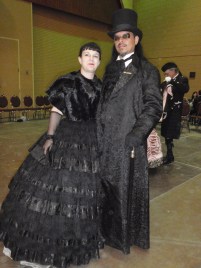
And some pictures of Goths, being Goth (what can I say, I like couples):

If this interests you, Toxic Tears has some tips on getting started:

Class and Conflict

Marx defined “class”not just as a group having certain elements in common.  Having certain elements in common was a necessary consideration, but it wasn’t sufficient.  To be a “class” as Marx defined it, the group must be in conflict with another class.

Thus we have “class struggle” and “class conflict” as central tenets of Marx simply because class is defined that way.  And this has pervaded Western thought to the extent that even when we don’t explicitly define “class” in terms of “conflict” people assume that the classes must be in conflict.

One example is the division of the “working class” and the “wealthy/capitalist/upper class”.  Now, historically, there has been some justification for that especially in the old “company towns” where there was only one significant employer and it was a lot harder to just pack up and move than it is today.  Employer paying in “scrip” which could only be used in the “company store” and further things that really had the employer acting more like a government than a business, making the employees more subjects than workers.  In such a case, the subjects organizing in revolt against their oppressive government (workers forming a union but in more functionally descriptive terms) has a certain logic.

So yes, there certainly have been cases of classes in conflict with other classes, but is it as universal as folk indoctrinated with Marx to the point that they don’t even recognize it as Marxian would have you think?

Well, one thing to consider is that folk aren’t as tied to “class” today as in times past.  Economic class?  In my life I’ve been through four of the five household income quintiles.  (Recent change from a two income to a one income household dropped me one quintile.) In the US 88% of millionaires (2017 data) are self-made.  And even if they don’t get “rich”, people generally move through various income levels over time.  My own case is hardly exceptional.  Three quarters of those American workers who were in the bottom 20 percent of income earners in 1975 were in the top 40 percent sometime over the succeeding 16 years (W. Michael Cox and Richard Alm, “By Our Own Bootstraps: Economic Opportunity & the Dynamics of Income Distribution,”
Annual Report, 1995, Federal Reserve Bank of Dallas, p. 8.) Far from defining a “class” in which one lives ones life, income is more likely to simply be a way station as one moves through different income levels in life.  Yes, there are some poor who remain poor and there are some people who are born rich and remain so throughout their lives.  But that is not the case for the majority of Americans.

Then there is conflict within a class.  Consider the “Capitalist” class. (This is itself a misnomer–do you have a pension fund or retirement account?  Congratulations you are a “capitalist”.  But that is a discussion for another day.) Conventionally we are supposed to consider these “Capitalists” as some monolithic block in competition with the workers.  Nothing could be further from the truth.  For one thing most of the conflict that the “Capitalists” face is not from workers but from other “Capitalists.” They compete for customers and markets.  They compete for resources.  And they compete for productive workers (representing “human capital”–another reason that “Capitalist” as a class is a misnomer).

Consider that Ford motor company was paying workers more than their competitors, was running shifts with 40 hour work weeks starting in 1914 (scaling back from 48) because Henry Ford believed the longer hours hurt worker productivity.  Some people want to claim that Unions were responsible for these improvements in worker conditions.  There’s only one problem:  Ford didn’t unionize until 1941.  Indeed, the unionization of Ford did not happen until government got involved, and unions obtained political power leading promptly to the unionization of Chrysler and GM with Ford the lone holdout.  This led to a rather bitter conflict between union organizers and Ford management but all this was after the 40 hour work week and other improvements in worker conditions.  Unionization was not the cause of them.

What did lead to these improvements was that Ford had to compete with other manufacturers–not just of cars since welders, metalworkers, and other folk can find work in other industries too–for productive workers.  The pay and other improvements in worker conditions meant he could select from the best workers allowing him to produce more cars at a cost that let him sell that 15 million cars and make a very handsome profit.

The conflict wasn’t between workers and capitalists, but between various capitalists with the workers benefiting.  On the flip side that “select from the best workers”?  If you wanted that job with, for the time, good pay and good working conditions?  You’d better be a more productive worker than the next guy.

The conflict within the classes dominated rather than any conflict between classes.  And the result was more commodities provided to society as a whole and an improved standard of living across the board.

The idea of “class conflict” is a pernicious one and one of the legacies of Karl Marx.  Indeed, it’s treated as a fact of nature to such an extent that people don’t even recognize it as a Marxian concept.  It’s something that people simply accept as true, as “self-evident.”  And yet, under even a modest examination it falls apart.

Confessions of a Viking Goth: A Blast from the Past

I have often described as Goth, although maybe “Goth Lite” or perhaps “Entry Level Goth” is a better description.  Part of it is “personal branding”–having a distinctive “look” that can be distinctive and recognizable.  For instance, there are other writers out there who wear black almost exclusively but when I started on my personal branding efforts I searched and no one was styling himself or herself as “The Writer in Black”.  So I did.

But it was more than just a branding effort.  It was also a matter of recognizing who I am.  In the early eighties, I was out of my home, in the Air Force, out of training, and at my first duty assignment in Great Britain.  Basically, this was the first time where I was positioned to make my own choices for style and clothing.  Oh, sure, on duty it was all Air Force uniforms but off duty was my choice.  I found myself choosing black clothes and a style that, in retrospect were kind of “Goth-ish”.  The someone told me that if I wanted to be attractive to young women I should wear bright colored clothes.  Being unreservedly heterosexual, young, and single this was an important issue to me.

Worst.  Advice.  I’d.  Ever.  Got.

For one thing, it didn’t work.  But the clothes I was wearing just weren’t “me”.  Oh, over time I convinced myself they were, but…no.

Fast forward many years later.  I get introduced to music that I hadn’t been exposed to before.  Power metal, Symphonic/Gothic metal, darkwave.

Music like this:

Or this:

Or this:

Oh wow.  That was some exciting stuff.  It called to me in a way that the stuff I’d heard before, even my very favorites from before, hadn’t.  And it broke through the wall I had built.  I looked at my bright colored shirts and khaki and beige pants and said “this isn’t me.”

So I start wearing darker colors, mostly black.  I feel more comfortable than I ever had before.  I dye my hair black (beard too sometime later when I started growing that), bleach a streak above my right eye (which I dye purple for cons and the like).  And I feel more comfortable in my own skin then I ever have before.

Now, one thing I did learn is that there are different subgenres of Goth.  There’s Trad Goth, Industrial, Pastel Goth, Cyber Goth, Cowboy Goth, and so on.  Similarly in metal:  Power Metal, Death Metal, Symphonic Metal, Viking Metal, and so on.

And wait a minute I thought.  Back up.  Viking Metal?  Could there be Viking Goth too?  I look.  There’s no Viking Goth that I could find.

Cool, thinks I.  I can try something new.  The trick is to get a “Viking look”  like, say this:

what-vikings-really-looked-like-women

And blend it with a Goth look like, say, this:

1b687892494fd07ac111b38083f0aaf5

So far my results are looking more “Viking Biker” than “Viking Goth” but working on it.  Biker would be a perfectly fine look, but it’s not what I’m aiming at.

Ice Follies ongoing: Some success.

Success!

The main problem ongoing here has been that my feet have been pure misery. Bad arches and rather thick feet and ankles contributed to the problem. Well, trying the skates at home (plastic guards to protect floor and blades from each other of course) I could concentrate on what’s going on. I found that with one pair of my orthotics in place there was a pressure point right behind the balls of my feet where the pain was concentrated. Ah Hah! Said I. The shape of the boot and the orthotic conspired to cause the end of the orthotic dig into my foot there. So I took out the orthotic and just used a gel insole, carefully trimmed to match the insole that came with the boot. With that my whole foot hurt with most of the pain running along the inside edge of the arch.

This led me to sit down and think. Remember what I just said about thick feet and ankles? The laces that came with the skates (108″) weren’t really long enough, even the longer laces (120″) I’d bought at the rink pro shop weren’t. I had to crank them down really tight through the instep to have enough lace to get even the first three of the speed laces (hooks) which I needed for ankle support.

So I went to the store and got two pair of 72″ laces. I tied two laces together (twice) giving me 140″ laces. And ta dah! I was able to keep them just snug over my instep and get up all four pairs of speed laces. I still got some foot pain, bad arches aren’t magically going away, but it was manageable .

Tried it out on the ice tonight. So much better. Did eight laps–a personal best–with only a couple of short breaks to relieve foot pain. At the end it was fatigue, catching toe picks on the ice and the like, which told me it was time to stop.

That was yesterday.  Today I had class.  And while I still had to take frequent short breaks to take my weight off my feet and let the pain subside, it was nowhere near as bad as it had been before.  As a result I was able to spend more time on the ice and made quite a bit of progress today.  In particular, my balance was better and I was able to start working on one foot glides.    The one foot glides were short, only a couple of seconds each, but they represent a major step forward from where I was before.

And when I was done, I realized that I felt really, really good.  The difficulty, the challenge, made that little bit of success all the sweeter.  It’s been hours (as of this writing) since class and I’m still feeling a bit euphoric from it.

As I had said in a previous post, it really does pay off to face something difficult, seemingly insurmountable at the start, and then keep at it until you succeed.   The more difficult the challenge, and to a great extent the more painful it is along the way, the greater the rewards of final success.

This does not mean beating your head mindlessly against the problem.  As I did here, you have to think things through, figure out what’s getting in the way of your progress, what you can do to make it better and then do it.   Sometimes what you need really is to just keep throwing yourself at the problem.  But sometimes it means a step back, a reassessment, and a change of direction–like in the above figuring out the specifics of why my feet hurt so much.  There are still some improvements that I think can be made (and losing weight is one of them–simply reducing the stress on my feet from supporting my rather large frame could make a significant difference) but I am doing better and can expect to continue to do better going forward.