A Brief History of Slavery

Well, okay, more of a montage than a history but then even a brief history (actual history) would fill volumes and this is a blog post.

Amélie Wen Zhao had a YA book accepted for publication by Delacourt Press, a major children’s publishing house.  As one might imagine, she was thrilled.  Unfortunately after receiving harsh…criticism is probably the kindest word…she withdrew the book.

For what was she criticized, you might ask?  Apparently because the novel depicts slavery and Amélie Wen Zhao, not being African American, apparently has no business writing about slavery.  It would seem that only African Americans are permitted to have anything to say about slavery.

That is an utterly ridiculous proposition.

Slavery is as old as history, probably older since slavery it was already present when recorded history began.  I mean, I suppose it’s possible that slavery and writing occurred simultaneously, but what are the odds?  Yeah, that’s what I thought too.

Slavery in history was found throughout the world.  Sure, it’s probably mythical that the Pyramids were built by slaves, let alone Hebrew slaves, but the contemporary civilizations in Mesopotamia certainly had slaves.

Enslaving people was one of the more common things done with prisoners taken in raids.  Debtors being sold to help defray their debts was another common use.

In Mayan society, for instance, slaves were used for the heavy labor of constructing stone temples.  That, however, might be a kinder fate than many others faced:  being fed into the maw of human sacrifice.

The term “Slave” itself comes from the Slavic people, being simply a corruption of “Slav” a Slavic person.  Imagine being a member of a group so often enslaved that the name for your people comes to mean someone enslaved.

The Romans were big on slavery.  Some people have pointed out that Roman Law gave slaves a variety of rights and privileges.  Nevertheless, they were also subject to horrific punishments up to and including crucifixion.  One might note that Roman slavery wasn’t “racially” based, at least not as we use the term.  But you have to understand that to Romans, there were Romans and there were barbarians.  Well, they might give grudging acceptance of Greeks as being civilized, and they might consider Egyptians (who were more than half Greek–having been ruled by Greeks since the time of Ptolemy–by the time Rome came around.  Roman “racism” was simply drawn more closely than in the modern West.   If you weren’t Roman, you weren’t fully human.

I could go on and on.  But I’m being brief so…

Of course, when most people think of “Slavery” in the modern world, they think of the transatlantic slave trade of black Africans.  As noted in yesterday’s post, only a very small part of that trade was to North America.  Most of it went to places like the sugar plantations of the Caribbean and South America.  And despite what Alex Haley might have you think, the European traders didn’t go chasing after Africans to catch them.  No, they simply bought their slaves from markets on the coast set up by Muslims and other Africans.

Well, what about Amélie Wen Zhao?  She was born in Paris but raised in Beijing.  Leaving aside accusations of slave (prisoner) labor in modern China.  From Wikipedia:

The Tang dynasty purchased Western slaves from the Radanite Jews. Tang Chinese soldiers and pirates enslaved Koreans, Turks, Persians, Indonesians, and people from Inner Mongolia, central Asia, and northern India.The greatest source of slaves came from southern tribes, including Thais and aboriginals from the southern provinces of Fujian, Guangdong, Guangxi, and Guizhou. Malays, Khmers, Indians, and black Africans were also purchased as slaves in the Tang dynasty. Slavery was prevalent until the late 19th century and early 20th century China.

It wasn’t until 1910 that slavery was outlawed in China.

So not only does Ms. Zhao have a “cultural connection” to slavery, it’s closer, more recent, than that of African Americans.

It’s ironic that a group that claims to support “multiculturalism”, to want to give a forum to “other voices”, should attempt to silence someone doing just that.  To restrict the addressing of a subject that has touched so many cultures worldwide, with victims and perpetrators of all races to a single, tiny representative is the exact opposite of that.

People have accused Ms. Zhao of racism.  Yet the people trying to silence her are saying, in effect, that certain groups cannot stand the idea of different voices, telling their own stories from a different perspective than their own narrow one.  In so doing, they are infantilizing those groups.

And that is racism.

If They’re Tearing Down Confederate Monuments, why is Marx Allowed?

(Extremely busy yesterday so no post.  Sorry.)

Today’s post was prompted by a recent news item about a statue to Karl Marx being vandalized.  A monument to a vile philosophy of the past being damaged if not outright destroyed?  Well, I wouldn’t be surprised given what’s been done with other monuments except this one, sad to say, is not “of the past.” If you don’t go looking, you may not realize how much Marx saturates the “intelligentsia” in the US.  He’s been ascendant in the Education-Entertainment Complex for generations (plural).  Arguments that are, at best, thinly veiled Marxism are treated as serious and, indeed, conventional.  Opposition is considered extremism.

How can this be allowed to continue?

Consider:  The number of Africans shipped to the US as slaves was never very great, totaling under 400,000.  Most of the more than 10 million Africans sent overseas to be slaves in the “new world” went to the Caribean and South America.  Frankly, I do not think that the US can be held accountable for the slave trade elsewhere.  Of course there were many more slaves in the US than that over time, thanks to the “natural increase” (i.e. slave women having children born in slavery and growing up to be slaves) but even so, the 1790 census reported just under 700,000 slaves in the United States.  By 1860, the eve of the Civil War, the number had risen to just under 4 million.

Given average lifespan even under the harsh conditions of slavery the total number of slaves in the US over the entire history of legal slavery cannot be more than about 15-20 million.

By contrast, Marx’s “ideas” have been responsible for over 100 million deaths and many more subject to oppression every bit as crushing as that of slavery.  It’s just the oppressor was the “government” (acting entirely for “the people” It Says Here).

If the institution of Slavery is so vile that we must erase people like Thomas Jefferson and Patrick Henry from history (slave owners, although of mixed feelings on the subject–Patrick Henry being a particularly interesting case) let alone folk like Robert E. Lee or Stonewall Jackson, remove their names from schools and street signs, and pull down statues to them, then how much more should we not destroy the monuments to Marx? (And, seriously, how can anybody wear those revolting “Che” shirts given what a monster Che was–a monster molded by Marx.)

If slavery was, and is, a blight upon the Earth (and I assure you, it was), how much more, than the greater blight of Marx?

Some might argue that it’s unfair to compare slavery in the US with the horrors of Marxism worldwide but that speaks to the influence the individuals and cultures memorialized in the US have had–which was strictly American at the time with the US only becoming a world leader well after the abolition of slavery–with that of Marx which has been global.  He and his ideas have led to far more misery and death than Thomas Jefferson, Robert E. Lee, Patrick Henry, and every other slave owner in the US combined.

My position is relatively straightforward.  While neither should be removed from history, both should be left in the past where they belong:

Cautionary tales, bad ideas unworthy of emulation.

Planning a Night Out

As I have mentioned previously, there appear to be two “goth” type events locally.  One is a “Goth Night” at the Black Circle Brewing Company that usually seems to be near the middle of the month.

Well, I noted that I haven’t had a “night out” just for my own entertainment in an embarrassingly long time.  Part of the issue is the responsibilities of being a single parent.  But I was reminded that it’s not good for either me or my daughter for me to lock myself up as a hermit.  So, the plan is to attend the upcoming event on the 9th.

The Black Circle Brewing Company is, as the name suggests, a microbrew place.  Unfortunately for me, I can’t drink beer–it spikes my blood sugar.  They also serve wine, cider, and mead (no distilled liquor) so I’ll be able to manage. (Drink responsibly, folks.)

Since this is a “Goth” event, it provides an opportunity I don’t get often to “dress up.” My boss in my day job is relatively understanding but even so I wouldn’t want to wear anything fancy here at the lab/office.  As it happens I had just recently ordered three different Victorian tail coats, one in black, one in purple, and one in red (black shown here):

Victorian Tail Coat_black

As it happens each of the coats is coming from a different location (go figure) and it will be the purple one that is scheduled to arrive by this weekend.  So, that’s what I’ll be wearing.  Black dress shirt and slacks, with the coat adding some color should make for a distinctive look.

And, so, the plan is to head out, have a late supper and possibly a couple drinks, listen to the music and people watch.

Ice Follies

No, this is not about the old touring company of ice skaters.  It’s about…well, you’ll see shortly.

My daughter a couple months ago expressed an interest in ice skating.  Part of her thinking was that the ice skating might help her ballet and ballet would help ice skating.  Reasonable.

So I signed her up for ice skating lessons and she got started.  As luck would have it, rehearsals for the upcoming competition and performance for ballet came in to overlap the lessons and that was that for the ice skating lessons for the time being.   We spoke to the instructor and she said they’d already introduced all the elements they were going to go over in that block of classes the rest was just going to be practice of those elements so Athena can practice that on her own and we can start her on the next block of classes after the ballet competitions are over for this year.

Now, we haven’t gotten to the “follies” part yet.  This is just background.

Back in the late summer of ’79 I was, for various reasons, staying in Arizona.  While there a friend of mine took me to an ice rink and there I learned to ice skate.  Strictly self taught.  I have reasonably good “kinesthetic sense” so I could, with some effort, transfer “book learning” of how things were supposed to work I could figure out at least the basics on my own.  Come labor day, I gathered up some pledges and participated in a 24 hour marathon for Muscular Dystrophy.  This long, concentrated effort smoothed out my technique quite a bit.

Then I returned home from Arizona back to Ohio and that pretty much put an end to my ice skating.  Briefly, I had a chance to go back to ice skating while I was in the Air Force and stationed in England–“Queens Ice Club” in London.  Even bought a pair of skates.  Rotate back to the United States and…no more ice skating until…

Fast forward to when Athena wanted to start skating.  I thought “Oh, I can get back into it too.  Okay, it’s been thirty-five years but surely it’s just like riding a bicycle.”

It’s not.

First time out, an “introduction” where Athena and I went out on our own in public skate time before we even signed her up for the class just to try it out.  Talk about embarassing.  I ended up hugging the wall all the way around and ended up on my rear end a good half dozen times.  You know, Judo is supposed to have taught me to take a fall without getting hurt but it looks like that’s not like riding a bicycle either.  Didn’t help that I guessed wrong on boot size.  I could get my feet into the boots but they squeezed so badly that…it was just misery.

One lap and I was done.  So was Athena that time.

Still, she was interested enough to sign up for classes.  And after classes, we’d do the public skate.  I’d do one lap.  Athena would skate until she was done.  I still had trouble with fit.  My feet have changed so much since I was younger and with the plantar fasciitis, I think the only way it’s going to work is to have my own boots with arch supports and and custom inserts.  Still, I’m game to make the effort, you know.

So that brings us to yesterday.  Athena has her ballet rehearsal and afterward asks if we can go ice skating.  Sure.  We go.  She has her skates and I rent a pair, as usual.  This time I find that I can lace them so they’re not too horribly uncomfortable on my feet and away we go.  I get one lap done and am still feeling pretty good so I go for a second.

Now, there was apparently some damage to the rink so they had a cut off shortly before one end marked with cones.  We had to divert across there rather than going all the way around along the wall.  So I’m nearing the end of that section, feeling pretty good because I haven’t fallen too many times.

Boom.

Before I even realize what’s happened I land flat on my back with a resounding thud.  My head snaps back “whack” against the ice and I lay stunned for a moment.  This was apparently an impressive enough wipeout that people, including at least one employee of the rink came over to see if I was okay.  I was.  As it happened the gather where I have my hair tied back in a ponytail actually provided substantial cushioning to the impact.  I was just a little sore where I might otherwise have had a knot.

It actually takes several attempts for me to get back to my feet but I manage and get back to the wall.  I then totter my way the rest of the way to the exit and, yeah, I’m done for the day.

In retrospect, I suspect part of the problem was that “more comfortable lacing” meant that my foot had too much play in the boot, so that I wasn’t as stable as I should have been.  Added evidence in that I had difficulty walking in the skates on the matted area outside the ring (a yielding material to prevent damage to the blades–never walk on a hard surface in ice skates without wearing blade guards).  The boots kept trying to roll my ankle.

In all honesty, I’m finding it harder to re-learn skating than it was to learn it the first time around.  And, this being the next day, I’m a mass of soreness.  I don’t…bounce…as well as I used to.  This means that I can only weather so much, and much less than when I was younger, before “I’m done.”

Still, I made it around that rink twice on my own.  Painfully, but on my own.

Go me!


Government and Business

A perennial complaint that people make is about the “control” big business has over government.  And, to be honest, there’s a lot of justice in those complaints.  And so, the people making those complaints argue we need to give government more power to regulate business.  More power to regulate business.  More power.

To be exact, that is exactly the exact wrong thing to do.

Here’s the problem.  The more power you give government to regulate business, the more valuable you make influence over the government, and thus over that regulation.  And the more valuable you make it, by definition, the more people or organizations (like big businesses) will be willing to pay for it.

Thus, the more you try to increase government power in order to regulate business, the more the biggest businesses will attempt (usually successfully) to influence that regulation in their favor.  It’s almost invariably the small businesses that end up paying the price–regulatory compliance is usually easier for big players than for small fry, and so the result is reducing competition to the big players.

The process is called “regulatory capture” And I’ve written about some examples of it before.

One might attempt to limit that through laws/regulations that limit what businesses are allowed to do in order to influence government–restricting things like campaign contributions.  There are, however, two groups that will stridently resist any meaningful attempt to do so (while, perhaps, allowing things that give the appearance of dealing with it while still allowing plenty of back doors):

  • Businesses with a vested interest in influencing government
  • Politicians with a vested interest in receiving the contributions that will help them win the next election.

It’s the mice voting to bell the cat while the cat doesn’t want to wear any such bell.

Thus, short of government simply taking control of business, “nationalizing” it, all increasing government regulation does is make the problem worse.  It becomes an incestuous mix of government regulation essentially written by the very businesses being regulated such that it benefits them and reduces the threat of competition.

“But wait!” Some might say. “Government can nationalize the businesses, thereby eliminating the problem. Go, Socialism!”

The problem there is that you run right smack into the issues that Hayek so ably described in “The Road to Serfdom” and I touched on, perhaps less ably, here. Once you take that step, the only way to make it work is through a totalitarian regime where force and threat of government sanctioned violence replaces the operation of prices and the market in determining the allocation of resources such as human labor.

There really is no way increasing government power can resolve the problem of “big business” influence over government without creating the worse problem of totalitarianism and reducing the population to serfs of a central Nomenklatura.

There is, however, one way to helpfully address the problem.  That answer is found in my third paragraph here, specifically: The more power you give government to regulate business, the more valuable you make influence over the government, and thus over that regulation.  And the more valuable you make it, by definition, the more people or organizations (like big businesses) will be willing to pay for it.

You see, the reverse also applies.  The less power you give government to regulate business (or, in general) the less valuable you make influence over that government and the less any businesses or individuals would be willing to pay for that influence.

If you’re truly concerned about the influence business has over government, the answer is not to increase the power of government, but to reduce it.  Strip government of the large majority of its power to regulate businesses and people in general and you eliminate the incentive, the value, of influencing that power.  The worst a business can do you you, after all, is refuse to do business with you.  They cannot (without the aid of a government) prevent you from taking your business elsewhere.  With government, they can send Men With Guns(TM) to ensure you do business exactly as they wish you to.  And even if you can “do business elsewhere” they can make sure that nobody else can offer terms of which they disapprove.

Reduce government involvement in business to legal sanctions against use of force or fraud and most of the problem of “government influence” by business goes away.  Mind you, it won’t be easy.  There are two groups that will object strongly to it:

  • Businesses whose influence over government gives them an advantage over new competitors
  • Politicians who benefit from people attempting to buy their influence.

The only thing that will make it work is creating a climate of opinion where that second category starts seeing that it’s politically profitable to disentangle themselves from the monied interests.  And that will be more people recognizing that the “fix” for the problem lies in smaller, not larger, government.

“Small is Beautiful” was a catchphrase of the counterculture movement of the 1970’s, generally aimed at businesses and in many cases failed because it ignored the value of efficiencies of scale.

But when it comes to government, small really is beautiful.

When is it Science? A Blast from the Past

There’s a lot of talk these days about people being “anti-science.”  The problem is, a lot of people making those claims either are a bit unclear on the idea of what science is or know full well what it is but are hoping youdon’t.  Just because someone calls something science doesn’t mean that it actually is.

First off, science is not a collection of “facts”.  It’s not a set of conclusions.  And it most certainly is not ultimate Truth, forever and ever, amen.

Science is a method.  And the core of that method can be summed up in one simple question:

“How would we know if we were wrong?”

The late Richard Feynman described it this way:

First, we guess what we think our new law will be.  Then we calculate what must happen if that law is right.  Then we compare the result of that calculation with experiment.

And here’s the most important part.  If the calculation from our guess does not match experiment, it’s wrong.  Period.  Yes, there can be experimental error.  Yes, if the data is variable sometimes just from chance you’ll get a result that is atypical.  But once you account for those, once you’ve gotten your measurements nailed down precisely enough  to differentiate from your calculated result, once you’ve got enough measured data for the statistics to say whether it matches calculated results or not, then if they do not match, they’re wrong.  Period.

It doesn’t matter how “common sense” your proposed law of nature/theory/hypothesis (various terms which science uses to label proposed explanations of how the world works) is.  Doesn’t matter how much you want it to be true.  Doesn’t matter how good, or bad, the results will be for you.  Doesn’t matter how many people, how many scientists, say it’s true.  If it doesn’t match experiment, it’s wrong.

The only reason, the only reason to accept or reject some scientific law/theory/hypothesis is whether or not  it agrees with experiment. And any such law/theory/hypothesis is always subject to being amended, or outright rejected, as further data comes along.  Science is never settled.

Let me give you an example.  Back in the early days of optics as a science there were two schools of thought on what the nature of light might be.  One was the “corpuscular” theory, that held that light consisted of really small particles that bright objects emitted.  The other was the wave theory, that light consisted of waves, like sound.  Now, waves and particles behave differently in certain circumstances.  In particular, waves will tend to diffract and interfere and particles will not.

Someone looked at that diffraction and did the math and found that in certain circumstances light, if it were a wave, would behave in ways that was just patently absurd.  In particular it was found that in some very specific circumstances the shadow of a small object illuminated by a point source light of a single wavelength on a screen behind it, certain combinations of size of object, distance to the screen, and the wavelength of light, the shadow would contain a bright spot in its center.  Contrariwise, light shining through an aperture would have a dark spot near the center of the light spot.  This, of course, was completely ridiculous so of course light had to be a particle.

The science was settled.

Then, someone actually found a combination of object and screen distance, paired with monochromatic light (a sodium flame was useful for this, it’s two spectral lines are close enough that it can be treated as a single wavelength for the purposes of many experiments).  And the bright spot in the shadow, the dark spot in the light disk, was there.  Once this was seen, it was utterly clear that light had to be a wave.  Couldn’t be anything else.  Only waves act like that, produce the diffraction and interference that would make that happen.

The science was settled.

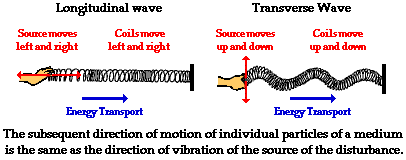
And then, once more, experiments started finding oddities.  We learned that the light had to be “transverse” waves rather than “longitudinal waves”:

u10l1c5


Bu that led to some puzzling aspects.  If it was a transverse waves, what was “waving”?  Transverse waves aren’t carried through a liquid or gas, but only through a solid (the ocean waves you see on the shore are a different phenomenon and can only happen when there’s an interface between two materials).  Furthermore, experiments in interferometry had given us the wavelengths of light–very, very short wavelengths–and the speed of light suggested that whatever material was “waving” had to be very stiff indeed.  This led to the conclusion that the Universe was filled with something both extremely tenuous but also extremely stiff to allow light to pass through it.  But this material wasn’t dragging on the planets as they circled the sun so it had to be infinitely elastic.

Then folk started finding out other things.  They discovered that light didn’t quite, or didn’t always, act like a wave.  The photoelectic effect, the “ultraviolet catastrophe” of black body radiation (you heat something and it glows, but for a wave, the higher frequencies should carry most of the energy so that instead of glowing red, or even white, most of the energy should be in ultraviolet, x-rays, and gamma–but it wasn’t).

The science was becoming unsettled.

Then a certain Swiss Patent Clerk (I won’t keep you in suspense; it was Albert Einstein) suggested that light was waves that came in discrete “packets” called quanta.  Under certain circumstances they behaved as waves.  Under others, as particles.  This was the foundation of what is now called Quantum Physics.

And the science is settled.

This Time For Sure.

Or until someone else comes along to unsettle it with some experimental results that just don’t fit.  Somebody will do an experiment.  They’ll look at the results and say “That’s funny.”

And then all that was “settled” will become unsettled again.

The Role of Government

I’m going to wax a bit philosophical here.

Folk who know me (most here, I would presume) know that I lean very heavily “pro-liberty” if not outright libertarian.

OTOH, I part company with many Libertarians (the capitalization is no accident) in that I believe that some government, a “state” if you will, with some modest power is necessary for the preservation of liberty. “That to secure these rights, governments are instituted among men….”

Consider this example: being able to get up on your roof with a rifle to drive off rampaging hordes of barbarians (whether Avars, Huns, Viking raiders, or rioters) is liberty. Having to do so because the barbarian hordes are endemic to your situation, is not.

So the barbarians have to be driven off or kept suppressed, which requires organization with the sanction to use force (since the barbarians, pretty much by definition, aren’t going to respond to sweet reason. If they did, they wouldn’t be barbarians). And once you have an organized body with the sanction to use force, there you have government.

Too little government, and your “freedom” is spent fighting off the barbarians piecemeal. Government itself is a restriction on freedom, also just about by definition.  And the more government, the more that restriction.

So there must, then, exist some level of government, some small level of government, where liberty is maximized, where each individual has the most freedom.  That level may change depending on circumstances.  For instance, a highly dispersed population with little in the way of external threats doesn’t need much in the way of a military and/or police to “keep the barbarians in check.”

The folk who founded the US appear to have been attempting to find that level. And perhaps, at the first, they were pretty close to it–or would have been if they could have gotten rid of chattel slavery (which wasn’t politically achievable at that time and the attempt would almost certainly have destroyed the country before it ever got started).

I submit, however, that the level of government that leads to the greatest freedom (which may vary depending on a number of factors) is always unstable–in fact, I wonder if it’s not the _least_ stable form of government–and will immediately begin to move in the direction of either anarchy or totalitarianism. Various “checks and balances” may slow the motion but they cannot halt it.  Add in that changes to circumstances (increasing population density, rise of external threats, etc.) shifts the amount required for greatest freedom, and maintaining that level becomes even more difficult.

I do wonder if perhaps the checks and balances in the original were not too successful in slowing the move toward totalitarianism. At least some of the Founders did appear to expect a revolution every couple of generations and they got one in the American Civil War, but, although that did lead to an end to chattel slavery I’m not sure that it was a net win for Liberty in the long run with the increase in Federal power that can be traced directly to it. But the increase was slow enough, before and since, that we, as a people, largely got out of the habit of revolution. While the old saw about boiling a frog is not true, not for frogs in pots of water anyway, it remains a useful metaphor and, I think may describe what has happened to the US.

I have said before that at this point, I don’t think a revolution is likely to help–it would just exchange one tyranny for another. Still, If we’re going to turn back from the brink, we’ll have to find other means.

What those means might be, I don’t know. I don’t even know if a new tyranny or even an outright “dark age” is avoidable at all.

And if, somehow, we were to turn back, where would we find that “sweet spot” of maximum liberty and is there anything more than was done in 1787 to give it some semblance of stability?

Good Luck with that, Cupcake

Pick ’em up.
Put ’em down.
Pick ’em up.
Put ’em down.
Pick ’em up.
Put ’em down.
Pick ’em up.
Put ’em down.
Pick ’em up.
Put ’em down.

Anybody remember that?  I do.

Well, we had this Internet tough guy:

50730738_514249369104048_4576445158928678912_n

Aren’t they so cute when they yap and think they’re all big and ferocious?

What he fails to realize is that the United States Military has been dealing with people a hell of a lot tougher than he is since Baron von Steuben was haranguing Continental Army recruits.  Even in the Air Force (see earlier posts about why I went AF rather than some other branch of service) any TI (Training Instructor–that’s what they were called in the Air Force) had more attitude, more sheer presence, in his left little finger than this “tough guy” has in his entire body.  I guarantee you he wouldn’t raise a peep.  And if he did?  Well, one of the reasons he wouldn’t is that the Instructor has the entire weight of the United States Armed Forces behind him.  The instructor knows it.  He knows it.  They both know that if the recruit really is stupid enough to try something he’ll feel the full weight of the Uniform Code of Military Justice.

But that’s by way of an aside.  As I said, the military has been handling this since the very earliest days.  The instructors know how to handle “tough guys”, and are more than capable of doing so.

So…lighten up, Francis.

“Wolf and Iron” and Human Wave: A Blast from the Past

I’m going to toss out an idea here. Gordon R. Dickson’s book “Wolf and Iron” (linked below) is a remarkably dark view of a post apocalyptic world. In that world the apocalypse consisted of a widespread economic collapse leading to a breakdown in various “services”. Communities become more “insular” as larger organizations fail, with individual neighborhoods practically becoming independent city-states. Roving bands of bandits complete the breakdown of rule of law, particularly when combined with any traveler or travelers not strong enough to protect themselves is seen as prey by those in more settled circumstances.

The main character, Jeebee an academic type, is struggling through this apocalyptic scenario trying to survive and reach his brother’s ranch.  His first interaction with other people almost ends in him being murdered for his meager belongings and does lose him some key equipment.  Along the way he meets a tame wolf (raised by a now deceased cattle rancher) that accompanies him and becomes his main companion.

The story is very grim and very bleak, at least in the story’s short term. But it’s also got an upbeat component. Jeebee is the sole surviving (so far as he knows) repository of a brand new field of “computational” social science, one which actually predicted the collapse although in true clueless intellectual fashion he never personalized the results of his work until it was almost too late. And, so, he works to preserve that knowledge so that when the world recovers from the current collapse it can be extended and, it is to be hoped, used to prevent such collapses in the future. There’s a strong undercurrent of “no matter how bad things seem now, we’ll get through this and we’ll make things better down the road”.

That undercurrent I believe makes this book “Human Wave” and so Wolf and Iron illustrates that “Human Wave” does not have to be all sweetness and light. It can be quite dark and still be Human Wave.

Wolf And Iron