Love Trumps Hate

I saw that slogan back in 2016.  However, since then, I’ve found that love trumping hate seems to involve a lot of things I never would have expected.

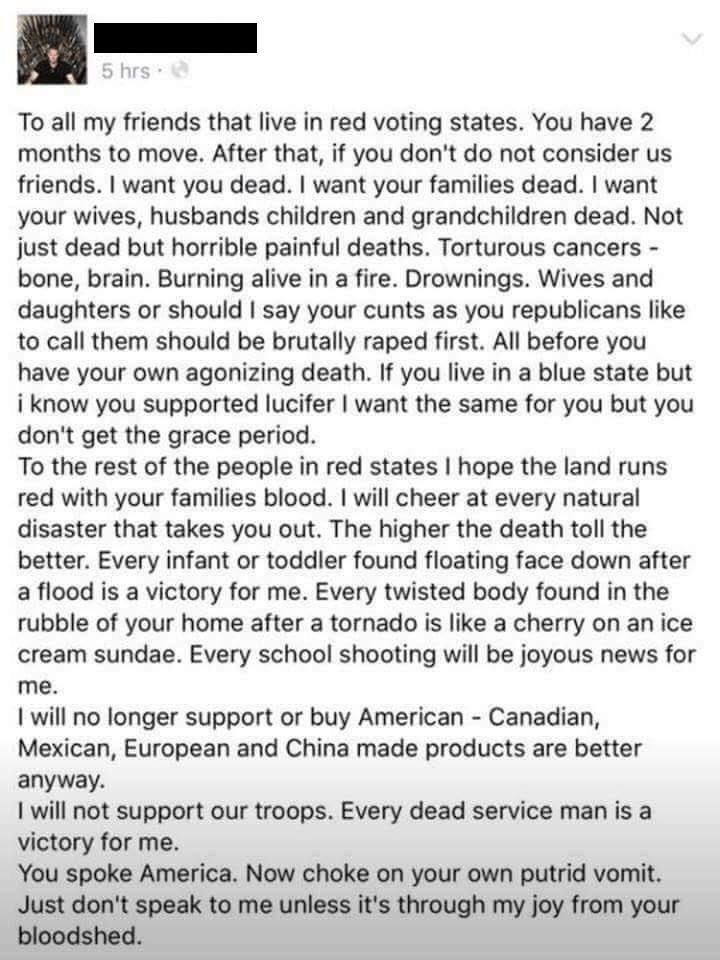
It seems to involve a lot more threats of armed insurrection.

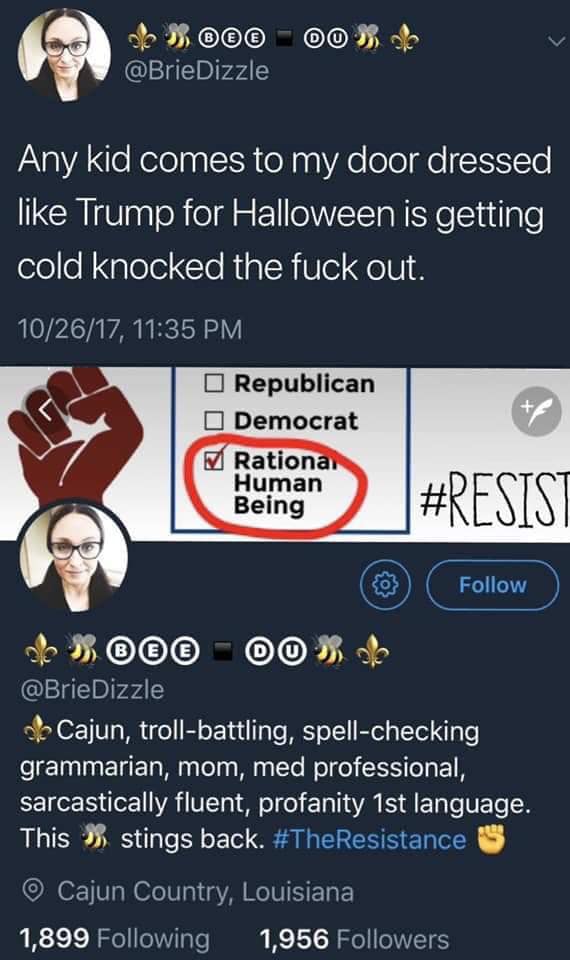
It seems to involve a lot more aggravated battery of a minor:

44945971_2253045614913341_2076156610719252480_n

It seems to involve a lot more gunfire.

It seems to involve a lot more, well, whatever this is:

44905872_1802942606499228_4457656808881782784_n

It seems to involve a lot more Assault and Battery:

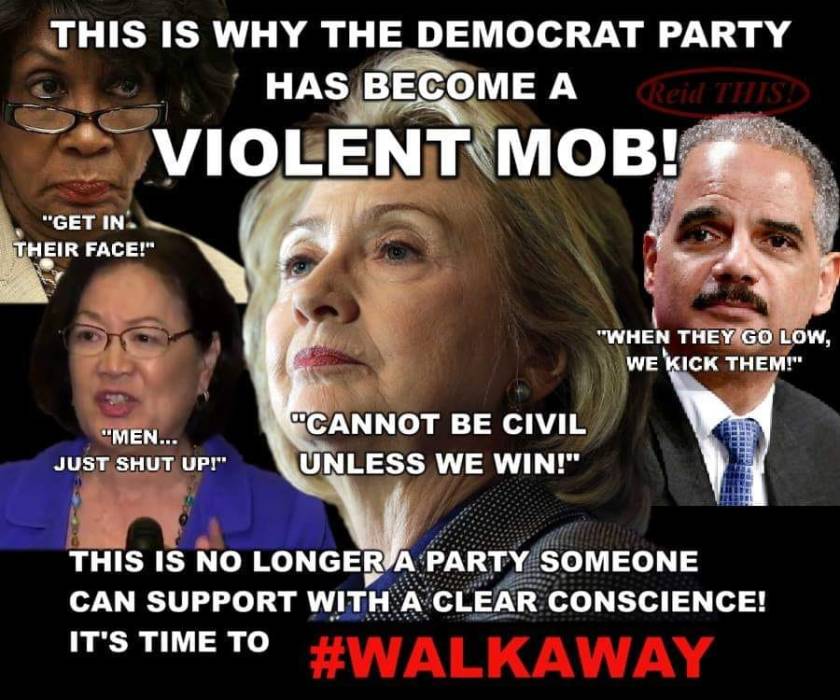
It seems to involve a lot more mob violence:

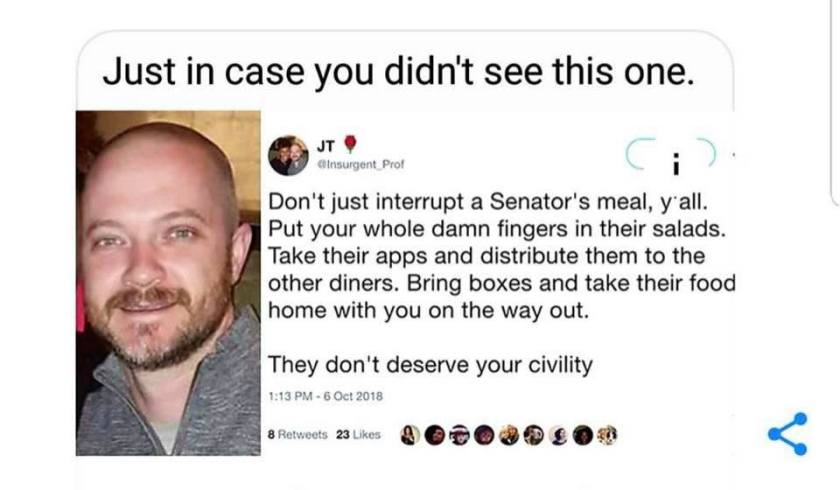
It involves a lot more theft and vandalism:

44226206_10215115856423932_4934226109463003136_n

Love trumping hate just seems to involve a lot more of…well…this:

43680040_1745487432227382_4985109209788973056_n.jpg

than I would have thought.

Stay classy, Dems.

Operation Blazing Sword

In June of 2016, in the wake of the Pulse Nightclub Shooting, Erin Palette (a trans woman and a good friend of mine) formed Operation Blazing Sword.  Its purpose was to assist LGBT people who were interested in arming themselves for their own defense.

The problem many LGBT faced was that, thanks to the way the media have portrayed gun owners and gun groups, they didn’t know what kind of reception they would face, who they could trust, for learning even the basics.

That’s what Operation Blazing Sword is all about.  Erin started collecting volunteers, people willing to offer their time and expertise to help people interested in learning safe gun handling with the idea of being able to defend themselves.  I was one of the first group of those volunteers.

There was just one thing we had in common:  your lifestyle, your religion, your politics, your sexuality and gender, none of these matter.  We do not judge.  All that matters is that you want to learn a bit about guns and about safe gun handling.

As volunteers, what we offer is basic instruction in firearms safety.  If you wish to buy one we can assist and advise.  We will also take you to the range at our own expense including ammunition so you can try one or more handguns and get started on learning gun handling.

Since its founding, OBS has grown.  Recently, it merged with the earlier gay/lesbian gun-rights group “Pink Pistols” (with the slogan “Armed gays don’t get bashed.”)  Erin has continued to do excellent work promoting the cause of personal safety through armed self defense.

In the wake of recent events, I’d also like to point out that OBS may have started for the cause of reaching out to LGBT who might have been uncertain of a friendly reception in the gun-owners community, its hand is out to other groups as well, Jew or Gentile, Christian, Heathen, or Atheist.  Anyone interested and legally able to possess firearms is welcome.  All we ask is a desire and willingness to learn.

You can find OBS instructors on the interactive map here.  Some are actual certified instructors, others are simply individuals with considerable firearm experience, a solid grasp of the fundamentals, and a willingness to be patient with beginners.

If you want to learn we’re here for you.  And we will not judge.

Gun Control once again

Whelp, a criminal asshole went on a rampage again and the bodies aren’t even cold before certain elements are screaming for gun control–when they aren’t blaming the current president for the event.

Yes, that’s right.  The president who moved our embassy to Jerusalem, who’s son-in-law is Jewish, whose daughter has accepted Judaism, who has actually deported a wanted Nazi war criminal to be tried for his crimes is somehow responsible for a madman shooting up a Synagogue.

Let me be clear about this.  The person responsible is the shooter, pure and simple.  May he freeze in the coldest corner of Nifelhel when his time comes. (He surrendered, so the police took him alive.)

Still, once again the Left is looking to make political points out of this (and scream at folk like, well, me–if they notice; I have no illusions about how much reach I have–to not “politicize” the tragedy when I dare to respond).

Once again a mass shooting happens at a gun-free venue.   He is able to keep shooting until armed response actually shows up.

Folks, that’s a hint.

And, it would seem, FBI data would appear to bear that out.  The FBI has published three reports on “active shooter events” (your basic spree killer).  One covers 2000-2013, one 2014-15, and the most recet from 2016-17.

The results have been compiled at concealedcarry.com.  Yes, it’s a biased source if you want to challenge that, but the data comes from the FBI’a reports and is available to anyone who wants to check it.

The FBI reports excluded several things:

  1. A firearm must be used by the attacker. This then means they have not included incidents like the armed citizen who saved a woman outside the GM building in Detroit from a stabber or the man who was stopped by a CCWer in a Smiths Grocery store in Salt Lake City when he was stabbing shoppers at random.
  2. Domestic incidents are not included. The FBI feels that an Active Shooter event has to be one in which the attacker is endangering strangers not only their own family members.
  3. Gang-related violence is excluded also.
  4. For the FBI to define an incident as an Active Shooter incident both law enforcement personnel and citizens have to have the potential to affect the outcome of the event based upon their responses to the situation.

This basically left spree killers using guns, what most people think of when they hear the term “mass shooting”.

From this data we learned several things.  The first I want to bring up is that it’s relatively rare for an armed  citizen to be present at the event.  This is no surprise since most of them occur at places where private citizens are not permitted to be armed for the defense of themselves or others. (There’s never been a mass shooting at a gun range.)  Specifically, out of 282 events from 2000 through 2017 only in 33 was an armed citizen present and available.

Of those where one or more armed citizens were present, in 75% of them (25 of the 33 incidents) the armed citizen totally stopped the attack.  In an additional 20% (6 incidents) the armed citizens were able to reduce the loss of life, generally by complicating the attacker’s problem, forcing him to think about something other than simply killing people.  Only in five percent (2 events) did having armed citizens not help.

Let me reiterate:  95 percent of the time, 31 out of 33 incidents, armed citizens were able to help the situation reducing the loss of life.

Armed.  Citizens.  Save.  Lives.

Now, this is the point (if not earlier) where some folk will bring up the idea of a “gunfight” making things worse (than a massacre?) and it’s better to wait for the professionals rather than have people “caught in the crossfire.” Basically, the idea of an armed citizen returning fire is considered a greater threat because they’ll lead to more people being killed.

So the question is, how many people were “killed in the crossfire,” shot by armed citizens at these spree killings.  That’s an important number.  How many people were killed by the armed citizens at the events where an armed citizen was present.  33 events.  How many innocents did those armed citizens kill?

You ready for the answer?

Zero.

95% of the time when armed citizens are present they are able to at least alleviate the problem.  In none of those cases have they killed an innocent.

You don’t get a more clear cut case than that.

Gun free zones kill.  Allowing citizens to be armed for defense of self and others saves lives.

It really is that simple.

The FDA

The new “Right to Try” law is the motive for today’s post.

For a long time it has been an article of faith among many people that it is a responsibility of government to protect the consumer from rapacious and callous businesses.  And so we have had a multiplicity of agencies all intended to “protect” the regulate and restrict those businesses in the name of protection. It’s government paternalism at its finest.

I’m taking a look at the FDA here since that’s the agency with the most nearly universal support.  Who, after all, wouldn’t be in favor of ensuring that the medications people take are safe and effective? (Yes, I know you folk are out there, but you do recognize you’re in the distinct minority, right?)

It all at the turn of the 20th century.  Noted Socialist Upton Sinclair went “undercover” in the Chicago meat packing industry.  As a result of his experience he wrote his novel “The Jungle” as an expose, published in 1904.

Sinclair’s novel was intended to expose the terrible conditions of the workers in the interest of furthering socialism.  Instead the public grasped onto the unsanitary conditions which Sinclair presented in the novel as the way the meat packing was done.

This sparked an uproar that led to the Meat Packing Act and the Pure Food and Drug act of 1906.

There were some surprising allies in this crusade for government regulation of the food and drug industry.  Even before Sinclair’s novel, organizations like The Women’s Christian Temperance Union and the National Temperance Society had formed the National Pure Food and Drug Congress.  One of their targets was the plethora of patent medicines and nostrums which were largely alcohol–which explains the interest of the temperance people.  Another ally was the meat packing industry itself.  You see, although the meat packing industry was well aware that poisoning their customers was simply bad for business (despite what Sinclair had to say in his novel), one problem they were encountering was that foreign markets were blocking the import of US beef claiming that it was diseased.  If they could get the government to certify that it was disease free, and also to pay for the inspections, they believed they could get past that barrier and enter those markets.  Another ally was the pharmacological industry and its trade associations. This one wasn’t entirely economic.  They saw it as a positive public good to regulate the direct sale of ineffective “patent medicines” promising miraculous cures.  That they were in direct competition with pharmacists and the manufacturers of medicines was also a factor, but likely a smaller one.

The result, as I said, was the Food and Drug act of 1906.  This was largely limited to the inspection of foods and the labeling of patent medicines.  There was language subjecting prescription drugs to control but this power was not used immediately.

It was not until the Eixir Sulfanilamide disaster of 1937.  Sulfanilimide was generally taken as a capsule or used topically as a powder.  The elixir form was intended for people who were unable to take capsules.  Tragically, the solvent used was highly toxic to humans although this was not generally known at the time.  The result was a disaster which led to more than 100 deaths (including the chemist who developed the elixir–who committed suicide while awaiting trial for his part in the disaster).

This led to the Food, Drug, and Cosmetic act of 1938 requiring animal testing and approval by the FDA to ensure safety before they could be sold in interstate commerce.  The decision had to be made by the FDA within 180 days.

So things mostly stayed until the lat 50’s and thalidomide.  Primarily prescribed as a sedative or hypnotic, thalidomide also claimed to cure “anxiety, insomnia, gastritis, and tension”. Afterwards, it was used against nausea and to alleviate morning sickness in pregnant women.

It was this last used that led to tragic results.  Thalidomide is a powerful teratogen–interfering in the development of the fetus–and it crosses the placental barrier.  This meant that literally thousands of children were born with severe birth defects including malformed limbs, deformed eye and heart, alimentary and urinary tracks, and many other issues.  Only about 40% of the children survived.

As it happened, the FDA declined to permit thalidomide from being sold in the US.  Once the horrific results of its use in pregnant women became known, President John F. Kennedy awarded the official in charge of the investigation which blocked thalidomide, Frances Oldham Kelsey, the President’s Award for Distinguished Federal Civilian Service.

The result was yet further expansion of the FDA’s power and further requirements that new medicines had to meet before being permitted in the US.

So far, that sounds very much like a good thing.  We get safer drugs and avoid another Elixir Sulfanilamide disaster or another Thalidomide disaster.

But, as always, when one talks of safety the questions must be asked:  compared to what and at what cost.

Both of those disasters were extremely costly to the companies involved in terms of liability lawsuits as well as loss of business.  Now, I can hear the howls now: “How dare you compare the companies’ financial losses to the pain, suffering, and deaths caused by feeding people toxic chemicals and calling them medicine!” Well, it’s not my intent to compare the two.  I am not saying that the financial losses are somehow just compensation for the pain and suffering.  That is not my point.  My point is simply that even from the most coldly pragmatic point of view, companies have an extremely strong incentive to not let another elixir sulfanilamide, another thalidomide, get out the door.  Even without the government regulation simple good business sense and an interest in making money will lead companies to do extra testing in an attempt to ensure that their products are both safe and effective.

Would mistakes happen?  Yes.  But then, mistakes will happen with government regulation too.  And have.  Many times over the years the FDA, as well as regulatory bodies in other parts of the world have changed their minds and withdrew approval for previously approved drugs.  Oops.

So, there will still be “bad” drugs getting out with either a regulatory agency like the FDA overseeing things or if companies are allowed to rely on their own self-interest to encourage testing.

One might still argue that there’s the flip side of the issue.  There are two kinds of mistakes that an organization like the FDA can make.  The first is what we have discussed above:  approving a drug that proves to be excessively dangerous with unacceptable side effects.

The second is to not approve a drug that could alleviate suffering or even save lives.

Consider the class of medications called beta blockers.  One of the uses of beta blockers is that when administered after a heart attack they can dramatically reduce the chance of death–“Secondary prevention of coronary death after myocardial infarction”–to the extent of saving more than 10,000 lives per year.  The first major beta blocker, propranalol, was introduced (not in the US) in 1964.  Simply look at the data on the FDA’s own site on when propranalol was approved for use in the US and do the math.  How many people died because of that delay?  How many elixir sulfanilimide or thalidomide disasters to equal the death and suffering that was simply every day business over those years?

The problem is that if a government bureaucrat approves a drug and it proves to be disastrous, that bureaucrat will be vilified, wrecked professionally and personally, and ill go down in the history books as a great monster.  If, however, that bureaucrat denies approval of a drug that could alleviate pain and suffering, or even save lives, who would ever know?

The incentive is to reject.  If there is any doubt whatsoever, reject.  And even with that incentive mistakes still creep through.  But with that incentive many potentially useful and beneficial drugs are filtered out.  With the result that thousands, possibly even millions, of people suffer needlessly.

I cannot point to direct math calculating costs and benefits, although the case of the beta blockers is telling, but I am firmly convinced that the FDA does far more harm than good.  Most of the “good” it might accomplish is already present in the financial incentives of the companies developing new medications.  The bad is conveniently out of sight of suffering and death not relieved because of medications and treatments that were not made available.

That’s why Right to Try is so important.  It doesn’t go nearly far enough but it is at least a good start.

Perception Gap

Sorry about being late.  Had a lot going on today.

Violent crime is on the rise and has been for a long time.

If you believe that statement you are a victim of a Perception Gap.

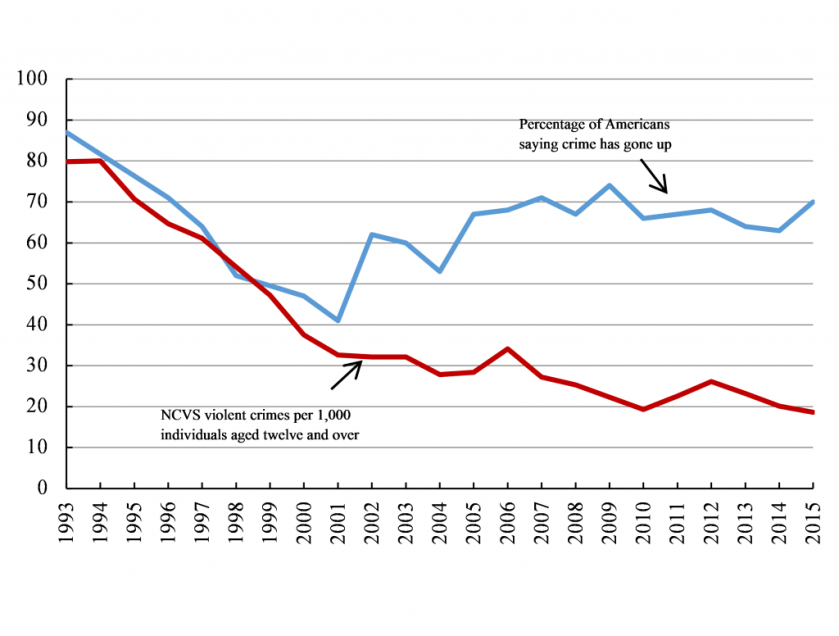
Take a look at the following:

perception gap

Look at the red line.Since 1993-4 violent crime has been trending downward.  There have been some occasional “blips” along the way, but the general trend has been downward, at first quickly, but then more slowly.

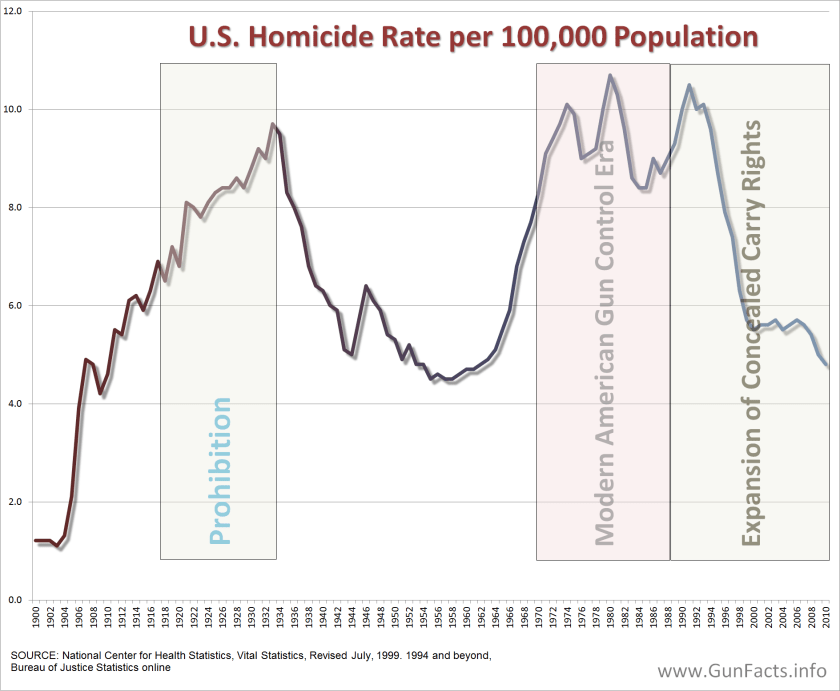
For perspective, consider the following chart of homicide rate (using a longer baseline):

homicide rate.png

That chart implies come causal relationships that it is not my intent to debate at this time.  What I want is to give a historical context on how low our current violent crime rates (in this case, homicide) are.  The last time we saw crime rates as low as we now experience was in the late 50’s, early 60’s.  And before that, we’re going back a hundred years before the present before homicide were so low again.

Yet, somewhere around the year 2001 people, a lot of people started believing that violent crime rates were going up.  And since then, there have been ups and downs but the general trend has been upward:  more people believing that violent crime is on the rise when it’s actually dropping.  Before 2001, the percentage of people believing crime was rising was falling right along with the actual crime rates.

The question to ask, then, is “why?” Why are more people believing violent crime is on the rise when it’s actually moving the other way?  Part of that is the nature of news.  The old saying is “If it bleeds, it leads.” Crimes that don’t happen are not news.  Crimes that do, are.  However that cannot be a complete explanation.  “If it bleeds, it leads” has always been the case.  News has always been biased toward the outre and horrific events.

Perhaps it’s cable TV and stations like CNN.  The problem is those things took off quite a bit earlier than the growth of the perception gap.  Consider, in 1975 there were about 3500 cable systems nationwide serving about 10 million subscribers.  In 1985 there were 6600 systems serving 40 million subscribers.  The numbers peaked in 2000 with a total of 68.5 million subscribers in 2000 (number of cable subscribers has fallen since, but satellite and Internet has taken up some of that slack).  CNN was founded in 1980.

All of this happened long before the rising perception gap and so, by themselves, cannot be the cause of it.  If they were, the perception gap would have appeared long since.

The simplest explanation is a shift in policy–instead of just reporting news as is, they deliberately, and more blatantly, attempt to shape the public perception according to a pre-defined narrative.  For reasons of their own (draw your own conclusions; I have my own) they want people to believe that crime is rising and thus foster that belief through their choice of reporting.

Of course, the other option is that they have simply become wildly incompetent and are completely unable to portray news in a way that leads people to draw accurate conclusions about the world around them.

Incompetence of deliberate?  Make your own choice which way presumption would be giving them the benefit of the doubt.  As I said, I have my own conclusions.

And it’s not just violent crime.  In many other areas people have views that are radically at variance with the reality around them.  And many of those views are driving by the media, particularly the news media.

A person might be doing well financially.  His job is going well.  He just got a raise.  He sees the news telling him how horrible the economy is going and thinks he must be an outlier.

A person has just been laid off.  His wife is in her 36th week of unemployment.  The news tells him that the recovery is going strong.  He figures it’s just his bad luck.

Neither of those people notice that their “outlier”/”bad luck” is repeated millions of times across the nation.  Perception gap.

There is a phenomenon known as Gell-Mann Amnesia.  A person reads/views/hears some item in the media about a subject he knows well.  He notes that article is wildly inaccurate–gets basic facts wrong, even has cause and effect reversed.  Then he goes onto the next item in the media, one about something he was not so familiar, and completely forgets how inaccurate it was on the subject he knew and presumes it is accurate this time.  And, presuming it is accurate, it becomes part of his world view.  Perception gap.

And that’s just when it’s honest mistakes.  When it’s deliberate misinformation, the problem increases a dozenfold.

Thus it is important to be skeptical.  Even when they are honest they are often wrong–and they are often not so honest.  Check against multiple independent sources. (Several sites repeating the same source is not “independent”.) Dig through for the original data as much as possible.  Question everything.  Come to your own conclusions.

And when you come to those conclusions, be prepared to change them based on new information because the media can be wrong, even wildly wrong, so can you. (And, yes, so can I.)


Final

I had a couple of ideas of what I was going to write about tonight but…something came up.  So there’s this instead.  I’ll save the others for some other time.

Some folk are aware that I have been going through a divorce over the past year.  Today, I checked the court status and found that the case has been decided.  The court has accepted our mediated settlement.  The divorce is final.

I am…of very mixed feelings about this.  No, I don’t really miss anything from the marriage.  That was…what it was.  I am, however, very wistful about what might have been.  One factor is that I was raised Latter Day Saint.  I’m not a believer any more, haven’t been for a good number of years now, but some of the early conditioning remains.  One part of that was that I was raised with the idea that marriage is forever, not just “until death do you part” but forever “For time and all eternity.” That didn’t happen and, so, a significant part of me sees that as a failure on my part.

But…it takes two.

So, as I said, very mixed feelings.  Really mixed.  All over the place mixed.

So let’s let some music express some of those feelings.  Like I said, they’re all over the place.

But, in the end, I suppose we have to let go and move on.

“There’s more to live than just you.  I may cry but I’ll make it through.  And I know that the sun will shine again, though I may think of you now and then.”


My first Sales: A Blast from the Past

I had something in mind to write about tonight but, well, this and that happened and drove the topic out of my mind.  So here’s a Blast from the Past:

On to my first sales.  In 1990 I moved to being a “full time writer” which, frankly, was another way of saying that I was unemployed. (Various reasons for that, none of them particularly germane to this blog.) At that point I started writing a lot.  Most of my stories were still fairly derivative but one was something a bit different, a near-future piece written in an epistolary format (that is, in the form of various letters back and forth).  It was this story, titled “The Future is Now” that garnered my first personal response from an editor:  Stanley Schmidt of Analog:

“This story has good microwriting, that is writing at the sentence and paragraph level but the essence of story is conflict.” And my story didn’t really have that.  So I went back, added a rival corporation and some challenges along the way.  That came back with the criticism that the conflict all happened “off stage” (letters about conflicts that were resolved). Stan suggested breaking out of the epistolary formatting and going to straight third person narrative for the key scenes.  I didn’t like that thinking it would jar with the rest of the story being written as it is.  So I came up with a compromise.  I wrote one of the key scenes as “minutes” of a board meeting and the other as transcript of a launch and rescue operation.  This gave the in-story immediacy that it needed and the next round Stan bought.

Shortly after that I got a contract back from a story I had submitted to Marion Zimmer Bradley’s Fantasy Magazine.  The story was a very short humorous (at least so intended) piece “Jilka and the Evil Wizard.”  Although this story was sold after The Future is Now it was actually published first. (More on that in a bit.)

Finally, while this was going on I was sending out queries for non-fiction articles.  I got a response from one from a magazine “High Technology Careers” asking that I write a 1500-1800 word article on the topic of The Economics of Lunar Mining at 17.5 cents a word.  This article was accepted as written and appeared about the same time as the other two stories.

Back to Marian Zimmer Bradley’s Fantasy Magazine.  The turnaround between Ms. Bradley accepting the story and it appearing in the magazine was awfully short.  In that issue, Ms. Bradley’s editorial expressed some ire at people who simultaneously submit and then withdraw accepted stories leaving the editor to scramble to fill a hole.  I’ve always assumed, given those two facts, that she bought my story because it was a “not impossible” of the right size to fill a hole she was scrambling to fill.  That may not actually be the case but I’ve always thought it likely.

A kind of sad point of looking back at these first sales is that two of the three magazines are no longer in business.  When Ms. Bradley passed away, Marion Zimmer Bradley’s Fantasy Magazine went with her.  And High Technology Careers ceased publication some years after my article’s publication.

There were several lessons I learned through all this:

1) “The essence of story is conflict.” That really comes down to the heart of things.  You cannot be nice to your characters.  If there’s no conflict you may have a narrative but you do not have a story.
2) The reader/editor is never wrong about their experience of the story but they may be wrong about how to fix problems they see.
3) Luck matters.  Sometimes the timing of when a story arrives can make the difference between selling to that market or not.
4) Persistence pays.  I sent out a lot of queries before I got the assignment to write the article.

Refugees?

So there’s this caravan of “refugees” “walking” from points south of Mexico to the US demanding asylum.

Here are a few:

migrants 1.jpg

migrant 2

You notice something odd about that mix?  Something missing in a group of refugees seeking asylum?  The vast, vast majority appear to be young adult men (one term is “men of military age).  There are a few women and children but most of it is young adult men in remarkably good condition for “refugees.”

But then, they have to be given what they are doing:

Migrant 6

migrant 3

“Peaceful refugees” seeking asylum–storming various borders along the way and crashing them by main force?  Something doesn’t jibe here.

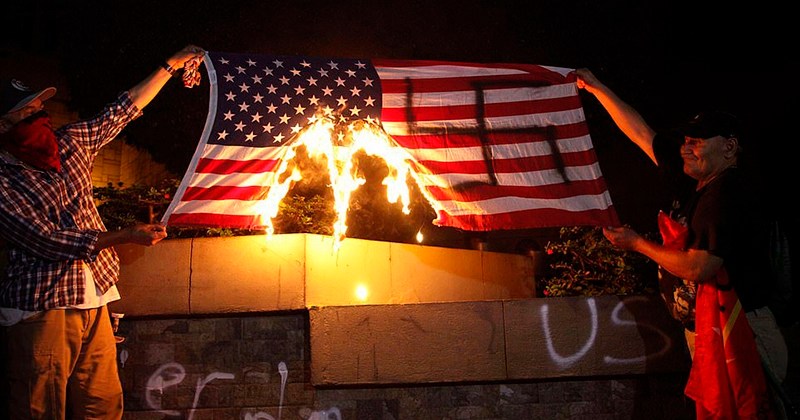
Then there is what their supporters are up to back in Nicaragua:

migrant 7

Doesn’t everybody paint a swastika on and burn the flag of the country you are asking to help you?

And the marchers?  What flag are they flying?  Well remember that first picture?

migrants 1

And there’s this one:

migrant 5

Doesn’t everyone seeking a new life in a new country do so under the flag of the country they are fleeing?

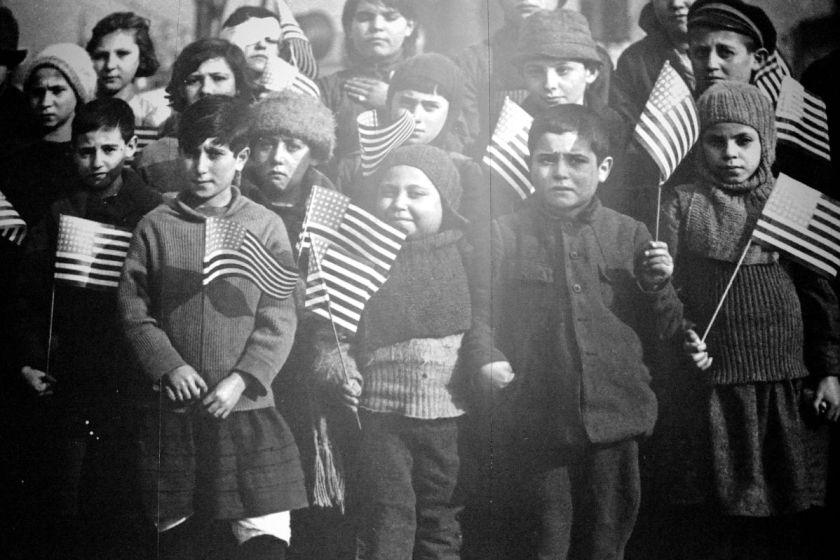
Perhaps somebody should have told these immigrants:

immigrants.jpg

When you add in the timing, it becomes clear this is no spontaneous assembly of the downtrodden seeking a new life in a free land.  This is a carefully orchestrated political ploy of people many of whom actively despise the country they are marching on.

The word for that is not “refugees,” but “invaders.”


Feeding the Active Writer: Cookies

As I have mentioned before, I have a big sweet tooth.  Feeding that, while keeping my blood sugar down is always a challenge.  Here are a couple of recipes for cookies that go a long way toward that end.

Shortbread

Ingredients

  • 6 Tbsp butter (softened)
  • 2/3 cup Splenda or equivalent granulated sucralose sweetener
  • 1 Tsp vanilla extract
  • 2 1/2 cups blanched almond flower

I did this one using a food processor.  Cream the sweetener and butter together in the food processor for about a minute.  Add the vanilla and do another minute.

With the food processor on slow, gradually add the almond flour.  Stop from time to time to scrape the sides.  Continue until all the almond flour is mixed in.

Scrape the dough into a small bowl.  Give it a final stir to mix in any remainder that was stuck to sides or bottom of the food processor and didn’t get thoroughly mixed in.  Chill the dough for about 1 hour.

Preheat the oven to 350 F.

Form the dough into small balls and flatten into disks about 1 1/2 inches across.  Place them on a cookie sheet so they are not touching.

Bake at 350 for about 12 minutes.

Snickerdoodles

These are basically the same as the shortbread only you coat them in cinnamon sugar before baking.

Make shortbread cookie dough as above.

mix about 1 Tbsp of ground cinnamon and 2 tbsp of Splenda or equivalent granulated sweetener in a small bowl.

After flattening the dough into disks, drop them into the cinnamon sugar mix.  Flip so both sides are covered.  Place onto a cookie sheet so not touching.  Bake at 350 for about 12 minutes.

Peanut Butter

Ingredients

  • 1/4 cup coconut flour
  • 1 1/2 cup Splenda or equivalent granulated sweetener
  • 1 16 oz jar 100% peanuts, peanut butter.
  • 1/2 cup butter, softened
  • 1/2 tsp salt
  • 1 Tbsp vanilla extract

Place the ingredients in the slow cooker.  Run it on slow for about 2 minutes, then on high for about 5 or until the ingredients are thoroughly mixed.

Scrape the contents of the slow cooker into a bowl and set in the refrigerator to chill for about an hour.

Preheat oven to 350 F.

Roll out 1″ balls and place them on a cookie sheet lined with parchment paper.  Use a fork to press criss-cross marks into the balls (or if lazy, squish them with a thumb–they’ll taste the same either way).  Bake at 350 for 12-15 minutes.

Makes about 90 cookies.