The Economics of Prisons

Over on The Book of Faces, I recently shared a memory which had Bernie Sanders making one of his silly pronouncements, in this case wanting there to be more people attending college than in prisons, paired with figures that showed that we did have more people, a lot more, in college than in prison.

So, Bernie was wrong. (What else is new?) However, someone in an attempt to defend if not the statement the idea behind it, made a claim about how much it cost to keep a prisoner in prison vs. how much college (using a lowball figure for a community college there, but let that go for purposes of argument).  Uh… So?  Those two figures, frankly, are not really relevant to each other.  They bear no more resemblance than the cost of my steak for dinner and the cost to have someone mow my lawn–both involve dollars and that’s about it.

If you’re going to measure the cost of having someone in prison, the relevant measure is not the amount spent by someone else for something else.  The relevant comparison is to the cost of not having that prisoner imprisoned.  So where do we go with that?

First off, the cost of crime is hard to determine even if we want to just look at economic costs and not emotional and moral costs (which many would argue are greater).  There’s direct cost:  money stolen, property damaged, and so forth.  But there’s more than that.  There’s the cost of security protections against criminals.  There’s lost productivity because somebody has been the victim of a crime, culminating in the complete loss of all the productivity a murder victim ever would have had they not been murdered (and more than that since the victim’s loved ones can scarcely be expected to be unaffected by the loss).  The Government Accounting Office cites figures from research ranging from $690 billion to $3.4 trillion annually.

So, how much does that work out to per criminal?  What does the average criminal in the US cost us?  That’s even harder to figure because we have to determine how many criminals there are.  From a certain perspective the number of criminals is equal to the population because the laws of the United States are so expansive and, in places, self-contradictory that no one can completely avoid breaking the law at least sometimes.  Indeed, some estimates state that the average person commits three felonies a day, without even knowing it.

Looked at from the other end, the US has about 2.3 million people in prisons nationwide.  And while most criminals aren’t in prison, the most “expensive” ones (repeat violent felons) do tend to end up in prison sooner or later.  Most crimes go unsolved but most criminals eventually get caught.  This apparent dichotomy is resolved when you remember that most criminals commit more than one crime.  According to Pew research, about 1/2 of violent crimes and 1/3 of property crimes end up being solved.  To be honest, that’s actually better than I thought when I started looking.  So there are 1-2 violent or property crimes for every solved case.  So, worst case, if every criminal sent behind bars then there are 2 others out and able to continue.  The time criminals spend behind bars–averaged over all offenses and all individual cases–is about 22 months.  Call it 2 years.  So the “turnover” in the prison population is about half the total (1.15 million) per year.  The upshot is that imprisoning criminals takes a minimum of 1/3 of the criminals who could be out and committing crimes off the street which means, they save the US from losses to crime, on the order of $345 billion to $1.7 trillion annually from losses if those criminals were still out committing crimes, or about (using the lower figure) $150,000 per year per criminal.

Admittedly, that’s just looking at aggregates and making some assumptions (which I tried to make conservative and worst case) in the lack of detailed information.  It can tell you very little about specific cases.  In some cases, in some crimes, the cost of enforcement is far higher than the cost of letting it go.  In these cases it might simply be better to legalize whatever “crime” is being enforced.  I suspect that most drug crimes (strictly drug crimes–not talking about the violence that comes from the fact that the drug trade is illegal) and most “sex work” (voluntarily engaged in–slavery is a whole other ballgame, and I suspect, exacerbated by the illegality of paid sex work) falls into that category.  But that’s not the subject of this post.

The point remains that it’s quite clear that, in aggregate, the high cost of incarcerating criminals is economically justified.  This is not to say that there aren’t better ways of handling the problem.  Perhaps there are.  But the argument that it’s too expensive to keep criminals in prison simply does not work.

And until an alternative, equally effective, method of dealing with the problem is presented, it’s too expensive not to.

Roaming the Universes: Cover Reveal

I’ve accumulated enough stories to make it worthwhile to put them into a collected volume for publication both in print and electronic form.  That’s what I’ve been working on the last few days, getting it all ready to go.  It will be a couple of days yet while it works through the system and the book is actually released but barring major problems to come, we’re about ready.

And so, here’s the cover for my first omnibus collection of shorter works:  Roaming the Universes.

Roaming The Universes V1.jpg


Epic Journeys Through Space and Time

Whether exploring the solar system in the
near future, or venturing to worlds of magic
and mystery, these fifteen stories take you
on a journey to other universes.

Included are stories from the FutureTech
Industries series, from the Knights of
Aerioch and an assortment of stand alone
tales.

The stories may be short of length, but they
are not short of wonder.

So climb aboard and see what these other
worlds have to offer.

Productivity and the Economy: A Blast from the Past.

This fits nicely with the economics I’ve been studying lately.

Robots are going to put people wholesale out of work!

Been hearing that refrain much?

Or recently there was a post online that implied that Solar was better than Coal or Gas from the perspective of employing more people to produce the a given amount of energy:

19429987_1933204173564155_6403163180417605163_n

If we switch from Coal and Gas to solar we’ll employ more people producing energy Ms. Kohn implies.

Yay?

No, not yay.

Go back to basic, basic economics.  What does wealth actually consist of?  Is it money?  Can you eat money?  Can you drive money to work?  Ride it to a pleasant destination for a vacation?  Stay in money when you get there?  Watch money for entertainment?  Read money? (While there are some words on most money, I find it rather lacking in plot and character development.)

No, money is not wealth.  In the end it’s simply a scorekeeping system representative of goods and services.  The money isn’t wealth.  What you can buy with it is wealth.

And this is the basic principle:  the more goods and services that are available to you as an individual, the wealthier you are as an individual.  Likewise, the more goods and services available to a society the wealthier that society.

So to make a society richer, so that the individuals within it can be richer, you need to make more goods and services available.

Humans have been trying to do that–to produce more goods and services out of the finite amount of time and effort available from the sum total of people able to engage in that production since the first individual hooked up an ox rather than his brother to his plow.  Instead of one guiding and one pulling they now had two brothers each able to guide separate plows and since oxen can pull farther and longer than ones brother, each was able to put more land into cultivation.  So instead of a family barely being able to feed itself (if they were lucky) a family could feed a small community, a community of potters, of stonemasons, of glaziers and smiths, of artists and craftsmen of all forms.

This was the birth of civilization.

And it continued.  The widespread use of water mills in the middle ages replacing much that was done with muscle power before.  Steel mills with water powered triphammers forging iron products in a fraction of the time that hammers driven purely by a smith’s arm could accomplish.

Then came steam and the beginnings of the Industrial Revolution.  Early automation in the form of punch-card looms.

There have certainly been complaints about these new advances putting people out of work.  A movement supposedly started by an individual who was probably mythical “Ned Ludd” arose to object vociferously and violently to the use of automated looms.  However, the automation proceeded and far from putting people out of work the economic boom created jobs in wholesale lots.

Thus it has been with every major increase in productivity–in producing more goods and services with less human time and effort.  The changes, despite doomsday predictions, have invariably led to more goods and services being available, often goods and services that the people before the change could never even have imagined.  The societies have become wealthier.  And the people within them have become wealthier.

When changes happen quickly, there can be a period of disruption while things adjust.  And the change is not without pain.  But then, nothing worthwhile is without pain, whether it’s a skill acquired, improvement in ones physical condition, all the way up to a newborn baby.  Change and growth are painful.  But then, so are stagnation and death.  In the former case, the benefits more than outweigh the transitional pains.

This is why silly claims like “the rich get richer and the poor get poorer” can never be sufficiently mocked.  The “poor” of today have at their fingertips wealth that not even the wealthiest of a hundred years ago could have dreamed.  A cell phone.  A cheap, smartphone on a “prepaid minutes” plan–costing about one full day’s work at unskilled labor rates–giving the person who owns it access to more information than even existed a hundred years ago, by several orders of magnitude.

Or they can use it to watch videos of cats.

Productivity creates wealth.  And that benefits everybody.

Turning back the clock, requiring more human time and effort, to produce the same goods and service–including the energy required for the production of other goods and services–depletes wealth, makes everyone poorer, harms everybody.

You want to create jobs?  Don’t make energy more expensive in terms of the effort needed to generate it.  Look to how to use the cheaper energy available to us to create more goods and services.  That benefits everybody and not just those getting the “new jobs” at the expense of making things worse for everybody else in a decline that in the end will hurt them too.

The Problem of Bureaucracy

The late Dr. Jerry Pournelle described what he called “The Iron Law of Bureaucracy” as follows:

In any bureaucratic organization, there are two kinds of bureaucrats:  those whose interests are the reasons for the bureaucracy, and those whose interests are the bureaucracy itself.  The Iron Law states that in every case the second category will achieve control of the bureaucracy, write its procedures, and control promotions within the organization.

The world does not appear to present any counter-examples to the iron law.  New and vigorous bureaucracies might, at first, vigorously pursue the goals of the bureaucracy but sooner or later (usually sooner) the Iron Law takes over and the bureaucracy becomes its own reason for being.

A useful marker is to look at the size and cost of the bureaucracy with no commensurate increase in results.

Take, as an example, education in the United States.  Spending (after adjusting for inflation) on each student over the course of their schooling from Kindergarten through High School  has more than tripled since 1970.  Yet despite this massive increase in spending, test scores in basic subjects like math, reading, and science have not improved:

pic_corner_080713_murdock-6

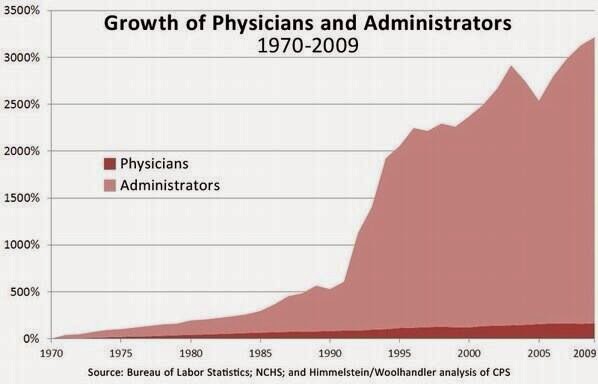
We see the same thing in health care.  In this case the extraordinary grown of administration compared with the very modest growth in number of physicians:

growth-in-administrators.jpg

Time and again we see the same thing, wherever there’s a bureaucracy the iron law takes over and those in charge of the bureaucracy become those less interested in the goals for which the organization was created, and more those of the organization itself.  Education, Health Care, Public Safety, The Environment, anything.

This is not to say that everyone in those organizations cares only about the bureaucracy and its size, power, and influence.  The Iron Law does not say that the first sort of bureaucrat goes away.  Those dedicated to the purpose of the organization–the teachers who care about the kids’ learning, doctors working hard to promote the health of their patients, police for whom “to serve and protect” is not just an empty slogan, and so on–still exist.  They’re just not the ones “driving the bus” as it were.

Unfortunately, the Iron Law is the Iron Law because their is no cure, not completely.  Most attempts to “fix” the Iron Law fail because, the people called on to implement those changes in the first place are bureaucrats of the second type.  And the implementation simply becomes another opportunity to enforce the Iron Law.

There are a few things that can mitigate the effect of the Iron Law.

One way to alleviate the problem of the Iron Law is to tie the power and influence of the bureaucracy to its success at meeting its goals.  One of the most effective ways to do this is through the market.  In businesses that have to compete with others, if the company (which is, itself, a bureaucratic organization) does not produce products and services that meet the wants of the customers those customers will go elsewhere.  Thus bureaucrat of first or second type matters little here since both types will have to meet the goals of the bureaucracy if the bureaucracy itself is to thrive.

While far more things than many will credit can be handled that way, not all things for which bureaucracies are created, even legitimately, are amenable to that treatment.  In those cases, there remain a couple of things that can be done to minimize the problem of the Iron Law.

The first of these alternate methods is to keep the bureaucracy small and local.  The tendency of any bureaucracy is to grow, but if you can restrict that growth, you can minimize its appeal to the second class of bureaucrat and delay the problem where the bureaucracy becomes its own reason for being.

The second is to simply reset the entire process periodically–sweep the bureaucracy clean from time to time and start over.  This is what the “spoils” system of the past did, where the new administration essentially replaced everyone top to bottom.  While that system certainly had its problems, I am not certain that the problems of an entrenched bureaucracy, as developed in the Iron Law, are not worse.

So, while the Iron Law may be iron indeed, even iron will bend if you hammer it enough.

Open House at my Daughter’s Dance School

Athena takes Ballet and Lyrical dance at a local school “Dance Legacy.” Today they had an open house to showcase some of their students.

It looks like Athena was having some problems with the timing but, hey, she’s trying.

When I uploaded the video I got a notice from Youtube about a “copyright claim,” I’m presuming for the music but they said no need to worry, they weren’t asking for a takedown.  They just might throw up some ads to the benefit of the copyright holder.

In Memory of Sophie Lancaster, an Annual Tribute

As someone who is goth(ish) I run into people who have all sorts of strange ideas about goths.  I’m a big ugly guy so most of that doesn’t get directed at me.  Others, however, are accused of being “dangerous” and “juvenile delinquents” or otherwise criminal because of a lifestyle we have adopted as fitting our “inner selves.” The truth is we’re more often abused than abusers (in my case “big ugly guy” shields me from much of that) and even when it doesn’t rise to the level of physical abuse we see the fear, the hatred, and the locked doors.  There’s this delightful “Hornbach” advertisement that illustrates it to a somewhat exaggerated effect but which makes the point (while showing the young lady has an absolutely great dad):

The case of Sophie Lancaster is not just a cute advertisement.  It is a real-life tragedy.  Today is the 11th “anniversary” of the death of her death at the hands of a group of violent thugs.

collect-picture-of-sophie-lancaster

Sophie was a “Goth” girl in Lancashire England.  While walking home on August 11, Sophie and her boyfriend Robert Maltby were attacked by a group of youths.  The only apparent motive for the attack was that Robert and Sophie were attired in Goth fashion.

They started by attacking Robert.  When he was knocked unconscious Sophie tried to protect him by cradling him in her arms.  The mob continued their assault, now focused on Sophie.  According to witnesses, members of the mob would run over and kick Sophie in the head and jump up and down on her head.  So severe were the couple’s injuries that emergency services arriving on the scene were unable to immediately determine which was male and which was female.

At least one of the attackers actually bragged about the attack as if he’d done something noble, saying to friends, “There’s two moshers nearly dead up Bacup park – you wanna see them – they’re a right mess”

Sophie and Robert were taken to the hospital, both in comas.  Robert gradually improved with some memory loss of the attack and events leading up to it.  This is not uncommon for traumatic injuries that involve unconsciousness.

Sophie, however, was not so fortunate.  It was eventually determined that so severe was her brain injury that she would never recover.  Her family agreed to cease life support on August 24, 2007 and the life of Sophie Lancaster passed from this world to whatever, if anything, may wait beyond.

Five youths involved in the attack were eventually arrested.  It is not known how many others might have been involved.  The five were first charged with “grievous bodily harm” but following Sophie’s death the charges were upgraded.  Of the five, two were convicted of murder and the other three had the murder charge withdrawn on a guilty plea of “grievous bodily harm”.  The five received sentences (after appeals) ranging from four years and four months to life imprisonment with a minimum (I presume, not being familiar with the British legal system, this means before eligible for parole) of fifteen years and six months.

Sophie, of course, is dead forever.  There is no appeal on her result.


Getting the Canary to Sing

Short one today.

My feed elsewhere is all abuzz about a certain individual testifying in exchange for a plea deal.  And the usual suspects are all chortling “Ah hah!  It’s over now!”

And this brings up something I absolutely despise:  the offering of a reduced sentence in exchange for testimony.  As the authors of the book Three Felonies a Day point out, this provides an incentive for the person not only to sing, but to compose.  If you don’t give them what they want, even if you have to make something up, they will impose serious sentences on you.  You’re innocent, you say?  Are you sure?  US law is so intricate, so all encompassing that you almost certainly are guilty of something. (Thus the title of that book from their contention that the average person commits three felonies in an average day.) If nothing else, all they have to do is question you until you make a statement that isn’t factually accurate.  (Are you sure you can go through long sessions of questioning without making a single mistake?  Misremembering something?) That becomes “lying to investigators”, the same charge that Martha Stewart was convicted on.

I utterly despise testimony given on the promise of a reduced sentence.  I don’t believe it’s reliable and it should not be admissible in court.  At most it should serve as probable cause for further investigation, but the final case should be able to prove “beyond a reasonable doubt” without using that testimony itself.

And while I haven’t named names, I’m pretty sure everybody here knows that the “buzz” is around Cohen and Trump and the statements Cohen has made.  And while that triggered the particular post for today, this is a subject I’ve had on my mind for a while–really ever since reading “Three Felonies a Day” some years back.

Of course, some folk will say that I’m only saying this because I like Trump (in which case I’d say you don’t know me or my views as well as you think) and will grab at any straw to save him from impeachment.  Even if true, it does not change the basic principle.  The principle needs to stand or fall on its own strengths regardless of who it’s applied to.

And if this latest in a long line of “We’ve got Trump now!” things does actually come up with the Brass Ring?  I don’t think the people directing their witch hunt at Trump will be any happier with President Mike Pence.

Single Stage Thinking and The Fallacy of Composition

I’ve been going through Thomas Sowell’s primers on economics, starting with Basic Economics and continuing with Applied Economics.  This has me thinking a bit more on these subjects.

A lot of where politics goes wrong (for the economy and the people as a whole–not for the politicians) is through the twin fallacies of Single Stage Thinking and Composition.

Single Stage thinking is where one takes the first effects of a policy and not following through on where things go as you continue farther and farther from the initial impetus.  For example, a city might increase its tax revenue for popular municipal projects, whether a new sports stadium, new city parks, or a brand new hospital by increasing taxes on businesses located within the city.  It’s not easy for a business, especially a factory with land and machinery that’s hard, and expensive, to relocate elsewhere so they have no choice but to pay the higher taxes.  And the politician gets the benefit of public acclaim (and votes in the next election) for the municipal project.  But over time, things change.  If the business has more than one location, when they have a downturn (as all businesses do–ask me sometime about how silly that scene seen in fiction where the hard rolling businessman is told that some stock he owns has fallen a fraction of a point and he says to sell because he “only backs winners”), it’s this high tax city where they cut production first.  Some smaller businesses (or even large ones) that might have been struggling, but with the possibility of getting through the tough times might find the additional tax burden “the straw that broke the camels back” and go out of business.  And there’s always some turnover of business–some fail while others start up–the folk looking to start new businesses look at the city’s taxes and decide maybe they’d be better in a different city with more favorable taxes.  And these second and third order effects start causing tax revenue to fall, perhaps even lower than it was before the tax rate was increased because there is simply less income being taxed.

All these things take time.  They don’t happen instantly.  And by the time the pinch is felt, no one associates the increase of taxes that started that downhill slide with the results.  The politician who rode the cheers for the municipal projects to re-election might well have moved on to higher office.

Now this is not even to say that the municipal projects were necessarily unworthy.  A new hospital may be of considerable value to the community.  But how worthy the project was does not change the effects of the changing tax structure.  And the very nature of politics provides incentives for the politician to go for the quick approval regardless of what the effects down the road might be.

The second fallacy is the fallacy of composition:  the idea that if something is good for some part of the economy, it’s good for the economy as a whole.  The classic example is protectionist tariffs.  I have used the example of tariffs on imported steel before.  Yes, they may be good for jobs in the domestic steel industry, but that is by increasing the cost of steel–it doesn’t bring the cost of domestic steel down to compete with imported; it drives the cost of imported up to match (or exceed) domestic steel.  And that means the cost to everyone who uses steel needs to pay more.  And that means things that are manufactured from steel, or even just manufactured using steel machinery (because the cost of that machinery also goes up and has to be recovered), which basically boils down to just about all manufactured goods.  Oh, it may take time for the costs to spread since existing machinery will still be in use, but the cost of maintaining that machinery will go up as well.  And one of the first principles of economics is that people will buy less of something as the price increases.  This reduces the quantity demanded for all those goods and services–people make do, hold onto things longer, find less expensive alternatives which could be as simple as buying used instead of new, or simply do without in some cases.  And that makes the demand for labor to provide all these goods and services.  And so, while jobs were saved in steel manufacturing, jobs were lost in other sectors of the economy leading to a net reduction in productivity and a lower overall standard of living.  So better for the steel production industry is not better for the economy as a whole.

Some might think that the case with steel is an exceptional case since steel is such an important metal to so much of the rest of the economy.  So let’s consider a more limited case.  Let’s look at cars.  And to limit it still further let’s ignore the effect that increasing the cost of transportation actually affects the price, and therefore the quantity demanded, of goods transported on the roads.  Tariffs on imported cars can look pretty good to domestic car makers.  Once again, though, we’re raising the cost of cars to the consumer.  This reduces the quantity demanded for new cars.  Now maybe that works out well for the domestic producers if the drop in quantity demanded fell more heavily on the imports so that the quantity demanded of new cars actually increased.  But what then?  There were certainly people right on the edge of buying new vs buying used.  Only the low-cost alternative for “new” is out of the picture.  So they buy used.  This increases the demand for used cars and thereby increases the prices.  Depending on a number of factors that may or may not lead to fewer used cars sold (“demand” and “quantity demanded” are two different but related things).  The average age of cars on the road goes up.  Older cars are more likely to break down.  So we have more missed work (and lost productivity) while people have to deal with their mechanical woes.  And on top of all that, people having to spend more money on their cars, new or used, means they have less money to spend on other things, reducing demand in other sectors of the economy.  And the end result is a net reduction in productivity and a lower overall standard of living.  So “better” for the domestic auto production industry is not better for the economy.

You might note that while I focused on First Order Thinking in the first example and Fallacy of Composition in the second and third, they all involved both.  I called them twin fallacies because they are so often intertwined.  First Order Thinking causes one to ignore the extended effects that show why the “good” one is seeking to accomplish may not be good for the overall economy.  And seeing that immediate good provides an incentive to stop there and presume that it must lead to an overall benefit.

Most people don’t think these things through.  It’s not that they are stupid or uneducated.  It’s that it takes a deliberate effort and the consequences often are not obvious.  Indeed, even some of the most knowledgeable economists in the world are known to differ on the effects of specific policies.  People don’t have the time to consider everything that might influence the economics behind political choices.  And so they end up seizing on something that sounds good and seems “intuitive”–even though intuitive is very often wrong.

And we’re right back to why Economics is “The Dismal Science” again.


Alchemy of Shadows: A Snippet

Tuesdays, my daughter has two ballet classes, an hour long one early evening and another, a half-hour long, later just before it’s time to head to bed.  Thus, my Tuesday evenings are pretty tied up.  As a result, I think for most Tuesdays I’m going to do stuff here that can be put up quickly:  snippets, “blasts from the past”, and maybe musical interludes.

Today we’ll go with a snippet from my most recent novel:  Alchemy of Shadows:


The locker room was dark, the only light came from my flashlight. I let Jeff lead the way since he had been there before and I had not. We passed through the room to a tunnel leading out to the field.

“You won’t need that.” I jumped at the sound coming from ahead of me.

My flashlight winked out. It didn’t dim or die. Just, one moment it cast its beam of light, the next instant it didn’t.

My hand dove into my satchel, feeling for one of the flares. Before I could pull it out, dim illumination grew around me. Stadium lighting, set to a low level, cast a pale glow over the field.

I left my hand in the satchel, my fingers caressing the flare. Darryl, or the thing riding him, had not even bothered to search us, let alone take our satchels. Hubris? I wondered, or simple confidence? I hoped it was hubris.

Near the center of the field, Ata stood, Becki at his side. Becki had her hands together in front of her waist—tied, I guessed—and Ata held her by her left elbow. I could hear inarticulate shrieking; her attempt to curse, I was sure, around the ball gag that blocked her mouth.

I had to suppress a grin at her pluck. I’m sure Jeff would not have understood.

Nearly a dozen football players formed a double row between Ata and where Jeff and I stood. They weren’t in uniform, just casual clothes. Jeans, mostly, and T-shirts advertising what band or TV show the individual favored.

And sunglasses. Every single one of them wore sunglasses despite the dim illumination.

“Shadows,” I whispered to Jeff.

He looked at me and shrugged.

I left my hand in the satchel, fingers wrapped around one of the flares.

I stepped forward between the two rows of players. Jeff strode alongside me. We continued until we faced Ata, about six feet from him.

“That’s enough right there,” Ata said. He grabbed Becki by the arm and pulled her to him. From his jacket pocket he pulled out a knife and flicked it open, holding it at Becki’s throat.

My throat went dry. I licked my lips. It was Paul, all over again.

“Becki!” Jeff started to step forward.

“Ah ah.” Ata pressed the knife against Becki.

Jeff stopped. We stood in silence, just looking at Ata for several seconds. I wondered why Ata was using a knife considering what the freezing touch of a shadow could do.

“What? No demands to know what we want?” Ata asked.

I shrugged. “Does it really matter? I’m here. You can let Becki go now.”

“You are here of your own free will?” Ata pulled the knife away from Becki’s throat.

I grinned a lopsided grin. “Does duress count?”

Ata laughed. “Close enough.” He frowned. “What are you doing with your hand? Bring it out where I can see.”

I pulled my hand slowly out of the satchel, fingers wrapped around the flare—regular magnesium flare, not one of my new ones, not yet. My thumb stuck through a loop of wire that fastened to the striking strip from a book of matches. A quick jerk and the strip would rub against a match head inside the flare, igniting it and setting off the flare.

Ata pointed at me with the hand holding the knife. “What’s that?”

I smiled and jerked my thumb back. Light exploded from the flare.

“Catch.” I tossed the flare in Ata’s direction and spun, facing the football players now charging me like an avalanche of monstrous bodies.

I grabbed another flare and lit it, tossing it between me and the onrushing human giants.

“Get Becki,” I called to Jeff. I grabbed another flare.

The football players stopped their charge, recoiling from the light. Three more flares lit the region before me like daylight. Beyond the glare, I could see the team fleeing.

“Adrian!” Jeff’s scream jerked me up short. I spun.

Becki lay on the ground, a pool of red spreading from her throat. Jeff knelt at her side, his hands hovering above her as if he were uncertain of what to do, afraid to touch her.

Ata was nowhere to be seen.

I swore and dove for Becki. Throat cut. Gott in Himmel, I thought, the cut went almost completely through to the spine. Her eyes stared sightlessly in the harsh light of the magnesium flares. She was not dead, not yet, but with a wound like that unconsciousness would have taken her almost instantaneously.


Want to see more?  Here’s the book:

Paperback: $10.99
Kindle: $2.99
Kindle ebook free with purchase of paperback from Amazon

I was born in the year 1215 in a small town in Westphalia As a boy, my parents apprenticed me to the famed alchemist Albertus Magnus. Under his tutelage I grew to adulthood and learned the mystical secrets of alchemy including the manufacture of the Elixir of Life. I have gone by many names through the centuries.

I was already centuries old when I encountered the creatures of darkness made manifest that I know only as Shadows. They have chased me down through the years for reasons I have never understood.

Light was the only weapon I had against these Shadows, light that could drive them back but not harm them. And so I ran. Every time the Shadows caught up with me I fled to a new identity, a new life, until inevitably they found me again. At long last, with nowhere left to run, I had to find some way to fight the Shadows, not just for myself, but for the people I had come to care about.

My name is Adrian Jaeger. This is my story