As I pointed out in a post not too long ago, the police have no duty to protect you as an individual. This has been asserted by law enforcement agencies and confirmed by the courts.
Somebody stops you on the street and threatens you with a knife lest you hand over all your money? Not the government’s problem. Oh, they’ll take your report and if by some chance they catch the guy they’ll add mugging you to the list of charges against him. Maybe. If they don’t plea deal that away. But protect you from him in the first place? Don’t be silly.
Some big ugly brute rapes your sister, wife, or daughter, beating her bloody in the process? Still not the government or police’s problem. Again, they’ll take the report and…good luck with that.
A gang breaks into your house killing your family and your dog (we’ll leave aside that this “gang” may wear badges for this discussion–that’s for another day). Police come to photograph the bodies, collect evidence, and once again if they catch the folk use this evidence in court against them. But you remain singularly unprotected.
And when they’re right there? Well sometimes. Maybe. But then there’s…
Be attacked by a knife wielding maniac on a subway car with police right there in the operator’s compartment. They’ll come out and arrest the maniac if you successfully subdue him despite being stabbed multiple times. But protection? I guess today was not your lucky day.
And so it goes.
Want to put a material into your body that the State considers harmful to you? The police won’t… Wait a minute! This one’s different. The state will make that illegal in order to protect you from yourself.
The State disavows any responsibility to even try to protect you as an individual. It’s only mandate is to protect “society.” But somehow, the State takes it on itself to protect you from yourself. It bans things because you might hurt yourself doing them. Whether the Narcotic act of 1914, the Volstead act in 1919, the manifold drug laws to follow, New Yorks “large soft drink” ban, and so on and so on, the same State that refuses to take responsibility to protect you from violent hoodlums takes upon itself the responsibility to protect you from yourself. Advice and education is not sufficient. It will protect you so hard that it will throw you in jail with violent criminals in order to “protect” you.
How does this make sense? It doesn’t, not if “protection” is the reason. If the State really was interested in protecting me then it would at least take responsibility for a best effort to protect me from violent criminals, not just society but each of the individuals that make up society. Yes, I know they can’t protect everyone, but that doesn’t mean they should not try to protect those they can.
Before Kreg could even begin to feel uncomfortable about the banter over him, Shillond smiled at him and said, “Don’t mind me. We have this argument quite often. Last week it was an injured sparrow; the week before, an orphaned fawn; Kaila has difficulty realizing that she cannot save the entire world from hurt and harm.” He cast a sidelong glance at his daughter.
“And if I cannot defend all the weak and helpless of the world,” Kaila said, “Is that not all the more reason to defend and aid those who do come under my hand?”
But they don’t do that. Maybe there’s a reason for that. Maybe “protection” is not the goal.
So ask yourself, if it’s not to protect you from yourself, what exactly is the purpose?
Actually with an APAP, that detects Apnea events and adjusts pressure (within a range of 4 to 20 cm water) as needed. The unit I got was a ResMed AirSense 10
First there was a slight problem at the fitting. I was the last one of the day and they had two styles of nasal pillows (I wear a full beard so that seemed the best option at least to start with) to try. However when they opened the package for one the contents did not match the label so that left us with the other as “take it or leave it.”
While I was there, I tried it. No sweat. I breathed easily at its low setting of 4 cm. They also recommended a chin strap to help encourage me to keep my mouth closed when sleeping at night. they also provided another strap to fit around my head and help keep the chin strap in place.
On the way home I stopped to pick up some distilled water for the humidifier in the CPAP. First stop was the local Kroger. The only “distilled water” they had was in the drinking water section with “minerals added for taste.” Yeah, getting the minerals out to avoid deposit buildup in the system is kind of the point. So Kroger’s a bust, so I try the local CVS pharmacy. After much searching I find it–over with the humidifiers. Pick up a gallon.
Get home and set the device next to my bed and figure I’m ready to go. And that’s where it stays until I go to bed. I fill the humidifier, turn it on, put the mask on and go to bed.
And that’s when the adventure begins.
It takes me a long time to get to sleep. Then I wake up about two hours after finally getting to sleep to find the mask has come off. So I put it back on, tighten the straps a bit (uncomfortably so, but I figure, I hope, I’ll get used to it).
Several times during the night I wake up to find that the mask has shifted. It’s either completely off my nose or, in some ways worse, partially shifted so the openings of the pillows themselves are partially closed, and the CPAP has run the pressure up enough that it’s actually a chore to exhale out through it leaving me falling into “in through nose, out through mouth. Return to basic of life, Daniel-san, breathe.” Sorry Mr. Miyage. Not when I’m trying to sleep.
In the morning, about seven hours after I got to bed, I find that the machine has only registered just under 3 hours of use.
All in all, the first night was a total fiasco.
Except…
Over the course of the day I have not had the daytime groggies. I’m more awake and alert than I remember being for some time. So even the minimal actual use of the machine, and the multiple actual wake-ups long enough for me to remember them, seems to have had a significant effect on the “quality” of my sleep.
So the trick now is to see if we can get past these initial problems and get this worked out.
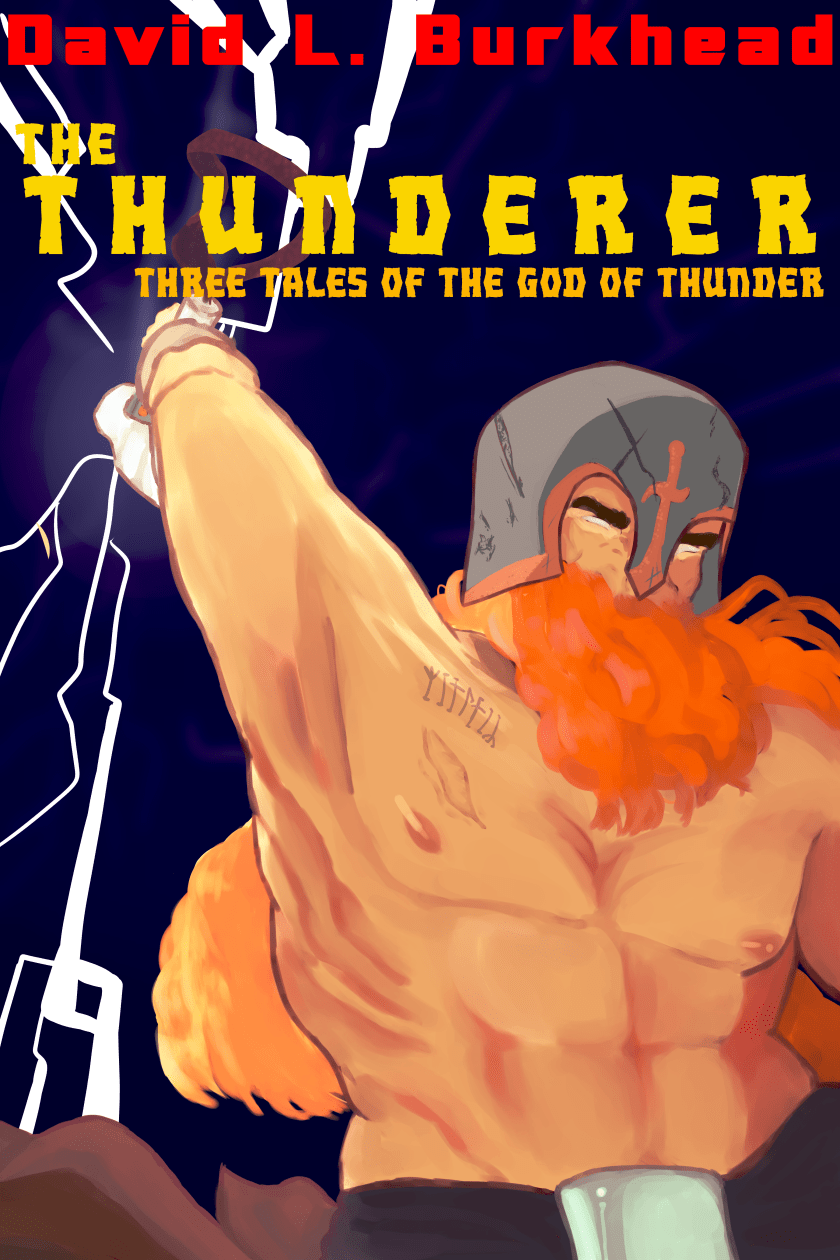
Brief one tonight. I’m preparing to release a new ebook, “The Thunderer” containing three stories featuring everyone’s favorite God of Thunder.
Donner Rothskegg:
When a struggling family man is mugged on his way home, a homeless drifter saves him. Strangeness follows this drifter who proves to be more than he at first appears.
We had reached a vaulted room. At the far side stood a dais with a throne. On the throne sat a, what, a werewolf? Some kind of half man, half wolf. No not wolf. Coyote.
“Welcome, nephew,” the creature said.
“Trickster you may be,” Donner said. “But that does not make you my uncle.”
“Am I not?”
“You are not so clever as he. You are trickster and tricked. He was ever the trickster never the tricked.”
“No? Was there not…”
Donner bowed. “One time only. And I am not so sure that he did not merely pretend to be tricked as part of some larger joke.”
The creature waved its hand in dismissal.
“Return the child,” Donner said.
“I claim that child as my own.”
I shouted before I could think. “No!”
Donner put a hand on my arm. “I think not, Coyote.” He smiled. “Stories in pictures, to entertain children. Such a simple thing. And yet this child believes in those stories. She believes in me. Her heart calls to me. She is under my protection. Return the child.”
The creature, Coyote, stood. “And if I refuse?”
Donner set his sack on the floor and opened it. He reached in and pulled out a wide belt of hinged metal plates. He buckled the belt around his waist. Next he drew from the sack two gloves, also of jointed metal, and slipped them onto his hands. Finally he pulled forth the largest hammer I had ever seen, at least a twenty pound sledgehammer with a handle only about ten inches long.
“Return the child!” Donner’s voice boomed like thunder.
“I claim the child as mine, to be raised in the old ways. Perhaps if she has no family to claim her…” Somehow–I did not see Coyote move–he was holding a bow and quiver of arrows. He drew and pointed. I knew that I saw my death.
The arrow flew. Donner lashed out with an arm and swept it around me. He pivoted, drawing me in and placing himself between me and Coyote. I heard a meaty thunk and six inches of arrow protruded from the front of Donner’s left shoulder.
My knees felt weak. Donner grinned down at me. “Flee up the passage. This is my work, my fight.”
I looked back over my shoulder. The passage was gone. “What passage?”
Donner pushed me back and turned to face Coyote. I saw the remainder of the arrow protruding from his back. “Ever the Trickster.” His arm swung with invisible speed. His hammer flashed across the room. Coyote stepped aside, evading the missile which struck instead the throne, reducing it to rubble.
Then, impossibly, the hammer flew back to Donner’s hand.
Donner? No, say the name I knew from my own childhood. Thor.
I stared. Thor. The stories I’d heard from my own childhood brought to life. Thor. Thor of the hammer, the hammer that always returned to its masters hand. The hammer that never missed.
And yet it had just missed.
Thor and Loki journey to the land of the giants. There, Thor faces his most difficult challenge, and his deadliest foe.
Toward evening Skrymir stopped. Thor caught up with him, breathless, Thjalfi at his side. Loki arrived a few heartbeats later.
“We will pass the night here, I think,” Skrymir said.
Thor looked up at the giant. “You said your brother’s place was near.”
“And so it is.” Skrymir nodded amiably. “We shall reach it soon come morning.” He stretched. “I am tired and think I will sleep. Here.” He dropped the bag. “There is food within. Eat.”
With that, Skrymir lay on the ground and was instantly asleep.
Thor dragged the bag to a sheltered spot between two great roots of the oak. He sat and began to work at the knots sealing the bag.
Thor pressed his thumb and forefinger into one of the cords tying the bag closed and pulled. The cord refused to budge. He tried another with the same result. Frowning, he tried to work the tie over the end of the bag. That, too, failed.
“Thor?” Loki looked down from where he sat on one of the oak’s roots.
“The bag will not open.”
Loki chuckled. “The mighty Thor, stymied by a cord?”
Thor held up the bag and stared at it for a moment. He took a handful of its cloth in each fist. He pulled, straining his back and shoulder muscles.
The bag did not give.
Thor threw the bag to the ground.
“The giant tricks us. He violates guesting law. He offered food and then withheld it by this…this trick.
“He…tricks…us.” Thor drew his hammer from his belt and stalked to the sleeping giant. He held the hammer overhead the swung it down in a massive strike against Skrymir’s head.
Skrymir’s eyes opened and he blinked sleepily. “Has a leaf fallen on my head?”
Skrymir rolled, his eyes falling on Thor who stood dumbfounded, Mjölnir hanging loosely in his grasp. “Why, Thor? Have you eaten? Are you ready to sleep for the night.”
“We…we are just going to sleep,” Thor said.
“Rest well then, Thunderer.”
“And you, Skrymir.”
Thor retreated to the meager shelter formed by the tree roots, chewing at his lower lip. Never before had Mjölnir failed him.
In the waning days of the Viking colonies on Greenland, a young warrior follows Skraelings that had been raiding their village, and learns the truth of the old stories.
Yes, children, let me sit by the fire. The cold gets into my bones these days. I will tell you a story.
That story? Yes, though your parents frown and the priests scowl, I will tell the story, for I have seen the truth of the old tales and they have not.
…
Night came and we found ourselves a hollow shielded from the wind. It had a small cliff with a slight overhang. There we stopped for the night. We built a small fire before the cliff. The rocks would hold the heat, you see, and would keep us warmer with a smaller fire than if we were out in the open.
Eirik set the order of the watch, to keep the fire lit as much as to watch for the skraelings, and the rest of us huddled between the fire and the rocks wrapped in our cloaks and slept.
That night I was, all of us were, awakened by a mighty thunderclap. I had never heard one so loud, not even the time I was standing three arm spans from Aelfred Olegsson’s chimney when lightning struck it. I thought I had been struck deaf but was proven wrong when the thunder returned, not with the crack following a lightning flash or the low rumble of distant thunder but in a steady roar that went on and on and on.
I held my hands to my ears and huddled on the ground calling on the Christian God to still the noise and take the pain away. I could see the others doing the same. But that God did not answer, or if He did, the answer was “no.”
Even in my pain, I could see that lightning was flashing over the ridge, striking in the next valley. This lightning against the sky shone into our own hollow and turned it to day. We could feel the very heat of it against our skins even through the pain of the thunder.
Even through all that, some part of my mind could only wonder that the skies were still clear. There was no storm to create that unnatural thunder.
Eventually that horrid thunder ceased. I tried to stand but the ground spun under me and I fell to crack my teeth against the stones. The world continued to spin and I could only crawl as though I were stupid with drink.
I felt a hand on my arm and looked to see that Eirik had grasped me. He too, was crawling, so I was not alone with whatever madness had infected my body. Blood poured from his nose and I reached up to my lip to find that I, too, was bleeding from the nose. Eirik’s mouth moved but I could hear no words, nor could I hear my own when I tried to speak. I knew then that I had been struck deaf.
Yes child, I can hear you. The curse was only for a time and had already begun to lift before dawn reared its head.
While it may shame a good Greenlander to say it, we were terribly a-frighted and huddled under that overhang, not daring to sleep, until dawn broke the sky.
As I said, by dawn the curse of deafness was starting to lift. I could hear Eirik’s words as though from a great distance. And his words frightened me even more than did the horrid thunder. He asked who would go with him to the next valley to see the cause of that terrible sound.
I wanted to flee. Whatever could make such thunder would be too horrible for any man to face. And yet, if I fled, then it would always be with me and I would always fear to look behind lest I find it coming for me.
I was not the first to say I would go with Eirik, but nor was I the last. In the end, no one refused.
If stories of Vikings and the Gods of the North appeal you you, you might also like my story The Spaewife:
What can a spaewife do, when even the gods are against her and the future she foresees is full of horrors?
For years Katla Gudmarsdottir told no one of the things the Norns, controllers of fate, told her were coming. She shared forecastings of when to plant and when to harvest and other simple things, but not the dread visions the Norns gave her.
Now Ulfarr, the Foul one, has kidnapped her and holds her children hostage for her foretelling.
And alone, forsaken even by the Norns, Katla must save herself, her children and her people.
Donner Rothskegg: A struggling family man encounters a strange drifter who proves to be more than he ever imagined.
In the Hall of the Giants: From the annals of Norse Mythology, Thor and Loki travel to the land of the giants and face their most fearsome foes ever.
God of Thunder: A young warrior in the last days of the Greenland colonies is chasing Skraelings who have raided their village when he encounters something extraordinary.
The cover art is by my daughter, Athena. Final steps in putting this together, including final cover design, are still underway but the ebook should be available shortly.
I keep hearing from people telling me “if you don’t like it, why don’t you just move?”
There’s just one problem with that. For those of us who prefer limited government on Constitutional principles (as written according to the understanding of those who wrote it, and as properly amended not just redefined away), where could we go? Short of building new colonies on Earthlike planets around other stars there is no place to go.
As Ronald Reagan put it in a 1964 speech:
The enemy he was referring to then, of course, was the Soviet Union. That enemy collapsed 27 years after Reagan gave that speech. Now it’s a new enemy or enemies, the rise of militant Islam is one threat. The apologists who object to treating it like an enemy, much like those who did the same regarding the old Soviet Union, serve to heighten and extend that threat.
But in many ways we face a more insidious threat. Many of the ideas the Soviet Union tried to spread to the US in its effort to achieve suzerainty still live on in the US. They are propagated in the entertainment media, spread in schools and universities, often by people who are not even aware that they are Marxist ideas. Ideas like class warfare, the idea that someone who is financially successful is the enemy. Ideas like zero sum economics so that the only way someone can have more is by depriving someone else. The idea that those who seek wealth are “greedy” and unworthy, but those who seek power (so long as they are opposed to those who seek wealth) are somehow virtuous and good.
Got news for you, to paraphrase an ancient proverb: Wealth might not always get you power, but power can always get you wealth.
And the folk fomenting that, those who want to turn the US into a carbon copy of Europe, say “if you don’t like it, go somewhere else.”
We did go somewhere else. We came here. Unless somebody develops true space travel there’s no place left to go. In Reagan’s words, this is the last stand on Earth.
This, of course, is the point where someone suggests “If you hate government so much, then move to Somalia.”
Look. A failed state broken into warring factions led by local warlords who are essentially absolute (until violently deposed) in their local authority is a far cry from a Constitutional government of limited powers with the rights of the people (actual rights not “whatever I want I have a right to and someone else has to pay for it” type “rights”) held sacrosanct. Indeed, it’s at least as far from that as the US is today.
Now, perhaps Somalia could be used as a starting point to make such a society, but the local warlords will not give up their petty fiefdoms willingly. So such a transformation would not be bloodless. And, not being bloodless, the international community would with near certainty take it upon itself to intervene and prevent the transformation.
So no, “going to Somalia” is not an option for those who actually desire a free society.
The same is not true for those who want European style socialism/social welfare. Europe, after all, is right there. It’s exactly what they say they want. No transformation necessary. If you’d be more happy in that system it’s there. You can go there. I would not deny you.
But you would rather stay here and deny me the kind of government that would make me happy. Not just me, but a lot of other people like me.
It’s not that you want to live under the social, political, and economic system that pleases you that bothers me. It’s that you want to force me to live under that system. I can wave my arm indicating all the choices you have for your desired system. You, and others like you, have worked hard through long years and decades to make sure there is no other choice for folk like me.
And that is why I will never stop fighting to leave at least one place in the world where Constitutional principles and individual liberty are given more than lip service.
That’s a motto still sometimes emblazoned on police cars. It’s a nice thought but there doesn’t appear to be any reality behind it.
The first thing you need to understand is that the police have no obligation to protect any individual. Even in the special case where the court has issued a restraining order on your behalf the police have no obligation to protect you from the person restrained. This has been upheld by the Supreme Court.
The theory is that police serve to protect “society” rather than individuals. There’s just one problem with that, what is society without its individuals? Take away the individuals and show me “society”.
Now, on a certain level they have a point. The police cannot guarantee each individual’s safety. They can’t put a 24 hour guard on each individual, not even each individual who has a restraining order against someone. Can’t be done. Thus, it would be unjust to make them legally liable for failing to provide that protection. They can’t always be there.
But there’s a problem with that. Since they don’t have a legal responsibility to provide protection, many take that to mean that there is no responsibility, legal or moral to even try. They may not always be there but even when they are there they have no obligation to intervene. This additional level of lack of concern for the individual was confirmed in New York were police were only a few feet away from a man being brutally attacked at knifepoint until after the victim, thanks to his own training in martial arts (and suffering multiple knife wounds in the process). Only once the knife wielding attacker was subdued did the police emerge from the motorman’s compartment (on which the attacker had previously banged the door claiming to be a cop so their claims they didn’t know ring a little hollow).
To be blunt, a duty to protect “society” which does not include a good faith “best effort” to protect the individuals that make up that society when they actually encounter situations to do so is nonsense. It’s not protecting “society”. At best it’s protecting the regime which seems more the job of a third world dictator’s secret police than the peace officers of a free society.
Without that best effort, “to protect and serve” isn’t even an empty motto. It’s nothing but a bad joke.
It’s popular these days to scream about “equality”. Equality is a goal to achieve. A lack of equality is a bad thing and we must stamp it out. If someone has more, he is to be detested and dragged down. If somebody has less, he is to be pitied and given handouts to “make it fair.”
But, others point out. People put in different amounts of effort. It’s unfair to take from the hard worker and give to the lazy to make them “equal.” Equality, they say, should be equality of opportunity, not equality of outcome.
However, even equality of opportunity has its own problems. Look, I have worked hard to make opportunities for my daughter that she wouldn’t have otherwise. There have actually been claims that reading to her when she was small was to give her a horrible unfair advantage. In addition, horror of horrors, I have made sure she had books she enjoyed reading so that she would not only read but read well–after all, you tend to get good at things you do a lot, and you tend to do a lot things you enjoy doing, so giving her books she enjoys reading is a means to the end of creating a good reader. I have made sure she had the instructional materials and supplies to further her artistic talent. I have made sure she’s competent in math, not just basic arithmetic but the thinking and reasoning that’s the foundation of higher math. I have exposed her to political philosophies and the foundations of economics so she can make informed decisions as she grows up. And before you say otherwise, no, I have not deprived her of her childhood in doing so. These things don’t take a lot of time out of her day. She has plenty of time for play and entertainment, for “kid stuff.”
But these things mean she will have far more opportunity than some child whose parents haven’t done this stuff for them. And I make no apologies for that.
If you think my daughter has an “unfair advantage” which “disadvantages” your child, then get off your hind end and start doing the same kinds of things for your own children. You make those kinds of opportunities for your children. It’s not my job to do it for you. It’s not the State’s job to do it for you. And it is especially not the job of me or the State to handicap my child because you won’t give your child the same advantages.
What the State can do is not put artificial barriers in the way of your child and mine. The only equality that is truly the purview of the State is the equality of getting out of the way and letting each person rise or fall on their own merits.
If your child has trouble because you did not instill in them an appreciation of reading, of the benefits of hard, focused work, of dedication to accomplishment and excellence it’s not the fault of my daughter’s privilege.
Now, if you, because of your own background, are trying and are just having trouble because you don’t have the skills–perhaps because your parents, and their parents, and on back–didn’t, there are people who are more than willing to help you. But blaming those successful at it won’t accomplish that.
I, and many people like me, are more than willing to help people who are trying to pull themselves up. We’re more resistant to those trying to pull us down.
Well, “a” problem, but I think a lot of the various problems stem from this one.
Consider operant conditioning. As a quick summary, it’s how organisms behavior is modified in response to stimulus. Behaviors that are associated with a “good” stimulus become more common and behaviors that are associated with a “bad” stimulus become less common.
It worked on rats in B. F, Skinner’s experiments. It works on people in general (although there are always a few stubborn cusses that will push hard against such conditioning, at least when it’s blatant). And I submit that it works on institutions.
Now consider that in the context of an educational bureaucracy. The stimulus is money. For a long time most of the time the folk who find reasons (however sincerely believed) why they “need” more money were rewarded with more money. Need computers? more money. Need more teachers so we can have smaller classes? More money. “Need” sports facilities and a coach so we can have a winning football team? More money. New textbooks for the latest educational theory to come down the pike? More money.
And what happens to someone who is frugal and comes in under budget? There’s a saying about budgets in bureaucracies: use it or lose it. Reward is based on coming up with reasons why the kids aren’t learning what they ought (or why the schools should be “teaching” even more things even though they aren’t teaching the basic skills the schools were created for in the first place). It is not based on how well the kids are actually learning.
For a long time we, as a society, have been rewarding the educational industrial complex for excuses for failure rather than for success. It doesn’t even require any dishonesty. People who honestly believe that this is the reason why the kids aren’t learning or that is important enough to take time away from “three ‘r'” work are rewarded. Folk who say “we need to go back to what works” or “we’re trying to do too much, we need to cut back to basics, get that right, and then think about what’s most important to add without losing those basics”…aren’t.
And the ones who are rewarded end up in positions of power and influence within the education-industrial complex. It’s the Iron Law of Bureaucracy at a nutshell.
We’ve been rewarding excuses for failure and penalizing success. As a result we get more excuses for failure and less success. Exactly the opposite of what we should be doing: rewarding success and penalizing failure, regardless of what excuses are presented for that failure.
Folk who know me (most here, I would presume) know that I lean very heavily “pro-liberty” if not outright libertarian.
OTOH, I part company with many Libertarians (the capitalization is no accident) in that I believe that some government, a “state” if you will, with some modest power is necessary for the preservation of liberty. “That to secure these rights, governments are instituted among men….”
Consider this example: being able to get up on your roof with a rifle to drive off rampaging hordes of barbarians (whether Avars, Huns, Viking raiders, or rioters) is liberty. Having to spend all your time on your roof because the barbarian hordes are endemic to your situation, is not.
So the barbarians have to be driven off or kept suppressed, which requires organization with the sanction to use force (since the barbarians, pretty much by definition, aren’t going to respond to sweet reason. If they did, they wouldn’t be barbarians). And once you have an organized body with the sanction to use force, there you have government.
Too little government, and your “freedom” is spent fighting off the barbarians piecemeal. Government itself is a restriction on freedom, also just about by definition.
So there must, then, exist some level of government, some small level, where liberty is maximized, where each individual has the most freedom.
The folk who founded the US appear to have been attempting to find that level. And perhaps, at the first, they were pretty close to it–or would have been if they could have gotten rid of chattel slavery (which wasn’t politically achievable at that time and the attempt would probably have destroyed the country before it ever got started).
I submit, however, that the level of government that leads to the greatest freedom (which may vary depending on a number of factors) is always unstable–in fact, I wonder if it’s not the least stable form of government–and will immediately begin to move in the direction of either anarchy or totalitarianism (usually, if history is any guide, toward totalitarianism). The movement may be gradual. Various “checks and balances” may slow the motion. But they cannot halt it.
I do wonder if perhaps the checks and balances in the original United States Constitution were not too successful in slowing the move toward totalitarianism. The Founders did appear to expect a revolution every couple of generations and they got one in the American Civil War, but, although that did lead to an end to chattel slavery I’m not sure that it was a net win for Liberty in the long run with the increase in Federal power that can be traced directly to it. But the increase was slow enough, before and since, that we, as a people, largely got out of the habit of revolution. While the old saw about boiling a frog is not true, it remains a useful metaphor and, I think may describe what has happened to the US. In this case, by the time the water got hot enough to start being a serious problem we had had multiple generations growing up with “There ought to be a law” and “goodies that other people pay for” so that even if a revolution did happen it would just be a faster route toward totalitarianism.
This is why I have been watching the Trump administration with bated breath. Some people pay more attention to the rhetoric, to the Tweets. To the protests. (Really? Trump being a new Hitler? I’ve addressed that already and the claims have just drifted more from reality since.) I, instead, have looked to the little things on the side. The appointment of judges, not just Goresuch, but a number of other federal judges, that are closer to Constitutional literalists than folk have been wont to appoint for some time. An executive order requiring to federal regulations to be repealed to be able to pass one new one. Tax reform that will actually reduce the tax burden of the majority of taxpayers. (Yes, people will tell you otherwise. They are lying to you.)
It’s not all roses, of course. We still have doubling down on the War on Drugs (the recent avenue is restricting people in pain from getting effective relief because a loosely familially related drug in the illegal drug trade is causing an “opiod crisis”). We still have the endorsement of “civil asset forfeiture” (depriving people of property without due process). Hack. Spit. But on balance, the trend does seem to be toward the better.
I’m far from certain that the trends will continue. The “Reagan Revolution” didn’t. The Gingrich Revolution didn’t. In both cases, there was a good start, some “rah rah” from the small government types, and then they passed. Washington returned to business as usual, and the succeeding administrations and Congresses swallowed up whatever had started in those years without a trace. The seven withered cows swallowed up the fat cows and remained withered.
I wouldn’t say we’re doomed. But I wouldn’t say we’re saved either. I remain…watchful.
In another discussion the proposal of universal gun registration (mechanism was requiring all gun transfers go through an FFL with background check, but the purpose was to ensure there was an unbroken chain of 4473’s to identify who owns a particular firearm–registration by any other name). The claimed goal was to ensure that legal firearms were not “inadvertently” sold to prohibited persons. The usual “to keep guns out of the hands of criminals” argument.
In the course of the discussion I made two counter proposals:
1) If a person can lose their rights under the 2nd Amendment via due process of law (and the 5th does allow losing liberty, which would include exercise of various rights, via due process of law), then said person can also lose their protection under the 4th. Why not, then, make a person convicted of a violent felony subject to search at any time for any reason, including the simple whim of the searching LEO? A person thus convicted who obtained a firearm would then be under constant threat that someone might pick them for today’s search and if found with said firearm, go back to spending a long period behind bars.
2) Why not have a “violent offenders registry” on the same model as the “sex offenders registry”? If everyone knows who the local violent criminals are, well, then only someone who is a criminal himself would sell a firearm to them, right?
Two different approaches. Sure, they’d have their own problems and issues that would need to be worked out. But they would be at least as effective, probably quite a bit more so, than the registration scheme at keeping guns out of criminal hands. (But then, it wouldn’t take much.)
Naturally, the “registration proponent” in that discussion did not address either of these proposals. Didn’t even acknowledge them at all. Nope, only “registration” was to be on the table.
So if registration is the only thing that will be considered and alternate proposals for achieving the same stated goal without the need of registration are dismissed out of hand as if they had never even been made, then one has to wonder what unstated goal remains that isn’t served by the alternate proposals.
Crime is a complex issue. The “solution” is likewise going to be complex. As much as some people want simple answers and others feed that desire in order to use it to get what they want politically the reality is that there are no simple answers. There is certainly no one answer, no magic pill that will make the problem go away.
Here are a few things we can do:
Concentrate law enforcement on actual violent offenses. That means we need to roll back the long list of crimes that are little more than annoyances. California made it an offense to “misgender” someone? An actual criminal offense? Every bit of effort spent enforcing as a criminal violation something that is, at worst, rudeness, is effort not available to catch murderers and rapists and get them off the streets. Since every crime out there is something that, in the extreme of non-compliance, police will kill over, you have to ask yourself: is this law worth someone being killed over? It won’t happen every time, but sometimes it will reach that point. Is it worth it? Eric Garner was killed for refusing to comply with a law regarding the taxation of cigarettes. Was that tax worth someone’s life? If it’s not, it needs to be taken off the books and the problem dealt with by means other than “pass a law.”
As part of that, we need to end the stupid war on drugs. Yes, the drugs in question are horrible. They destroy lives. But a lot of the problems associated with them–particularly the crime and violence–are not because of the drugs themselves but because they were illegal. We saw that with Prohibition. The “roaring 20’s” were “roaring” because of the crime associated with the illegal alcohol trade. In addition to the crime generated not because of the drugs themselves, but simply because they are illegal (not talking about illegal use of drugs here–that would be tautological–but things like gang wars over drug trade which is an “add on” from their being illegal), there’s also the severe damage to the US Constitution from the “war on drugs”. No knock warrants, many times delivered to the wrong house or based on false information, leading to innocent people, and their pets, being terrorized, abused, and even killed. “Asset forfeiture” where a person can be deprived of cash or valuable property simply on suspicion, without even being charged with, let alone convicted of, a crime. And if they’re able to get the property back at all (good luck with that) it’s only after spending extensive time and money fighting to have it returned (which is yet another way of depriving them of their property).
On that subject of law enforcement, we need to work on the “us vs. them” mentality of the police. Instead of “us” being the law abiding and “them” being the criminals we have an “us” of police and a “them” of everybody else. If I may make a movie allusion here, Robocop had it right in his prime directives. First was “protect the innocent”. Second was “serve the public trust”. Only number three was “Uphold the law.” (Of course, there was that fourth one, but we won’t get into that here.) We need to go back to “community policing”–“Peace officers” rather than “Law Enforcement Officers”.
Let people defend themselves, and have the means to effectively do it. Look, the vast majority of people are decent human beings. They’re the “good guys”. In a level playing field the bad guys are forced to work on at the fringes because otherwise if even a modest fraction of the majority who are decent turn on them and they end up out of circulation. But we don’t have a level playing field. The “good guys” face restrictions that the bad guys ignore (because they’re bad guys) and the “fringes” become a lot larger. (I know. I know. “If we let people be armed then…” Except all those dire predictions of what will happen if we let people be armed to defend themselves? They never materialize. Fender benders don’t turn into shootouts. Barfights don’t turn into gunfights. And blood does not run in the streets. Yes, I know “country X has strict restrictions and it has much lower crime than we do”. Well see above about “no simple answers” and go take a look at what their crime was like before they passed the restrictions. Hint: you’ll look long and hard without finding a place where they had high crime, passed gun control, and as a result had low crime. They had the low crime before they had the weapons restrictions. The weapons restrictions were not the cause.)
A lot of this crime is related to mental health problems. That, in itself, is a complicated issue. First off, not all mental health problems lead to crime. Most people with such issues live their lives perfectly law abiding (or at least as law abiding as anyone else–when the law is so pervasive and self-contradictory as it is, can anyone truly be “law abiding”?). There are several things that can help in that area. Many years ago, because of concerns about abuse, it was made extremely difficult to involuntarily commit an individual to in-patient mental health care. The abuses were real, but the need to be able to make such commitments was also real. The actions taken to alleviate the former we threw away the latter. We need to be able to ensure that those who are a direct and present danger to self and (particularly since we’re talking about crime here) others get the help they need to stop being such a danger. The flip side of that is some people are afraid of getting help because of fear of losing their rights (RKBA is a big one here: ever been treated with antidepressants? Lose your guns. VA says you can’t handle your own finances? No guns for you.) Such fears keep some people from getting the help they need early, when its more likely to be correctable lest they permanently lose their rights. Again, we need to find a way to deal with people’s problems without driving them away for fear of such consequences. And even if now they are a danger and have to have their rights suspended for that reason, they need to be able to have confidence that they can recover and have their rights restored.
There certainly is a lot more that can be done, but that’s a good start. Those are things that are likely to have an actual, real, effect on violent crime as opposed to “gun control” which won’t. Indeed, can’t.
So, when someone of the political class, in response to a horrific crime, calls for “gun control” rather than things like the above, it’s not crime they’re looking to control.




 The Writer in Black