Insulation from Feedback.

44818044_1119629534858966_1001518341145231360_n

There are more ways to be wrong than to be right.  Indeed, since the ways to be right are generally limited but the ways to be wrong unlimited, there are infinitely more ways to be wrong than to be right.  Don’t think so?  Okay, think of a number between zero and ten.  Ready?

You’re wrong.

I can say, with pretty good confidence, that nobody guessed (sqrt(2)/cuberoot(97))^e.

There are infinite real numbers between zero and ten, between any two numbers really.  Without some kind of hint, say if I’d said “integer” or “whole numbers” the “correct” answer gets lost in an endless sea of wrong answers.

This isn’t so important in things like “guess the number” but becomes vital in trying to figure out the world around us.  In science, this is why a key element is testing our theories.  We look for what must happen, and what cannot happen, if our ideas are right and then we look.  And if something our theory says must happen does not, or something it says cannot happen does, why then we know our theory is wrong and we go back to try to figure out a better idea.

That feedback is essential in the effort of trying to get closer to “right” than not.  The mismatch between our ideas and what happens in reality is a guidepost to keep from going astray.

The problem comes when people insulate themselves from feedback.  You have an idea, you expect a certain result.  Then, when you try out the idea something else happens, often in direct opposition to what one set out to do with the idea.  Instead of re-examining the idea and considering that maybe it was wrong, you instead find, or invent, reasons why the idea was really correct and it’s the results that are “wrong” in some way.

We saw this happen in the sixties and onward in the criminal justice system.  Folk started talking more about “rehabilitation” rather than “punishment” and about addressing the “root causes” of crime.  And so penalties started being reduced, in practice if not in law.  More and more extensions of “rights” were “discovered” by the courts in the interest of “fairness” so that the least clever criminal could be as likely to evade punishment as more clever or connected criminals.  And, in the meantime, millions, then billions, then trillions of dollars were poured into programs intended to alleviate poverty, the key “root cause” of crime (It Says HereTM).

And yet crime persisted in going up not just for years but for decades.

Excuses?  There were all kinds of excuses. “Less crime is happening but more of it is being reported.” (Except murder, where you usually have a dead body, was going up right along with everything else.  There isn’t exactly a lot of room for their to be that much previous “unreported murder”.  Some, yes, but not enough to explain it.) “We didn’t do enough.” (As Robert Heinlein once said: “You can make water flow uphill if you pray hard enough.  How hard?  Hard enough to make water flow uphill.”) And a perennial favorite. “It would have been even worse without our changes.” (Notice that no evidence is required.  It’s just assumed.)

Nowhere in that is the question of whether maybe their original ideas were right examined.  Nowhere do they say “Maybe we were wrong and we need to try something else instead.”

They have insulated themselves from all feedback.  The excuses are so general, so sweeping, that anything that happens at all can be explained away.  There is no possible way, so long as those excuses are accepted, to differentiate between their being wrong and their being right.  It’s the falsifiability problem again.  They are completely insulated from any feedback that might challenge their beloved ideas.

Rudyard Kipling wrote a collection of stories called “just-so” stories.  These were tales that gave fanciful explanations for how various things came about:  How the camel got his hump, how the leopard got his spots, and so forth.

Well, that’s what we’ve got today:  politics by “just-so” story.

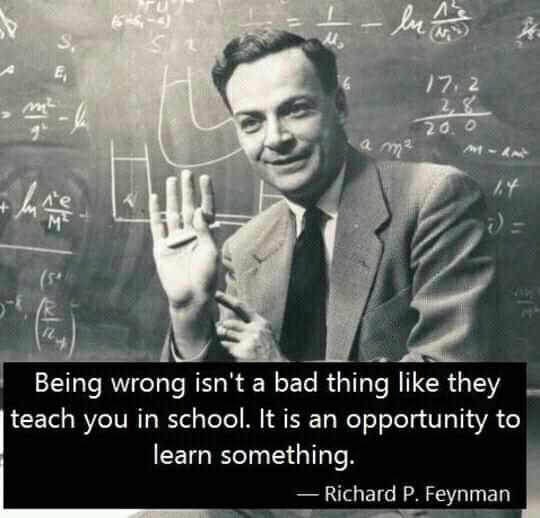
Edit: That Feynman pic represents this piece much better than the previous.

Mindlessly Extrapolating Trends = Bad Public Policy.

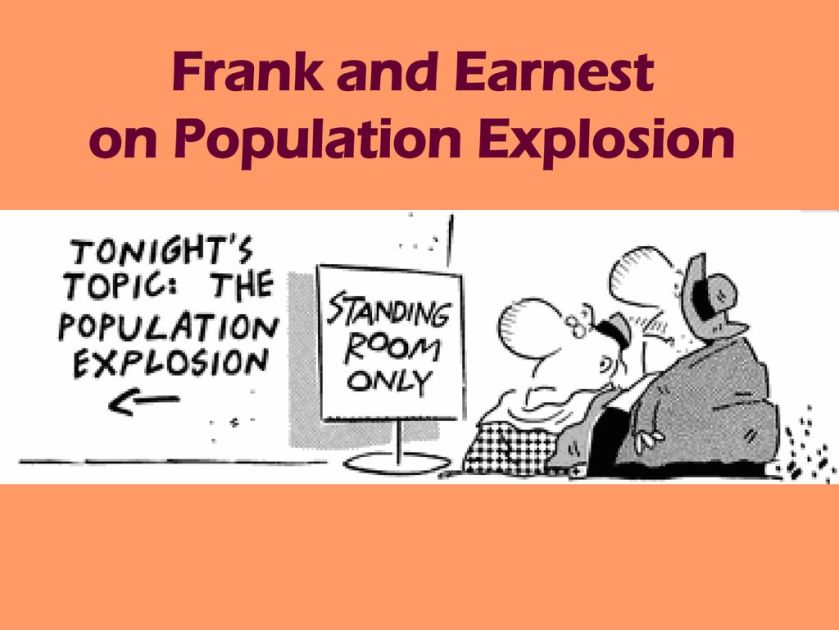
Frank and Earnest on Population Explosion

One of the frequent means used to drive public policy is the extrapolation of current trends, any current trend, far into the future, showing that it leads to dire consequences, and demanding immediate action to avoid the horrible fate that awaits us if we don’t “do something” right. this. instant.

However, it’s worth taking a look at such predictions and examining what happens to them in the real world.

Consider, for instance, the population growth predicted by Thomas Malthus.  One of the bits of “data” he used was Benjamin Franklin’s offhand assertion that the population of the US had doubled over the course of 20 years and would do so again over the next 20.  Population doubling every 20 years.  Exponential growth.  Catastrophe! Well, there were several problems with that.  First off, Franklin’s numbers (and others about British population that also went into Malthus’ work) were not exactly the most accurate measures.  Additionally, the population growth was highly dependent on the conditions at the time.  Great Britain was going through the Industrial Revolution and becoming a major trading economy, leading to a major increase in prosperity.  The United States was rapidly growing.  And if those trends had continued?  Well, the population of the US was just under 4 million according to the 1790 census.  Doubling every twenty years would have given the United States a population today of more than eight billion, more than the entire World’s population is now.  Similar extrapolation of the population growth rate of Great Britain will produce similar nonsense figures.

Clearly, the growth rates did not continue unabated.  The United States has not grown to a multi-billion population and avoided that without repeated widespread famines, without plagues rivaling the Black Death (five or six such plagues would have been required to knock back our population from that predicted from such a growth to what it actually is), or widespread slaughter in war.

Indeed, any such prediction based on extrapolating a trend from then to now would produce equally ludicrous results.

Yet people continue to blindly extrapolate trends into the future and call it “science.”  This mindless extrapolation, carried to ludicrous extremes, is used to predict dire consequences unless we “do something” right now.

As one example, the surface area of the Earth is 510 trillion square meters.  If we allow 1/2 square meter per person for “standing room only” at a population growth rate of 2% per year and using current population figures (more on that another time), we’d reach that in about 600 years.  Oh oh!  To Americans that seems a long time but it’s a hundred years less than the last eastern Crusade which still causes such heartburn in the middle East.

Of course, it’s not going to happen.  Those trends are not going to continue any more than Franklin’s described trend in US population and Malthus’ predicted trend in British population continued.  Demands to “do something” based on those predictions are not science.  They’re politics wearing the flayed skin of science while demanding the respect due the edifice it slew in the face of ideology.

External Costs

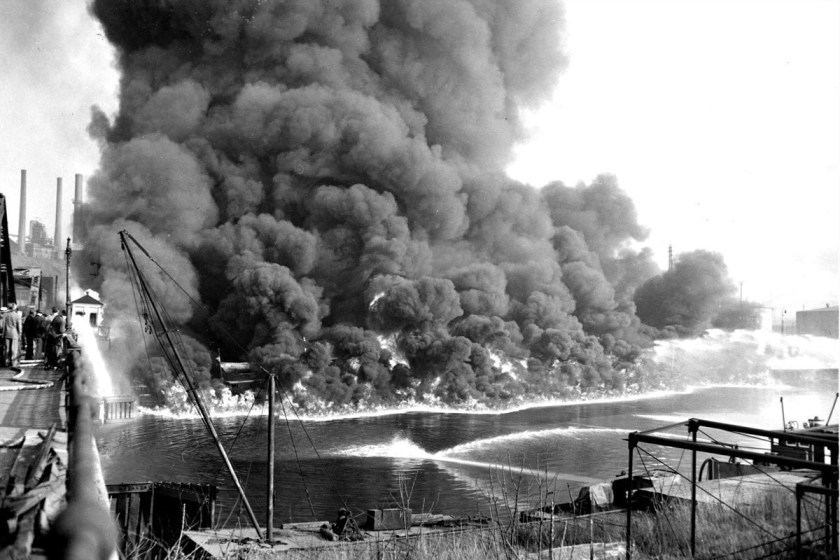
cayuhoga-river-fire

Economists, even strongly pro-liberty/free-market economists like the Thomas Sowell and the late Milton Friedman recognize that external costs, where a cost of a transaction is incurred by people not directly part of the transaction, are not something the free market handles well.  External costs, where part of the cost of a transaction in a good is paid by those not party to the transaction, tend to produce more of the good than if the full cost was paid for by those transacting it.  Less commonly considered, external benefits, where part of the benefit is received by those not party to the transaction tends to produce less than if the full benefit were received by the parties to the transaction.  I don’t think I’ll get into external benefits this time.  External costs are more than sufficient for a blog post.

In the case of external costs consider the classic example.  If you own land through which a stream runs.  Someone upstream of you, let’s call him Ivan, decides to make widgets and sell them to you.  These widgets are something valuable to you.  The problem is, the process for making the widgets produces waste.  Ivan just dumps that waste in the stream and the contaminated water flows through your property.  You, of course, are not happy with this.  The contamination is a cost to you, reducing the value of that water to you.  Depending on how bad it is, it might be tolerable, but it’s still a cost imposed on you.

So long as Ivan is only selling his widgets to you, you can simply include the cost of the reduced water quality in what you’re willing to pay for them.  You’re willing to pay less for the widgets because you’re already “paying” through the damage to your water supply.  But suppose Ivan sells the widgets to someone else, let’s call this one Francois who doesn’t live anywhere near that river.  Francois is not already “paying” through the contaminated water so he’s willing to pay more for the widgets than you are.  Now maybe he’s willing to bid less for those widgets than he would otherwise in support of your plight and maybe he’s not.  If not, maybe Ivan will still sell them more cheaply to you to help compensate for your loss and maybe not.  Once that third party is involved, in a strictly market driven situation (no laws or regulations to force things), you getting compensation for the loss you suffered with the start of Ivan’s production and dumping relies on other people voluntarily deciding to act against their own self interest to compensate you for your loss.  And as more and more people become customers for Ivan’s widgets, the likelihood that they’ll all voluntarily adjust their bids to make sure you retain your own compensation for the loss to your water supply becomes vanishingly small.

You could get together with other folk downstream of Ivan and ride up to his house to express your displeasure in a way that will “suggest” that it would be in his own self interest to clean up his act. (Am I being too obscure here?  I mean you can threaten violence, and show that you’re both willing and capable of carrying through.) And if the contamination is severe and clear cut enough the vast majority might consider it justified.

Now, however, suppose you go into business making fishing lures.  You use lead for weights.  As a result of your own operation some lead gets into the water, about 5 micrograms per liter that’s about 1/3 of the actionable limit permitted by the EPA for drinking water.  Suppose, now, someone downstream objects to your contamination of the water.  Are they, in their turn, justified in coming and threatening violence to get you to reduce your already low effluence still further?  Or maybe you can just pay them to compensate for the “damage” you cause, the reduction in value of the water to them caused by your contamination.

Now add more people on the stream, some producing and adding some small amount of waste to the water, others using and seeing the value of the water reduced to them.  Some doing both–seeing the value of the water coming from upstream reduced by the waste those upstream producers are adding and their own waste reducing value to those below them.

It soon becomes simply impossible to determine who owes what to whom for value reduced, and value added.  Attempts at market solutions break down through the inability to sort out what the individual transactions would be.  In a market transaction if you don’t like the price offered you can simply not make the transaction.  Somebody charges too much or offers too little and you don’t buy or sell.  But in cases like the water, if you don’t accept the compensation that’s on offer for the cost imposed by water contamination and your neighbors do, the contamination keeps happening.

The usual fixes of a market to someone charging too much or too little break down in the case of external costs.  This is where an external party can, with advantage, step in to try to manage things.

This does not mean that the current approach with organizations like the EPA and their endlessly more complicated and more pervasive regulations are the best, or even a good, way to deal with the situation.  As Thomas Sowell is wont to point out, just because in some circumstances, government can do better than the market does not mean that it will.  While a strong case can be made that something needed to be done back when the EPA and various other government regulations went into effect, once they were begun the Iron Law of Bureaucracy went into place and they soon became an end in themselves, going from beneficial to actual harm.

Milton Friedman, on the same issue of pollution suggested an “effluent fee”, basically a tax on the emission of various levels of effluent.  This would ‘internalize” the external costs and allow the market to then find the optimal amount of emission.  Personally, I think he was optimistic in thinking that such fees would bear any resemblance to the actual external costs and think they would instead simply become another bottomless pit for government taxation, but they would probably be superior to the current approach.

So there are some things where government can handle them better than the market.  Unfortunately, current mechanisms manage to find ways to be actively worse than just letting the market operate.

Don’t have a pithy end to this because I don’t really have a solution.  We really need to scrap the current system and start over but the political forces in place pretty much mean that’s not going to happen.

Helping Others with Ice Follies

I actually helped teach at ice skating this last time. We had several brand new people–as in never skated before–in the adult class, along with me, one person who was a little behind me in skills, and one person quite a bit ahead of me.  The adult class is generally small and there aren’t really enough instructors to go around so we generally all get lumped together.

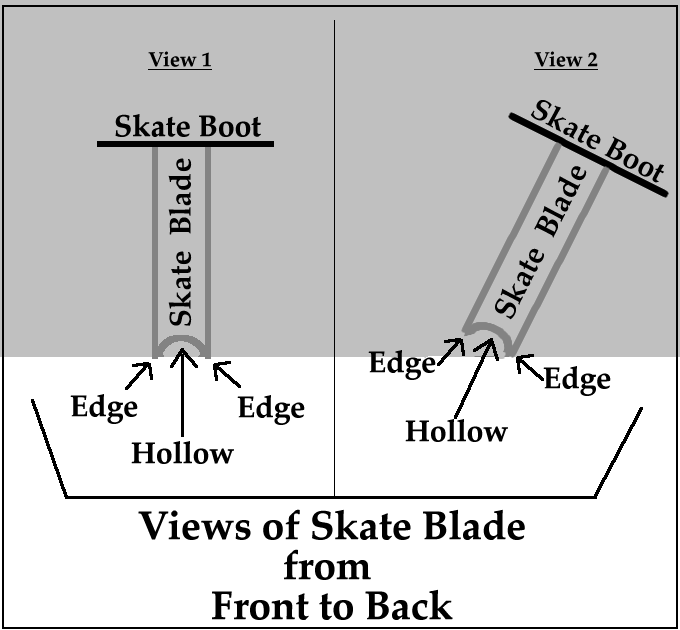
A bit of background here, I just had the blades on my skates replaced (bad sharpening had screwed up the profile on the old ones) and the coach who did the sharpening went a bit deeper in the “hollow” between the two edges, judging that better for me. This made the edges a little “grabbier” than I was used to and so I had to get a new feel for them in practicing stops. As a result, I took a couple of spills in my before class practice and I wanted to take it a bit easy in class.

Skate blades

At the start of the class it was just the three of us more experienced and one of the brand new ones (the other two came in a little later). We were doing warmups where the instructor had us doing swizzles across the ice. That’s a technique where you point your toes out, push out while flexing the knees, then point them in while rising up and letting them come together as you progress across the ice. The new woman was just told to do forward marching, basically just walking across the ice on the skates but she tried to do the swizzles

I saw the difficulty she was having and the instructor was busy with the others so I came over and offered some advice to the new woman. She could get the outward portion–not great because this was her first time–but stalled out on trying to get her skates back together. So I took her hands and showed her the motion backwards while she did it forwards. This let me give her a little nudge, to keep her forward momentum as she brought the skates back together

By the time we got across the ice and back. The instructor was trying to figure out how to divide her time between the five of us and I suggested since I wanted to take it easy, I could help with the beginners. She was on that like white on rice. Handed me a card with the techniques for “Beginner one” and let me work with them while she worked with the more experienced skaters.

The result was I got a lot of practice with backward skating–slowly, because they were only creeping along–as I worked in front of the skaters, giving advice and encouragement. I ended up spending most of my time with the young woman who was clearly having the most difficulty but I kept an eye on the other two and gave advice/encouragement as needed.  All of them made considerable improvement between the start and end of the class so I call that a success.

Go me!

“You Scientists Can’t Just Appreciate Beauty. You have to Analyze it.” A Guest Post by Jason Fuesting

triple-rainbow.jpg

One of the motivations for the late Richard Feynmann learning to draw was so he could represent, artistically, the beauty he found in math and physics. Math and science does not reduce the beauty of the world around us. I can fully appreciate the beauty of a double rainbow. (And I’ve seen the occasional triple rainbow–glorious.) And I can also appreciate, the nature of the wave equations, how dispersion, the differential propagation speed of different wavelengths of light through a medium, separates the white light from the sun into different colors and how total internal reflection in spherical water droplets magnifies the effect to create the arc of color in the sky.

Knowing the science doesn’t take from the beauty. It adds whole new dimensions.

And so, the following guest post from Jason Fuesting.


I’ve been told before that because of who and what I am, I could not see the beauty in the world around me. That somehow, being a hard science and math type, a technologist, and a conservative amongst other things, that somehow those things have rendered blind me to the world while they themselves held superior vision and only they could appreciate what lay around them….

Why is it that the people who claim superiority never actually are? Why is it those loudest in their proclamation of the faults of others are nigh universally declaring their own faults and casting them upon others?

As a compulsive learner, I have never been in a position where at some level I did not ask myself “Why?” I’ve never been in a position where I did not try to answer that question and then question the answer, and then question that answer, ad infinitum. Only time has limited my search for knowledge and understanding.

When I step out on my front porch, I see beauty. Everything, everything is beautiful. Every. Last. Thing.

I see the trees… Their structure? The structure they have grown in to was dictated in real-time by localized conditions that skew protein expression, whose skew is in turn determined by its own set of rules encoded in each tree’s DNA, which is in turn dictated not just by inheritance but the subtle, fickle hand of the universe… The way they move in the wind? The interplay of time-variant, fluid dynamic forces fleeting variations of pressure density tugging with drag one moment, pushing the next as the cellular structures they affect bend and twist under their influence. The grass, no different.

I see the squirrels, the birds, the insects, every last living thing, and they’re all this time-slice’s ultimate expressions of their phylogenetic heritage. They are the tip of an unbroken chain reaching backwards in time all the way to the first organic structure that somehow managed to encase itself in hydrophobic proteins, thus preventing its immediate dissolution by the polar solvent we know as water. Yet, that same structure’s function is wholly dependent on the very things that will ultimately dissolve it anyway: water and oxygen.

I see the people. Our fates, our beginnings, they are no different, neither from each other’s, nor from those of the animals.

And yet, the unbroken chains of every living being I see represents is but a minuscule part of a larger chain, one that will remain unbroken, pushing forward through the barrier of time that drags us along. That chain stretches out toward a horizon none of us will ever directly experience in our current form, to a destination wholly unknowable and mysterious.

I see the sky, blue as it only appears to be, and marvel at the trillions of trillions of photons streaming into the atmosphere above me at any given moment. I see the blues from Rayleigh scattering that hide the blackness of space during the day, the Mie scattering that gives us the whites of the clouds, all the subtle scattering influences that give the world color, hue, verdant warmth, and chill pallor.

And when the sun has gone down, I see the universe laid bare before me. I see the moon looming overhead, tidal locked to the irregular spheroid I stand upon, with its linear and angular momentums, forced by the warp and weave of spacetime into an apparently circular path, much as our path circles the sun. Yet even that isn’t static, for as we move the moon, so must it too move us, and the same between us and the sun, and so forth for everything in our solar system, an endless precessional and processional dance of n-body orbital dynamics.

But that chain of influence does not stop there. I see the endless, unfathomable black stretching out, interrupted only by the twinklings of a past that took millions, if not billions of years to travel directly to my eye. I see the endless spheres, the endless layers of influence, our solar system and countless others orbit a central point, which in turn orbits something else, and so forth, each larger system influencing and being influenced by its children and its peers, a nigh limitless cosmic choreographing to a Great Song so beautiful we only experience it as the flow of time.

And yet, by seeing the vastness of eternity laid out before me, I see, hear and feel the infinitesimal, vanishing smallness that eternity is composed of, seemingly ignorable yet omnipresent and omnipotent in ways so easily missed, so easily misunderstood.

At human scales, one can see, touch, and feel without ever knowing of this smaller realm nor its rules. Yet knowing the rules, as ill-defined as we have suffered in our quest to define them, one stumbles upon uncomfortable truths. One does not ever touch a thing for the electromagnetic force stops you long before you come in contact with anything. In fact, the act of seeing is not seeing, nor is the act of hearing actually hearing. They are all electromagnetic interactions.

Hearing? Particles in the air move because other particles push on them. The structures of your ears focus this movement into a chamber where, in their moving, they disturb other particles, which in turn sets off a chain reaction that generates electric arcs that spiral deep into your brain. Those currents are what you eventually interpret as sound, and the quietest sound one can hear without undamaged hearing involves the movement of particles whose distance travelled is smaller than the diameter of a hydrogen atom.

Touch? Little different. The feeling of touch is merely the influence of other particles that excite certain nerves into firing their own currents that feed to different parts, different processing centers of the brain. Feeling heat? The same with the only exception that instead of long-term compression sensitivity, those nerves are sensitive to short term energy transfer, because heat is precisely and only the transfer of energy. It’s exactly the same thing as the energy transferred when a thrown ball strikes a wall, except the ball is a particle and you are the wall.

Sight? Sight is subtly different. One does not “see” the object. What one “sees” are photons emitted by the object. Much like hearing, structures in the eyes focus these photons onto sensitive tissues that trigger currents when struck, and those currents are passed into yet another neurological structure for interpretation.

Even our idea of what constitutes a thing doesn’t apply at this scale. One grips a ball and knows the ball is solid, but one does not know the ultimate truth. Particles are not solid. They are distributed into a cloud whose shape and perturbations are determined by the sum of influences at every given point of the cloud, and the influences are what most think of as forces. And yet, the shape and perturbation of one cloud dictates the sum of influences it has against neighboring clouds and vice versa. Thus, some clouds become bound to others so long as they contain less than a certain amount of energy. When one holds a ball, the electromagnetic force keeps the particles of your hand separate from the particles of the ball. When one squeezes the ball and it feels solid, the clouds that comprise the ball compress to a minimal volume as allowed by their joint sum of influences, beyond which the force so applied cannot compress further, and that incompressibility is fed into the sense of touch.

But more subtle than that, and lost on many, the particles that compose one’s skin do not form a uniform surface, much less a flat barrier. Much as one can grip a ball of sand and the sand emerges from between one’s fingers, so too do the particles of the ball, but on the quantum scale. As such, the particles of the ball necessarily squeeze into those gaps, and given the shape and density of all the clouds are dictated by the sum of influences, during this compression one will necessarily see some small number of clouds pass through others into places solid objects could not go. And in releasing the compression, not every particle, nor every structure of particles bound to other particles, will return to its original placement. Some of the particles of your skin will be left on and in the ball, just as part of the ball will be left on or in you.

And the apparent weirdness persists because that description only largely applies to what we have defined as bosons, as matter, as things. There are things that are not things in the way we think of things being, not even a little bit. Those? Those are gauge particles like photons.

Photons are things and yet not things. They are events that propagate like waves, yet their effects resolve like particles. They are the means of interaction, the ultimate expression of the electromagnetic force. And much like their cousins, gluons, who fill the same role for the Strong force, they carry momentum and energy yet have no mass. In being so, in being so they teach us the first of so many lessons: the universe is under no compulsion to make sense to us. We are the students, not the teachers. Just as students do not dictate the lessons, we must not presume to dictate terms to the universe when we are but motes of dust if we hope to learn from it.

And all that is just what I see before me as a man and physicist. My perspectives are many. The interactions between the people are laid bare through my explorations on Liberty and economics. Motives, actions, reactions, all are part of a consistent set of rules that explain every last knowable thing. The technology I can see, the cars, the street lights, power lines, all of them are expressions of humanity to manipulate the environment using the rules we know to achieve results we want using the resources we have, all of which are ultimately dictated by the influence of Liberty and economics. Everything mentioned, they’re all systems and those systems are fed by smaller systems while simultaneously themselves feeding into larger systems. They are a long, unbroken, spiral of chains of influence stretching from the smallest scales to progressively larger ones, each link influencing the link before, the link after, and the link beside it.

Even our own bodies and the neurological structure with which we parse the world beyond for us is not an exception this. We, however you want to define ‘we’, are embedded in running-state-based self-programming organic computers which in turn are embedded in a larger organic structure we use to manipulate and observe the world around us.

And here I am, gazing upon it all in biblical awe, and, in bearing witness to the same, I am not afraid. Instead, I want to know more. I want to know it all.

And there is so much to learn. We start this life unknowing and naïve. We learn the world around us by interacting with it, not knowing that in every interaction, our perspective, derived from our running state, dictates our interpretations. As we learn, we explain unknowns and populate the running state with expectations, gaining perspective in an iterative process where every layer of knowledge builds on previous observation, previous perspective. Eventually those expectations seem feature complete, but they’re not. Most learn only the lessons of the system that exists at the scale we live in, not knowing our system is merely the natural result produced by progressively smaller systems. Similarly, they do not necessarily learn that the results of our scale’s system project upward, directing the ebb and flow of systems ever larger than we are. Vanishingly few bear witness to the unbroken chain from the infinitely small to the infinitely large, an infinite sum of the smallest that ultimately describes the largest in such excruciating detail that the smallest influence is undetectable.

Those influences are all describable in one language: mathematics. Everything you see, everything you touch, everything you hear, from the most mundane object to your very self, they are, at their heart, nothing but math. All of them part of a larger yet unbroken and in this case unbreakable chain. An infinite sum of infinite sums, stretching in infinite directions across an infinite series of scales, connecting both the known and the unknown to a past we do not know to a future we cannot know and then to a future we will never see because all things are fleeting, not just us, but the stars themselves as well.

And despite our efforts and the cumulative efforts of those who have come before us, the unknown still looms, just beyond our notice. And we should, no, we aught necessarily seek to understand because in not knowing we are limited. And in our limitation, we err. On the personal scale, we harm those who should not be harmed, shelter those who should not be sheltered, aid those who should not be aided. We seek peace when we should fight and fight when we should seek peace. We fail to see our desire to heal only produces harm. On nearby scales, we lack solutions for problems that can and should be solved. At scales non-adjacent to our own we fail to find the knowledge that leads back to solutions at other scales, which in turn eventually loop back to provide solutions at our scale.

Those solutions and so much more lie in the unknown, just beyond our notice. We could have them if only we were curious enough, persistent enough to seek them.

But why? In seeking the unknown, what will we find? Why am I, like so many, driven to push against the night, to push the unknown back as our forefathers did before us? What were they searching for? What are we searching for? Why?

From the steps outside my house, looking at the beauty in the infinite complexity around me and the vastness of Eternity, I am find myself curious, as do many others. What do we see, peering forward in time with the tools we have? We know enough to know those predictions will always be imperfect precisely because the scales below us are so innumerable, but what if we could look backwards? The past has already happened, its influence laid bare in its totality around us. What would we see if we could but roll back the hands of time, rewinding the Great Song back to the beginning? What truth awaits us there?

What we see today when we attempt to do so certainly suggests much, but is our understanding sufficient such that by applying what we know, do we find what truly was? Or is what we currently find waiting for us at the beginning merely an expression of our ignorance, a defect in our knowledge? We do not nor cannot know for certain. And so we push forward, as did our forefathers. Standing on the shoulders of the giants that came before us, we are pulled along by the flow of time, searching, hunting for ever more knowledge. We hope to fill in the gaps, perhaps gaps we aren’t even aware exist. We hope, in the knowing of new things, we will recognize ever more subtle details in the picture, the great Infinite Sum, before us. And with that newfound clarity, we seek to forge what we hope is the final link of yet another unbroken chain that spans from the horizon behind us to where we stand today.

As it has in every one of their children since, when the first human gazed upon the stars for the first time so many eons ago, the sight stirred a need in their hearts, in their spirits. The sight before them evoked questions that have no answers and a need to answer them. Who am I? What am I? What does this all mean? What comes next?

And yet, bearing witness to all of this, when my heart aches at what I see, I am told I see not the beauty in the world around me by those who presume the superiority of their perspective. In making that presumption, they commit the gravest of fundamental errors: they presume to dictate to the universe what is and is not. Unseeing, they knowingly turn their back on the unknown and embrace their limited state along with everything that implies.

Not everyone who sees the world differently is blind, for believing so presumes one truly sees. Only in refusing to question what we see are we ever truly blind.

Be the bright mote in the darkness that lights the way for others, not the one who seeks to snuff it out. Be the shoulders upon whom future generations will stand upon to reach even further, not the hand that yanks them back into ignorance. Be the next link in the chain, not the destroyer. All scales affect the others. This need not be the end.

Romantic Goth

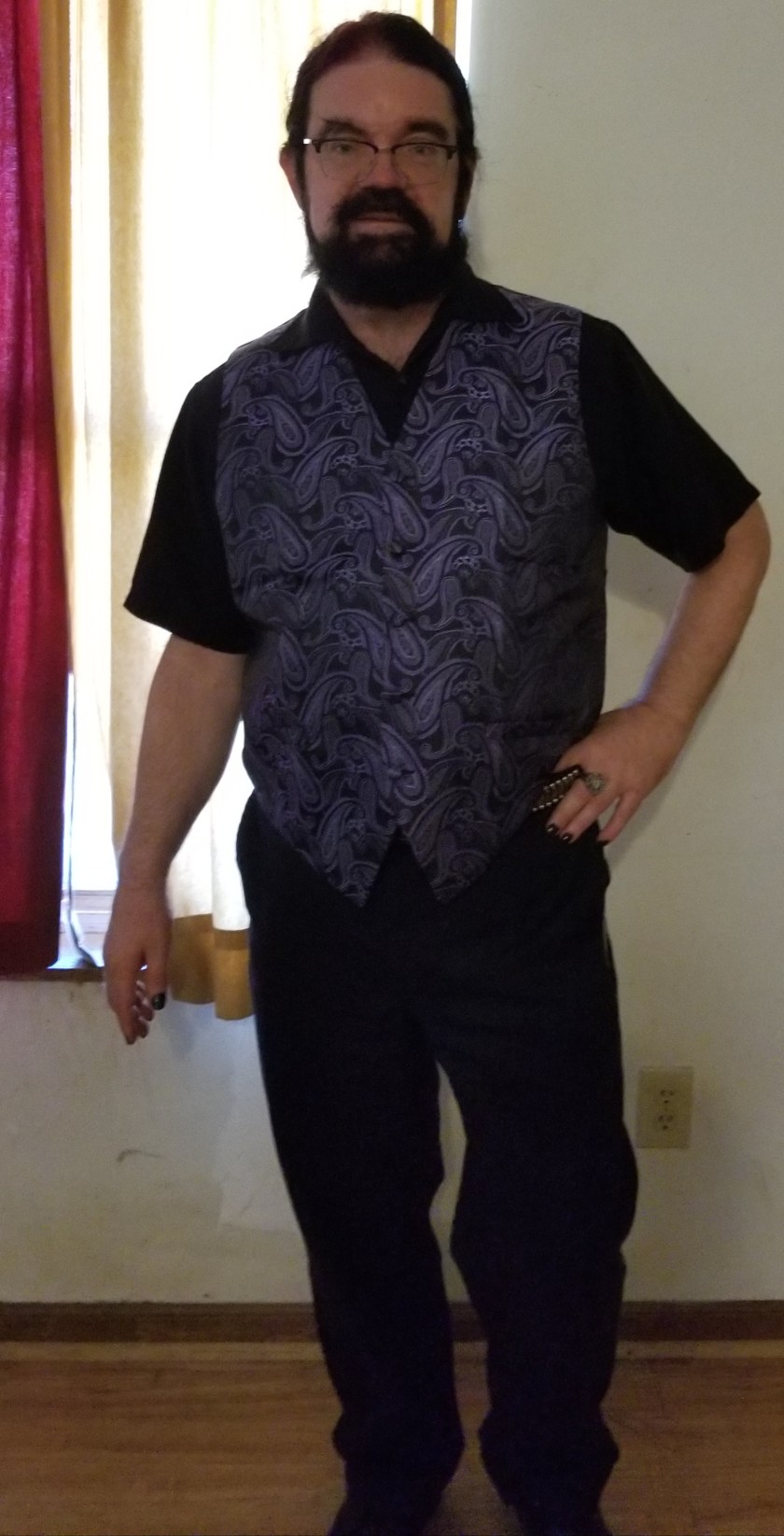
While I’m still wanting to make “Viking Goth” a thing, I’m starting to drift more toward a “Romantic Goth” look.

“Romantic” here doesn’t mean love, although that can certainly be a part of it, but rather the “Romantacism” of the romantic period of history.  Romantic goths focus on beauty in darkness: dead roses, moonlight illuminating a graveyard, ravens and wolves, and so forth.

Fashion tends to be flowing, lace and velvet are quite common.  Styles from the Victorian and Edwardian ages, or even further back to Medieval times, are popular.

“An elegant goth, for a more civilized day.”

Indeed, it’s the exact opposite of that silly screed I fisked before:

Goth deliberately crosses all the lines of proper dress, manners, refinement, and decency.

Stuff and nonsense.  There’s nothing the least bit indecent about any of this:

And, if I might be so bold as to suggest:

20190824_102522

I Guess I’m a “Statist”.

Short one.

gulag.jpg

I get that accusation from time to time.  It seems to center on four things.

First:  I’ll sometimes talk about what law currently is, rather than what it should be (or shouldn’t be).  Basically, “these are the constraints we have to work under at the moment.” Since I’m not immediately dismissive of any unjust law, or, well, let’s be honest, of any law at all, and advocating ignoring/disobeying that law I apparently “support” it.

This, in some minds, makes me a “statist.”

Second, I think that some small amount of government with the coercive force that implies, properly managed is necessary in all but the smallest societies to maximize liberty.  I call this the “paradox of liberty” and have discussed it more here.

That, in some minds, makes me a “statist.”

Third, I believe that given the gargantua our government has already become, great care is needed in pruning it back.  It can’t be done quickly any more than it was quickly built to its size and intrusiveness.  Attempting to do so can cause hardship which will cause the populace to push back hard against the reductions leading to a redoubling of the growth and intrusiveness of government leaving us worse off than when we started.  I’ve discussed that before too, most recently here.

That, in some minds, makes me a “statist.”

Fourth, I believe in looking at achievable goals, not some pie-in-the-sky utopian dream.  Furthermore, I have to deal with the reality that there are other people out there with their own utopian dreams that they are trying to reach and that will affect what goals are actually achievable.  And sometimes that might mean I’m going to lose and the best I can hope for is to minimize the loss.  But since I don’t throw all practicality and achievability to the wind and stand on unadulterated “principle” regardless of whether it actually helps achieve anything or not is a crime in some eyes.  I have discussed that before too here.

That, in some minds, makes me a “statist.”

In short, I work toward an achievable approximation of my ideal which will fall short of perfection in this imperfect world filled with imperfect people.  That makes me a “statist.”

I can live with that.

Think “Things” not “Words”.

Oliver_Wendell_Holmes_Jr_circa_1930-edit

Supreme Court Justice Oliver Wendell Holmes, Jr. said (among a great many other things): “Think ‘things’ not ‘words’.” Words can often confuse matters.  “Things” are often much clearer.  Thomas Sowell is wont to repeat this statement in terms of economics.  And there is much truth to it.

Consider, for instance, the much maligned “unfavorable balance of trade.” This comes from the old merchantilists.  At the time, (before Adam Smith and his treatise on The Wealth of Nations), a nation’s “wealth” was considered to be the amount of gold and silver, specie, that it possessed.  If one imports more than one exports, the result is a net flow of specie out of the country to the folk who were exporting.  More specie going out than coming in meant smaller reserves, less wealth as they saw it.

This use of specie as the measure of wealth was really only of importance to the upper classes of society.  The well-being of the population as a whole was not considered significant.  The nation could become “wealthier” so long as there was more gold and silver, even if that wealth was obtained on the backs of an impoverished population.  Adam Smith’s key insight–that it’s the goods and services available to a population, not the amount of specie, that’s the true wealth of a society and that trade increases that–made the term, as used, obsolete.

Where thinking “words” instead of “things” comes into play is that this outdated concept of “unfavorable balance of trade” remained in place and people take it seriously.  And yet, the US had a “favorable balance of trade” during every year of the 1930’s (also known as “The Great Depression”).  And some of our best “boom” times?  And the record “unfavorable balance of trade” in 1984?  That came in the midst of a huge economic boom averaging 4.3% GDP growth and 2.8% employment growth.

The “words” were “unfavorable balance of trade” but the thing was “more goods and services available to the American people”.  The thing promoted more prosperity, and with it more jobs and more wealth, exactly the opposite of what the words brought to mind.

Words, particularly in the political arena, are often used to mask the “thing”.  Words can be manipulated more easily than “things.” The “thing” doesn’t change, but it’s easy to use multiple meanings for a word, and to change the meaning one is using without notice (the Fallacy of Equivocation).

So look beyond the words to the things.  Think things, not words.

“Not True Communism/Socialism”

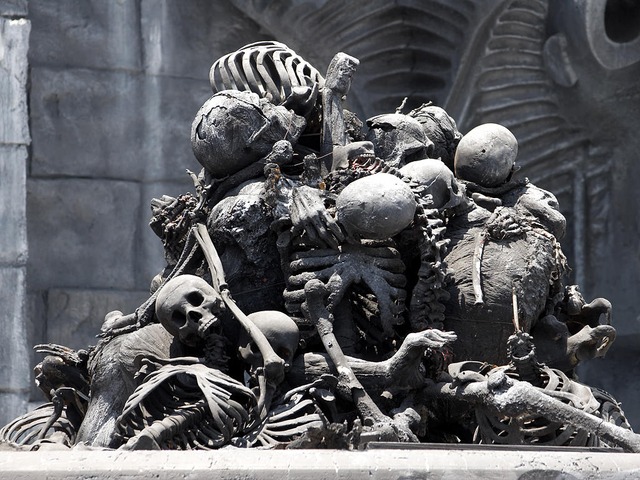
bone-pile-3614_640

Whenever one points out the horrors of communism and socialism historically, folk pushing the latest round always dismiss them saying they weren’t “true communism” or “true socialism.”  First let’s dispose of the difference which is mainly in how you get there.  They both involve seizure of control of the means of production for what they profess to be the “common good.” The only real distinction is communism generally involves armed overthrow of the existing system and socialism does so through lawfare.

But let’s go with the idea that it wasn’t “true communism/socialism”:

Lenin: “Let’s do Communism/Socialism.”
Russia: “Okay.”
Horrors follow.
“That wasn’t true Communism/Socialism.”

Mao: “Let’s do Communism/Socialism.”
China: “Okay.”
Horrors follow.
“That wasn’t true Communism/Socialism.”

Ho Chi Minh: “Let’s do Communism/Socialism.”
Vietnam: “Okay.”
Horrors follow.
“That wasn’t true Communism/Socialism.”

Castro: “Let’s do Communism/Socialism.”
Cuba: “Okay.”
Horrors follow.
“That wasn’t true Communism/Socialism.”

Kaysone Phomvihane: “Let’s do Communism/Socialism.”
Laos: “Okay.”
Horrors follow.
“That wasn’t true Communism/Socialism.”

Pol Pot: “Let’s do Communism/Socialism.”
Campuchea: “Okay.”
Horrors follow.
“That wasn’t true Communism/Socialism.”

Chavez: “Let’s do Communism/Socialism.”
Venezuela: “Okay.”
Horrors follow.
“That wasn’t true Communism/Socialism.”

Bernie Sanders: “Let’s do Communism/Socialism.”
USA: “?”

I don’t care if it’s “true” (however you define “true”) Socialism/Communism.  The pattern after “Let’s do communism/socialism” and “okay” remains what it remains.

How about “let’s not.”

Pure Sentiment: A Musical Interlude.


I have a playlist of love songs but given the state of my…personal life let us say, well, listening to them could be a hit or miss proposition whether they’d make me feel good or trigger a depressive bout.  I’d compare the music with my reality and…

Well, one of the things I’ve had to learn is that there are worse things than being alone.  Much worse.  As the late Robin Williams put it:  “I used to think that the worst thing in life was to end up alone.  It’s not.  The worst thing in life is to end up with people who make you feel alone.”

I’d kind of understood that intellectually, but until I actually grasped it on a visceral level it was just words.  But once I did, I learned to appreciate where I am.  If anything happens in my life, great.  If not, that’s okay to because there are far, far worse places I could be.  And once I really understood that, I could listen to the music without the need to compare the music with my life.  I could simply enjoy the music.

So here’s some of it.  The music tends to be simple, likewise the “story” of the song.  Evocative imagery and powerful use of metaphor is used to evoke unrestrained emotion.  The musical styles, indeed, are often not to my normal taste but the expression here makes them an exception to all my usual tastes.


I have heard it said that a good song is one you groove along to; a great song is one that grabs you, holds you so that you just sit there with goosebumps.  This is one of those songs.


Remember, I grew up in a religion where the very idea of heaven was the ongoing, eternal continuation of love and family.  I was still a believer in that religion when I first heard this one and it still has enormous power to move me.  “If love never lasts forever, then tell me what’s forever for?”


This is actually a medley from a religious musical.  I don’t have to believe the religion to enjoy the story–and the second part of this, the “Eternity is You” part?  Wow!


And let’s wrap up with two of the most powerful (in my opinion) love songs ever written:


Now, excuse me while I go find some tissues. (Yes, I can be a sentimental softie sometimes.)