I was mowing the yard recently (between weather and schedules it had gone much too long since last time). I got the back yard done and was starting on the front when I was mowing next to an old woodpile and wasps started coming out of the pile. I got away from there but managed to get stung twice.
I thought I had some wasp spray around here but couldn’t find it. What I did find was a guy up the street mowing a neighbor’s yard.
“Are you equipped to deal with wasps?”
“Yes.”
How much to take care of a wasp nest on my yard?”
Skip to the end and for $40 he’ll finish the mowing, including trimming, and deal with the wasp nest.
Sold!
Normally I’d just finish the job myself. But this time, the wasps just added that little bit of extra that said, “let somebody else deal with it.”
As it happened “deal with the wasp nest” meant mowing and trimming the area with the nest, not spraying it down to kill them. So, next day I head out to the store and get a double can of wasp spray.
The wasps are dead now. And at least my yard looks nice.
Frederic Bastiat wrote about “The Seen and the Unseen”, essentially describing what economists now call “opportunity cost”. What this means is that while you can see the effect of money being spent–as in the case of money spent to fix a broken window (the classic example) puts money in the glazier’s pocket which he can then go and do other things with, what you don’t see is what else the person might have done with that money if he hadn’t had to fix that broken window. Once you start looking deeper at those things, a different picture emerges. The person, instead of fixing the window (since it’s not broken) buys a new suit of clothes, and the clothier then goes and does other things and…the upshot is the economy is ahead by one suit of clothes over the broken window case. This is called “The Broken Window Fallacy” like so:
The same principle applies in fields other than economics. Take, for instance, what happens any time a high-profile crime (especially when the crime involves guns, but it doesn’t have to be) and people call for more “gun control” and the argument is “don’t you care about (the victims of that crime).”
Yes, I do care about the victims of those crimes. But that is the “seen”. I also care about the “unseen.” I care about the little girl whose father was accosted on the way home but whose attackers fled on seeing that the father was armed. I care that she wasn’t rendered fatherless, or at the very least her father’s ability to provide for her reduced. I care about the woman who was not raped because she was able to pull a gun on her putative rapist. I care about not just the patrons and employees of a store not robbed because an employee or customer was armed; not just them but all the future patrons and employees of other stores that will not be robbed because that robber was stopped. I care about the neighborhoods that riots diverted around, and the people living in them, because people living in them, armed people, presented a clear message of “this line you do not cross.”
I care about the hundreds to thousands of times (minimum) every day that crimes do not happen because people are armed for their own protection.
But these are the “unseen.” News doesn’t report “crimes that never happen.” People who aren’t robbed or raped or victims of battery often do not report the crime that didn’t happen to the police. People alive, healthy, unmolested because they’re armed. A “silent population” that doesn’t make headlines.
That these things are often not reported present a difficulty to attempts to study the phenomenon. At the very low end, a survey of crime victims, we get numbers like 70,000 per year. The problem with that one is that, again, it’s only the “seen”: crime victims. People who were not victims, who never reported the incident, usually where simply presenting the gun causes the criminals to flee, are excluded by its very nature. So it’s going to be low. But even there that’s twice as many people defending themselves with guns as being killed by people using guns. And if we exclude suicides (the presence of a gun may affect choice of method; it does not render a non-suicidal person suddenly suicidal) it’s 4-5 times as many as are murdered with guns.
Most studies, which attempt to quantify the number of gun uses including those not reported to the police produce estimates ranging from 500,000 to a high of 3 million every year. Even at the low end that’s better than half again as many as the total number of guns being used to commit crimes (300,000 for the year in 2008–and, incidentally violent crime in general and crime committed using firearms is down from 2008’s levels. See the chart I generated here.)
This is the great unseen, not just because it’s not obvious without careful thought and study, but because the people who are publicly wringing their hands over the latest atrocity and using it to stampede you into agreeing with their political demands don’t want you to see it. They’re purposely silent on this other side and, indeed, belittling those supporting it, playing the “don’t you care…” game.
So when people put up pictures of the latest atrocity up on your screens and asking “don’t you care” remember the others, the people you don’t see, the people who are able to go about their lives safe and unmolested that those putting the pictures up would have you forget.
Heart-wrenching, to be sure. However, once again we have a “seen and unseen” situation.
The post where I saw this over on the Book of Faces snarked about her two abortions as the “two children she killed” and suggested she should “let that sink in.”
Well, my views on abortion are complicated and I don’t generally discuss them in public–and I’m not inviting discussion on that topic here by others. Too much heat, too little light for any such to serve any purpose.
So, leaving that aside, let me offer the following:
Hey, Alyssa, between 900 and 9,000 people defended themselves against criminals today–with guns (presuming an “average” day). Let that sink in. Their being armed meant that they weren’t victims.
So, yes, my heart goes out to the family of that baby. What happened to it was tragic. However, my heart also goes out to those who weren’t victimized thanks to their being armed to defend themselves. And it goes out to those who were victimized because people like you stripped them of the ability to effectively defend themselves.
We live in a horribly imperfect world. Terrible things happen in it on a daily basis. But mindless, simplistic “answers” like “ban guns”, and “leave people disarmed” do not help. The “solutions” often make the problem worse. They would do so here–as shown by the simple fact that, by the best available studies on the subject, more people use guns to defend themselves against crime than use guns to commit crimes.
Remove the guns and. you. have. more. victims.
Since those in the political class have access to all the information necessary for them to know this, they either have other reasons for wanting to restrict RKBA or they’re being willfully blind and proceeding “in reckless disregard of the truth.” There is no third option although I will allow the possibility that they combine the two.
Now, Ms. Milano, I’m willing to give you the benefit of the doubt. After all, you made your fame playing pretend, mouthing words that other people wrote for you. Nothing in that “talent” requires any great level of brightness, nor any grasp of risk assessment, criminology, probability and statistics, or really anything that makes you any more qualified than a dancing monkey to spout on topics you do not understand. You’re good at hand-wringing on cue. That’s about the extent of it. So, I’ll give you the benefit of the doubt and assume that you are simply ignorant and too stubborn to look beyond your blinders and not actually malicious.
The politicians and pundits from whom you get your marching orders, however? They still fall into one of those two categories (or, as conceded above, possibly both).
Make your bets on which way for any given politician or pundit.
Long ago, in the dim recesses of prehistory, there were some of TV shows that I’d seen then that largely vanished but somehow remained stuck in my consciousness.
First, we have The Avengers. No, not the superheroes but, well, if coolness is a super power…
In the initial episodes, mostly lost, Patrick McNee in the role of John Steed was the assistant to Dr. David Keel played by Ian Hendry but as the series progressed the roll of John Steed took increasing importance. A strike cut short this first series and when they resumed John Steed took center stage, he was assisted by Dr. Martin King (Jan Rollason) and Nightclub singer Venus Smith (Julie Stevens), but what really changed the dynamic of the show was Dr. Cathy Gale (Honor Blackman). Gale soon became Steeds regular partner.
Steed himself saw a transformation during this time, changing from a more typical tough guy to a suave, charming British Gentleman, full of sang froid.
In 1965, the show was sold to ABC which provided the budget to start shooting on film rather than tape. This era also saw the introduction of Diana Rigg as Mrs. Emma Peel.
This is when I started seeing them. It was only years later that I even knew that there were earlier partners for John Steed. The “Emma Peel years” pretty much sum up my memories of the series. As the series progressed episodes featured science fictional themes with villains who were mad scientists and their plots being the problem they had to solve.
Eventually, Rigg left the series to pursue other interests. I know that’s often a euphemism for “fired”, but that doesn’t seem to be the case here.
The show was a lot of fun. And, to my great delight I found that the Emma Peel episodes are collected and available from Amazon:
Another show from my childhood, one of a slightly later vintage, was UFO. In the first episode Colonel Ed Straker, of the US Air Force is the only survivor of a UFO attack. We jump forward ten years and he’s the commander of SHADO–the Supreme Headquarters Alien Defense Organization.
I took this show a lot more seriously as a youth than I can today. The creators had some strange ideas of how the future would go, from the mesh uniforms worn by their submarine crew (Skydiver) to the tight jumpsuits worn by female personnel in both the Earth headquarters (secretly located under a film studio) and the moonbase. to the purple wigs that were part of female uniforms on that moonbase. The vehicles show the influence of the producers previous “supermariotmation” programs such as Fireball XL5 and Thunderbirds. Kind of depressing that they thought we would actually have the capability for routine flights to the moon (in at least one episode in addition to SHADO’s moonbase, there was a commercial facility) by 1980.
Still, I very much enjoyed the series, enough that I remembered it years later despite rarely if ever seeing it in syndication. And on rediscovering it recently, I found that it is still eminently watchable, episodes often having a delightful darkness without going into the outright depressing. This is a war with casualties, where one is often having to scrape together the best out of a bad situation.
And the series is available on YouTube:
The third I’m going to discuss today is The Champions.
Three agents for an international espionage organization named “Nemesis” crash in the Himalayas. There, they are rescued in secret by a hidden civilization that heals them and also, unbeknownst to them at first, bestows on them the epitome of human capability, strength, speed, and even limited psychic powers.
The series revolves around them using their abilities to complete their missions for Nemesis while keeping their abilities secret both from the people they oppose and their own bosses.
Look, I grew up on superhero comics so this was more of the same to me. Why they’re keeping their abilities secret may not make a lot of sense. Those people in the Himalayas may not want their existence revealed but wouldn’t these people’s first loyalty be to the people they work for? Still, roll with it.
On discovering the series later, I don’t find it as good as I remember. It hadn’t aged as well as the others. Not something I’d “binge watch” these days but I can still spend a pleasant fifty minutes or so on an episode. And it, too, is available on YouTube:
There you have it, three TV shows from my youth and childhood that stuck through me through the years well enough so that in the modern age of Internet Video I was able to track them down. The Avengers has aged very well indeed, in my opinion. UFO, not quite as well. The Champions, the least of the three but at least retains enough nostalgia value that I still find it watchable.
A criticism I run into from time to time from people outside the goth subculture is that we all “look alike.” It’s often couched as a sneer about being “nonconformist exactly the same.”
Outrage at people “not understanding” aside, from a certain perspective there’s a certain degree of truth to it.
The first thing you have to understand is one of the characteristics of how human perceptions work. Perception runs from the general to the specific. The largest, most obvious features tend to be the first things the brain notes as identifiers and to distinguish from other things. It is only with increasing familiarity that finer details become part of the identification and distinguishing process. This, incidentally, is why “they all look alike” is a common response to minority groups that one is relatively unfamiliar with. It’s not “racism” but simply that one hasn’t had the specific familiarity yet to automatically note finer details of individual characteristics so the brain gets swamped by the larger, more obvious characteristics.
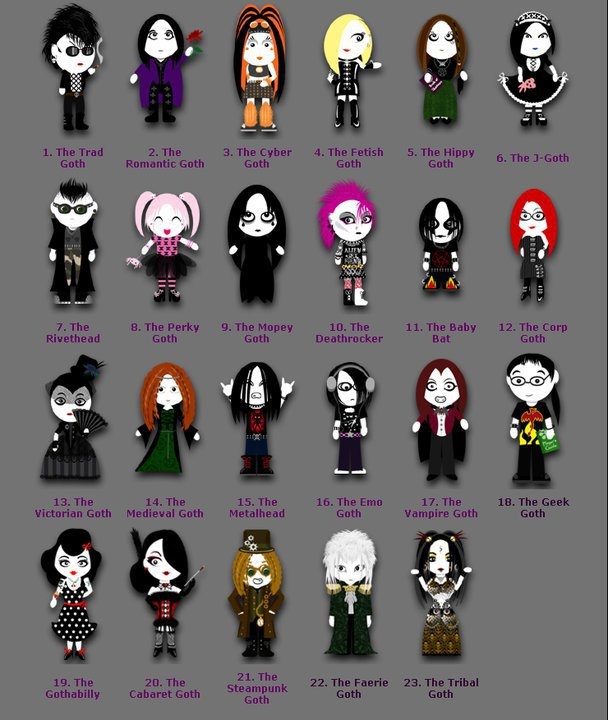
When it comes to Goth, you have subgroups within the subgroup, each quite distinctive in and of itself, something like this:
People outside the goth subculture see mostly black clothing, mostly black or “colorful” hair, pallid complexions and think “they all look alike” because that’s as far as their perception goes. The substantial differences, sufficient to actually create subcultures within the subculture, are ignored because that’s as far as perception goes.
What makes that happen, to another extent is another feature of human beings. Humans are tribal. They have always been tribal. Tribes could consist of those living in a particular area but need not be so. So strong is the drive toward tribalism that the wonder of Western society is not the remnants that remain (various ways people identify and divide as “our people” and “those others”) but to the extent that we’ve managed to overcome it–we, at least, are able to recognize people not of our tribe as still being people. That, in itself, is a pretty major advance over much of history and nearly all of prehistory.
Part of being tribal is that members of a tribe tend to “mark” themselves in various ways–clothing, hairstyles, jewelry, even body modification of various forms. Goths are no different. The start of goth subculture wasn’t in fashion itself but in the music. Groups attracted to various bands in the post-punk era–Bauhaus, Joy Division, Souxie and the Banshees, etc.–were the folk who became the founders of the goth movement. It was these fans of the music, adapting certain styles of dress, makeup, and hair that formed the origin of “goth fashion”. That fashion was specifically used to set them off from others. They were, in effect, forming a “tribe” and the fashion was, in effect, a tribal marker.
To be a tribal marker, however, it must be both distinctive and sufficiently consistent to be recognizable as indicating “tribe.” Those very features, that make it adequate to the purposes of marking tribe are also going to render it so that to those outside the tribe who have little familiarity with the tribe, will think “they all look alike.” Because to those people they do “all look alike.” The “tribal markers” overwhelm perception in the individual perceptions.
A further complication is among newcomers to the tribe. Historically it has generally been rare, although not unheard of, for members of one tribe to join another. You were, back then, born into a tribe and absent unusual circumstances, in that tribe you died. In modern Western society, tribal mobility is more common.. In the modern day in particular, it is fairly common for young people to explore different tribes to see which suits them and which they are better suited for. Their elders tend to refer to these explorations as “phases” with the expectation that they will settle down into the parent tribe in time. And sometimes that happens. And sometimes it doesn’t. In either case, when the young person (and sometimes older person–I was rather late coming to the goth/metal “tribe”) they generally adopt the “tribal markers”, often in the most archetypical form. They do this because they, too, don’t have much experience with the new tribe. They start with no more than an outsider’s experience and, so, they grab onto the most obvious, most distinctive elements. They become the very stereotype that the outsiders have of the tribe.
There is nothing wrong with this. It is an important stepping stone, the transition from outside to inside, from curiosity to understanding. It may be that a particular individual will never progress beyond that basic tribal marking. They may decide that the particular tribe isn’t for them and move on to something else. That, too, is okay. Or they may find the home, “their people”, that they had been looking for. In the latter case, they will gain the experience and understanding to allow them to move past the most basic tribal markings. They can go beyond that to more self-expression.
Since a large part of finding a good tribal fit is in identifying who you are and who “your people” are, it becomes natural to blend tribal markers with self expression. The tribal markers become a part of ones self. Or rather, you discover how the tribal markers fit the self you’ve always been. And the result is that you become a distinct “you” even within the tribal markers.
And folk on the outside will still say “you people all look alike.”
So I’m in ice skating class. I’m doing forward swizzles. Instructor says that I need to bend my knees more. I bend my knees more. “No, more then that, bend them as much as you can.”
So I start doing more knee bending and it’s going pretty well for one, two, three swizzles. Then something happens. I’m not sure what but I fall. Wouldn’t have been bad except somehow the blade catches on the ice–probably in a groove left by previous skating–at just such an angle that my foot is essentially locked in place and as my weight comes down it twists my leg. I feel pain in both my knee and my ankle.
Instructor comes over to see if I’m okay. Mostly, but I am definitely done for the day. So, I get up. Knee feels okay, but ankle is sore. There’s only a few minutes left in class but I skate, gingerly to the exit, grab my skate bag, and sit on the bench waiting for the class to finish. I remove the skate from my left ankle (the uninjured one), but leave it on the right to keep some compression and support on the ankle.
Once class is over, my daughter still has the learn to play hockey class. I ask my instructor if I can have some ice. Yes, they’ve got a whole rink full but it’s not in a form I can use. And while I’m snarking here, my instructor did not. While waiting to see what she comes up with I switch from my skate to my shoe on the right foot.
The vending/snack bar is closed but they have ice and I get ice on my ankle while my daughter continues her second class.
After the class, we have several stops to make before we’re done for the day. Food first (it’s been a while; we’re both hungry.) Then shopping, mostly for groceries. Injury or no, we’ve got to eat.
Once I get home and get my shoes and socks off, I find that there is some swelling of the right ankle. Not much but some. I take an epsom salts bath because I’m also starting to feel some muscle aches up through the leg. Nothing in the knee, so I lucked out there. I know from past experience that knee injuries really suck.
I wrap an Ace bandage, one of the ones which sticks to itself so it doesn’t need to be tied, taped or otherwise fastened. I have, however, found that this style works a bit better if you tuck the free end under to finish. It lasts longer that way before it starts to unwind. Eventually, I go to bed.
Unfortunately, I wound it a bit too tight and wake up with pain in the ankle from the squeezing. I adjust the bandage and we’re good to go on that but then I find I can’t get back to sleep.
So here I am, writing this up and getting it into the queue to post in its turn.
All told, the ankle’s not too bad. Range of motion is reduced and it doesn’t like to be tugged on (like when pulling my socks off). All told, it could have been worse.
And so, yeah, injuries suck. But, on the other hand, if I’m going to continue learning, I’m going to have to push past previous limits. And that means I’m going to take falls and spills. And that means I’m going to have the occasional injury. They are part of the process of learning.
In one of the “Goth” groups over on the Book of Faces someone posted a “meme” about feeling more confident when dressed “Goth”, that the clothes were their armor.
I find that a very good description actually.
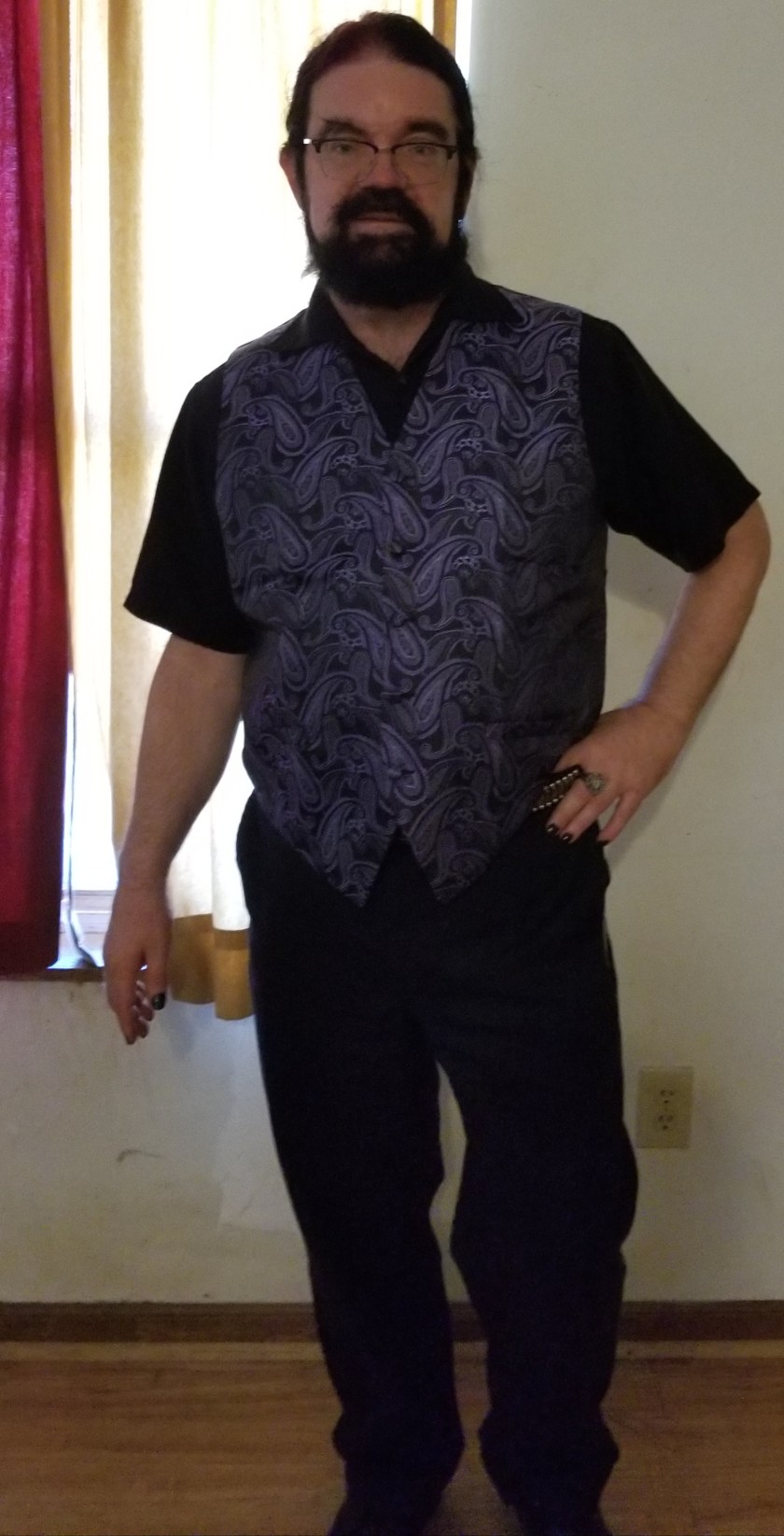
While I have mostly dressed very basically–black t-shirt, black pants or jeans, black or purple nail polish–of late I have started to “dress up” more. At first I had dressier outfits to wear for “special occasions” and kind of lamented the fact that I didn’t have a good excuse to wear them. Then I came to a realization: I didn’t need a special occasion. I could wear them just because I wanted to wear them. I didn’t have to dress for anybody else–especially not for strangers at a club or other public gathering. I could “dress up” simply to please myself.
And once I started doing that, I found something remarkable. Oh, sure, I’ve talked about my issues with social interaction in the past, that I don’t get social cues, that I get tongue tied (possibly related–I don’t know what to say because I don’t understand the cues to know what “type” of conversation we’re having), and as a result I have major, major social anxiety. Well, not entirely as a result. I think those things feed into each other.
That said, when I dress up, I find that the anxiety level goes way down. Sure, I still don’t get social cues. I still get tongue tied. I’m still extremely introverted. But those things create less stress. Being around other people uses fewer “spoons”. The fancier dark “gothy” clothes really are a form of “armor”, shielding me from those intangible stresses
When I dress up, I am simply happier and more comfortable in my own skin, in my own clothes, in my own dark armor.
They say it’s a poor carpenter who blames his tools, but sometimes the tools matter.
I was having a particular difficulty with some of my techniques in my last class, particularly the “backward swizzle”. Instead of the edge catching in the ice and pushing me backward like it was supposed to:
What I was getting was the blade skittering a bit across the ice. So, after class I asked the instructor if maybe the blades were in need of sharpening. He checked and they were fine in that respect, but there was another problem.
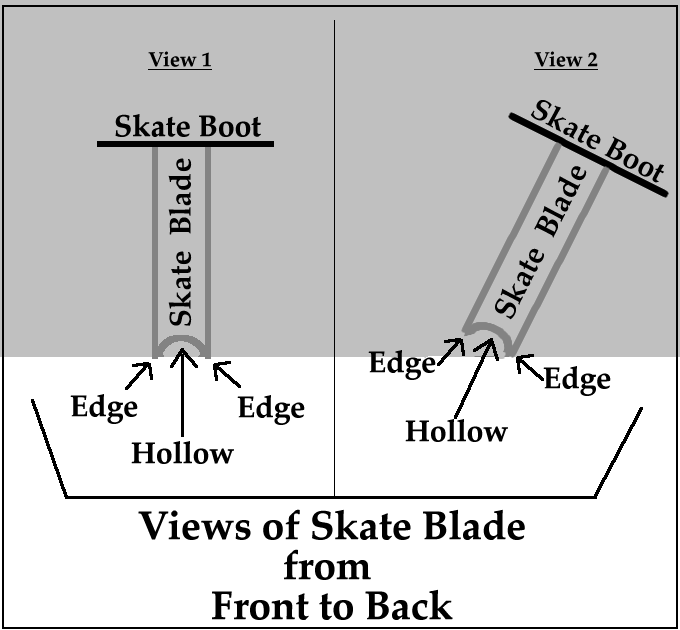
Figure skating blades have a curvature front to back. This is part of what allows turning on the ice. The blades have two edges with a hollow between them:
When the blades are straight up and down, you go straight forward or backward. When you tilt the blade to one side of the other, the front to back curve guides the skate around in a curved path.
In hockey blades, the curvature is symmetrical front to back, but in figure blades it changes along the length of the blade. You have a sharper curve near the front (called the “rocker”) a less sharp curve near the middle, and flattening out somewhat at the rear. Here’s an example from a well established competition blade the “Phantom”:
The folk who sharpened my skates did them more like a hockey blade so that I’m not getting the tightening up of the curve at the front of the blade. Now, this wasn’t causing my particular problem, the one that was causing the blade to skitter in the swizzles (probably not catching the ice at the right angle, or the right part of the blade), but might well be responsible for some of the other difficulties I have been having.
My instructor suggested I talk to one of the other instructors–the one that was his coach–who can see about getting the blade sharpened to the proper profile.
As I’m learning, there’s a lot more involved in this than one might think.
Recently, in the wake of several high-profile shooting murders, Texas Representative Dan Crenshaw came out suggesting the passage of TAPS legislation. Well, I’m not in a position to discuss TAPS knowledgeably at this time. However, Mr. Crenshaw went beyond that. He also advocated “Red Flag laws”, the common term for “Extreme Risk Protective Orders.”
The solutions aren’t obvious, even if we pretend they are. But we must try. Let’s start with the TAPS Act. Maybe also implement state “red flag” laws, or gun violence restraining orders. Stop them before they can hurt someone.https://t.co/2G2pZSWaF1
I have, of course, made my displeasure on the subject of Red Flag laws known previously on this blog. It was utterly dismaying to see such endorsement. Furthermore, when called on it he offered an explanation where he claimed there were “good” and “bad” red flag laws and he would only support the “good” ones. Just trust him.
It’s clear that there has been some confusion about what conservatives would support when it comes to laws that try to better protect our communities. Let’s address this directly. Watch. pic.twitter.com/TRYjPIclEm
I’ll be blunt, there is no such thing as a good “red flag” law. Nothing that goes by the name cannot be a blatant violation of the 2nd Amendment (RKBA), the 4th (Unreasonable search and seizure), and the 5th (due process). If you limit it sufficiently not to be a violation of those things, one wonders what you have that isn’t already covered by various psych-hold laws. Almost all states already have such laws. Whether they use them or not is a separate question, but in cases where they were not (like, for instance, in the lead up to the Parkland school shooting), why give them more power when they’re not using the power they already have?
But what really dismayed me is the number of people, supposedly of conservative to libertarian mindset, who were willing to give him a pass on it apparently because he’s “their guy.”
The thing with apologists for folk with an “R” after their name. I am reminded of Milton Friedman’s statement on how you change things. It’s not by electing the right people (although that’s nice when you can). It’s by making it politically profitable for the wrong people to do the right things.
But for it to be politically profitable for them to do the right things, it must be politically _un_profitable to do the wrong things. If you cannot even raise loud objections when a politician of “your side” is doing the wrong thing what possible incentive for that politician, or any other, to do the _right_ thing?
You can love Crenshaw (or whoever) on ninety-nine out of a hundred points, but if you don’t make your displeasure heard loudly about that hundredth one then you are making yourself heard–and what you’re saying is that the politician need not care about that issue.
I don’t care who the politician is or how much you love them overall. When they do something with which you disagree don’t sugar coat it. Make your displeasure known in no uncertain terms. And make sure they know that the issue _will_ be one you are considering come the next election.
Make them aware what really is “politically profitable” for them, and what is not.



 The Writer in Black