Political Truth

One of the key elements of totalitarian, or even just authoritarian, regimes is the concept of “political truth”.  This, basically, is something that must be true because the tenets of the ideology demand that it be true.

In Marxism, a political truth is the exploitation of the working class under capitalism.  It’s simply assumed true and any arguments otherwise–argument about the value those who provide capital bring to an enterprise, the concept of risk and compensation to induce people to take that risk, and so on–are weasel worded around or simply dismissed.

Another example in the American Left which simply declares that any difference in outcomes between different groups that can be defined in terms of various physical characteristics–melanin content, shape of facial features, hair texture, possession of reproductive organs, how they choose to pair said reproductive organs with others, etc.–must be, can only be, because of discrimination by other groups (well, actually there’s only one group that is ever called to task for this).  If one suggests that cultural factors that form self-propagating learned behaviors might actually be part the differences, well, that too is part of the discrimination don’t you know.  And don’t you dare suggest something as “racist” as assimilation into cultures that produce more desired outcomes.

And, yes, there’s the other side where such differences are taken as stemming completely from genetic differences.  To them, the claim is that such differences mark the inherent “superiority” or “inferiority” of one group compared to another.  Suggest to these folk that maybe the differences are learned–culturally or otherwise–and you’re just…well, the names can get creative.

One thing all these various forms of “political truth” have in common is a deep and abiding avoidance of objectively verifiable reality.  Oh, sure, they may cherry pick a few “facts” that appear to support their ideology, but anything beyond that, anything that challenges their cherished tenets, is anathema.

And the main tool that all of these have in common–every single one–is to attack the motive of the person presenting the uncomfortable facts.

“You know, maybe the learned behaviors in that subculture are suboptimal for success in modern American society and…” THAT’s RACIST!

“You know, if folk had just had a better environment at home and in their communities there’d be a lot less…” YOU X LOVER!

“You know, if you simply let people make the voluntary economic transactions across the board that they choose to make, the net result is prosperity across the board.” YOU FASCIST! (Which is a very strange accusation to make to that claim but…it is a claim made.)

“You know, there are some situations involving things like external benefits and costs which voluntary exchange, the market, does not handle well, so perhaps…” YOU COMMIE!

None of these actually address the issue at hand in each case.  They attack the motive, and therefore the character, of the person raising the point.  They are classic example of “Argument ad hominem” “argument to the man” where one accepts or rejects an argument not because of its logic or factual support but because of who makes it.  And it’s a logical fallacy for a reason.  Good people can make bad arguments and have erroneous conclusions.  And bad people can make good arguments leading to correct conclusions.

For that matter, a bad argument might still have a correct conclusion and a good argument might still lead to an incorrect conclusion (chiefly because some unknown factor might affect the result).

When people make arguments that a particular statement is some form of “ist” (or the closely related “phobic”), watch out.  You’re usually running into somebody’s political truth.  And that political truth, stemming from cherished ideology, will not stand contradiction.

And if they can’t dismiss your facts, they’ll simply dismiss you.

The Role of Government

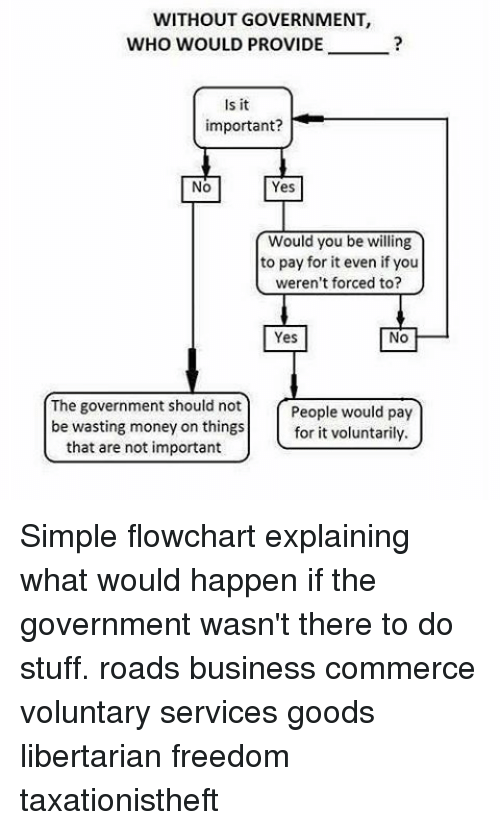
Some folk at the extreme end of the Libertarian spectrum insist that government is bad, pure and simple, that anything, absolutely anything, government can do that’s the least bit beneficial, private voluntary transactions can do better.  Here’s an example of the thinking:

without-government-who-would-provide-is-it-important-no-yes-17945559

This position, however, drastically oversimplifies the matter.  It works well when the people who receive benefits and pay costs are direct parties to a transaction.  However, that’s not always the case.  People outside the transaction are sometimes also involved–the transaction between two individuals can involve things that impose a cost on others, or produce benefit beyond the folk engaged in the transaction.  In either case, they distort the cost of the transaction.  Milton Friedman called these “neighborhood effects”.  Thomas Sowell and others more recently use the terms “External costs” and “External benefits.”

A classic example is a business dumping waste into a stream or river.  On the one hand, there is no such thing as “pure water” in nature.  Even “unspoiled” rivers high in the mountains contain the waste of the deer and bear that live there.  It’s all about the amount.  “The poison” as they say “is in the dose.” “More pure” has a value to it, just as other things we desire have values to them.  And just like with those other things we value, we would be willing to part with some of it for something else we value sufficiently.

If there were just two people involved, a stream that ran only from the dumper to the dumpee, they could come to a mutual arrangement.  The dumper would be allowed to dump X amount of waste in return for giving the dumpee Y to compensate for the reduced purity of the water.

The problem is we don’t have only two.  When one party dumps into a stream it affects the water purity for everyone downstream.  It becomes difficult to determine who is affected how much and to arrange individual transactions to compensate for the lost value for each affected individual.  When you have multiple parties doing the dumping as well as multiple parties downstream and parties on both the receiving and the delivering end of the dumping it becomes simply impossible.

In addition to external costs, there can also be external benefits.  Thomas Sowell uses the example of mud flaps on cars.  By reducing the “spray” from a car’s tires onto vehicles following them those other vehicles have the benefit of improved visibility.  They can see better because they are not getting as much rain, snow, and mud thrown onto their windshields.  However, each driver receives no benefit from mud flaps on his own vehicle, only a benefit from the mud flaps on the vehicle ahead.

Another example of an external benefit is education.  I benefit from other people being well educated, whether it is the surgeon who removes my malfunctioning gall bladder or the engineer who designed the brakes on the car I drive.  There are endless benefits I receive that are hard to track down to the specific parties to the transaction.  Yes, the specific surgery or the specific car purchase is an individual voluntary transaction, well handled by the market (albeit the former distorted by both regulation and insurance systems), the education of doctors and engineers, let alone the foundational education before they even sort into doctors, engineers, scientists, teachers, lawyers, and so on is much less so.

The case of externals costs/benefits is a situation which “the market”, the system of voluntary transactions, does not handle well.

Another class of situations that presents a particularly difficult challenge to a system of strictly voluntary transactions is when the benefits are to a group and cannot be divided out to particular individuals.  National defense is the classic example here.  Everyone in a society can agree that defending that society from foreign aggression has value but everyone gets that value regardless of whether they, in particular, pay for it.  The incentive, then is for each individual to rely on others to pay for the defense while they individually reap the reward while paying nothing.  Not everybody will take such a cynical approach.  Some will pay because they recognize that someone must and, thus, it is their duty to do so.  But those duty-driven individuals will pay more because others, not so driven, will take the benefit without making the voluntary (remember, we are talking about a system of voluntary exchanges here).

So, it soon becomes apparent that some means needs to be put into place to deal with external costs and benefits and non-divisible benefits.  Since this won’t be strictly voluntary transactions it will, by definition, be some form of government.

The problem is that just because in some circumstances government can handle a matter better than can the market, does not mean that it will handle it better.  Once the government program is in place, its own constraints and incentives will take over.  The iron law of bureaucracy will soon come into play and the various government organizations will soon become more interested in expanding their own power and influence and less over the problem they were created to deal with.

However well intentioned any government program for dealing with external costs/benefits or indivisible benefits, the programs will grow and expand to the point where the costs exceed the benefits.  Thus, while the elimination of government entirely is feasible, the default should always be toward pruning.  And when looking at the supposed benefits of a government program one needs to be highly cognizant of the fact that the costs very often exceed the benefits (meaning the resources being spent could be better spent elesewhere) or that in most cases the market, voluntary transactions between individuals and self-organized groups of individuals, really does handle things better.

Some more musings on memories.

A friend of mine posted over on the Book of Faces a few days ago (remember, I’m queuing these up in advance) about serving as a chaparone on an LDS Youth Conference.  These are events held by the church for young people that include lectures, scriptural devotionals, dances and other activities. It reminded me that the first dance I ever attended was at one of those youth conferences. The band was…truly awful. Extremely limited repertoire which included maybe three “slow dance” songs.

And this dance then set the pattern for every such event I attended ever since–in terms of my personal issues, not the music–most events I attended had much better music at least’

A couple of years later, when I was in Phoenix a dance held by the local church ward (it would be some years yet before I drifted away from the church) had a band that was at least somewhat better than that first one but they really, really needed a sound engineer. Vocals would get swamped by the instruments. Drums would overpower guitar (or vice versa). Somebody who could sit at the mixer board and adjust the various levels as needed for particular songs would have really put some professionalism into their performance. Setting it once at the start of the performance just didn’t work, and I’m not sure if they even knew how to set it in the first place.

I wonder, sometimes, if things might have gone differently had I approached them about that idea and offered to work in that capacity.

There’s a bit of a story behind that trip to Phoenix. A friend of mine’s family had moved out to Phoenix the year before and I had saved up money from a summer job (my first) to go visit. Since I had turned 18 the year before, I derived the cunning plan of trying to find a job in Phoenix and stay there–get out of the backwoods of Cambridge Ohio (which, really was the ass end of nowhere so far as I was concerned). I got myself enrolled in the local high school for my senior year: Thunderbird High School to be exact. I had lodging that was willing to put me up for a while while I was looking for work. In the end, however, I wasn’t able to find work that fit with a school schedule and had to return to Ohio. In the interim, my mother had moved from Cambridge to Byesville. If I had thought Cambridge was the ass end of nowhere, I was to be proven oh, so wrong. I ended up graduating not from Cambridge High School but from Meadowbrook High School.

At least I was able to find work after graduating–mid-shift dishwashing at a restaurant that was only about a two mile walk from where we lived.  And when I was rejected by the college to which I applied (yeah, stupid to apply to only one college–I applied to Brigham Young University and was not expecting the local Branch President, the local religious leader, to veto my application on the grounds that I was then wearing my hair a bit longer than BYU’s dress code permitted) going into the military was my next best choice.

Social Interactions

When it comes to personal interactions I tend to have two main modes and a couple of lesser modes.

deer-in-the-headlights

One I term “deer in the headlights.” Basically, I have no idea what to say. I freeze. It’s not just a matter of I need a second to think, I really just have no clue what words should come out of my mouth. I have had folk tell me that this comes off as brusque or downright rude. And, well, I’m not intending to be it’s just that a combination of social anxiety and utter cluelessness causes me to freeze. You can be my best friend in the world and I still have no idea what to say.

The second mode is when you get me going on a subject I’m passionate about. Then, the problem is the exact opposite; getting me to shut up. I get motivated about the topic and…well, that just takes over.

There are a couple of lesser modes for special situations as well.

The first of these is “polite greeting.” “Hi.” “How are you.” “Nice day.” “Things going well?” “Take care. Have a nice day.” Basically “canned” phrases (which doesn’t mean that they aren’t well meant) that I have sometimes heard described as “polite noises.” I can do that. I can even be sincere about it. It’s just, you run out of those pretty quickly.

The last is “on stage presence” which is what I use when doing panels at cons or when doing training related to my work. (Want to learn how to use a NanoScope AFM? We teach people that.) It’s sort of a toned-down version of mode 2 that relies on the more formal structure of a panel discussion or a training session to keep me from going overboard as I am wont to do without that structure.

“Stage Presence” mode is something I learned from a very early age.  I was raised in a church with a “lay clergy” in which members of the congregation were expected to get up and give “talks” (what served as “sermons” in this church) or to teach various Sunday School classes.  I learned early on to put on an appropriate “mask” for this, and it carried over nicely once I started participating in programming at science fiction conventions.

The observant reader will note that what’s lacking in there is a “mode” that is useful for social interactions, in particular for meeting new people. It is no great surprise that virtually all of my friends are folk I’ve met through cons and thus were able to interact with initially via “on stage presence”. Online also comes closer to that “on stage” than any in person interactions and, so is behind most of the rest of my friends–those I didn’t meet through cons I “met” online. Indeed, I tend to be a lot more “open” online than I’d ever dream of being face to face with all but my absolutely closest friends.

And this lack is one of the major challenges of my life: how to actually meet and get to know people in “meat space” beyond the rote (although never empty, not for me) pleasantries.

Getting Sentimental 2, Another Musical Interlude

Many years ago, in Jerry Pournelle’s novel “Janissaries” he had the character of Gwen think that love didn’t exist.  All the poems and such about it were probably written by people who thought such feelings ought to exist but they hadn’t really hadn’t really experienced it.

In darker moments (which came quite frequently back in the day), long before I’d read that book I would say “Love isn’t real.  It’s just something invented so that Belinda Carlisle would have something to sing about.”

(Given the subject and tone of the song this video is a bit…strange)

Feeding the Active Writer, Another Chicken Mole.

I’ve been trying different recipes for Chicken Mole over time. This one seems to have turned out really well.
2 lb boneless skinless chicken breast
3 Tbsp xantham gum
2 24 oz jars Kroger brand Medium Salsa.
1 16 oz jar Mrs. Renfro’s Habanero Salsa.
1 quart chicken broth.
2 tbsp garlic powder.
1 cup olive oil (optional–I wanted to increase the fat content to make it a more keto-friendly dish).
1/4 cup unsweetened cocoa powder
2 oz unsweetened bakers chocolate.
I would probably have just used more cocoa powder but I ran out so I used what I had.
Put the chicken in a 5 quart slow cooker Sprinkle the xantham gum over it. Add the remaining ingredients.
Cook on low for about 8 hours. Stir. The chicken should break up into small pieces. Any pieces that don’t, shred with two forks.
Makes about 15 1 cup servings (so, party or to nosh on over a week or so).
I’ve served it over riced cauliflower, mixed “non-starchy” vegetables, or just eaten it like a stew. If you’re not doing low carb then over rice or noodles would also be good.

Anti-vaxers vs math, Part 2.

Short one today.  Short, but important.

In a previous post I pointed out how ridiculous the idea that the money people behind “big pharma” were pushing vaccines, not because it was medically a good idea but simply to make money.  (Spoiler alert:  There’s a lot more money in treating even “harmless childhood diseases” like measles compared to preventing them with vaccines.)

The other point that is claimed is that the vaccines themselves cause injury and are more dangerous than “acquiring immunity naturally” (which is weasel wording for “getting the disease”).  And one of the things they like to point to is the Vaccine Injury Court and all the awards it’s granted.  There, proof positive that vaccines are dangers and so you should avoid them.

Well, not so fast.  First off, there’s very little actual science in this Vaccine Injury Court.  As ZDogg (a practicing physician with popular YouTube and Facebook feeds) points out, you don’t need to prove beyond a reasonable doubt like in a criminal trial.  You don’t even need a preponderance of evidence like in a civil court.  All you need is to spin a story that’s reasonably plausible to people who only have a layman’s knowledge (i.e. none to speak of) of immunology and biochemistry.

But let’s take the strongest possible argument.  Let’s presume that every case where an award was granted really was because of vaccines.  In the thirty years between 1988 and 2018 20,728 petitions were filed with the vaccine injury court.  Of these, 6,579 were determined to be compensable, i.e. that presented a case that sounded good to folk essentially ignorant on the subject.

6,579 over 30 years, or an average of 219 per year.  In my previous post I noted that, before vaccination, the number of deaths from measles alone averaged about 450 per year.

Without vaccines, more than twice as many died from a single “harmless childhood disease” than all the compensable injuries (even at that very low standard of evidence) from vaccines–even if the compensable claims all, every single one, represented real injuries from vaccines instead of “just so stories”–combined.

Vaccinate your kids, people.

On This Day, 50 years ago today

Fifty years ago I watched men from planet Earth first set foot on the moon.  I never dreamed that 3 1/2 years later I would watch the last (for my lifetime most likely).  The great disappointment of the Apollo program is that we didn’t go anywhere with it.

In any case, here’s a transcript of the communications of the Eagle’s terminal approach and landing:


Communicators in the text may be identified according to the following list.

Spacecraft:
CDR  Commander  Neil A. Armstrong
CMP  Command module pilot   Michael Collins
LMP  Lunar module pilot  Edwin E. ALdrin, Jr.
SC  Unidentifiable crewmember
MS  Multiple (simultaneous) speakers
LCC  Launch Control Center
Mission Control Center:
CC  Capsule Communicator (CAP COMM)
F  Flight Director

Remote Sites:
CT Communications Technician (COMM TECH)
Recovery Forces:
HORNET   USS Hornet
R  Recovery helicopter
AB  Air Boss

A series of three dots (…) is used to designate those portions of the communications that could not be transcribed because of garbling. One dash (-) is used to indicate a speaker’s pause or a self-interruption and subsequent completion of a thought. Two dashes (- -) are used to indicate an interruption by another speaker or a point at which a recording was terminated abruptly.


04 06 28 51 CC
Eagle, Houston. We read you now. You’re GO for PDI. Over.

04 06 28 57 LMP (EAGLE)
Roger. Understand. AELD control circuit breakers. DECA GIMBAL AC – closed?

04 06 29 07 CDR (EAGLE)
What?

(GOSS NET 1) Tape 66/4 Page 309

04 06 29 08 LMP (EAGLE)
DECA GIMBAL AC – closed? Circuit breaker? COMMAND OVERRIDE – off? GIMBAL ENABLE? RATE SCALE – 25.

04 06 29 23 CC
Eagle, Houston. Your alignment is GO on the AGS. On my Mark, 3 30 until ignition.

04 06 29 29 LMP (EAGLE)
Roger.

04 06 29 33 CC
Mark.

04 06 29 34 CC
3 30 until ignition.

04 06 29 38 LMP (EAGLE)
Roger. Copy. Thrust translation – four jets – Balance couple – ON. TTCA throttle – MINIMUM. Throttle – AUTO CDR. Prop button – RESET. Prop button. Okay. ABORT/ABORT STAGE – RESET. ATT CONTROL – three of them to MODE CONTROL. 0kay, MODE CONTROL is set. AGS is reading 400 plus 1. Standing by for …

04 06 30 45 LMP (EAGLE)
Hit VERB 77?

04 06 31 04 LMP (EAGLE)
Okay. Sequence camera coming on.

04 06 31 32 CC
Eagle, Houston. If you’d like to try high gain, pitch 212, yaw 37. Over.

04 06 31 45 LMP (EAGLE)
Roger. I think I’ve got you on high gain now.

04 06 31 49 CC
Roger.

04 06 32 03 LMP (EAGLE)
Say again the angles, though.

04 06 32 05 CC
Roger.

04 06 32 06 LMP (EAGLE)
I’ll set them in to use them before we yaw around.

04 06 32 08 CC
Roger. Pitch 212, yaw plus 37.

04 06 32 24 LMP (EAGLE)
OMNI’s in.

04 06 33 09 LMP (EAGLE)
… 10 … 10 percent …

(GOSS NET 1) Tape 66/5 Page 310

04 06 33 41 CC
Columbia, Houston. We’ve lost them. Tell them to go aft OMNI. Over.

04 06 33 51 CMP (COLUMBIA)
They’ve lost you. Use the OMNI’s again.

04 06 34 01 LMP (EAGLE)

04 06 34 05 CMP (COLUMBIA)
Say again, Neil?

04 06 34 07 LMP (EAGLE)
I’ll leave it in SLEW. Relay to us. See if they have got me now. I’ve got good signal strength in SLEW.

04 06 34 13 CMP (COLUMBIA)
Okay. You should have him now, Houston.

04 06 34 16 CC
Eagle, we’ve got you now. It’s looking good. Over.

04 06 34 23 CC
Eagle – –

04 06 34 24 LMP (EAGLE)
– – descent looks good.

04 06 34 25 CC
Eagle, Houston. Everything is looking good here. Over.

04 06 34 29 LMP (EAGLE)
Roger. Copy.

04 06 34 34 CC
Eagle, Houston. After yaw around, angles: S band pitch, minus 9, yaw plus 18.

04 06 34 46 LMP (EAGLE)
Copy.

04 06 34 59 LMP (EAGLE)
AGS and PNGS agree very closely.

04 06 35 01 CC
Roger.

04 06 35 14 LMP (EAGLE)
Beta ARM. Altitudes are a little high.

04 06 35 45 LMP (EAGLE)
Houston. I’m getting a little fluctuation in the AC voltage now.

04 06 35 51 CC
Roger.

04 06 35 52 LMP (EAGLE)
Could be our meter, maybe, huh?

(GOSS NET 1) Tape 66/6 Page 311

04 06 35 54 LMP (EAGLE)
Stand by, Looking good to us. You’re still looking good at 3, coming up 3 minutes.

04 06 36 13 LMP (EAGLE)
… real good …. about on.

04 06 36 18 CDR (EAGLE)
Our. position checks downrange show us to be a little long.

04 06 36 21 CC
Roger. Copy.

04 06 36 24 LMP (EAGLE)
AGS has gone about 2 feet per second greater …

04 06 36 36 CDR (EAGLE)
… ought to be … Stand by.,

04 06 36 43 LMP (EAGLE)
Altitude …

04 06 37 00 LMP (EAGLE)
… it’s going to stop.

04 06 37 18 CC
Eagle, Houston. You are GO to continue – –

04 06 37 19 LMP (EAGLE)
… closed … GO … at 4 minutes.

04 06 37 22 CC
Roger. You are GO – You are GO to continue powered descent. You are GO to continue powered des cent.

04 06 37 30 LMP (EAGLE)
Roger.

04 06 37 35 CC
And, Eagle, Houston. We’ve got data dropout. You’re still looking good.

04 06 38 04 LMP (EAGLE)
… PGNS. We got good lock-on. Altitude lights OUT. DELTA-H is minus 2 900.

04 06 38 18 CC
Roger. We copy.

04 06 38 20 LMP (EAGLE)
Got the Earth right out our front window.

04 06 38 23 CDR (EAGLE)
Houston, you’re looking at our DELTA-H?

04 06 38 25 CC
That’s affirmative.

04 06 38 26 CDR (EAGLE)
PROGRAM ALARM.

(GOSS NET 1) Tape 66/7 Page 312

04 06 38 28 CC
It’s looking good to us. Over.

04 06 38 30 CDR (EAGLE)
It’s a 1202.

04 06 38 32 LMP (EAGLE)
1202.

04 06 38 48 CDR (EAGLE)
Give us a reading on the 1202 PROGRAM ALARM.

04 06 38 53 CC
Roger. We got – We’re GO on that alarm

04 06 38 59 CDR (EAGLE)
Roger. P30.

04 06 39 01 CC
6 plus 25, throttle down – –

04 06 39 02 LMP (EAGLE)
Looks like about 820 –

04 06 39 03 CC
– – 6 plus 25, throttle down.

04 06 39 06 CDR (EAGLE)
Roger. Copy. 6 plus 25.

04 06 39 14 LMP (EAGLE)
Same alarm, and it appears to come up when we have a 1668 up.

04 06 39 17 CC
Roger. Copy.

04 06 39 23 CC
Eagle, Houston. We’ll monitor your DELTA-H.

04 06 39 24 LMP (EAGLE)
… worked out beautifully.

04 06 39 28 CC
DELTA H – –

04 06 39 29 LMP (EAGLE)
… looks good now.

04 06 39 30 CC
Roger. DELTA H is looking good to us.

04 06 39 34 LMP (EAGLE)
Ah! Throttle down – –

04 06 39 35 CDR (EAGLE)
Throttle down on time!

04 06 39 36 CC
Roger, We copy throttle down – –

(GOSS NET 1) Tape 66/8 Page 313

04 06 39 37 LMP (EAGLE)
– – … throttles down. Better than the simulator.

04 06 39 42 CC
Roger.

04 06 39 48 LMP (EAGLE)
AGS and PGNS look real close.

04 06 40 08 CC
At 7 minutes, you’re looking great to us, Eagle.

04 06 40 13 LMP (EAGLE)
Okay. I’m still on SLEW so we may tend to lose as we gradually pitch over. Let me try AUTO again now and see what happens.

04 06 40 21 CC
Roger.

04 06 40 23 LMP (EAGLE)
Okay. Looks like it’s holding.

04 06 40 24 CC
Roger. We got good data.

04 06 40 49 CC
Eagle, Houston. It’s descent 2 fuel to MONITOR. Over.

04 06 40 55 CDR (EAGLE)
Going to 2.

04 06 41 01 LMP (EAGLE)
Give us an estimated switchover time please, Houston.

04 06 41 05 CC
Roger. Stand by. You’re looking great at 8 minutes.

04 06 41 10 LMP (EAGLE)
At 7000 –

04 06 41 12 CC
Eagle, you’ve got 30 seconds to P64.

04 06 41 15 LMP (EAGLE)
… Roger.

04 06 41 27 CC
Eagle, Houston. Coming up 8 30; you’re looking great.

04 06 41 35 LMP (EAGLE)
P64.

04 06 41 37 CC
We copy.

04 06 41 51 CC
Eagle, you’re looking great. Coming up 9 minutes.

(GOSS NET 1) Tape 66/9 Page 314

04 06 42 05 CDR (EAGLE)
Manual attitude control is good.

04 06 42 08 CC
Roger. Copy.

04 06 42 10 CC
Eagle, Houston. You’re GO for landing. Over.

04 06 42 17 LMP (EAGLE)
Roger. Understand. GO for landing. 3000 feet. PROGRAM ALARM.

04 06 42 19 CC
Copy.

04 06 42 22 LMP (EAGLE)
1201

04 06 42 24 CDR (EAGLE)
1201.

04 06 42 25 CC
Roger. 1201 alarm. We’re GO. Same type. We’re GO.

04 06 42 31 LMP (EAGLE)
2000 feet. 2000 feet. Into the AGS, 47 degrees.

04 06 42 35 CC
Roger.

04 06 42 36 LMP (EAGLE)
47 degrees.

04 06 42 41 CC
Eagle, looking great. You’re GO.

04 06 42 58 CC
Roger. 1202. We copy it.

04 06 43 01 LMP (EAGLE)
35 degrees. 35 degrees. 750. Coming down to 23.

04 06 43 07 LMP (EAGLE)
700 feet, 21 down, 33 degrees.

04 06 43 11 LMP (EAGLE)
600 feet, down at 19.

04 06 43 15 LMP (EAGLE)
540 feet, down at – 30. Down at 15.

04 06 43 26 LMP (EAGLE)
At 400 feet, down at 9.

04 06 43 29 LMP (EAGLE)
… forward.

(GOSS NET 1) Tape 66/10 Page 315

04 06 43 32 LMP (EAGLE)
350 feet, down at 4.

04 06 43 35 LMP (EAGLE)
30, … one-half down.

04 06 43 42 LMP (EAGLE)
We’re pegged on horizontal velocity.

04 06 43 46 LMP (EAGLE)
300 feet, down 3 1/2, 47 forward.

04 06 43 51 LMP (EAGLE)
… up.

04 06 43 52 LMP (EAGLE)
On 1 a minute, 1 1/2 down.

04 06 43 57 CDR (EAGLE)
70.

04 06 44 04 LMP (EAGLE)
Watch your shadow out there.

04 06 44 07 LMP (EAGLE)
50, down at 2 1/2, 19 forward.

04 06 44 13 LMP (EAGLE)
Altitude-velocity light.

04 06 44 16 LMP (EAGLE)
3 1/2 down, 220 feet, 13 forward.

04 06 44 23 LMP (EAGLE)
11 forward. Coming down nicely.

04 06 44 24 LMP (EAGLE)
200 feet, 4 1/2 down.

04 06 44 26 LMP (EAGLE)
5 1/2 down.

04 06 44 31 LMP (EAGLE)
160, 6 – 6 1/2 down.

04 06 44 33 LMP (EAGLE)
5 1/2 down, 9 forward. That’s good.

04 06 44 40 LMP (EAGLE)
120 feet.

(GOSS NET 1) Tape 66/11 Page 316

04 06 44 45 LMP (EAGLE)
100 feet, 3 1/2 down, 9 forward. Five percent.

04 06 44 51 LMP (EAGLE)

04 06 44 54 LMP (EAGLE)
Okay. 75 feet. There’s looking good. Down a half, 6 forward.

04 06 45 02 CC
60 seconds.

04 06 45 04 LMP (EAGLE)
Lights on. …

04 06 45 08 LMP (EAGLE)
Down 2 1/2. Forward. Forward. Good.

04 06 45 17 LMP (EAGLE)
40 feet, down 2 1/2. Kicking up some dust.

04 06 45 21 LMP (EAGLE)
30 feet, 2 1/2 down. Faint shadow.

04 06 45 25 LMP (EAGLE)
4 forward. 4 forward. Drifting to the right a little. Okay. Down a half.

04 06 45 31 CC
30 seconds.

04 06 45 32 CDR (EAGLE)
Forward drift?

04 06 45 33 LMP (EAGLE)
Yes.

04 06 45 34 LMP (EAGLE)
Okay.

04 06 45 40 LMP (EAGLE)
CONTACT LIGHT.

04 06 45 43 LMP (EAGLE)
Okay. ENGINE STOP.

04 06 45 45 LMP (EAGLE)
ACA – out of DETENT.

04 06 45 46 CDR (EAGLE)
Out of DETENT.

04 06 45 47 LMP (EAGLE)
MODE CONTROL – both AUTO. DESCENT ENGINE COMMAND OVERRIDE – OFF. ENGINE ARM – OFF.

(GOSS NET 1) Tape 66/12 Page 317

04 06 45 52 LMP (EAGLE)
413 is in.

04 06 45 57 CC
We copy you down, Eagle.

04 06 45 59 CDR (TRANQ)
Houston, Tranquility Base here.

04 06 46 04 CDR (TRANQ)
THE EAGLE HAS LANDED.

04 06 46 06 CC
Roger, Tranquility. We copy you on the ground. You got a bunch of guys about to turn blue. We’re breathing again. Thanks a lot.


HERE MEN FROM THE PLANET EARTH
FIRST SET FOOT UPON THE MOON
JULY 1969 AD
WE CAME IN PEACE FOR ALL MANKIND


The New Philosopher Kings

A double dozen centuries ago (about 380 BC) Plato wrote a treatise called “The Republic.” The system of government described bore essentially none of the characteristics that would come to define what anyone else ever called a Republic.  The Roman Republic bore far more resemblance to what the Founding Fathers of the US called a Republic than anything Plato wrote about.

Plato’s Republic was a sort of totalitarian “meritocracy.” The people who were best at farming were assigned to be farmers.  Those best at war were assigned to the army.  And so on.  And at the top of it all, the Philosopher Kings, who decided who would be farmers (because, of course, the Philosopher Kings–the central planners of the Republic–knew who would be best at farming).  They decided who would be soldiers (because the central planners knew best).  They decided who would do every task.  And all would work not for their own benefit but for the greater good of the whole.

If this sounds familiar, it’s because it is.  Marxism (as it’s come to be known, which Thomas Sowell notes is somewhat different from what Marx actually wrote) or “Socialism” in the modern day.  A centrally planned economy (and “economy” ends up functionally meaning “everything you do”) organized not for individual benefit and certainly not for the “greed” of those engaged in business but for the “greater good” of society.

This social vision is portrayed as “progressive”.  It’s supposed to be new and forward thinking.  And yet, it’s simply the writings of a 19th century philosopher that have failed every time anyone has actually attempted (or claimed to attempt) to put them into practice.  Lenin’s “reinterpretation” a century ago was the only “advancement” of those particular ideas that have happened since (not counting the endless ways of repackaging the same ideas, wrapped in new rhetoric, to disguise the long series of failures) and that a century ago.

“Progressive” has somehow come to mean the regurgitation of a century or more old set of ideas that have failed every time anyone has tried to sell them to the masses.

Every.  Single.  Time.

But it’s actually worse than that.  Marxism, as reinterpreted by Lenin, is nothing more than the concept of the Philosopher Kings wrapped in new rhetoric.  It’s the divine right of kings with proper socialist thought replacing bloodlines.  The inbreeding is intellectual rather than genetic, but just as deadly as any hemophiliac princes.  More, since while a hemophiliac prince might be in danger of bleeding to death, the inbred ideas of the “progressive elite” risk bleeding the whole society to death.

A double dozen centuries of tyranny and oppression for the people at large, for economic failure that spreads misery and poverty.

This is “progressive.”

More bad apples

Yes, I have talked about this recently but this one just disturbed me to no end.

iStock_91860253_SMALL.jpg

“One bad apple spoils the whole bunch.” If said bad apple is not immediately removed, the rot spreads.

That this psychopath could be acquitted in large part because the judge suppressed the body cam footage, suppressed introduction of his public statements where he looks forward to killing people, and suppressed introduction of his personalized weapon with “you’re fucked” on it demonstrates that the rot has already spread quite wide indeed. It’s not just the cops but judges and prosecutors who are complicit.

Add in that the whole purpose of the “simon says” they were forcing a man who had done nothing illegal to follow was to keep the suspect disoriented and confused (and thus prone to make mistakes) and then the police use a single mistake as a justification for killing him.  This demonstrates that the purpose of that procedure is, indeed, simply to give them an excuse to kill someone.  If you want someone to follow orders and comply, you give orders that are clear and easy to understand and follow.  If you want them to make mistakes, then you give confusing and contradictory orders.  And if the entirely predictable result of those orders is that they make a mistake in following them, and said mistake is justification for shooting them, well, that looks a lot like premeditation from over here.

Again, the rot has spread far and wide throughout the system.

And to cap it all off, he gets a pension for having PTSD from murdering a man? AYFSM?

It’s not “a few bad apples” (or not anymore). It’s a systemic problem.