

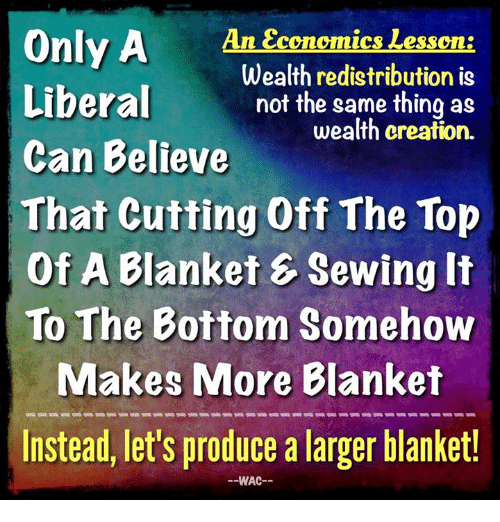
Over in another forum someone arguing for socialist policies (the explicit argument was for estate taxes) made the following argument (and thought it was a “mic drop” since a number of writers were on that forum): “I know a lot of very intelligent writers who have not been rewarded commensurate with either their talents or contributions” This is the tendency that Thomas Sowell points out frequently where when people talk about “worth” they talk about what they think, as third parties, not part of the transaction, think something should be “worth.”
Now, I am one of those writers and I would certainly like to make more money, but, well, read on…
The only people whose opinion on the “worth” of a transaction matters are those directly making the transaction. So long as the transaction is voluntary (no coercive force used) then the transaction will only take place if both gain more than they give by their own values. (And that’s the key…”by their own values”, not values someone else assigns for them.)
The Dell gaming laptop I’m typing this on? I bought it because the computer was worth more to me than the money I paid for it. Dell sold the computer to me because they valued my money (or more specifically what that money could buy) more than they did the computer. Someone outside might decide that the money I spent was worth more than the computer “should” be worth (by their values, which simply means they wouldn’t be willing to spend that much for it) and thus Dell “cheated” me.
But, the simple fact is, Dell (and it’s stockholders by extention) has lots and lots of money not because they “took” it from others but because they provided goods that people valued more than the money they paid Dell. Yes, Dell has a lot of money. But those people have goods and services that are worth more to them than the money was. People look at Dell and see “big corporation” with “lots of money” (and its stockholders as wealthy because of it). They don’t see the lots of people who in turn gained wealth (to the tune of a computer that was worth more to them than the money they paid for it) because they are spread out throughout the economy. One’s concentrated and thus easily visible. The other is diffuse, and thus not so visible. A classic example of Bastiat’s “Seen and unseen.”
Now, let me touch base a bit on the writing and “deserve”. It works the same way there. People buy my stories if they think they’ll get more value (in terms of the enjoyment they get from reading them) than is charged by the vendor. I tend to keep my prices low because I’m trying to build readership. But that “more value than the cost” thing has a couple of factors involved. First off there’s how well I’m able to convey the value they’ll get–the cover art, description (blurb), right choice of categories, and so forth that give people an idea of what kind of story it is. The other big factor is simply making people aware that the story exists, to get it in front of people who might then look at those initial bits (cover art, description, etc) and decide whether they want to part with some of their hard-earned money for the bit of entertainment I provide. And I’m not just competing with other science fiction and fantasy books, but with anything else that might provide some entertainment to the consumer. I’m competing with Amazon Instant Video rentals, with a six-pack of cheap beer (or maybe a couple of bottles of better beer), with a few minutes of Laser Tag, or with whatever else the person might spend that money on. I have to serve their needs better than whatever else they might do with that money instead. Somebody might think my writing is the best thing they’ve ever read. Drama, pathos, a truly satisfying conclusion, all wrapped around concepts that are worth pondering. (Or, maybe not.) But that they think that doesn’t impose a duty on others to think likewise and shower me with money (although if you’d like to do so, then, please. Can never have enough). No, that’s a decision each individual has to make. Is this item, right here, right now, worth to me what I’m being asked to pay for it? If and only if the answer is “yes” does the transaction happen.
My odds get better as more people become aware of my work, but in the end it remains a matter of do I please my potential customers? Neither more nor less.
That’s what happens when I, or anyone else, deals with a private business that doesn’t have coercive force a available to make me do business with them. Let’s look at what happens in the case of government.
When I deal with the government, well, what I “get” is, frankly, worth a lot less to me than the money I spend. Third parties, may try to explain why it “really is” “worth it” but they’re simply imposing their values on me. They act as if, and indeed seem to believe, that their values are somehow “better” and “more worthy” than mine.
Unlike dealing with Dell, I can’t simply say “no, that’s not worth it. I’m not buying.” If I tried, the government would use coercive force. I.e. the government would send Men with GunsTM to force me to pay or, in the extreme of non-compliance on my part, kill me.
So, I pay, even though I do not receive value for the money. Or, rather, the “value” I receive is not being imprisoned or killed.




 Some years back, I watched the deCappuccino version of The Man in the Iron Mask. The movie was okay, but one line caught me. It’s near the end, the second in command of the palace guard points to a dying d’Artagnon (it’s not a spoiler at this late date, is it?) and says, “All my life, all I wanted to be . . . was him.”
 The Writer in Black