Yes, He Really Said That (But I was Wrong).

There was a meme going around on the Book of Faces that quoted Gropey Joe Biden as saying that no ordinary American is concerned about their Constitutional Rights. I shared it because I remembered him saying it.

Well, what I “remembered” was apparently a Mandala effect issue because he actually said something different. (Thus the “But I was Wrong” in the title.)

The actual quote from the above video is:

“No law abiding citizen in the United States of America has any fear that their Constitutional Rights will be infringed in any way. None. Zero.”

Now, one can quibble whether the “no ordinary American is concerned about his Constitutional Rights” is a reasonable paraphrase or not, but the “fact” checkers (spin-doctors in reality) will be sure to mark it as “false” or “mostly false” because it’s not the direct, word-for-word, quote of what he said.

But let’s go with his actual quote, what he actually said, the “Yes, he really said that.”

“No law abiding citizen in the United States of America has any fear that their Constitutional Rights will be infringed in any way. None. Zero.”

I fear that my Constitutional Right will be and are being infringed.

  • Civil Asset Forfeiture could take my property without anything resembling due process. (Fifth Amendment)
  • Red Flag Laws can do the same. (Fifth Amendment)
  • Widespread government surveillance and electronic monitoring violates the right “to be secure in their persons, houses, papers, and effects, against unreasonable searches and seizures” (Fourth Amendment).
  • Platforms like Said Book of Faces, Twitter, et al are given government sanction to silence political voices without losing their Section 230 protections. And, for that matter, not being called on their monopoly status (companies have been found in violation of anti-trust laws for “controlling” far smaller fraction of the market than do these tech giants). The way laws are being ignored to give them a pass to censor certain political voices but not others makes them a defacto agent of the State, so, yes, they are infringing on First Amendment rights.
  • Oh, and they do want to take my guns.

So, yes, I fear that my Constitutional Rights will be and are being infringed. So, what does that mean in light of Biden’s statement?

  • Is he saying that I’m not law-abiding?
  • Is he saying that I’m not a citizen (perhaps losing my citizenship through wrongthink?)
  • Is he saying this is not the United States of America anymore?
  • Or is he simply calling me a liar for saying that I fear such things (even the ones that are actually happening)?

So which is it? Perhaps it’s “Law Abiding” that he disputes. I mean, I suppose that given the complexity, intrusiveness, and often self-contradictory nature of the law, the average American commits three felonies a day without even knowing it. In such case, well, I suppose that could make his statement true in the same way that “No invisible pink unicorns fear being hit by cars” because invisible pink unicorns don’t exist. If there are none, then they can’t fear anything, n’est pas?

Or maybe, he really does mean that this isn’t the United States of America any more? I mean, I read the Constitution and the Declaration of Independence and…sure the Declaration of Independence was a propaganda piece rather than a legal document but it does outline the philosophical basis of the new country they were forming, a nation unique, or nearly so, in being founded on and defined by a creed rather than anything else, and I look around and see how little of that creed remains in force in official circles (what remains is still well and away better than the rest of the world but that’s an observation on how bad the rest of the world is, not a contradiction to how far we’ve fallen). Perhaps he does mean that no law abiding citizen in the United States of America fears such things because there’s no longer a United States of America, in its original sense, for them to be in.

Or perhaps he just dismisses people like, well, me entirely. Perhaps we simply don’t matter to him. We aren’t fully human in his eyes because we hold the wrong opinions, we believe in the wrong things.

Perhaps the word he’s looking for to describe us is “Untermenschen.”

Home Defense Firearms: A Newly Relevant Blast from the Past.

Well, it’s started. The new administration (hack. spit) is calling for yet more “gun control”, leading the charge for an “assault weapon” ban, magazine size limits, universal background checks (which requires a complete gun registry to be enforceable), and so on.

Today I’m bringing forward a post addressing that so-called “assault weapon” issue. The definition of “assault weapon” is slippery. It mimics the term “assault rifle” but doesn’t meet the definition of one (an assault rifle is a rifle of intermediate power with “select fire”, meaning that it has a full-auto or “burst” capability–that is one trigger operation fires the rifle multiple times). Generally, “assault weapon is a semi-automatic (fires once for each trigger operation) rifle or carbine (overall length being the main difference there, or intermediate power (not the uber-high-power that the media would have you believe), and some various ergonomic and cosmetic features. It is this definition that I address in the post below.


When it comes to home defense, a strong argument can be made that the best, the absolute best, weapon for defense against a home invasion is a compact semi-automatic rifle with certain, particular features.

Despite what Hollywood would have you believe, criminals often continue to function after being shot, often after being shot several times. “The dead man’s ten seconds” is a phenomenon well and long known (the phrase comes from the Civil War). The criminal may be effectively dead from the first shot, but they still have the ability to do a great deal of harm before they’re stopped. Thus, it may take multiple shots to stop them. Maybe they’ll spend their entire “dead man’s ten seconds” staring down at the hole in their chest.  Maybe it’s easy for you to bet other people’s lives that that’s how it will go down but maybe instead they’ll use that ten seconds to hurt or kill the homeowner unless distracted by, oh, other holes being put in their body from repeat shots until they do stop.

We have repeated reports of people in military theaters shooting an individual multiple times and having them continue to fight.

And that’s not even counting that robberies are often committed by more than one person. Again, local news reports suggest that the majority of home invasions involve multiple attackers.

Now, maybe in the “average” it’s over after only a couple of shots. But one can drown in a stream that “averages” 6 inches deep if one happens to step in a hole that’s 8′ deep (the rest of the stream only being 4″ or so, so the “average” comes to 6″). But multiple attackers requiring multiple shots each to put down is one of the scenarios a “civilian” may face.

The person defending his home can’t wait until he’s got overwhelming force, SWAT, and backup before going in and engaging. They have to deal with the problem right. now. with only what they have ready to hand. Firing a shotgun twice into the air may or may not scare off attackers (or might not, despite what then Vice Presidential candidate Joe Biden advocated) and shooting through the door is generally a felony (again, despite Joe Biden’t advocation of that very thing).

In high stress and fear situations human beings have certain common issues. One is that fine motor skills go to hell. Simply working the action of a rifle or handgun can become a thing of fumbling when one is in fear for ones life (a necessary condition of use of lethal force in all jurisdictions in the US). Much better a simple action of “aim, pull trigger, aim, pull trigger”. Thus, semi-automatic. (Police and civilian firearms trainer and recognized expert witness on firearms matters discusses the effects of fear on ones shooting ability in his book Stressfire among others.)

When an attack comes, you can’t be sure that everyone in your household is all together. You may, for example, have to go get the kids. This doesn’t involve hunting the “bad guys.” I don’t recommend that at all. Get your family together and defend them if the bad guys come to you, but “get your family together” may require some moving around. Now, when you’re moving around, you may have to do things like open doors or work light switches. Or maybe (it’s dark, say, and this occurred after everyone was in bed) you need one hand free to hold a flashlight. Maybe you have a light mounted on your rifle but, well, you’re looking for your kids. It would be good to have a light you can shine on things without pointing your gun at them, don’t you think? (First rule of safe gun handling is treat any gun with the respect due a loaded gun but the second rule is “never point a gun at anything you’re not willing to destroy.” What that means regarding using a light mounted on your firearm to look for family members is left as an exercise for the student.) A “pistol grip” simply makes it easier to handle and keep control of the rifle in such circumstances. Also, a more “compact” design is easier to maneuver down hallways, through doors, and the like.

The attack happens at night? When you fire the muzzle flash blooms in front of you, temporarily blinding you. Who knows what can happen in the couple of seconds it takes your eyesight to recover? A flash suppressor/hider doesn’t actually suppress or hide the flash. It diverts it to the side where it interferes less with your vision allowing you to keep eyes on target allowing you to assess whether the attacker had been stopped or if you need to keep shooting, and if you do need to keep shooting you can aim rather than fire blindly (literally) and trust to luck.

A rifle is easier to aim accurately than any handgun. A centerfire rifle has more stopping power than any handgun.

Now, maybe you’re not the one available to grab the rifle.  Maybe it’s your wife (or husband if you’re a woman reading this–or whatever if you’re in a non-traditional relationship.  I won’t judge) who’s smaller than you (or larger).  Or maybe you sometimes use the rifle out in the cold while wearing heavy, thick clothing and sometimes when its warmer so you don’t have so much heavy clothes on.  A stock that can be adjusted for length helps size the rifle for easy, comfortable, accurate shooting.

Now note what I’ve just described: a compact rifle with a pistol grip, “large” capacity magazine (actually “standard” capacity since that’s what these rifles are designed for), flash hider, adjustable stock, and possibly a rail to which a light can be attached. While there’s no “shoulder thing that goes up” (Carolyn McCarthy can never be sufficiently mocked for that) what I’ve just described is an “assault weapon” per the media and folk like the Brady Campaign. (Not an “assault rifle” as defined by the military since that definition calls for fully automatic capability.)

It also happens to describe the best tool for defending your family against one of the between 4 and 40 thousand home invasions that occur every year.

How many of those 4 to 40 thousand families, many with children, are you willing to sacrifice?

My First Tattoo

For most of my life I never considered getting any tattoos. I was just not into doing permanent things that I might come to regret later and body ink was one of the things that fell into that category. However, when my daughter decided to start a career as a tattoo artist my position changed. After all, it’s one of the jobs of a father to support his daughter. It’s a rule.

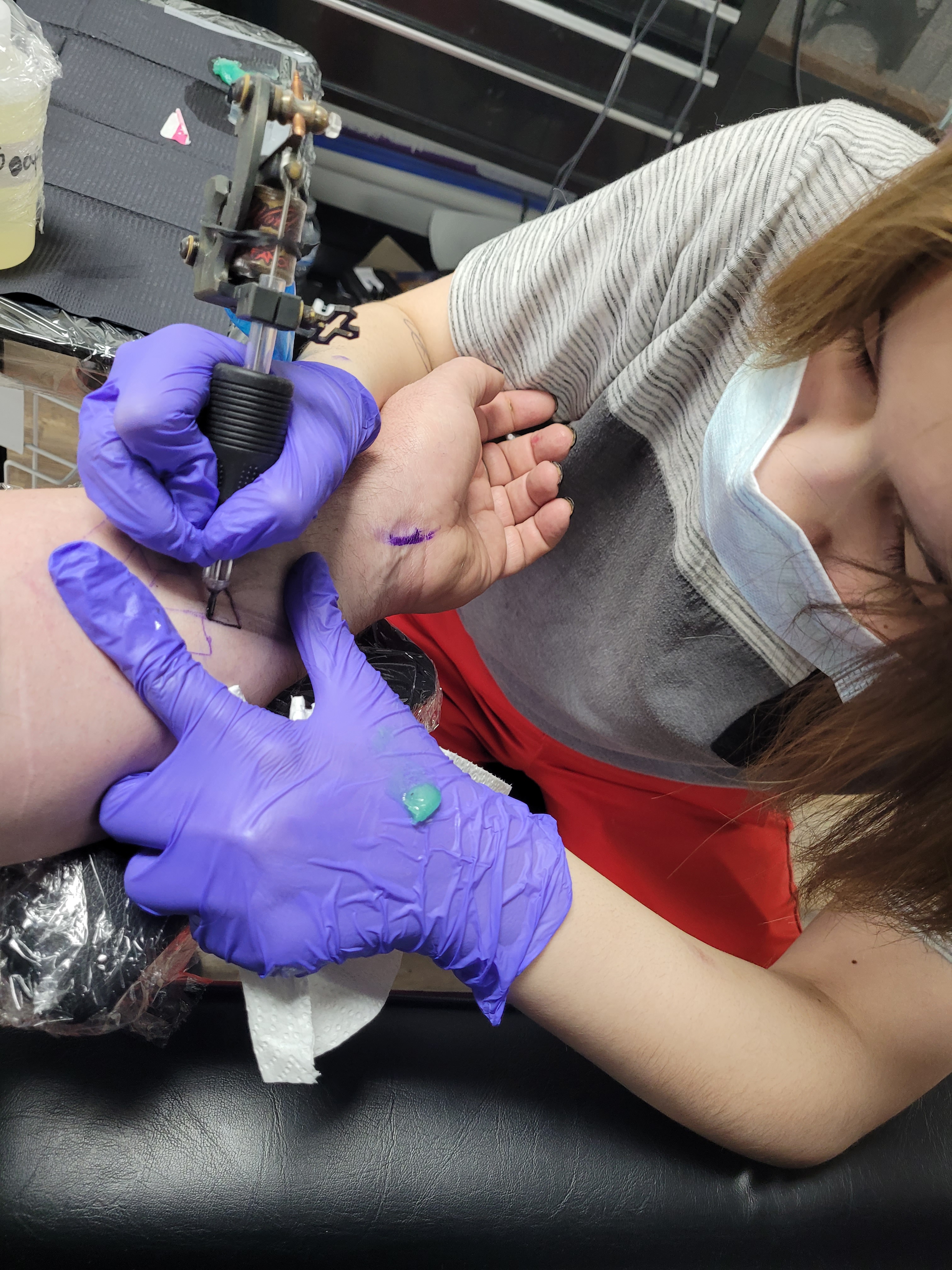
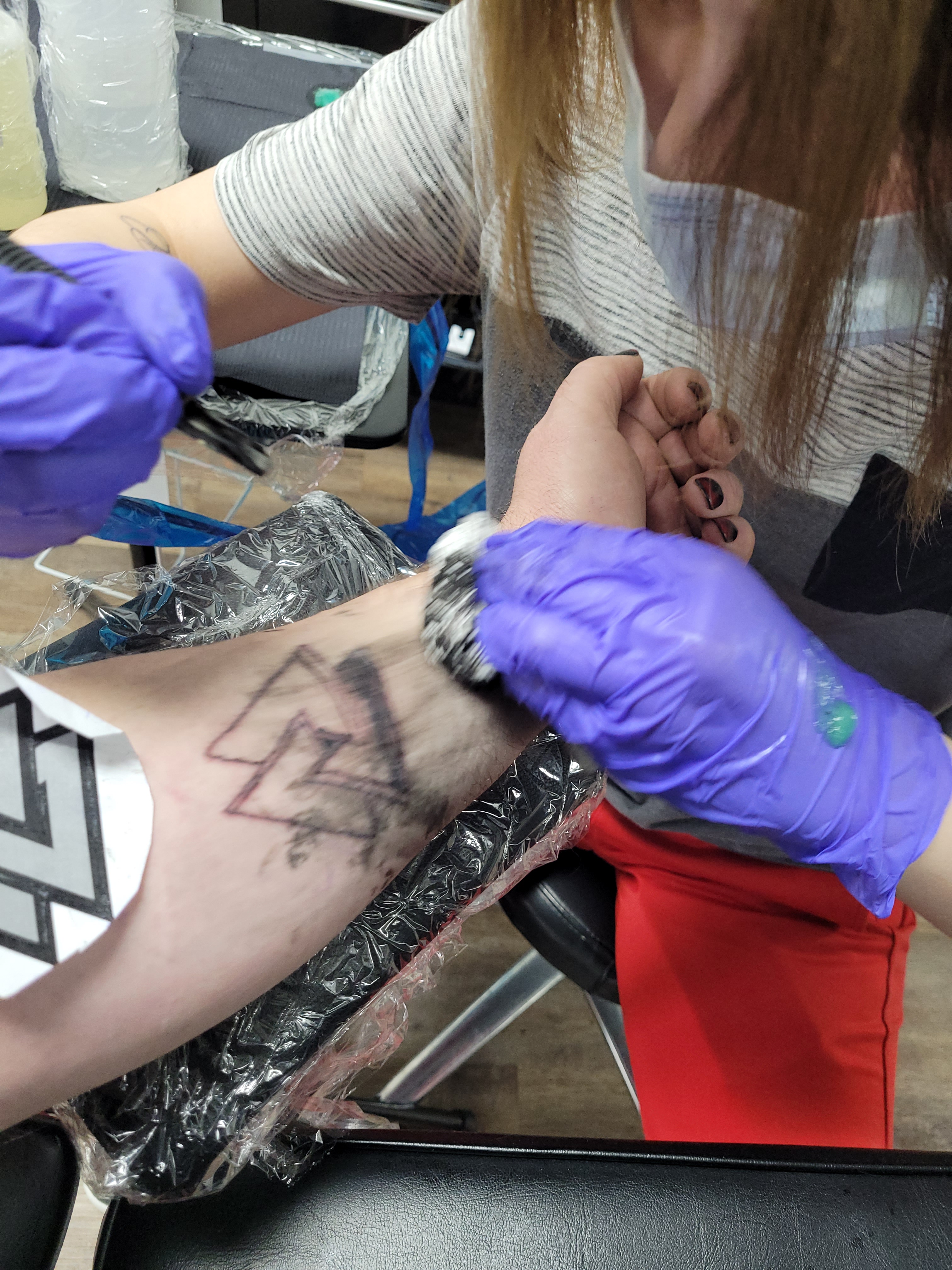
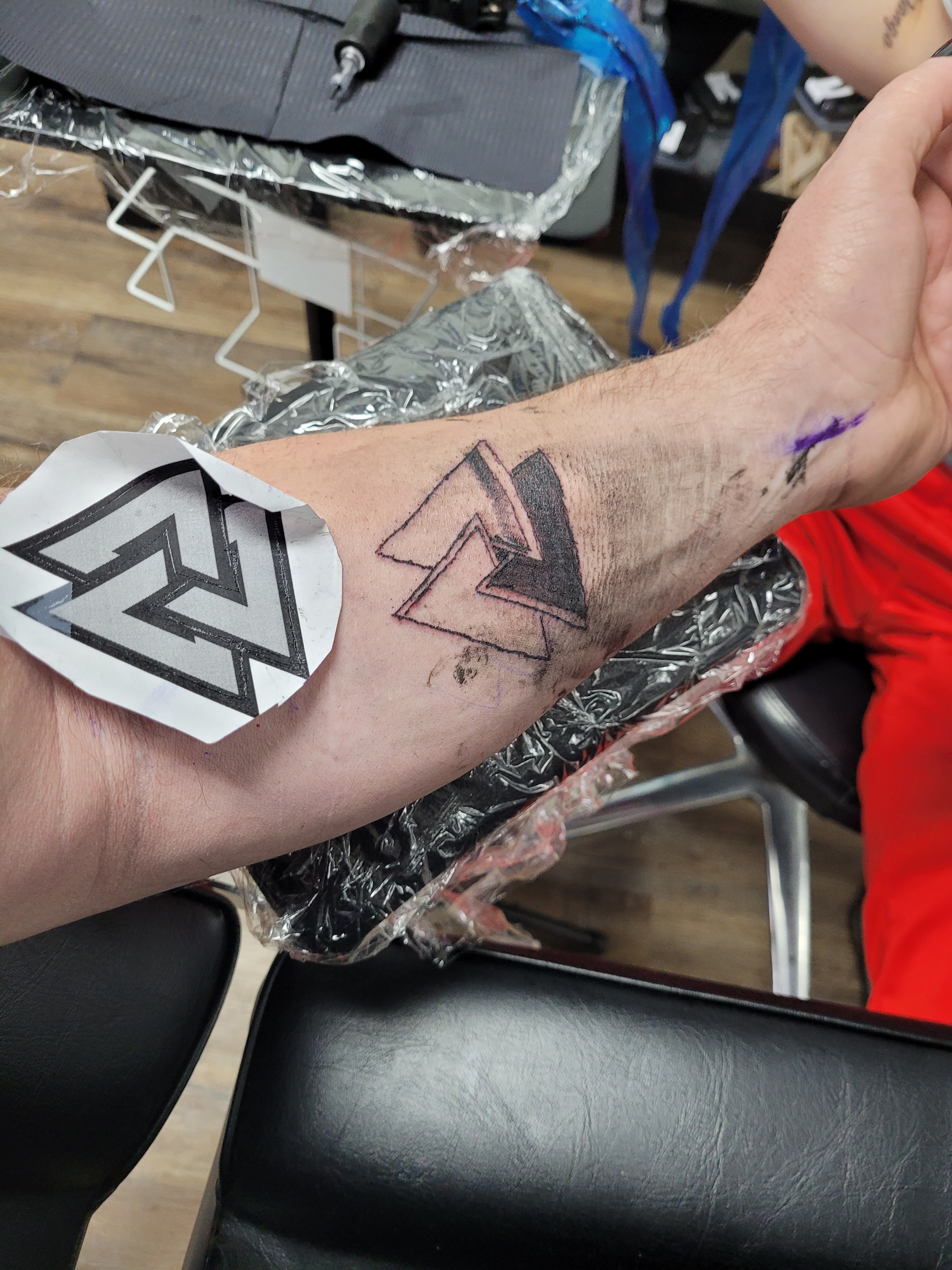
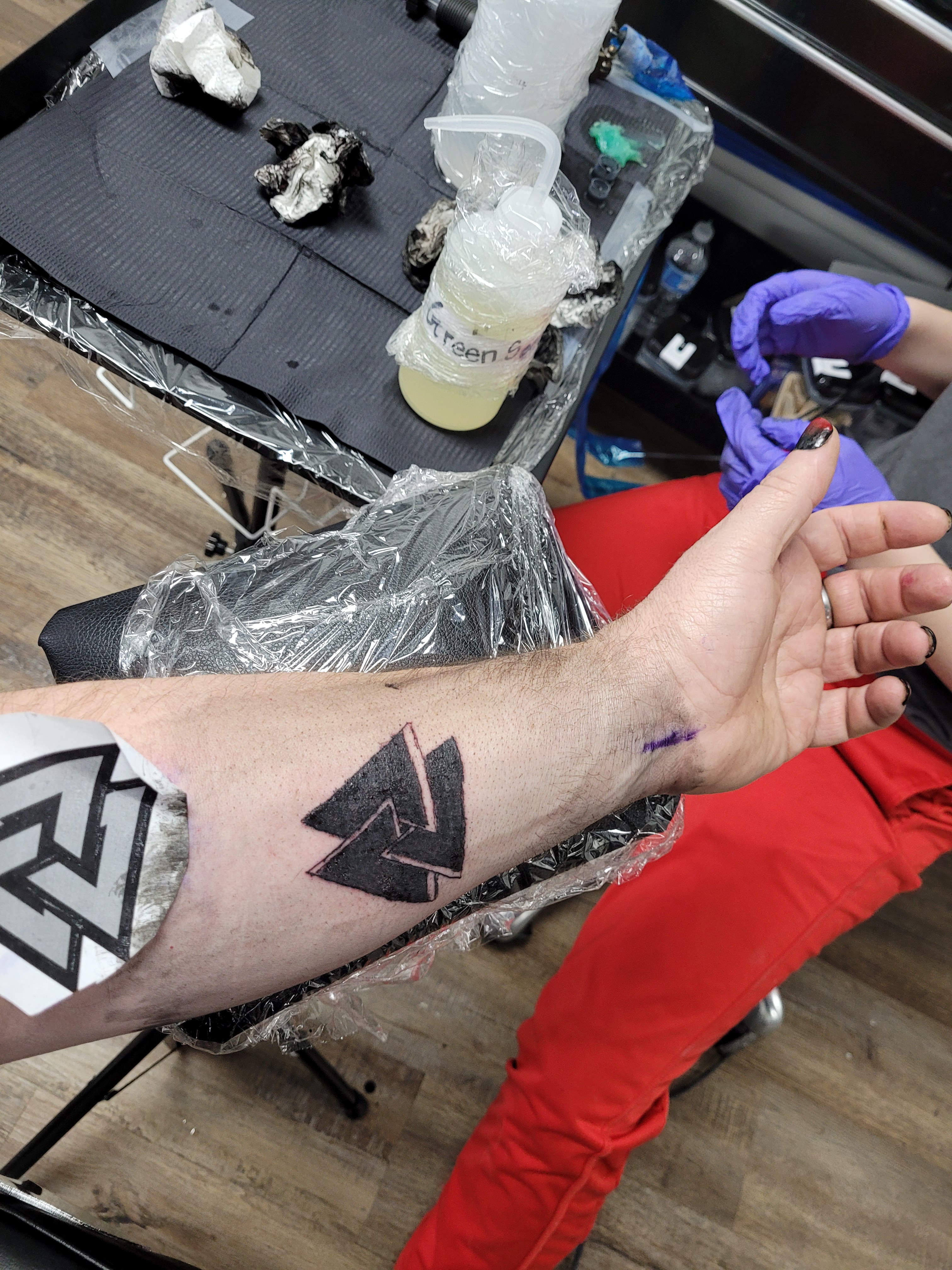
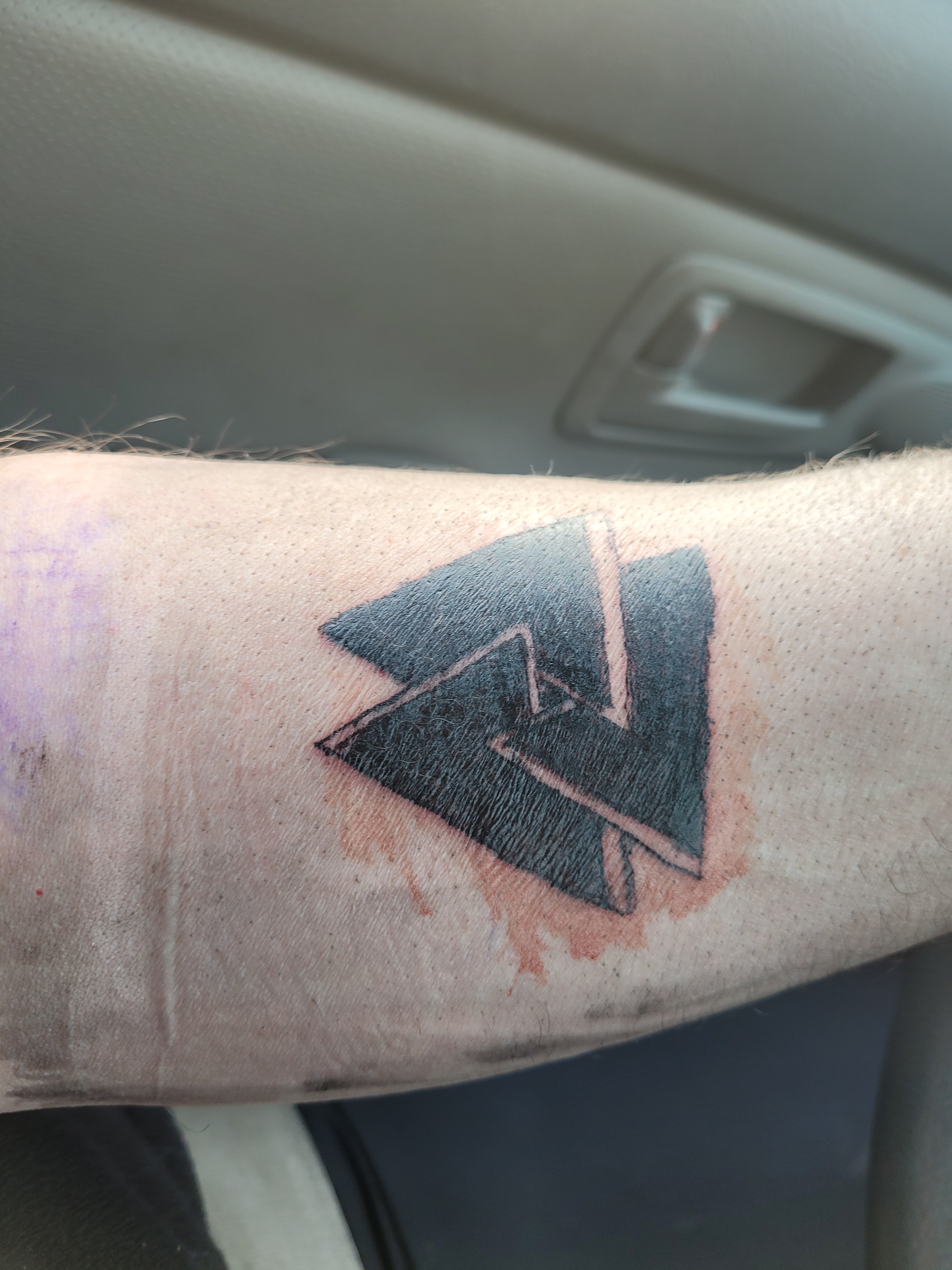
So I had my first tattoo. It’s a fairly simple and straightforward one, a Valknut done on my inner left forearm. In retrospect the inner forearm may not have been the best choice for a first tattoo. I suspect that area is more sensitive than some other areas would be. Still, I have plans for shoulder and back pieces once my daughter gets more experience. They’re a little more complicated and would involve color, which her mentor isn’t ready to try her with just yet.

So…pictures.

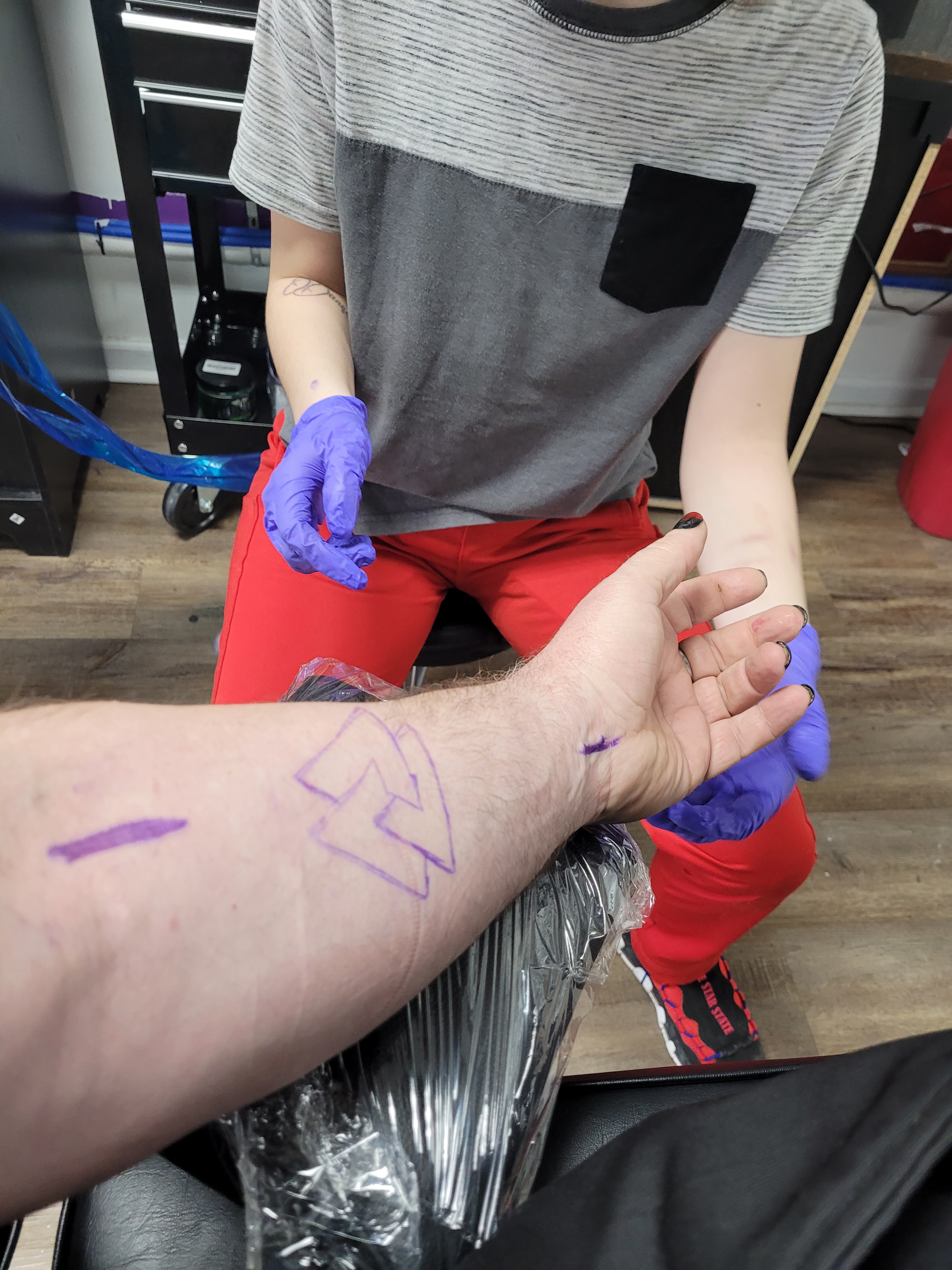
The stencil applied to my arm. The linedrawn at the elbow and wrist are guides to center the tattoo.
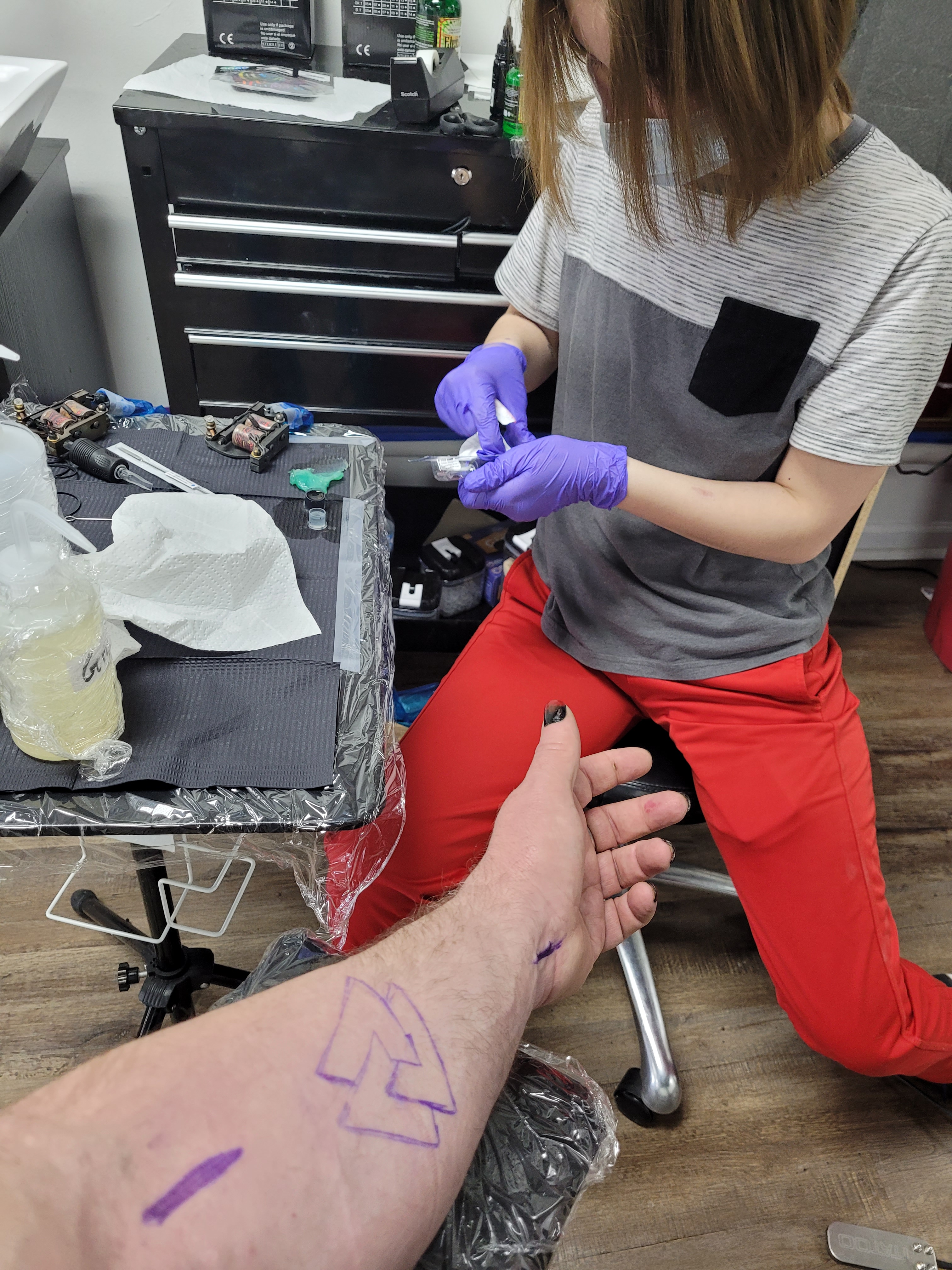
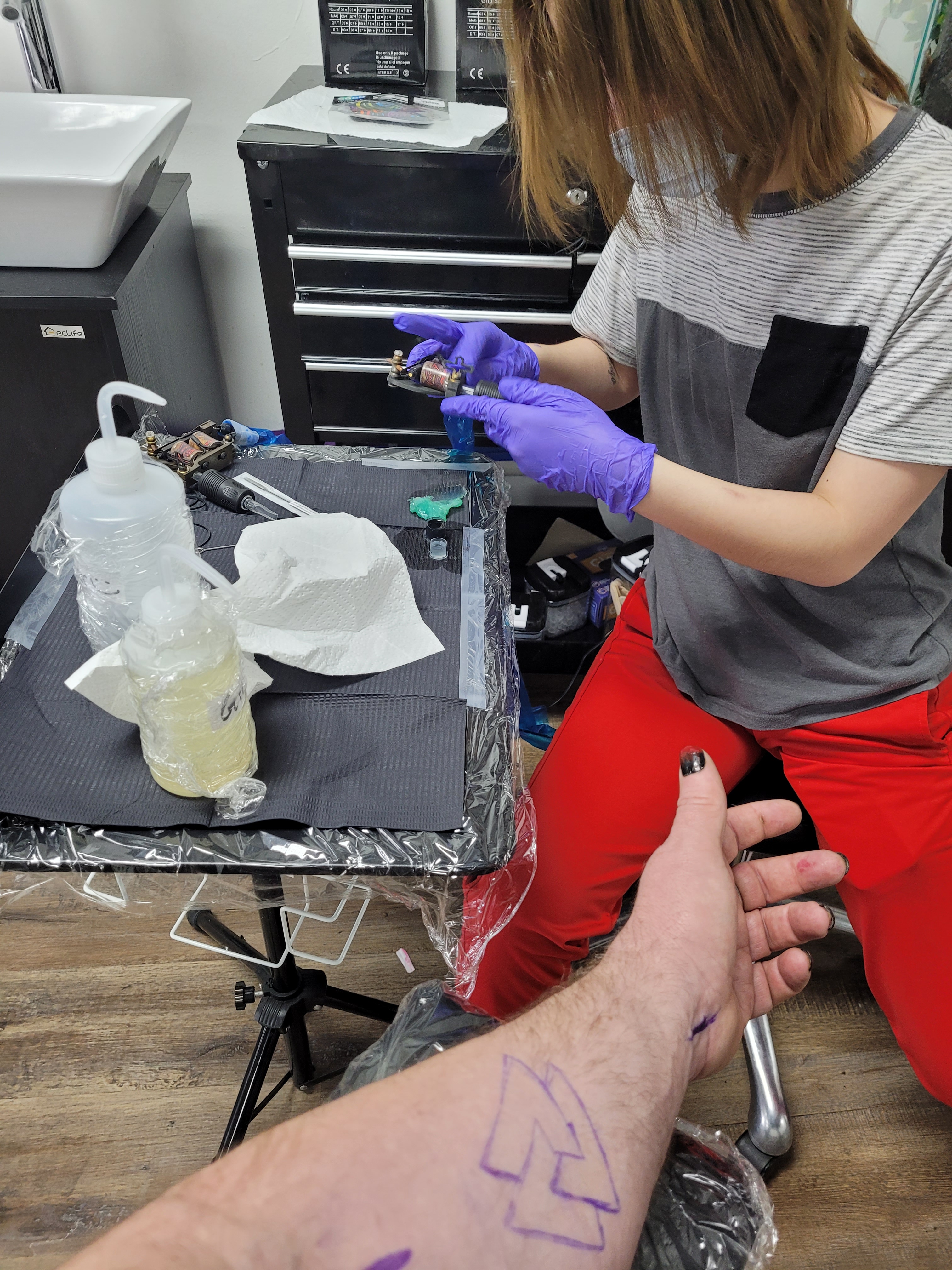
Setting up her equipment.
She’s got two machines, one a “liner” an one a “shader” used for filling in larger areas.
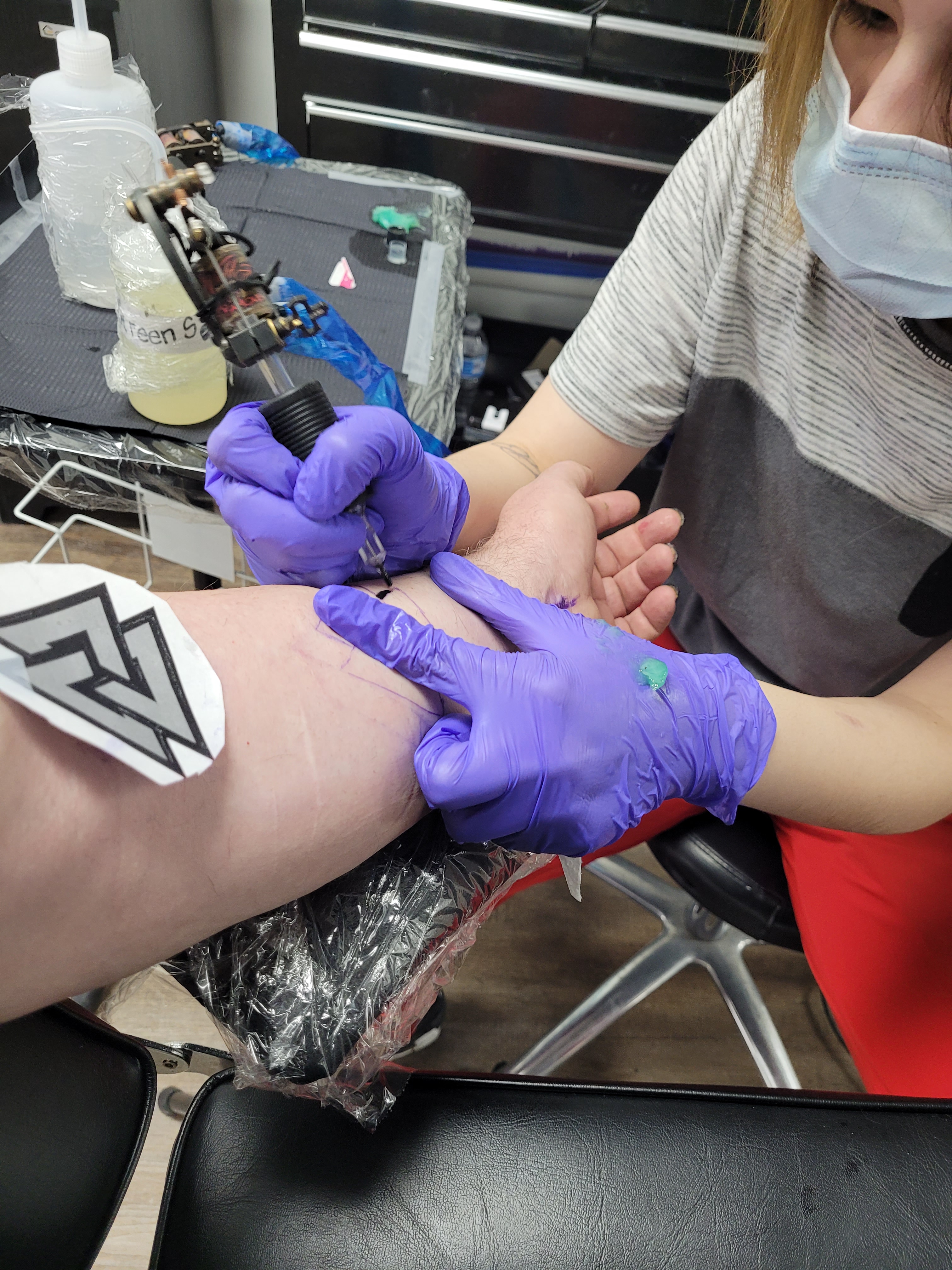
She’s beginning to work with the liner. Note the plastic wrapped over the arm rest. They are extremely careful about infection and cross-contamination here. i watched the preparations and they are very thorough.
Continuing on the line work.
Line work done, she starts working with the shader. The streaking is ink on the surface of the skin being wiped away.
Continuing the filling in. Somewhere around here she told me to relax my arm. Tensing up makes it hurt more.
Nearly done. There are a few touchups yet to be done.
The final result about a half hour after, once I’ve removed the wrap they put over it after it’s finished but before I ha a chance to wash the area. The red discoloration, I am told, is plasma leakage and normal at this stage. It washed away once I cleaned up the area according to the instructions given by the shop.

And that was my experience with my first tattoo. Yes, it hurt. They are, after all, stabbing you thousands of times with needles. However, it was far from unbearable. It stung a little bit for an hour or so afterward and now is only a little tender. I’m told that it will take about two weeks for the area to fully heal and they gave me care instructions to keep from damaging the area and protecting against infection.

Faith

The New Testament is big on the idea that a person is saved through “faith” rather than earning their way through “good works.” Pontius Pilate infamously asked, “what is truth” but turned away before the individual he was asking could answer. The question might also be asked “What is faith?”

Full disclosure: I am not a Christian. This, however, does not mean that there isn’t much within Christianity that is worth considering and implementing in ones own life just as there is in many another belief system (not all; I am not so foolish as to declare that all belief systems have their “good side”).

I submit that doing good simply because it is good is, in itself, an act of faith. Consider the exchange between Susan and Death at the end of Terry Pratchett’s book The Hogfather (a book I highly recommend):

Susan:
Now… tell me…

Death:
What would have happened if you hadn’t saved him?

Susan:
Yes.

Death:
The sun would not have risen.

Susan:
Then what would have happened?

Death:
A mere ball of flaming gas would have illuminated the world.

Susan:
All right, I’m not stupid. You’re saying that humans need fantasies to make life bearable.

Death:
No. Humans need fantasy to be human. To be the place where the falling angel meets the rising ape.

Susan:
With tooth fairies? Hogfathers?

Death:
Yes. As practice, you have to start out learning to believe the little lies.

Susan:
So we can believe the big ones?

Death:
Yes. Justice, mercy, duty. That sort of thing.

Susan:
They’re not the same at all!

Death:
You think so? Then take the universe and grind it down to the finest powder and sieve it through the finest sieve and THEN show me one atom of justice, one molecule of mercy. And yet… you try to act as if there is some ideal order in the world. As if there is some… some rightness in the universe by which it may be judged.

Susan:
But people have got to believe that, or what’s the point?

Death:
You need to believe in things that aren’t true. How else can they become?

When people do “good”, not for gain or to avoid loss–not because they will be rewarded for doing it or punished for not doing it–they are acting on the basis of their own belief. They are, in effect, exercising faith.

This is implicit in Jesus’ admonition about the giving of alms, of charity:

1Take heed that ye do not your alms before men, to be seen of them: otherwise ye have no reward of your Father which is in heaven.
2Therefore when thou doest thine alms, do not sound a trumpet before thee, as the hypocrites do in the synagogues and in the streets, that they may have glory of men. Verily I say unto you, They have their reward.
3But when thou doest alms, let not thy left hand know what thy right hand doeth:
4That thine alms may be in secret: and thy Father which seeth in secret himself shall reward thee openly.
Matthew 6:1-4 (I usually use the KJV simply because that’s the one I grew up on and, thus, the one I’m most comfortable with)

If one is “doing alms” publicly, in order to receive the praise of other men (and women), then it’s something being done for reward. When done in secret however, not even letting your left hand know what your right hand is doing, then you do it because you believe it to be good pure and simple. Any reward that might come is of the “bread cast upon the waters” variety, uncertain and itself a matter of faith.

There simply is no greater act of faith than to do “good” simply because one believes it to be good.

“Go, and do thou likewise.”

Why Libertarians (Big-L) Lose

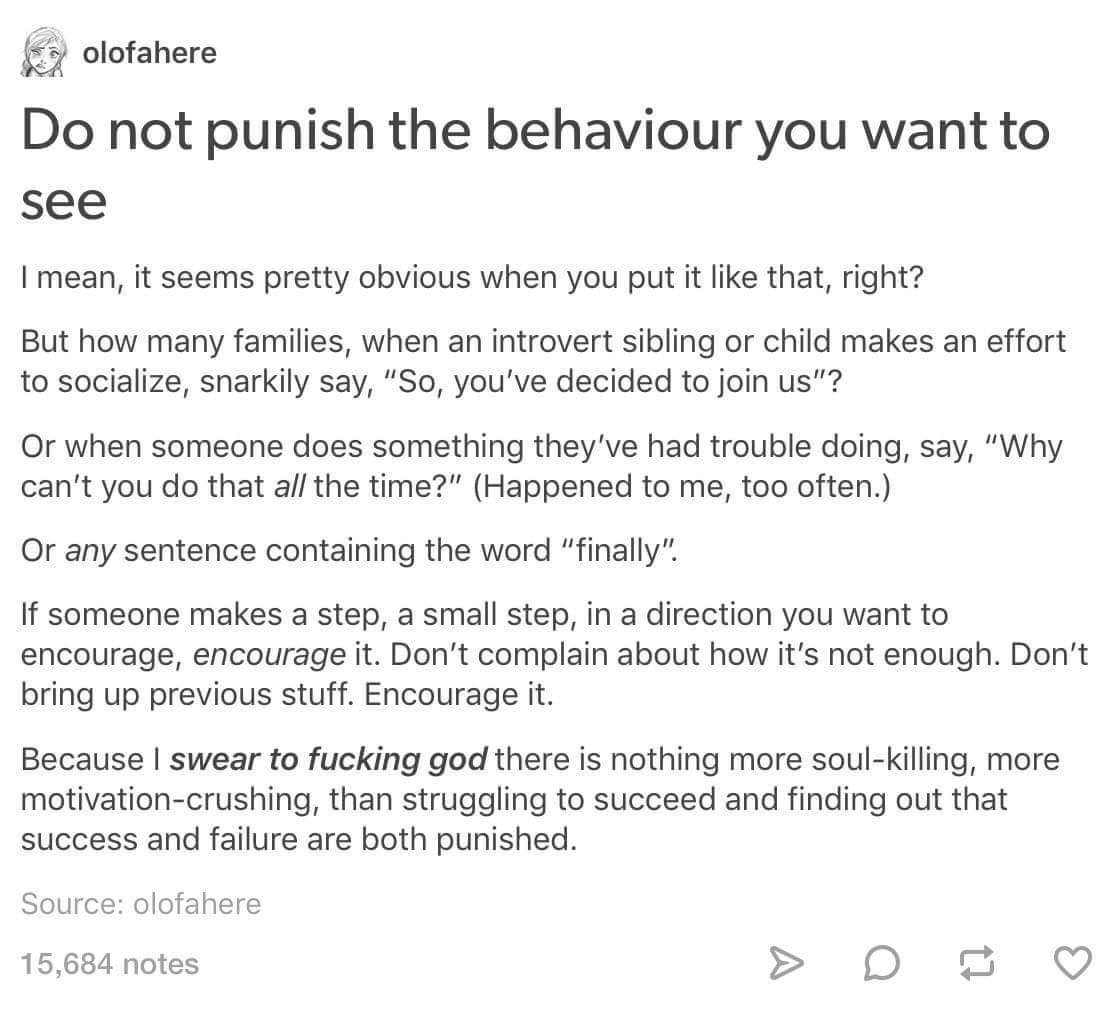
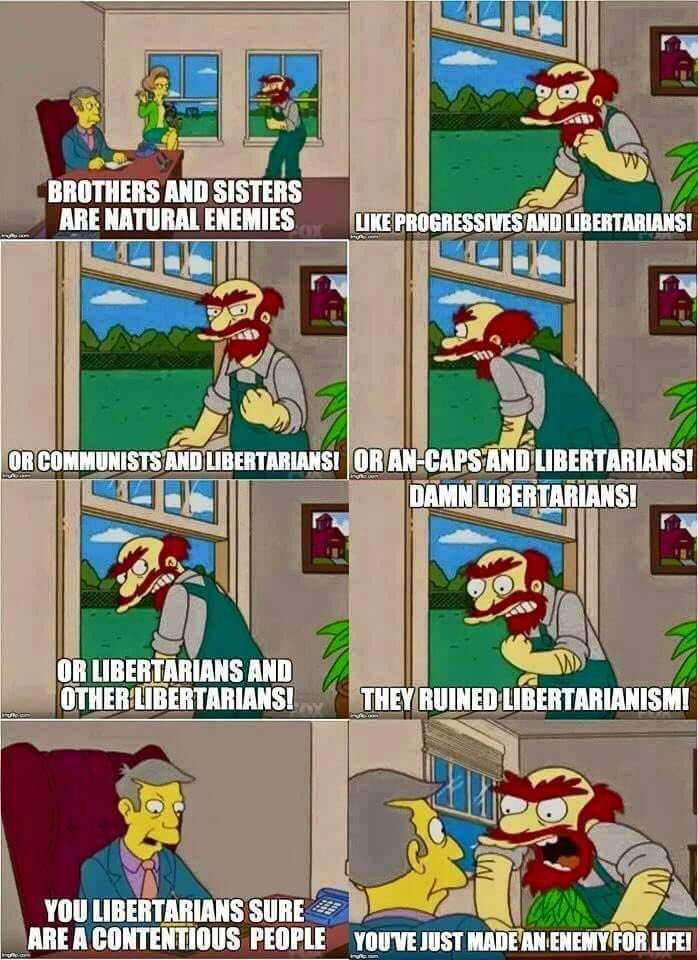
This image showed up in my “memories” over on The Book of Faces and it really sums up why the big-L Libertarian types can’t get out of single digits in national elections.

Here’s the thing. Most people aren’t libertarian, let alone Libertarian. And, if you listen to Libertarians, most Libertarians aren’t Libertarian. Ask three different Libertarians and get five different views on what it is to be “Libertarian.” This cartoon, frankly, nails it:

Libetarians of the big-L variety seem to be unwilling to make common cause with folk they disagree with on some aspects in order to further things with which they do agree.

And that’s a large part of the reason they have been so very bad at spreading their ideas of individual freedom. (Note: I’m leaving aside questions of vote fraud–I’ve discussed some of that elsewhere–because it, frankly, isn’t needed for Libertarians to lose in the national arena. All the excuses they make pale behind the simple fact that they are really bad at outreach.) Consider someone who’s not anything close to libertarianism, but has decided that on some particular point, the government has gone too far and things should be dialed back, returning the liberty to the people. How do Libertarians react? Do they applaud the person’s increased understanding of the value of personal liberty? Do they rejoice at the cracks developing in the mirror of state power through which they had previously viewed the world–small cracks, perhaps, but maybe a start?

Nope. In my experience, the most common reaction is disdain that the person doesn’t go far enough. Instead of seeing a person taking the first steps on a journey toward libertarianism they see the person as still being “statist” and therefore a supporter of tyranny. After all, anything other than a pure voluntaryist society is simply tyranny in their eyes.

And when that happens the person who has taken those first steps usually turns right around and heads back. Congratulations. You’ve just driven somebody who might have been an ally in increasing liberty in the nation into being an opponent.

As somebody who is pretty far down that road, not quite voluntaryist but pretty far into minarchist, it’s enough to make you snatch your hat off, throw it on the ground, and stomp on it. As my grandmother used to say, “makes me so mad I could crush a grape.”

I understand the frustration when people can’t seem to wrap their heads around the idea of actual liberty, when perfectly reasonable, fact based arguments persistently bounce off or, as the old saying goes, “in one ear and out the other”. I get it. It’s frustrating and it’s all too easy to end up responding hotly. I’ve done it myself. I am, after all, only human. In the end, though, perhaps it’s not the best approach in most circumstances.

We want to see people supporting more liberty. To that end whenever we see someone making a step, even a tiny step, in that direction from where they were, we should be encouraging it, and not punishing it. Lambasting them for the “statist” views they still hold is counterproductive. This does not mean you can’t criticize those views but a gentle halter to guide rather than a whip and spurs might work better toward that end, particularly when combined with fulsome, and sincere, praise of the steps they have made in the “right” direction.

The old saw about catching flies, however flawed it might be (who wants to catch flies, really?) comes to mind.

Goth on Ice: Go for the Gold

Okay, probably not really, but I am planning to compete. There’s a competition coming up in Fort Wayne, IN on March 27. The competition is based on the LearnToSkateUSA progression. I’ve talked before about the different progression levels: Adult 4, Adult 5, Basic 5, Basic 6, and so on? Well, that’s how the competition is divided up. A competitor is allowed to compete either in the highest level they’ve completed or one level up. If it were held today, I could compete in Adult 4 (completed), or Adult 5 (almost completed), but not Adult 1-3 or Adult 6 (and never mind “Free Skate”).

Each of these has two separate sub-divisions: Compulsory and “Free skate with music.” Unlike USAFigureSkating events (sectionals and nationals) or ISU Worlds, where you have the short program and have to place high enough to qualify for free skate, the compulsories and free skate with music are two separate events. A person could enter either or both.

So, I plan to enter. The plan is to aim at Adult 5 since I really only have one technique left to complete that–the two foot spin. Once I complete Adult 5, I’m no longer eligible to compete in Adult 4 (or any lower level) and I don’t think I’ll be ready for Adult 6 by then. I’ve got three techniques to learn yet for Adult 6–inside 3 turn, change of edge, outside to inside, on a line, and beginning one foot spin. I plan to enter both compulsories and the free skate with music giving me two shots at it.

So, the techniques I’ll need (plus steps to connect them together into a cohesive program): Backward outside edge on a circle (left and right), Backward inside edge on a circle (left and right), Backward crossovers (clockwise and counterclockwise), Forward outside three turns (right and left), Forward swing rolls, and beginning two foot spin.

I don’t have any good videos of my basic backward edges on a circle but here’s the other stuff I’ve done for Adult 5:

From a while ago. I have gotten better
Likewise, somewhat dated and I have improved. Indeed I now actually use this three-turn when skating.
The consecutive forward edges I’m working here aren’t quite swing rolls (never videoed myself doing thost) but they’re fairly closely related.
And, yeah, this is going to need some work.

Oh, well, what’s the worst that can happen? I can fall on my ass and look ridiculous? Like that’s never happened before (and no doubt will again).

I’ve worked out a schedule with my boss that will allow me more ice time to prepare. It involves going to work early and staying late so I can take some time in the middle of the day to head up to the rink. Those days will be short sessions but I plan to use them to focus heavily on technique and use the weekend time for longer duration skating for conditioning. I’m also looking into the local figure skating club which arranges “club ice” time and possibly “free skate” sessions (figure skaters only, more expensive than “public skate” particularly since public skate is free while I’m taking lessons).

So, we’ll see how it goes.

That Would Be a Very Bad Idea, Cupcake

Allow me to explain, Pam, why this is a really, really bad idea. I have warned about how bad an idea legal reprisals against a departing administration would be, but let’s consider the specific case you present here.

Let’s consider for a moment, purely for the sake of argument, that this were actually true. If folk, including governors, started treating Trump as the legitimate president and, therefore, the election illegitimate, what’s to stop them from treating an impeachment or indictment as equally illegitimate? Even imprisonment (follow that indictment with a show trial and send him to prison) wouldn’t stop it. After all, it’s not unknown for mob bosses to continue to run their organizations from behind bars.

So, what’s the solution? If this is truly the path they were to take how would they stop that “shadow government”? There are only two ways. One would be to hold Trump completely incommunicado, even to the extent of forbidding him contact with counsel to discuss appeals and other aspects of due process. Or they would simply have to kill him (assassination or execution depending on whether they fig-leaf it with a kangaroo court).

That would be absolute “go time”. Count on it.

Indeed, at this point, after comments by people like you, Pam, the movers and shakers among the Left need to be praying for Trump’s continued good health because if anything happened to him, anything at all–his fault, their fault, nobody’s fault–nothing in the universe would prevent people from assuming it was a political assassination and responding accordingly. Just like few people believe that Epstein killed himself.

So, I’ll say it here first: Donald Trump did not kill himself.

At that point, it won’t matter what actually happened. All that will matter is what people believe. And, people will believe that your side had him killed. And none of your willing lapdogs in the media will be able to change that belief. And when you add rhetoric about making lists of Trump “supporters” with what qualifies as a “supporter” being left delightfully vague, people with even a modest preference for Trump’s policies (i.e. close to half the nation) will see their options shrinking, getting closer to “fight or die” or maybe “fight and die or just die”. In which case, you’ll see a lot of people figuring if they are going down anyway, they might as well take a few others with them.

And that is why following your line of thinking to its inevitable conclusion is a very bad idea indeed.

Feeding the Active Writer: TDG Keto Iced Sugar Cookies

Once again I venture into experimenting with cookie recipes. This is one that has almost no net carbs–1/2 gram carbs per good-sized cookie. They are high in fat and low in protein making them a good “fat bomb” for folk trying to hit specific targets on their daily macros.

Ingredients:

The cookies:

  • 1 cup butter (softened at room temperature)
  • 4 large eggs
  • 1 tbsp vanilla extract
  • 4 cups sugar substitute such as Splenda (make sure it’s a 1 to 1 sugar substitute. The amount is high because most sweeteners, including Splenda, lose some of their sweetness in cooking. You may need to experiment to taste if you use something else)
  • 1/2 cup cellulose fiber powder
  • 1/4 cup psyllium husk fiber powder.
  • 1 tsp baking powder
  • 1/4 tsp salt.

The frosting:

  • 1/2 cup butter (softened at room temperature)
  • 1 1/4 cup powdered (confectioners) sweetener. (If all you have is granulated, you can use a blender to make powdered sweetener. Note that the volume will go down in the course of blending it. Measure the powdered sweetener, not the original granulated.)
  • 1 tsp vanilla extract
  • 1-2 tbsp heavy cream.
  • optional: food coloring

To make the cookies, place the butter, eggs, and vanilla in a large mixing bowl and beat until smooth. You can also place them in a food processor and process on high. Add the remaining ingredients and mix until smooth. Place in the refrigerator to chill at least one hour.

Preheat the oven to 350 degrees (175 C). Line a baking sheet (I used a large pizza pan here) with parchment paper. Scoop out some of the cookie dough and roll into about a 2″ (5 cm) ball. Flatten it and place it on the parchment paper. It should make about 16 3″ (7.5 cm) cookies.

Bake at 350 for about 15 minutes. Remove from the oven and set aside to cool.

While the cookies are cooling, you can make the frosting.

Add the butter, vanilla, and 1 Tbsp of the heavy cream to a small mixing bowl. Beat on high until smooth. Add the sweetener and continue to beat. Add small amounts of additional heavy cream until you get a good consistency to the frosting. It should hold together (not break apart into “crumbs”) while beating but should remain stiff. Be careful not to add too much cream or you’ll end up with a runny frosting.

You can leave the frosting its basic off-white color or you can add food coloring. You can divide the frosting into several smaller bowls and add different colors to add some visual variety to the cookies. I did not bother here, just using a bit of yellow food coloring for the whole batch.

Spread the frosting over the cooled cookies. The recipe makes enough for a generous coating on each of 16 cookies.

Enjoy.

Each cookie (of 16) has 19.5 g fat, 1.5 g protein, and 0.5 g net carbs and about 4 g of dietary fiber making it a near-perfect fat bomb.

Goth on Ice: A rough Day

Just under one hour on the ice yesterday. Had planned to try to do at least a full hour only at about 57 minutes of skating in, they told everyone to clear the ice so they could run the Zamboni. I wasn’t going to wait until they were done resurfacing the ice to skate an additional 3 minutes.

The bad: when I got off the ice I found one of my skate guards where I left it. I leave it sitting on the wall next to the entrance to the ice (common for folk to leave their guards here). I like to wear the guards whenever I’m in skates off the ice. The floors at the rink are padded to protect the blades but there’s always the chance of stepping on something which can nick the blade and ruin your edge.

Now sometimes one of the guards will fall off the wall. I then find it on the floor next to it. Not this time. It was gone. G O N E gone. Brand new guards and I have to buy another pair.

The good: While I was sitting on the floor (the benches and chairs were packed) removing my pads and changing from skates back to my shoes, a couple of young women (early 20’s maybe) approached me and asked where I got my mask. (I was wearing the spiked pleather mask in black and painted to look like blood spatter.) I said “Amazon.” They said that they liked my style (I was wearing a ruffled shirt, a paisley vest in red and back, and dress slacks. And they liked my earrings (little “dragon claws” holding a milky white orb–cheap costume jewelry bought at Hot Topic). Okay, they were a third of my age but it was nice to hear.

The frustrating: Forward change of edge, outside to inside, on a line. That is one of the techniques I need for Adult 6 and it’s proving…a challenge doesn’t begin to cover it. I find it harder than the Consecutive outside and consecutive inside edges that my instructor had me learning shortly before the COVID shutdown stuff. The consecutive forward edges is normally learned in Free Skate 1, which is two levels “higher” than Adult 6. I’m thinking this is actually more challenging than the spins that I’ve been attempting to learn.

This technique, required for “Adult 6” is proving to be my kryptonite.  I swear it’s harder than consecutive forward outside and consecutive forward inside edges even though those aren’t required until Free Skate 1.  While I was struggling with them in practice my instructor skated over from her own class (we have practice time at one end of the rink when the other class is in session) and gave me two suggestions:

1: Don’t try full half circles, just go for shallower “half ovals” for now.
2: Do the outside edge on one foot, then go ahead and glide on both for the other, just to get used to the movement for now.

I was told in another case that the flailing my arms around when I make the edge change was “throwing off my balance.” However, the causal arrow is reversed.  I’m flailing my arms around because my balance is already off and I’m just trying to stay upright.

I start with the “skating foot” side arm forward, and the other arm back and to the outside.  When I make the edge change, I have to move the trailing arm down and to the outside (of the new curve) to keep from falling over, and within a few inches to a couple of feet I have to put the free foot down.

It’s very frustrating.  At first I reminded myself that the consecutive edges were equally frustrating when I was just starting, but it’s not coming together like the edges (and the swing rolls they led to–necessary for Adult 5), so I’m particularly frustrated here.

For other techniques I’ve been able to use YouTube tutorials as an added assistance when I was getting stuck.  They sometimes provide either a different approach from my instructor that “clicks” better for me or a reminder of something that I forgot or didn’t catch when the instructor was teaching it. (Example, the back to front two-foot turn is done on the back of the blade where I’d been trying to do it on the front, on the “spin rocker”.) However, I’ve been able to find nothing on this technique.

Political Violence and the Second Amendment

Anyone reading this blog knows that I am a strong proponent of the Right to Keep and Bear Arms, among other things for the defense of life, liberty, and the pursuit of happiness. In particular, when it comes to liberty, as, in the final extreme, as a defense against government tyranny. I have also written, with great vigor, in opposition of using violence in protests and how calling violence “protest” does not make it legal, even if the cause of that protest is just (and especially when it’s not).

Some might think that makes me a hypocrite. Well, that’s for others to judge, but hear me out here on my reasons to hold both views.

The first thing to consider is the purpose of protest. In general, the purpose of protest is to bring to light injustice (as those protesting see it) in order to sway public policy by creating a climate of opinion such that those in power will be encouraged to change their ways. This usually involves making people aware of the injustice, convincing them that it is and injustice, and making it important enough to them that it will affect their voting decisions (in places with representative government anyway) thus encouraging those in power to address and rectify the injustice. In Milton Friedman’s words, it creates a situation where it’s politically profitable for the wrong people to do the right things:

For that purpose, violence, leaving aside moral issues, is rarely helpful. If anything, it tends to harden opposition. Usually, these issues are those where the majority would agree if they were only aware of the scope, or even existence, of the problem.

One might ask, then, if peaceful protest is so much more effective than violent, what, then, is the point of supporting RKBA as a hedge against government tyranny. To answer that, one has to look to more serious cases, cases where the entire system is corrupt, where there is no way to peacefully protest and get the message heard. Censorship (whether by government or by monopolisitic or near-monopolistic information distribution channels). Being deliberately misconstrued and lied about in the media. Or a government that simply is not responsive to popular will or does not respect the rights of individuals. Those are the kinds of things that can render peaceful protest moot.

But, here’s the point. When you cross the line from “peaceful protest” to “using violence” you are no longer engaging in protest, per se. Individually, you are engaging in violent crime. If it goes on enough, you are waging war against the government and nation. You may consider the government illegitimate. It may, in fact, be illegitimate, but even so what you’re doing is waging war. Put another way, once you become violent, you are no longer protesting, but rebelling.

And you can expect to be treated as doing so.

In protest, a peaceful protest, you can generally expect to go home at the end and, barring actual injustice (which will only underscore your cause) you can expect not to be arrested and imprisoned for your peaceful protest. If you are, well, that just proves your point and everyone seeing it can recognize that. You can go on basically living your life as normal until the next protest in which you participate.

If your protest was actually peaceful.

If it was not peaceful however you are now an actual criminal. You might be a traitor (as the government and its supporters, however legitimate or illegitimate they may be). You cannot then expect to just go back to your life. This will follow you until you either win, are captured, tried, and punished, or if you’re lucky until you’re forgotten.

Or, maybe you’ll be lucky. Maybe you’ll actually be useful to those in power for their particular political purposes and they’ll let you go unmolested because it suits them. But beware. That only lasts so long as you are politically useful to them. And it tends to have the opposite reaction of the goal of protest given above: it tends to harden opinions against you. Oh, people might voice agreement with you but it’s fear, or at least prudence, talking. They are saying what they hope will prevent them from being attacked. But their minds aren’t changed, not in your favor anyway, and once the threat goes away they go right back to opposition to your views.

Violence, then, is really only justified when there is no other recourse, when speech is shut down, when public opinion no longer matters, when elections are decided, as alluded to by Stalin, not by those who vote, but by those who count the votes. And when you cross that line, it’s not an issue of “protest and go home” but it’s war. Don’t kid yourself that it’s anything else. The war might be justified, but it remains a war and you are an enemy combatant to the powers that be. They might just treat you as a criminal if they don’t want to acknowledge the war. Or they may go ahead and acknowledge the war and brand you a traitor. In either case, you are pledging “your life, your fortune, and your sacred honor” to that cause.

If you aren’t ready to do that, then keep your protest peaceful, and stay far away from those who do not.