On this day: The Invasion of England

September 28, 1066, Duke William II of Normandy invades England and begins the Norman Conquest of England which, in essence provides the foundation for Great Britain as we know her today.

To understand these events we have to go back a bit farther.  In 911, “Charles the Simple”, “negotiating” with a group of Vikings and hoping to create a buffer against other Norse raiders, allowed that group of Vikings, led by one Rollo, allowed that group of Vikings to settle in a region adjacent to the English Channel.  These Vikings were called “Northmen”, shortened to “Normans” and the region called “Normandy.”

The Normans quickly assimilated, adopting Christianity and mostly adopted the local language (keeping some elements of their own).  They did not entirely give up their warlike ways and acquired some of the neighboring lands, incorporating them into Normandy.

In 1002 King Æthelred the Unready married Emma of Normandy, the sister of Richard II, Duke of Normandy.  Their son, Edward the Confessor lived in Normandy in exile for many years before ascending the English Throne in 1042.  This, however, led to the Normans casting their eyes across the channel and becoming quite interested in the situation in England.

In England, Edward found himself in conflict with Godin, Earl of Wessex.  He may also have “encouraged” William, Duke of Normandy, Grandson of Richard II, in his own ambitions for the English Throne (wink wink nudge nudge).

When Edward died, still childless, there were a number of claimants to the throne.  The primary claimant was Harold Godwinson, the son of Godwin, Earl of Wessex.   Harold was elected King by the “Witangemot” a “meeting of wise men” an assembly of the ruling class and duly crowned.

Two powerful forces immediately rose to challenge that crowning.  One was Harald III of Norway, commonly known as Harald Haradrada–based on a supposed agreement between earlier Kings of Norway and England that if either died without issue the other would inherit both Kingdoms.  The other was William of Normandy who claimed that Edward the Confessor had promised him the throne.

Both Harald Haradrada and William of Normandy began assembling troops.

A spoiler of a sort arose in Harald Godwinson’s exiled brother Tostic, who began raiding England’s southern coast.  Driven back, Tostig retreated to Scotland to recruit fresh forces.

Harold Godwinson continued to patrol the south of England with levied troops but as the troops were levies and not full-time soldiers they needed to go back to their farms in time for harvest son on September 8, Harold dismissed them.

Of the two main rivals, Haradrada struck first.  In early September he invaded England.  Tostig joined his forces to Haradrada’s and together they defeated an English force raised by Edwin of Mercia and Morcar of Northumbria.  They then moved on York and took it.

Harold Godwinson had to raise his army again and march North.  And on September 25, Harold Godwinson defeated Harold Haradrada, killing both the Norwegian king and Tostig at the battle of Stampford Bridge.

In the meantime, in Normandy, William was gathering forces.  Modern historians say probably about 7-8000 men.  Contemporary writers claim as much as 150,000.  In any case, they landed at Pevensey in Sussex on September 28.

Harold (easier to write now that there’s only one of them left), with his army tired and depleted by the hard fighting at Stamford Bridge, had to march south where he met William near the town of Hastings.

Whether through strategem or chance (I have seen arguments for both), William’s forces drew part of Harold’s out of position and was able to concentrate the larger part of their force on a smaller part of Harold’s, severely depleting the defenders of Harold’s forces.  Eventually, Harold fell.  Tradition, and one interpretation of the scene depicted on the Bayeux Tapestry, says that Harold was struck in the eye with an arrow.  In any case, his forces, now leaderless, were routed.

And that was pretty much the end of Anglo-Saxon England.  There was some resistance over the next few years but in the end, William, now dubbed William the Conqueror, and his Normans had control of England until the ascension of Henry II, the first of the Plantagenet Kings in 1154.

Politics in Uniform

When I went through Basic Training one thing that was explained to us was that any kind of partisan political activity while in uniform was absolutely forbidden.  No taking opinion polls, no campaigning for candidates, or any other kind of overt political activity that implies, or appears to imply official sponsorship of one side or another of a political issue.

That includes not showing up at political rallies wearing a uniform unless one has official duties that require one to be present (like, say, the President’s Marine Corps guard detail).

That was 35 years ago.  The basic policy has not changed.

From the Army’s web site:

That’s not to imply, however, that military members and civilian employees can’t participate in politics. In fact, DOD has a longstanding policy of encouraging members to carry out the obligations of citizenship, officials said. DOD encourages its military and civilian members to register to vote and vote as they choose, they said. Both groups can sign nominating petitions for candidates and express their personal opinions about candidates and issues.

However, officials emphasized, they can do so only if they don’t act as, or aren’t perceived as, representatives of the armed forces in carrying out these activities.

Beyond that, the list of do’s and dont’s differs depending on whether the employee is a member of the armed forces, a career civil service employee, a political appointee or a member of the career Senior Executive Service, officials said.

Military members, for example, may attend political meetings or rallies only as spectators and not in uniform. They’re not permitted to make public political speeches, serve in any official capacity in partisan groups or participate in partisan political campaigns or conventions.

They also are barred from engaging in any political activities while in uniform.

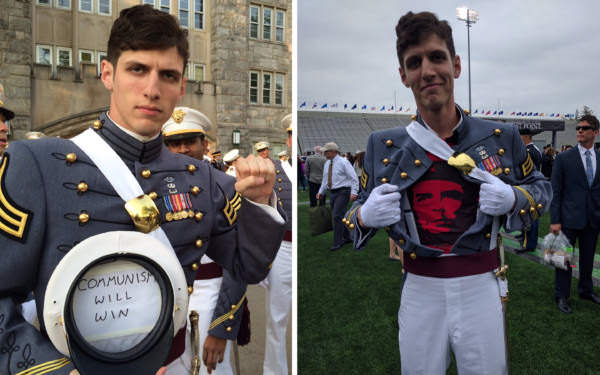
Then there’s this asshat:

rapone-600x375

Army Ranger, West Point Graduate, and now Infantry Officer.

While I may disagree with his twitter posts under the handle “Commie Bebop”, those, at least were done at one remove from being “in uniform”.  One might question whether a series of posts/tweets on the same topic might constitute “public political speeches” but as a First Amendment near-absolutist, I’m willing to give him the benefit of the doubt there.  It’s not in uniform and doesn’t even give the appearance of implying any kind of official sanction.  His beliefs?  Well, I doubt they are compatible with honorably serving his commission but, again, I would be willing to give him the benefit of the doubt until he actually demonstrated through his actions that his beliefs are incompatible with honorable service.

But in uniform at a military (including military academy) event?  That’s a clear violation.  Indeed, that the very demonstration that his beliefs are incompatible with honorable service.  He needs to be court martialed and discharged with something other than honorable (I won’t hold out for a dishonorable–I want him gone and without the benefits of those who serve honorably more than I want sanctions beyond that.  I won’t even hold out for a prison sentence although one is applicable–let’s not make him more of a martyr for the anti-American Left to celebrate).

Of course the usual suspects will bleat about “First Amendment” and “Right of Conscience” (Hey, he’s not being asked to bake a cake).  Those who have served in the military know that Freedom of Speech is limited.  Try saying “Our commander is an utter moron, unfit to lead a marine to a whorehouse, let alone a company into battle” and see where that gets you. (You folk currently serving know that would be a bad idea, right?)

This crosses the line so this disgrace to the Uniform needs to go.  He can go with public panapoly or he can softly and silently vanish away, but he needs to be gone.


Blast from the Past: Before the Hyphens Came

I am not a fan of country music.  Nothing specific wrong with it, just not my cup of tea.  One thing I will give the genre, though, a number of artists have put out some very good patriotic songs.

So, some time back I went on a quest looking for some rock or metal groups doing patriotic stuff.  Some folk over in another forum pointed me at a group called Madison Rising.  My first introduction was their rock version of The Star Spangled Banner.  Now, I’ve had some people criticize it as just another case of people trying to “personalize” the national anthem but I take a different view which I illustrate with two points:

  1. It’s on my “main” playlist to come up in rotation whenever I’m listening to music.
  2. My daughter (just turned 10) asks to hear it from time to time.

If it gets people who otherwise wouldn’t to listen to the song and pay attention to it, that’s a win in my book.

But it’s another of their songs that I want to talk about today:  “Before the hyphens came.”

So here it is:

My 5 A.M. alarm goes off, I’m rolling out of bed
I turn the TV on, to wake up and clear my head
I catch the news, just in time to view another stirring of the pot
Talks of in-equality, what people need, and forgetting what they’ve got
But in these times of opposition, the prejudice runs deep
Dividing us by heritage is all they ever preach
Chorus:
They tell us that they really care
But to them it’s just a game
‘Cause we were all Americans
before the hyphens came
When people cared ‘bout who you were
and less about your name
‘Cause we were all Americans
Before the hyphens came

Somewhere down along the line, someone had the great idea
to divide us up by heritage, and profit from that fear
But growing up a while back, before these racial trends
Whether immigrant, or white or black, we just called each other friends
And if we spoke an extra language, it was just another way
To pledge allegiance to the flag, God bless the USA
Chorus
So don’t listen to those talking heads
There’s one thing they forgot
That this Sweet Land of Liberty
Should be one big Melting Pot
So take away the hyphens
We’ll all be the same
No more lines betweens us
Together we’ll remain
Forget about your color
Forget about your name
No more lines between us
Cause we are all the same
Chorus

Unfortunately, the nostalgia of the song describes an America that never was.  There was never a time where it was generally true that “we were all Americans, before the hyphens came.”

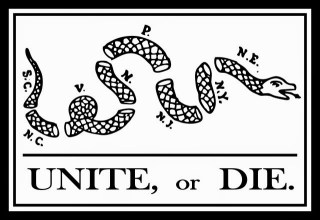
Even so, there is a big difference between now and then.  Back then, they may not have achieved the ideal.  Irish may have hated Italian, Protestant might have hated Catholic.  In a great irony many of the “whites” hated the “indians” (who were here first).  And everyone hated the Mormons.  But “That this Sweet Land of Liberty Should be one big Melting Pot” was the ideal.  It was the goal we strove for.  While individuals may have wallowed in hatred of others, as a nation we recognized that the divisions between individuals were wrong and weakened us.  As Benjamin Franklin put it in his famous cartoon:  Unite or Die:
And people who came to the US came to be Americans.  Becoming a part of the greater culture was a priority.  And when they became part of our greater culture, the brought a little of their own.  To a very great extent, it was true that “This sweet land of Liberty, should be one big melting pot.”
Nowadays, however, that’s changed.  Assimilation is frowned upon.  People come to the US for economic or other advantage with no intention of becoming “Americans” in any cultural sense.  Oh, sure, there’ve always been some, but there’s been a sea change in the numbers and assimilation is actively discouraged.  And reverse assimiliation, if people of “American Culture” adopt things from others it’s called “cultural appropriation” and people get up in arms about it.
All of that is ridiculous and discards everything that makes America America.  Cultural Appropriation?  That is our culture, to take the best of what we see around us and make it our own.  And it starts with the American people deciding, first and foremost, to be American and not some hyphen.
And so I leave with this musical interlude:

The NFL and the National Anthem

So it started last year, this third-string quarterback on the edge of being cut makes a big production out of not standing for the National Athem because “oppression.” (Dammit, can somebody oppress me with an $11 million contract?)

Suddenly, the fact that nobody wants this third string quarterback is political.  He’s not being cut because he’s bad, oh no.  He’s being cut because…racism.  And other teams don’t want to hire him, not because he’s bad but because, again, racism. (70% of professional football players are black compared with 13.3% of the US population in general.)

And the story grows.  Other players begin to not only not stand but to expressly kneel as further protest.

What they’re protesting?  Um, that’s a good one.  Aside from a general “America bad” and “Trump bad” this isn’t particularly clear.  And the usual suspects in the media cheer their “courage”.

And the result of this?  People are attending fewer games.  Fewer people are tuning in on television.  And fewer people are buying less NFL merchandise (with some notable exceptions which I’ll get to).

You see, they forgot one thing.  The people who are impressed by this protest, in the vast majority don’t. watch. football. games.  They couldn’t care less about the sport except now to point to the protesters on “their side.” But the thing is, that care, that pointing and saying “see, they agree with us”, doesn’t translate into actual sales.  These protests aren’t pulling those people into stadiums.  They aren’t getting them to buy player jerseys or NFL logo apparel or, really anything.

The folk applauding the logo aren’t becoming football fans.

The actual fans, on the other hand, are annoyed, offended, and insulted.  And. they’re. staying. away.  Sales are tanking.

So what are the teams, and the NFL administration doing?

The coach for the Pittsburgh Steelers decides they’re not going out on the field until after the anthem.  Only one player, Alejandro Villanueva, defied that decision, Villaneuva, a combat veteran, stood alone on his side of the field for the National Anthem.  Of course since then, he’s been “convinced” into apologies for doing so.

I made coach (Mike) Tomlin look bad, and that is my fault and my fault only. I made my teammates look bad, and that is my fault.

No, Mr. Villaneuva.  They made themselves look bad.

As for the fans, Mr. Villaneuva’s jersey is the best seller in the NFL.  People are voting with their wallets.

And there you have it.  While I’d be the last person to say that players don’t have the right to peacefully protest as they see fit, I would say that fans also have the right to not buy tickets to games.  That they have the right to not order pay-per-view showings of games.  That they have the right to not buy merchandise.

And if these protests cost the owners of these teams money (and it’s not just the team the individual players play for.  There’s some complicated rules on how income is distributed among teams that means it hurts everyone in the league) then the owners (within the limits of existing contracts) have the right to replace them with players that don’t cost them money.

I mean, come on, this is the league that fined a player for twerking in the end zone.  You think it’s not within their purview to speak out against politicking on the field, particularly when it’s driving away their fanbase?

Now that’s Badass

Let us lift a toast to Ben L. Salmonson, Captain, Dentist, Baddest of Badasses.  Hero.

In June of 1944 the US was in the process of invading Saipan to liberate it from the Japanese.  Attached to an army unit was one Ben L. Salmonson, the regimental dentist.  During active combat, there wasn’t much need for a regimental dentist so Captain Salmonson volunteered to replace a surgeon that had been wounded by mortar fire.  He ended up working an aid station about 50 yards from the front lines.

On the night of July 6, the Japanese gathered for a counterattack suicide charge.  Literally.  Commander of the Japanese ordered: “We will advance to attack the American forces and will all die an honorable death. Each man will kill ten Americans.”

At about five in the morning, with forces of between five and six thousand men, the Japanese attacked the approximately eleven hundred American defenders.  In minutes Salmonson’s aid station was overwhelmed with wounded.  While Salmonson was desperately working to save the most seriously wounded, the Japanese entered the aid tent.  One of them bayoneted one of the wounded soldiers.

No one knows what Salmonson said or thought at that moment.  I imagine it was something like “Oh no you didn’t.  Not my patients.” He picked up a gun and shot the offending Japanese soldier.  He clubbed the next two with a rifle then stabbed one with the bayonet and shot the other.  He head butted a fourth, providing an opportunity for another wounded soldier to shoot the Japanese.  He then ran out of the tent seeking help to defend the aid station.

The situation was hopeless.  The suicide attack had overwhelmed the Americans.  While there were scattered pockets of resistance, most of the American troops were falling back toward the shore.

Salmonson was about to become one of these pockets of resistance.  He grabbed a dropped rifle and joined a handful of others in defending against the Japanese.  Eventually he took charge of a machine gun whose operator had been killed.  This was the last anyone saw of Salmonson alive.

The next day, after continual fighting, in which the Americans had lost 919 men killed or seriously wounded, an 83% casualty rate, the Americans regained their position.

They found Captain Salmonson’s body slumped over the machine gun.  He had been hit with bullets, bayonets, and no fewer than 24 times before succumbing to his injuries, and a total of 76 times.  I guess they wanted to be sure that he wouldn’t rise and continue to fight.

In return, the trail of bodies showed that he had killed 98 Japanese soldiers.  The blood trails showed that while wounded, Salmonson had relocated the machine gun several times to maintain clear fields of fire.

Because he was medical corps and not supposed to bear arms–and then following up with paperwork problems when it was recognized that the restriction was for offensive purposes and self defense, which is what Salmonson did, was okay–it took a long time indeed for the Army to properly recognize his heroism with the Congressional Medal of Honor.  48 years actually, with the Medal being awarded in 2002 by President George W. Bush.

Instead of each of the Japanese killing ten Americans, it took more than a hundred to kill one dentist.

Captain Salmonson holds an honored place at Odin’s table..

DACA?

Minor children brought to the US against their will (at least nominally–I don’t think all of them were kicking and screaming that they wanted to go back to wherever they were leaving).  What to do with them?

One approach is a simple one:  The law is the law and they should go back where they were brought from.  Another is also simple:  it wasn’t their “fault” so we should give them a pass and let them stay.

Arguments can be made both ways and it’s a subject on which reasonable people may disagree.  This is the kind of thing where reasoned debate, votes to determine popular will, and maybe even finding a middle ground that a large majority of the electorate can live with, could beneficially be applied.

Unfortunately, the world is full of unreasonable people.

Some of the unreasonable arguments.

You hate immigrants!

This conflates illegal immigration with all immigration.  A person can be perfectly comfortable with legal immigrants and still be opposed to illegal immigration.  On the flip side, a person could be entirely comfortable with “illegal immigrants” because they like to exploit cheap labor who are limited in their legal remedies to abuse.

Which of those, exactly hates immigrants?  Think about your answer.

As for me, it goes beyond “some of my best friends”.  If you counted off my five best friends, three of them are immigrants.  My wife is an immigrant.  Two of those four people (at least) were temporarily “illegal” despite good faith efforts on their part due to bad legal advice or paperwork errors.

You racist!

Oh, for the love of Mjolnir, not everybody who disagrees with you is a racist.  You can claim it’s about the “brown people” but if you have ten million people living illegally in the US from one part of the world who share certain physical characteristics and one million from other parts of the world with different physical characteristics, it’s not racist that most of ones notice is going to go to the ones that outnumber the others ten to one.

They’re just trying to escape…

I sympathize.  I do.  But we can’t bring everyone who “wants to escape…” here.  It’s not possible.  Any who are “saved” that way are a drop in the bucket.  You might consider even that to be worth doing and that would actually be a reasonable argument except for one thing:  you could help the same people, and more, by helping them make where they came from better.  You know, a lot of nations have pulled themselves out of abject poverty.  Some without much, if anything, in the way of their own natural resources.  Enough of them have used the same basic pattern that you could almost call it a recipe (I’ve discussed this elsewhere).  It works.  It’s effective.  And it helps far more people than we could ever absorb via immigration.

This illustrates the problem well:

It’s hypocrisy since your ancestors came to America illegally

First off, that’s a short form of a rather more involved argument implied by every invocation of Native Americans on the subject.

Europeans invaded and conquered the Americas.  I make no bones about that.  We won.  They didn’t.  And that’s pretty much how things have been since the dawn of time through most of the world.  We may have decided since then that maybe this isn’t the best way to do things going forward (although that might prove to be a pipe dream–time will tell) but that’s how things were done then.

But when you invoke the European invasion and conquest of the Americas as some kind of argument in favor of illegal immigration you are saying that it is once more an attempted invasion and conquest.  It would then follow that the invaded are justified in treating it as such.  That the illegal immigrants are enemies, foreign invaders, waging a covert war on the US.  And that would also mean that folk supporting them are giving aid and comfort to said foreign invaders.  Treason by a strict Constitutional definition.

Are you sure that’s an argument you want to make?

There are plenty of arguments that can be made on both sides of the issue.  Arguments about tempering law with compassion and mercy without completely dismissing rule of law.  Arguments about the good of the nation and its people–to which our laws have to give precedence if we are to be a nation at all.

But those above are just a sampling of some really stupid arguments to make.

Snippet from a work in progress

Sorry I didn’t post yesterday.  I was down with some kind of bug and just didn’t have the energy.

So, to make up for it a bit, here’s a rather longish snippet from one of my works in progress (currently got four active projects which I’m cycling through):


The chill night air burned in my throat as I ran.  Sweat rolled between my breasts.  One vampire I could handle.  Two, were a challenge, but an acceptable one.  Four, however?  That was a different story.

I sprinted toward the edge of the roof.  Alley.  Twenty feet wide.  Next building one story lower.  I could do it.  I had to do it.  My left foot hit the low retaining wall at the edge of the roof.  I leaped. The sound of traffic from the streets below became louder, unimpeded, as I passed the edge of the wall.  I sailed over the alley sixty feet below and cleared the far side by a good six feet.

As I continued to run, I stripped off my jacket leaving me clad only in a sleeveless leotard and jeans.  The jacket represented too much weight, too much heat, for my level of exertion.  Bye, bye, six hundred dollar leather jacket.  I dropped it behind me.

A soft thump to my right indicated one of the vampires landing on the rooftop.  A second thump marked another landing nearby.

Where were the other two?  That was the problem with vampires.  They ran almost soundlessly.  Not only did their tread fall lightly even in a sprint, but they made no sound of breathing to alert you.

I shifted to the left.  I was being herded.  I knew it.  But either they had split up or there were more of them.  In the latter case I wad dead.  But if the four of them had split up, two to herd and two to wait, I had a chance.

Next roof edge coming up.  Abutting buildings.  This one a two story drop.  I kick my feet out in front of me, dropping to the roof into a sliding stop that would have made a major league baseball player proud.  I twisted, parallel to the edge of the roof.  I rolled off, one hand and one foot hooked over the edge of the roof.  I released the foot, hanging down at full extension from one hand, then let go, letting the slight kiss of friction against the wall slow my fall.

I hit, letting my legs flex to drop to a low crouch.  Ahead a shadow loomed, silhouetted against the backdrop of the next building.

I reached over my shoulder and pulled a stake from is sheath.  I charged.  The other charged in return.  I drove the stake forward, a specially built stake with a honed steel point backed by a rowan shaft.

The vampire caught my arm and pulled it to the side and up.  My left hand fell to my waistband with practiced ease. The vampire pulled my captive arm closer, fangs piercing the inside of my arm, seeking the brachial artery.  Pain shot up my arm into my shoulder and side.  My left hand wrapped around the hilt of the Kahr K9 in its holster tucked inside my waistband.  Silver does little to vampires, but lead and copper do nothing.  A little silver solder melted into the cavity of Jacketed Hollow Point bullets made a round that would at least sting.  The trade off was screwing up the balance of the bullet so that accuracy went to hell.

I fired three rounds at contact range, up and through the torso of the vampire.  He jerked away a moment before releasing his grip on me.  The movement pulled me off balance.  I continued the motion, dropping to one knee.  My right arm still burned from the bite.  Blood poured from the wounds.  I ignored the pain, ignored the blood, and drove forward and up with the stake.  It pierced the vampire’s flesh just below the breastbone.  I drove in and up, seeking the heart.  I felt the point hit the lump of muscle.  I twisted, putting all the weight of my body behind the shove.  I had to drive the steel through, get wood into the heart.

The vampire shrieked once, a sound abruptly cut off as the stake penetrated.  I stood.  The entire fight had taken mere seconds but the others would be here soon.  I just needed to take the head before…

A heavy weight hit me in the side as another vampire tackled me.  My gun went flying.  The impact drove me toward the edge of the roof.  Toward, and over.

As my head passed the edge of the roof I saw the glaring neon of signs, cars on the street, pedestrians moving purposefully along the sidewalks.  Desperation drove my actions.  First, I hooked my instep, catching the retaining wall with my foot.  This stopped my forward momentum, but did nothing about the pull of gravity.  Four stories to the ground.  The second vampire, my attacker, released his grip on me and began to fall separately.  Freed of that burden, again in desperation I reached back with my right hand to grab a cornice.  My fingers closed on it, then pulled free almost immediately.  I felt the bone in my little finger pop.  The brief grip nevertheless diverted the direction of my fall.  I slammed into the side of the building and hit a windowsill which killed a bit more of my speed before I bounced away from the wall again.  A glance below showed that I had diverted my path enough.

I had time for two thoughts as I rushed toward the awning that marked the main entrance to the building.  How cliché to have an awning break my fall.  And this was going to hurt.

Awnings are not trampolines.  They are not nets to provide safety for circus acts.  They are meant purely to provide a decorative means of keeping rain and snow away from a doorway or window.  Punching through it killed some of my speed, as did my collision with the poor sucker who didn’t get out of the way in time.  I felt a rib go as I hit the concrete.

All in all, I got off lightly.  Even my enhanced constitution might well have not survived the fall.

I staggered to my feet.  Too many people around.  Where was the vampire?

I saw him.  He had grabbed a man by the throat and was holding him aloft in one hand.  The vampire gave the man a shake and the man went limp, his neck broken.

Someone screamed.  As if that sound was a signal others began screaming and stampeding away from the vampire.  He grabbed a young woman before she could flee.  Blonde.  Bottle, according to the dark roots.

“Shit,” I said.  I wasn’t supposed to fight vampires in public.

I didn’t have any choice.

I reached over my shoulder, feeling, and found that my second stake was still in its sheath on my back.  I pulled it free and took a step forward.  Fire in my left ankle.  Something else I’d hurt in the fall.

The vampire pulled the woman in front of him.  His hand over her mouth stifled her screaming.  I took another step forward.  The vampire opened his mouth wide, exposing his fangs.  I heard shouts behind me.

Great.  At least a dozen people were seeing this.  I could hope that the reports would be dismissed but too many incidents like this and people would notice.

I took another step.  My vision blurred.  I glanced down.  Blood still pulsed from my arm.  A lot of blood.  I had to wrap this up quick.

With my next step I sprinted.  Okay, it was more of a lumbering run.  The vampire clearly saw that I would not be deterred.  He bit and tore with his fangs, ripping the woman’s throat out.  He hurled the corpse in my direction.

I lunged to the right, ducking the grisly missile.  The vampire turned to run.  Mistake.  I leaped.  I wrapped my right arm around its neck.  My injured arm had little strength, but it only had to remain in place for a moment.  I drove in with the stake, piercing the creature’s heart.

With a short, strangled cry the vampire collapsed to the street and I collapsed on top of him.

I lay on the body for a moment.  I let my eyes close, just for a moment.  I opened them to an unholy keening and a strange pulsing of blue light.  I shook my head and started to struggle to my feet.

“Freeze!”

I only half understood the word.  I turned in the direction of the voice.

“I said ‘Freeze!'”

Oh.  My muddled brain finally parsed what ears and eyes were telling me.  Sirens, the flashing lights of police cars.  An officer stood, pointing a gun at me.  Young, barely out of the academy I guessed.  I could see terror in his eyes.

I froze.  I’ve hunted vampires for years but there is nothing, absolutely nothing, more dangerous than a terrified rookie cop.

“Hands on your head,” he said.

I complied.

“On your knees.”

Again, I complied and used the movement to cast a quick glance at my right arm.  Blood still surged from it in time with my pulse.

“Officer,” I said forcing my voice calm.

“Shut up.  Just shut up.”

“I’m bleeding out over here, officer,” I said.  My vision started to tunnel. “And I think I’m about to pass out.”

I didn’t quite get the word “again” out before blackness swallowed me.

Musical Interlude 3

The first was gothic/symphonic metal.  The second was more traditional Goth Rock.  This time Viking themed music.

I suppose it’s appropriate to start with something from Wardruna from the “Vikings” TV show soundtrack:


Then there’s the band Leave’s Eyes which I discovered soon after I got introduced to symphonic metal:


Amon Amarth


Tyr:


And that should be enough for today.

The United States Constitution

I injured my left hand at the gym earlier today so right now I’m typing one handed, and not in a fun way.  I can use both hands in short spurts before I need to get ice back on the injured hand so no long stretches of words today.

So, to make things easy on myself (copy and paste is a wonderful thing) I’m going to honor today as the 230th Anniversary of the ratification of the United States Constitution by including here the text of the document so ratified.  The founders were smart enough to know that alterations, expansions, and corrections would be needed over the years.  They were also smart enough that said changes have only been needed with sufficient obviousness to convince 2/3 of the House, 2/3 of the Senate, and 3/4 of the State legislatures 27 time–and one of those was to “undo” a previous change.

So here it is:


We the People of the United States, in Order to form a more perfect Union, establish Justice, insure domestic Tranquility, provide for the common defence, promote the general Welfare, and secure the Blessings of Liberty to ourselves and our Posterity, do ordain and establish this Constitution for the United States of America.

Article. I.
Section. 1.
All legislative Powers herein granted shall be vested in a Congress of the United States, which shall consist of a Senate and House of Representatives.

Section. 2.
The House of Representatives shall be composed of Members chosen every second Year by the People of the several States, and the Electors in each State shall have the Qualifications requisite for Electors of the most numerous Branch of the State Legislature.

No Person shall be a Representative who shall not have attained to the Age of twenty five Years, and been seven Years a Citizen of the United States, and who shall not, when elected, be an Inhabitant of that State in which he shall be chosen.

Representatives and direct Taxes shall be apportioned among the several States which may be included within this Union, according to their respective Numbers, which shall be determined by adding to the whole Number of free Persons, including those bound to Service for a Term of Years, and excluding Indians not taxed, three fifths of all other Persons. The actual Enumeration shall be made within three Years after the first Meeting of the Congress of the United States, and within every subsequent Term of ten Years, in such Manner as they shall by Law direct. The Number of Representatives shall not exceed one for every thirty Thousand, but each State shall have at Least one Representative; and until such enumeration shall be made, the State of New Hampshire shall be entitled to chuse three, Massachusetts eight, Rhode-Island and Providence Plantations one, Connecticut five, New-York six, New Jersey four, Pennsylvania eight, Delaware one, Maryland six, Virginia ten, North Carolina five, South Carolina five, and Georgia three.

When vacancies happen in the Representation from any State, the Executive Authority thereof shall issue Writs of Election to fill such Vacancies.

The House of Representatives shall chuse their Speaker and other Officers; and shall have the sole Power of Impeachment.

Section. 3.
The Senate of the United States shall be composed of two Senators from each State, chosen by the Legislature thereof, for six Years; and each Senator shall have one Vote.

Immediately after they shall be assembled in Consequence of the first Election, they shall be divided as equally as may be into three Classes. The Seats of the Senators of the first Class shall be vacated at the Expiration of the second Year, of the second Class at the Expiration of the fourth Year, and of the third Class at the Expiration of the sixth Year, so that one third may be chosen every second Year; and if Vacancies happen by Resignation, or otherwise, during the Recess of the Legislature of any State, the Executive thereof may make temporary Appointments until the next Meeting of the Legislature, which shall then fill such Vacancies.

No Person shall be a Senator who shall not have attained to the Age of thirty Years, and been nine Years a Citizen of the United States, and who shall not, when elected, be an Inhabitant of that State for which he shall be chosen.

The Vice President of the United States shall be President of the Senate, but shall have no Vote, unless they be equally divided.

The Senate shall chuse their other Officers, and also a President pro tempore, in the Absence of the Vice President, or when he shall exercise the Office of President of the United States.

The Senate shall have the sole Power to try all Impeachments. When sitting for that Purpose, they shall be on Oath or Affirmation. When the President of the United States is tried, the Chief Justice shall preside: And no Person shall be convicted without the Concurrence of two thirds of the Members present.

Judgment in Cases of Impeachment shall not extend further than to removal from Office, and disqualification to hold and enjoy any Office of honor, Trust or Profit under the United States: but the Party convicted shall nevertheless be liable and subject to Indictment, Trial, Judgment and Punishment, according to Law.

Section. 4.
The Times, Places and Manner of holding Elections for Senators and Representatives, shall be prescribed in each State by the Legislature thereof; but the Congress may at any time by Law make or alter such Regulations, except as to the Places of chusing Senators.

The Congress shall assemble at least once in every Year, and such Meeting shall be on the first Monday in December, unless they shall by Law appoint a different Day.

Section. 5.
Each House shall be the Judge of the Elections, Returns and Qualifications of its own Members, and a Majority of each shall constitute a Quorum to do Business; but a smaller Number may adjourn from day to day, and may be authorized to compel the Attendance of absent Members, in such Manner, and under such Penalties as each House may provide.

Each House may determine the Rules of its Proceedings, punish its Members for disorderly Behaviour, and, with the Concurrence of two thirds, expel a Member.

Each House shall keep a Journal of its Proceedings, and from time to time publish the same, excepting such Parts as may in their Judgment require Secrecy; and the Yeas and Nays of the Members of either House on any question shall, at the Desire of one fifth of those Present, be entered on the Journal.

Neither House, during the Session of Congress, shall, without the Consent of the other, adjourn for more than three days, nor to any other Place than that in which the two Houses shall be sitting.

Section. 6.
The Senators and Representatives shall receive a Compensation for their Services, to be ascertained by Law, and paid out of the Treasury of the United States. They shall in all Cases, except Treason, Felony and Breach of the Peace, be privileged from Arrest during their Attendance at the Session of their respective Houses, and in going to and returning from the same; and for any Speech or Debate in either House, they shall not be questioned in any other Place.

No Senator or Representative shall, during the Time for which he was elected, be appointed to any civil Office under the Authority of the United States, which shall have been created, or the Emoluments whereof shall have been encreased during such time; and no Person holding any Office under the United States, shall be a Member of either House during his Continuance in Office.

Section. 7.
All Bills for raising Revenue shall originate in the House of Representatives; but the Senate may propose or concur with Amendments as on other Bills.

Every Bill which shall have passed the House of Representatives and the Senate, shall, before it become a Law, be presented to the President of the United States; If he approve he shall sign it, but if not he shall return it, with his Objections to that House in which it shall have originated, who shall enter the Objections at large on their Journal, and proceed to reconsider it. If after such Reconsideration two thirds of that House shall agree to pass the Bill, it shall be sent, together with the Objections, to the other House, by which it shall likewise be reconsidered, and if approved by two thirds of that House, it shall become a Law. But in all such Cases the Votes of both Houses shall be determined by yeas and Nays, and the Names of the Persons voting for and against the Bill shall be entered on the Journal of each House respectively. If any Bill shall not be returned by the President within ten Days (Sundays excepted) after it shall have been presented to him, the Same shall be a Law, in like Manner as if he had signed it, unless the Congress by their Adjournment prevent its Return, in which Case it shall not be a Law.

Every Order, Resolution, or Vote to which the Concurrence of the Senate and House of Representatives may be necessary (except on a question of Adjournment) shall be presented to the President of the United States; and before the Same shall take Effect, shall be approved by him, or being disapproved by him, shall be repassed by two thirds of the Senate and House of Representatives, according to the Rules and Limitations prescribed in the Case of a Bill.

Section. 8.
The Congress shall have Power To lay and collect Taxes, Duties, Imposts and Excises, to pay the Debts and provide for the common Defence and general Welfare of the United States; but all Duties, Imposts and Excises shall be uniform throughout the United States;

To borrow Money on the credit of the United States;

To regulate Commerce with foreign Nations, and among the several States, and with the Indian Tribes;

To establish an uniform Rule of Naturalization, and uniform Laws on the subject of Bankruptcies throughout the United States;

To coin Money, regulate the Value thereof, and of foreign Coin, and fix the Standard of Weights and Measures;

To provide for the Punishment of counterfeiting the Securities and current Coin of the United States;

To establish Post Offices and post Roads;

To promote the Progress of Science and useful Arts, by securing for limited Times to Authors and Inventors the exclusive Right to their respective Writings and Discoveries;

To constitute Tribunals inferior to the supreme Court;

To define and punish Piracies and Felonies committed on the high Seas, and Offences against the Law of Nations;

To declare War, grant Letters of Marque and Reprisal, and make Rules concerning Captures on Land and Water;

To raise and support Armies, but no Appropriation of Money to that Use shall be for a longer Term than two Years;

To provide and maintain a Navy;

To make Rules for the Government and Regulation of the land and naval Forces;

To provide for calling forth the Militia to execute the Laws of the Union, suppress Insurrections and repel Invasions;

To provide for organizing, arming, and disciplining, the Militia, and for governing such Part of them as may be employed in the Service of the United States, reserving to the States respectively, the Appointment of the Officers, and the Authority of training the Militia according to the discipline prescribed by Congress;

To exercise exclusive Legislation in all Cases whatsoever, over such District (not exceeding ten Miles square) as may, by Cession of particular States, and the Acceptance of Congress, become the Seat of the Government of the United States, and to exercise like Authority over all Places purchased by the Consent of the Legislature of the State in which the Same shall be, for the Erection of Forts, Magazines, Arsenals, dock-Yards, and other needful Buildings;—And

To make all Laws which shall be necessary and proper for carrying into Execution the foregoing Powers, and all other Powers vested by this Constitution in the Government of the United States, or in any Department or Officer thereof.

Section. 9.
The Migration or Importation of such Persons as any of the States now existing shall think proper to admit, shall not be prohibited by the Congress prior to the Year one thousand eight hundred and eight, but a Tax or duty may be imposed on such Importation, not exceeding ten dollars for each Person.

The Privilege of the Writ of Habeas Corpus shall not be suspended, unless when in Cases of Rebellion or Invasion the public Safety may require it.

No Bill of Attainder or ex post facto Law shall be passed.

No Capitation, or other direct, Tax shall be laid, unless in Proportion to the Census or enumeration herein before directed to be taken.

No Tax or Duty shall be laid on Articles exported from any State.

No Preference shall be given by any Regulation of Commerce or Revenue to the Ports of one State over those of another: nor shall Vessels bound to, or from, one State, be obliged to enter, clear, or pay Duties in another.

No Money shall be drawn from the Treasury, but in Consequence of Appropriations made by Law; and a regular Statement and Account of the Receipts and Expenditures of all public Money shall be published from time to time.

No Title of Nobility shall be granted by the United States: And no Person holding any Office of Profit or Trust under them, shall, without the Consent of the Congress, accept of any present, Emolument, Office, or Title, of any kind whatever, from any King, Prince, or foreign State.

Section. 10.
No State shall enter into any Treaty, Alliance, or Confederation; grant Letters of Marque and Reprisal; coin Money; emit Bills of Credit; make any Thing but gold and silver Coin a Tender in Payment of Debts; pass any Bill of Attainder, ex post facto Law, or Law impairing the Obligation of Contracts, or grant any Title of Nobility.

No State shall, without the Consent of the Congress, lay any Imposts or Duties on Imports or Exports, except what may be absolutely necessary for executing it’s inspection Laws: and the net Produce of all Duties and Imposts, laid by any State on Imports or Exports, shall be for the Use of the Treasury of the United States; and all such Laws shall be subject to the Revision and Controul of the Congress.

No State shall, without the Consent of Congress, lay any Duty of Tonnage, keep Troops, or Ships of War in time of Peace, enter into any Agreement or Compact with another State, or with a foreign Power, or engage in War, unless actually invaded, or in such imminent Danger as will not admit of delay.

Article. II.
Section. 1.
The executive Power shall be vested in a President of the United States of America. He shall hold his Office during the Term of four Years, and, together with the Vice President, chosen for the same Term, be elected, as follows

Each State shall appoint, in such Manner as the Legislature thereof may direct, a Number of Electors, equal to the whole Number of Senators and Representatives to which the State may be entitled in the Congress: but no Senator or Representative, or Person holding an Office of Trust or Profit under the United States, shall be appointed an Elector.

The Electors shall meet in their respective States, and vote by Ballot for two Persons, of whom one at least shall not be an Inhabitant of the same State with themselves. And they shall make a List of all the Persons voted for, and of the Number of Votes for each; which List they shall sign and certify, and transmit sealed to the Seat of the Government of the United States, directed to the President of the Senate. The President of the Senate shall, in the Presence of the Senate and House of Representatives, open all the Certificates, and the Votes shall then be counted. The Person having the greatest Number of Votes shall be the President, if such Number be a Majority of the whole Number of Electors appointed; and if there be more than one who have such Majority, and have an equal Number of Votes, then the House of Representatives shall immediately chuse by Ballot one of them for President; and if no Person have a Majority, then from the five highest on the List the said House shall in like Manner chuse the President. But in chusing the President, the Votes shall be taken by States, the Representation from each State having one Vote; A quorum for this Purpose shall consist of a Member or Members from two thirds of the States, and a Majority of all the States shall be necessary to a Choice. In every Case, after the Choice of the President, the Person having the greatest Number of Votes of the Electors shall be the Vice President. But if there should remain two or more who have equal Votes, the Senate shall chuse from them by Ballot the Vice President.

The Congress may determine the Time of chusing the Electors, and the Day on which they shall give their Votes; which Day shall be the same throughout the United States.

No Person except a natural born Citizen, or a Citizen of the United States, at the time of the Adoption of this Constitution, shall be eligible to the Office of President; neither shall any Person be eligible to that Office who shall not have attained to the Age of thirty five Years, and been fourteen Years a Resident within the United States.

In Case of the Removal of the President from Office, or of his Death, Resignation, or Inability to discharge the Powers and Duties of the said Office, the Same shall devolve on the Vice President, and the Congress may by Law provide for the Case of Removal, Death, Resignation or Inability, both of the President and Vice President, declaring what Officer shall then act as President, and such Officer shall act accordingly, until the Disability be removed, or a President shall be elected.

The President shall, at stated Times, receive for his Services, a Compensation, which shall neither be encreased nor diminished during the Period for which he shall have been elected, and he shall not receive within that Period any other Emolument from the United States, or any of them.

Before he enter on the Execution of his Office, he shall take the following Oath or Affirmation:—”I do solemnly swear (or affirm) that I will faithfully execute the Office of President of the United States, and will to the best of my Ability, preserve, protect and defend the Constitution of the United States.”

Section. 2.
The President shall be Commander in Chief of the Army and Navy of the United States, and of the Militia of the several States, when called into the actual Service of the United States; he may require the Opinion, in writing, of the principal Officer in each of the executive Departments, upon any Subject relating to the Duties of their respective Offices, and he shall have Power to grant Reprieves and Pardons for Offences against the United States, except in Cases of Impeachment.

He shall have Power, by and with the Advice and Consent of the Senate, to make Treaties, provided two thirds of the Senators present concur; and he shall nominate, and by and with the Advice and Consent of the Senate, shall appoint Ambassadors, other public Ministers and Consuls, Judges of the supreme Court, and all other Officers of the United States, whose Appointments are not herein otherwise provided for, and which shall be established by Law: but the Congress may by Law vest the Appointment of such inferior Officers, as they think proper, in the President alone, in the Courts of Law, or in the Heads of Departments.

The President shall have Power to fill up all Vacancies that may happen during the Recess of the Senate, by granting Commissions which shall expire at the End of their next Session.

Section. 3.
He shall from time to time give to the Congress Information of the State of the Union, and recommend to their Consideration such Measures as he shall judge necessary and expedient; he may, on extraordinary Occasions, convene both Houses, or either of them, and in Case of Disagreement between them, with Respect to the Time of Adjournment, he may adjourn them to such Time as he shall think proper; he shall receive Ambassadors and other public Ministers; he shall take Care that the Laws be faithfully executed, and shall Commission all the Officers of the United States.

Section. 4.
The President, Vice President and all civil Officers of the United States, shall be removed from Office on Impeachment for, and Conviction of, Treason, Bribery, or other high Crimes and Misdemeanors.

Article III.
Section. 1.
The judicial Power of the United States, shall be vested in one supreme Court, and in such inferior Courts as the Congress may from time to time ordain and establish. The Judges, both of the supreme and inferior Courts, shall hold their Offices during good Behaviour, and shall, at stated Times, receive for their Services, a Compensation, which shall not be diminished during their Continuance in Office.

Section. 2.
The judicial Power shall extend to all Cases, in Law and Equity, arising under this Constitution, the Laws of the United States, and Treaties made, or which shall be made, under their Authority;—to all Cases affecting Ambassadors, other public Ministers and Consuls;—to all Cases of admiralty and maritime Jurisdiction;—to Controversies to which the United States shall be a Party;—to Controversies between two or more States;— between a State and Citizens of another State,—between Citizens of different States,—between Citizens of the same State claiming Lands under Grants of different States, and between a State, or the Citizens thereof, and foreign States, Citizens or Subjects.

In all Cases affecting Ambassadors, other public Ministers and Consuls, and those in which a State shall be Party, the supreme Court shall have original Jurisdiction. In all the other Cases before mentioned, the supreme Court shall have appellate Jurisdiction, both as to Law and Fact, with such Exceptions, and under such Regulations as the Congress shall make.

The Trial of all Crimes, except in Cases of Impeachment, shall be by Jury; and such Trial shall be held in the State where the said Crimes shall have been committed; but when not committed within any State, the Trial shall be at such Place or Places as the Congress may by Law have directed.

Section. 3.
Treason against the United States, shall consist only in levying War against them, or in adhering to their Enemies, giving them Aid and Comfort. No Person shall be convicted of Treason unless on the Testimony of two Witnesses to the same overt Act, or on Confession in open Court.

The Congress shall have Power to declare the Punishment of Treason, but no Attainder of Treason shall work Corruption of Blood, or Forfeiture except during the Life of the Person attainted.

Article. IV.
Section. 1.
Full Faith and Credit shall be given in each State to the public Acts, Records, and judicial Proceedings of every other State. And the Congress may by general Laws prescribe the Manner in which such Acts, Records and Proceedings shall be proved, and the Effect thereof.

Section. 2.
The Citizens of each State shall be entitled to all Privileges and Immunities of Citizens in the several States.

A Person charged in any State with Treason, Felony, or other Crime, who shall flee from Justice, and be found in another State, shall on Demand of the executive Authority of the State from which he fled, be delivered up, to be removed to the State having Jurisdiction of the Crime.

No Person held to Service or Labour in one State, under the Laws thereof, escaping into another, shall, in Consequence of any Law or Regulation therein, be discharged from such Service or Labour, but shall be delivered up on Claim of the Party to whom such Service or Labour may be due.

Section. 3.
New States may be admitted by the Congress into this Union; but no new State shall be formed or erected within the Jurisdiction of any other State; nor any State be formed by the Junction of two or more States, or Parts of States, without the Consent of the Legislatures of the States concerned as well as of the Congress.

The Congress shall have Power to dispose of and make all needful Rules and Regulations respecting the Territory or other Property belonging to the United States; and nothing in this Constitution shall be so construed as to Prejudice any Claims of the United States, or of any particular State.

Section. 4.
The United States shall guarantee to every State in this Union a Republican Form of Government, and shall protect each of them against Invasion; and on Application of the Legislature, or of the Executive (when the Legislature cannot be convened), against domestic Violence.

Article. V.
The Congress, whenever two thirds of both Houses shall deem it necessary, shall propose Amendments to this Constitution, or, on the Application of the Legislatures of two thirds of the several States, shall call a Convention for proposing Amendments, which, in either Case, shall be valid to all Intents and Purposes, as Part of this Constitution, when ratified by the Legislatures of three fourths of the several States, or by Conventions in three fourths thereof, as the one or the other Mode of Ratification may be proposed by the Congress; Provided that no Amendment which may be made prior to the Year One thousand eight hundred and eight shall in any Manner affect the first and fourth Clauses in the Ninth Section of the first Article; and that no State, without its Consent, shall be deprived of its equal Suffrage in the Senate.

Article. VI.
All Debts contracted and Engagements entered into, before the Adoption of this Constitution, shall be as valid against the United States under this Constitution, as under the Confederation.

This Constitution, and the Laws of the United States which shall be made in Pursuance thereof; and all Treaties made, or which shall be made, under the Authority of the United States, shall be the supreme Law of the Land; and the Judges in every State shall be bound thereby, any Thing in the Constitution or Laws of any State to the Contrary notwithstanding.

The Senators and Representatives before mentioned, and the Members of the several State Legislatures, and all executive and judicial Officers, both of the United States and of the several States, shall be bound by Oath or Affirmation, to support this Constitution; but no religious Test shall ever be required as a Qualification to any Office or public Trust under the United States.

Article. VII.
The Ratification of the Conventions of nine States, shall be sufficient for the Establishment of this Constitution between the States so ratifying the Same.

The Word, “the,” being interlined between the seventh and eighth Lines of the first Page, The Word “Thirty” being partly written on an Erazure in the fifteenth Line of the first Page, The Words “is tried” being interlined between the thirty second and thirty third Lines of the first Page and the Word “the” being interlined between the forty third and forty fourth Lines of the second Page.

Attest William Jackson Secretary

done in Convention by the Unanimous Consent of the States present the Seventeenth Day of September in the Year of our Lord one thousand seven hundred and Eighty seven and of the Independance of the United States of America the Twelfth In witness whereof We have hereunto subscribed our Names,