I don’t always roll a joint…

But when I do, it’s my ankle.

At ice skating class things were going pretty well.  For the most part, what I need is to develop both my balance and my confidence in my balance that I’m not always half afraid of my feet going out from under me and ending up in a painful drop on the ice. (It’s a lot worse at my age than when I was 18.)

I was doing a new technique today, “slaloms”.  Doing pretty well actually.  Only I was paying too much attention to the new technique and not enough on making sure I had sufficient room to stop comfortably (still rather weak on my stops) before I ran out of ice.  So I see I’m getting close to the wall and I try and stop short.  Only I lean back a little too much and…

Boom.  It wouldn’t have been too bad only  my right leg was folded under me and I landed my weight on my ankle.

Yeah, I was done for the day.  Got some redness and swelling.  And I’m sitting at home now with ice on it.  Hoping it’s just a minor twisting of the ankle and not a full-on sprain (although the swelling suggests otherwise).   If it’s not significantly better by tomorrow morning I’ll go in to have my doctor look at it.  I can stay mostly off my feet until then.

What would really, really suck is for it to be a serious sprain putting me out of action for several weeks.  I paid for eight weeks of classes.  So far, I’ve gotten two of them.  Hate to not be able to take the other six because of an injury.

Keeping the car running well

I recently had the wheel bearings replaced on my Explorer.  One set had gone bad–as in wheel was about to fall off bad–and the others were on their last legs.  The price was so low I merely screamed (one arm, one leg, two extra fingers).  Because of the cost of that, I’ve been doing some other required maintenance on my own to save a few shekels.

The first thing was new spark plugs. It had gotten a bit cranky on starting–sometimes requiring two or three tries to get it to fire up. However, once I thought about it, I realized I was still running on the original plugs–190,000 miles in service on the original plugs. I checked videos on spark plug replacement on the Explorer (what used to be utterly routine engine work is complicated these days because of all the other crap under the hood. The things you have to remove or work around to get access is…challenging. After viewing the videos I decided to ask the shop where I had the bearings done for an estimate to have them do a tune up–yes, access to the plugs looked that bad. I really didn’t want to do it myself.  However that number they quoted? Uh, no. So I bit the bullet and bought a new set of plugs and wires to do the job myself.

Turns out replacing the plugs weren’t as bad as I expected from the video. A couple of extensions and a u-joint for my ratchet drive and a 5/8″ spark plug socket (tools I already had) and I was good to go. It took time, but I got there.

The old plugs were in reasonably good shape. No carbon or oil fouling. Neither “hot” or “cold”. This suggests the internals of the engine are still in good shape. The plugs were just worn–gap had increased from the spec of 0.054″ to about 0.09″.

What I did not do this time around is replace the plug wires. That _is_ going to be a more complicated procedure. Looks like, at least, I’ll have to remove the alternator to get access.

The two things left from a complete “tune up” are an oil change–which isn’t quite due yet–and a fuel filter change. That’s another one that looks to be more of a production, particularly since there appears to be a special tool needed to release the fuel line from the filter.  The quick disconnect tool isn’t expensive it’s just–I hope to get another hundred thousand miles or so out of this car so I’ll probably only use that tool once and then I’ll be on to something that doesn’t use it.  It’s the principle of the thing, you know?

Still, after running some errands as a test drive, I found the hard-starting was gone and I think I’m getting a bit better gas mileage.  So I call that a win.


A Snippet

From a work in progress:


Kaila clung to the ladder just below the lip of the parapet.  She listened, straining to hear any sign that anyone or any thing waited on the wall above.  Silence.

Slowly, Kaila climbed one more rung.  She eased her head up, letting her eyes clear the edge.  Nothing. The wall was empty as far as she could see in the moonlight.

Haste replacing silence, Kaila scambered the remaining height of the ladder to drop onto the wall walk.  Moments later, Isemet joined her. Others followed, each swarming up the ladder in turn.

Working according to the plan, Isemet and one of the others crouched in the shadows, facing away from the gate house.  If any kinmar approached from that direction they would at least have warning.

Motioning for the others to follow her, Kaila trotted toward the gatehouse.  They moved silently, so many ghosts on the walkway. Kaila stopped at the steps leading to the upper level of the gatehouse.  A scuffing sound, barely at the edge of hearing, came from above.

Kaila lifted her sword to a high guard then sprang up the steps.

At the top Kaila saw two kinmar.  The first was standing at the parapet, looking out into the desert.  Kaila’s sword lashed out, catching the kinmar at the top of the neck, just below the jawline.  She turned, drawing the sword through the kinmar’s neck as she faced the other kinmar. This one was squatting near the inner lip of the gatehouse, gnawing on a bone.

The head of the first kinmar toppled from its neck as Kaila’s sword completed its slice.  Kaila spun the sword over and around, a near invisible blur. The first kinmar’s body started to collapse, blood spraying in a shower from the stump of its neck.

Kaila’s sword struck the second kinmar at the angle between neck and shoulder.  The sword cut deep. It passed half through the kinmar’s torso before, with a twisting jerk, Kaila pulled it free.  More blood fountained.

Kaila spat at the coppery taste of blood in her mouth.  She waved the others of her detail to join her on the gatehouse roof.

As the nomads of Kaila’s small band climbed the stairs, Kail looked out over the desert.  She saw no sign of movement. She glanced up. The greater moon was almost at zenith. Soon.

She had made little noise.  She had struck before either of the kinmar on the top of the gatehouse could raise an alarm.  With luck, no one would spot them before Bassum led his men to draw out the ready guard in the gatehouse.  With luck, they would be able to fall upon whoever remained within and prevent the closing of the gate. With luck.

Without luck, if Bassum did not arrive before they were discovered, if the kinmar within chose not to pursue the bait as they had before, then to Kaila’s group fell a harder task.  Then, they must fall upon the forces within, forces not depleted by chasing Bassum’s lure, and open the gates themselves, not just open them, but defend them against whatever other forces might come from the city.

Kaila glanced up again, measuring the height of the greater moon with her eyes.

Soon.

Claiming Sole Ownership of a Cultural Element

I have talked in the past about the ridiculousness that is the idea of “cultural appropriation”.  In that vein, there was this on Social Media:

55927989_2363144660570102_4959631596933087232_n

This Lauren Hunchar person appears to think that because certain “people of color” use the term “Spirit Animal” that somehow blocks others, particularly white people, from having a concept which can be described using the same term.

This is absolutely ridiculous.

Now, this Hunchar person (I would like to say “Ms. Hunchar, but I would never dream of assuming this person’s gender–this person would probably be most offended were I to do so) may be thinking that “white” is synonymous with “of Judeo-Christian belief” and, certainly, one could argue that Judeo-Christian belief is not a place where you’d find much room for “spirit animals”.  Or maybe not.  After all, the Holy Ghost is reported to have descended on Jesus in the sign of a dove.  Jesus himself is often described as “the Lamb of God”.  One might argue that these representations could be described as deity presenting as a “spirit animal” to lead people to salvation.

But leaving that aside, the Judeo-Christian religions are far from the only traditions found in the history of “white” people.  And a small but growing minority of people are turning in many ways to the folk religion of their ancestors.

My own ancestry is Germanic on my father’s side and Irish/Celtic on my mother’s.  Now, much of the original Germanic belief (as practiced by the tribes in what would become modern Germany) is long lost, but the other branch of that belief, that practiced in the Nordic countries, had a bit more survive to be recorded and reach us to the modern day.

One of the beliefs among the Germanic/Nordic people is the Fylgjur.  These were spirits that accompanied a person in connection to their fate or fortune.  Oft times these Filgjur would appear in the form of animals that were seen at the birth of a child, or which would eat the afterbirth.  Sagas report mice, dogs, foxes, cats, birds of prey, or carrion eaters as these fylgjur.  Other sagas report fylgjur that reflect the character of the person.

Spirits, that take the form of animals and that are connected to an individual.  Spirit animals.

That’s the Germanic side, but what about the Celtic?

Well, in Celtic belief the gods and godesses frequently had animal forms or at least animal associations.  As one example, the Morrigan was associated with crows, ravens, wolves, and horses.  Animals were often seen as guides, providing omens, sent by the gods/spirits.  So, once again, spirit animals.

As you can see, there is a tradition of spirit animals on both sides of my ancestry.  I have as much “right” to claim the term “Spirit Animal” as any Person of Color.  Just because they have that concept in their culture does not mean they can deny the concept to others which have it as well.

So I will thank you, Hunchar person, not to deny me my cultural heritage.

The Gamble of Gun Control

It has been said that if you permit the citizenry to be armed, you will have tragedies, but if you don’t you will have genocides.

In the US, out of a population of over 300 million, there are about 13,286 homicides by gun per year (2015 figures).  Some will tell you that’s an appalling figure, but you know what else is an appalling figure?  In the 20th century more than 100 million people were killed by their own governments.

Even assuming you could make all the homicides that are committed using guns go away by removing guns from private hands (you can’t, but let’s assume it for argument’s sake) it would take over 7500 years for the US gun homicide figures to add up to the number of people killed by their own governments in the 20th century alone.  Let’s take a look at what that means.  7500 years.

7500 years ago we had the Samarra culture in Mesopotamia (modern Iraq).  They were just beginning to use farming and irrigation.  In Europe we had the Danubian culture, also just starting to learn farming.  Likewise in China with the Xinle culture.  The earliest known writing is still 2000 years away.

During that time the longest any government has maintained any kind of continuity is possibly the Roman Empire (although an argument can be made for ancient Egypt), giving every benefit of every doubt, it stretches from it’s founding in the 8th century BC to the fall of Constantinople (the Byzantine Empire being simply the name given by historians to the Eastern Roman Empire) in the 15th AD.  That’s about a 2200 year existence.  But even with that “continuity” the remnants of the Roman Empire in the 15th century bore little resemblance to the Rome of Cicero, let alone that of Brave Horatius (of “at the gate” fame).  And even so, Rome is an exceptional case (as is Egypt).  Most governments have only lasted a few centuries at best without being overthrown, conquered, or otherwise replaced.

Going forward, how many changes can one expect over the next 7500 years?  How certain are you that at no time will it be necessary for the citizenry to resist a government turned malignant?  If you strip from the people the ability to resist, and that means having personal arms that are at least in the same ballpark as military weaponry, then you are gambling that the lives “saved” by said restriction (which itself I dispute, but will allow for sake of argument here) will not be outweighed by the lives lost because an unresisted government turned malignant.

Now, I have so far only looked at the number of homicides in the US.  What about in the world?  Well, even though most of the world has more severe restrictions on owning firearms than does the US, the total number of homicides annually worldwide (2015 numbers) is estimated at about 160,000.  That’s more than 10 times as many as the US numbers.  But even so, we’re talking 625 years of criminal homicides to match the number of people killed by their own governments in the 20th century.  For comparison, that’s a period that stretches from 1394 to the present day.  In 1394, the vestiges of the Roman Empire (i.e. the Byzantine Empire) still existed.  There were still Viking settlements in Greenland.  The English Civil War, the Glorious Revolution, and other upheavals were still to come.  The Hundred Years War was merrily percolating along.  Martin Luther and the Protestant movement were more than a century in the future.  Monarchy was the government of the day, with the Dutch Republic still almost two centuries in the future.  And so on.

Can you even gamble a mere 625 years that there will be no need for a citizenry to forcibly resist a government turned malignant?

I can’t.

First Rounds

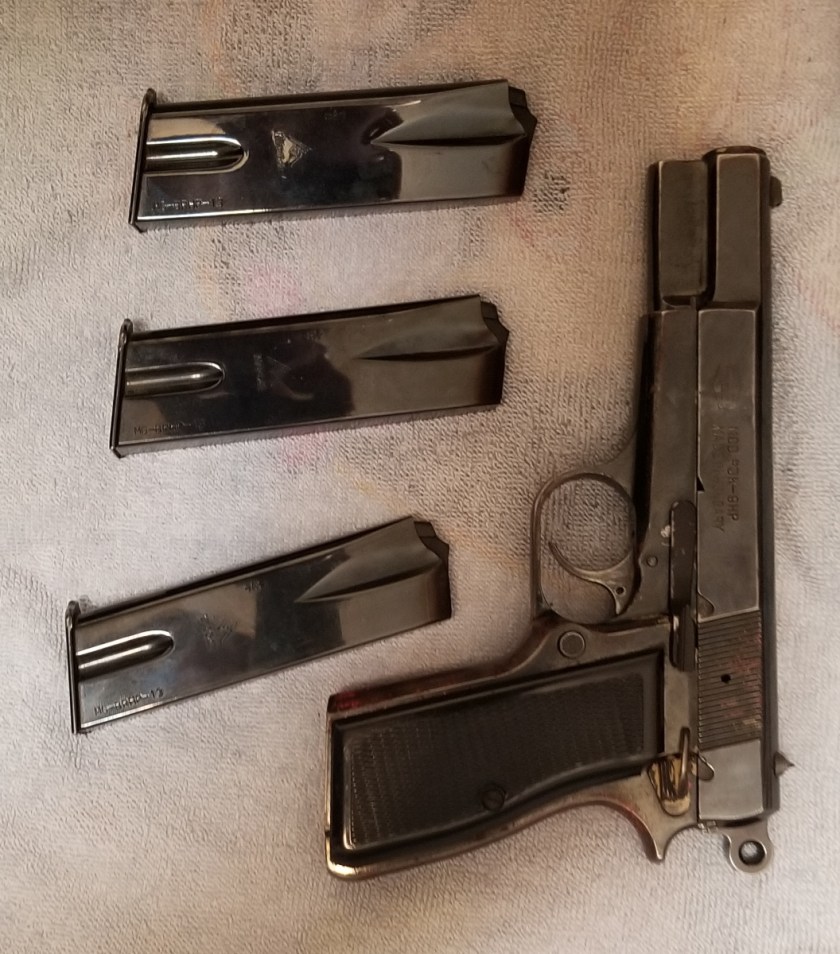
In the latest Indy 1500 Gun and Knife Show I picked up one of my “bucket list” guns: a Hungarian made Browning Hi Power. (The “bucket list” just said “Hi Power”, not specifically Hungarian made.) The finish on it is a little rough. Since there’s no real collectors value for this gun, I plan to refinish it eventually.

High Power

In the meantime I took it to the range yesterday for the first time and ran a box of ammo through it.

Fit my hand surprisingly well for a double stack. I have big palms but short fingers–a combination that makes it hard to find gloves, let me tell you. I’ve shot other double stacks and they’ve all felt clunky in my hand (yes, even the mighty CZ75B 😉 ).  One compact .380 was actually painful to shoot simply because of the shape of the grip.  The Hi Power was very nearly perfect.

The Hi Power pointed well so I could get the sights lined up and on target quickly. Shot nicely. I’m not all that great a shot so I can’t really speak to its accuracy but well within “Minute of bad guy” at about 7 yards. Someone in the past had removed the magazine safety. No loss so far as I’m concerned.

The controls (slide release, safety, trigger of course) were all easy to reach. Nice crisp trigger pull. Just one problem. The trigger spring was weak. Sometimes the trigger wouldn’t return fully allowing the trigger lever to reset. Pushing the trigger forward lets it reset and I can fire. Fortunately, this looks like a fairly straightforward fix, simply replacing the spring.  And it looks like it’s easily accessible:  simply field strip (actually easier than a 1911) and drift out the trigger pin.

The Evil of Red Flag Laws

Another reason why “red flag laws” are out and out evil.

Some years back, I had some business with a lawyer. What the business was is unimportant to this post (it did, in the end, come out in my favor). In the course of the business he told me of a case where a man spent every summer in jail. Seems the man’s ex would accuse him of assaulting her. The police would arrest him. Then, when it came to trial she would not show up and the case would be dismissed on “lack of evidence”.  Then the next year, she would do it again.  As you can imagine, it made it difficult for this man to hold down a decent job or anything of the like.  So making bail every year was out of the question.  And so from arrest to trial (at which point charges would be dismissed through lack of evidence), he sat in jail.

I asked the lawyer if the police didn’t eventually figure out what was going on. He said that from their perspective they didn’t see “a bunch of false accusations.” They saw a man with record with a long list of arrests.  The judges hearing the case for arraignment would see the same thing.  And, as their thinking no doubt went, where there’s that much smoke….

This is just one case in a situation where there is due process protection:  primarily the “speedy trial” provision.  For sufficient values of “speedy trial.”  I’m not even really complaining about the system here.  Any system is going to be abused (see “First rule of government“).  About the only thing I could think of to add in cases like this is stronger censure about people making false reports and reports which they don’t follow up on.  But this is what happens with due process protection.  And even with them, there are people who will use it to harass the innocent.  Take that away and what do you think will happen?  Really?

“Red Flag” laws are just another way for the vindictive and just plain evil to use the state to carry out harassment and abuse on their behalf.  And it does so to accomplish something which are already addressed by existing law if the state will just use them.  Chief among these is the 72 hour psych hold.  You can take someone suspected of being “a danger to self or others” in for 72 hours, 3 days, for evaluation allowing them to gather evidence to make a case before a judge (at which the accused can also be represented, present his or her own evidence, and argue his own side of the case) that the person needs to be deprived of liberty or property (I’ll presume “life” isn’t on the table in cases like this).  You know, what whole Fifth Amendment thing about “nor be deprived of life, liberty, or property without due process of law”?  Yes, it’s a lot of trouble to do that.  It’s supposed to be a lot of trouble.  Depriving someone of basic rights like life, liberty, or property is supposed to be hard.

If you want something easy, find a different line of work.

Thus, “red flag laws” are not necessary.  The only thing they “buy” is the ability of people like the ex described above to get the police to harass people they don’t like.  And that makes them far worse than useless.

That makes them downright evil.

Cultural Appropriation Again

Elsewhere someone was talking about this silly concept of “Cultural Appropriation”.

  • I wear pants, an article of clothing invented by the ancient Chinese.
  • I speak English, a language that derived from Norman soldiers trying to seduce Anglo-Saxon barmaids.
  • Our government is a Republic, derived from a form invented by the Romans (Plato’s “Republic” had nothing to do with anything we recognize as a Republic today), with other parts deriving from the Dutch Republics and even the Iroquois nations.
  • I drive a car, the motor-carriage being invented by a German.
  • The general purpose computer I type this on is owed to an Englishman.
  • My dinner was “Italian” which featured tomatoes which come from the Andes. And since I’m on a low-carb diet the
    •  pasta (invented in China) is actually
    • Shirataki noodles, which come from Japan
  • My ex comes from Japan meaning my daughter is half-Japanese.
  • My father’s ancestors from Germany
  • My mother’s from Ireland.

I could go on and on.  Dogs originally domesticated in Eurasia.  Buttons on clothes from Germany.  Coffee (although I can’t stand the stuff, others can’t live without it) from Ethiopia.  Chocolate from Central America.  Beer from Mesopotamia (modern Iraq).  Wine from China (Take that, Frenchies!).  Distilled liquor comes from Asia, by way of Greece and then via the Arabic alchemist Abu Musa Jabir ibn Hayyan (often referred to as “Geber”).

Cultural Appropriation? That _is_ our culture.

First Rule of Government

The First Rule of Government:
Any government power that can be abused, will be abused.

The Second Rule of Government:
All government powers can be abused.

This means that any use of government power needs to be wrapped around with all manner of checks and restraints. You won’t prevent abuse, but you can, at least, make it more difficult and, hopefully, slow the progress of abuse.

Whenever some new policy granting power to some part of government is proposed, the first question the wise man will ask is “how will people intent on abusing power use this?”  A good touchstone is to personalize it: “how would my worst enemy, intent on doing me harm, use this?”

If the answer to that question makes you break out in cold sweats, maybe thing twice about granting that power to government.  If it doesn’t make you break out in cold sweats, well, I hate to break it to you, but that doesn’t mean it’s safe.  It may just mean a failure of your imagination to consider all the ways that it might be used to your harm.

This is why I am utterly and completely opposed to the “Red Flag” law proposed in Congress.  Basically, these laws state that somebody can make a claim about an individual–the individual being a “danger to self or others”–and police will swoop down on this person in order to remove any weapons they might have.  And if the person makes any mistakes, any mistakes at all, why the police already have an excuse to open fire because, you know, “danger to self and others.”

The requirement for “due process” is supposed to be a check on government abuse.  This flies in the face of that.  Simply having a judge rubber-stamp someone’s accusation does not make it “due process.”

Due process is a two-way street, which includes actual evidence and not just somebody’s word and allowing the accused to present evidence and call witnesses in his behalf.  It is not just one side making a decision unilaterally.

Admittedly, there are some limited cases where things can be held for a very limited time while things are sorted out (that three day hold I mention–most arrests as another example) but only for a very brief period so that the process doesn’t become the punishment. They are limited for a reason.  It’s why there’s a “speedy trial” provision in the Bill of Rights and why we have things like Habeus Corpus (you can only hold a person so long before charging and before arraignment).

“Red Flag” laws fly in the face of all of that.