This guy, in an effort to try to extend his fifteen minutes, just keeps spouting nonsense. This time it was a Washington Examiner article which cites him as saying “You’re a terrible shot if you need an AR-15 to defend yourself.”
As usual, Hogg doesn’t know what he’s talking about. That’s a given. But for folk who aren’t clear and yet are still “teachable” let’s go into things a bit.
First, one of the things that happens when a person is in genuine fear for their life is that a whole lot of neuromuscular things happen. The old “fight of flight” reaction (actually a lot more complex than that but it will do for the moment). Your body prepares for maximum effort to either run or to fight. Now, one of the effects this has is to trade off things like fine motor control for strength, speed, and relative insensitivity to pain–all things that to our ancestors could make the difference between life or being cave bear chow. However that loss of fine motor control means that when really scared, your marksmanship deteriorates a lot. So even if you are an excellent marksman at the range, where the targets don’t shoot back, you’re not going to be able to equal that performance when faced with a real threat. (This is also why “shoot to wound” is nonsense.) Check out police trainer Massad Ayoob’s book “Stressfire” for an in-depth look at this.
Second, bad guys don’t just come one at a time. Case after case we see multiple people breaking into someone’s home. You can take out one only to have the next get you. Unlike the police who have backup on call, who can wait until they have overwhelming force before confronting the bad guys, all you’ve got is yourself and what you can grab quickly in the heat of the moment.
Third, while in the movies when the good guys shoot the bad guys one shot is all it takes, that isn’t how the real world works. You can mortally wound the bad guy–put a bullet right through his heart (but see point one above) so he’s essentially dead on his feet–but that doesn’t mean he’s stopped. “The dead man’s ten seconds” is a concept that goes back at least to the Civil War. A person can be shot, essentially a walking corpse, but they’re still a threat until they finally go down. Maybe they’ll spend that “dead man’s ten seconds” looking down at the hole in the body and regretting the life choices that brought them to that point. Or maybe they’re they’ll use that time in a rage-driven frenzy which, unless you can give them something else to think about (like other holes in their body) can lead to them taking you with them.
These reasons are why the police want weapons like the AR15 (and it’s full-auto cousins the M16 and M4) available for themselves, this despite what I said about backup and most of the time the ability to wait until they have overwhelming force before choosing to engage. Ordinary folk face the exact same threats the police do, and so so first with only what they have on hand and can grab quickly.
Recently, I had a series of issues with the old Ford Explorer that led to some rather expensive repairs. Now, if I’d had the total bill up front I might well have decided I was better off replacing it but they came bit by bit and in making those decisions you have to consider what you have in front of you and what you can expect going forward, not what has already been spent.
It started when I replaced the tires. This is the third set I’ve had on the car. I’ve gotten good use out of them but the tread was getting shallow and it was time for new ones.
Not long after replacing the tires, I started getting some oddball handling issues. At first, I thought that it might have been something wrong with the tires. After all, when something happens soon after a change, that’s the first place to look. But, no. It seems that after more than 190,000 miles (of which more than 160,000 were mine) the right rear bearing was shot–to the point that it had actually damaged the axle. So had the shop replace those–committing me to that repair right there–allowing them to do some further test drives. Looks like the other bearings were also on their last legs. What I thought was “tire noise’ on the road was the bearings, which should not be producing noise like that. So added that repair on. In addition they also replaced swap bar links and some other things.
All well and good only not long after I get stranded on the road because apparently the brand new bearing they’d put on that right rear axle had come apart (that’s actually how they described it later). Frustrating, but I get towed back to the shop and they not only cover the repair under warranty but comp me the tow, the Uber’s to get home and to a car rental agency, and the cost of the car rental while they’re making the repair.
And, after that the Explorer has been handling great–at least as well as one can expect. After all, it’s an SUV, not a sports car. Rides significantly quieter too. Now I know that the noise I was hearing was not tire noise (from past experience I knew that some tires were noisier on the street than others) but warning that the bearings were getting ready to go. I’ll know better next time.
However, despite that, there were still a few issues. The engine had been occasionally running rough and once in a while would be hard starting. On reflection, I thought back and realized that a “tune up” had never been done. I was still on the original plugs and wires. So I bought a new set and installed first the plugs. Inspection of the old plugs showed no problems. You can tell some important things about the internal condition of an engine by reading the plugs. No carbon fouling. And especially no oil fouling (which could indicate ring or valve seal problems). The gaps had gotten quite quite wide from wear, but that was all. Indeed, I probably could have just re-gapped the original plugs and put them back in. I went ahead and installed the new plugs anyway. Didn’t install the wires. Apparently that’s a much bigger task requiring (at least) removing the alternator.
This resolved the hard starting issue and much of the rough running.
Finally, when I went in to get the regular oil change done. While I was there I had a fuel injection cleaning done.
And now the Explorer just purrs contentedly. Runs much more quietly with more repsonsiveness to the throttle (kind of thing that creeps up on you). Very, very pleased with the results.
I’ve still got to change the spark plug wires and the fuel filter. Both are a little more involved process with the explorer than with some cars I’ve owned. For the latter, I’ve got to get it up on jack stands. And I’m getting close to due for a transmission service, probably next month.
But even without those, she runs like new again. A little beat up on the outside but:
She may not look like much, but she’s got it where it counts.
That was something my mother said to me when I’d tell her how I thought the world ought to be. And it was old when her mother told it to her.
It seems there comes a certain time in a young person’s life when their vision starts to expand beyond their immediate home and they start looking at the larger world. And they bring concepts of “fair” and “right” which, while well meaning, lack the, shall we say, depth that comes with experience?
And they are so certain that they know exactly what would make the world right if people would just… Only they have no idea of the costs (not just the old economic bugaboo of “allocation of scarce resources that have alternative uses” but the human costs) of their “just” and what second and third order consequences would be (what Thomas Sowell called a failure of “thinking beyond stage one.”)
But they are so certain of their rightness. And their limited knowledge of the world convinces them that they are the wave of the future and their victory is assured, at the very least after those old fuddy duddies with their outdated ideas die off.
Case in point there was this tweet by David Hogg:
Look, David. Your fifteen minutes is up. Give it a rest already. And your attempt to look badass? You just look constipated. Also, you’re going to Harvard. I know that your admission was purely a virtue signal on their part, but come on, I would expect a better understanding of punctuation from someone going to what has been one of the most prestigious universities in the country. You’re making them look bad. But the real issue is your claim of certainty of victory. (Now, I’m giving you the benefit of the doubt here. Your actions do look a lot like instead of any well-meaning but misguided through a lack of experience and understanding of the larger world stance, you are just riding the issue for your own benefit–after all it got you into a far better college than you could hope to attend on your own merits.)
The first thing you need to remember is that not all young people think like you. And of those that do, many will shed their ideological blinkers and start looking beyond what they want to be to the realities of what is. In short, many will outgrow your certainty.
But, if none of that moves you to think beyond your own narrow views I can at least offer an anthem for you, from others that also felt that they, the younger generation, would win.
Things like “the future belongs to us” and “We’re on the right side of history” have been said before. And if you actually knew and understood history, rather than the pre-digested pap that was spoon fed to you in school, you’d know just how ominous such sentences can be.
In the meantime, you’d better write that book while you still know everything.
I don’t usually do back-to-back blasts from the past, but a post on a friend’s FB page brought this subject up:
That is a refrain I hear all the time. Automation, will take over people’s jobs and put them out of work and we’ll end up with endless numbers of people for whom there are no jobs.
But is that really how it works?
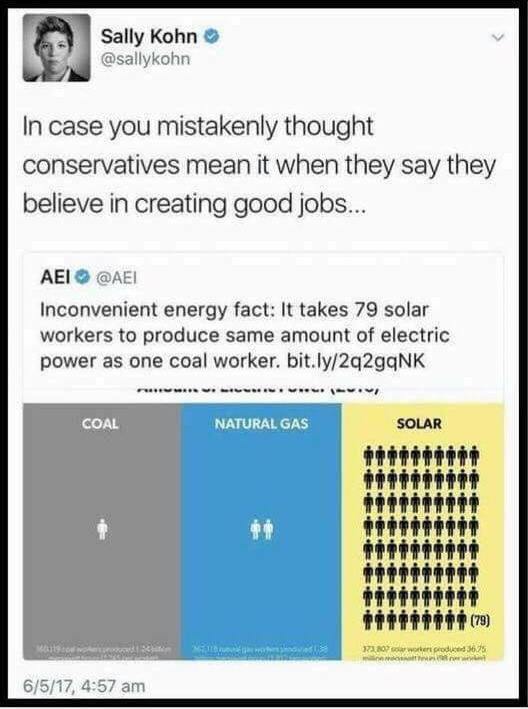
Liberal political commentator Sally Kohn seems to think so:
She is clearly advocating here a means of producing energy that requires 40-80 times as much labor to produce a given amount of “product” (in this case energy). Exactly the opposite of what automation does.
Automation, the use of robots, produces more with less labor than was possible before. That means we don’t need as many people to fill the need for whatever we’re producing. And that means the “excess” people are out of work, right?
Sorry, but that’s not how it has ever worked except in the very shortest of terms.
Producing more with less labor has been the spur for economic growth since before recorded history began.
In early agriculture, farmers planted crops by poking a hole in the ground with a stick, dropping seeds into the hole, then closing it by stepping on it. One person could raise enough food that way to feed him or herself with very little surplus. Just about the entire population had to be full-time farmers.
Along the way somebody discovered that if you dragged the stick along the ground you could create a furrow, preparing a field for seed in less time. This rapidly turned into the scratch plow pulled at first by other people and later by animals. One person could keep more land in cultivation, meaning you needed fewer people to produce the food for your population meaning more people were freed up for other activities. People could become artisans, and craftsmen–specializing in those activities and not simply performing them as a sideline between stints in the fields.
It is no coincidence that the flourishing of the ancient civilizations of Mesopotamia, the Nile valley, and the Levant arose following the invention of the plow–other things too such as the potter’s wheel, which also allowed fewer people to produce the pots and urns that people needed.
So it has been throughout history. Western (i.e. European) civilization took off when extensive use of water mills, and later steam power, took the place of muscle power for industry.
One of the steps along the way, an early example of automation, the use of punch-card controlled looms for making textiles, led to actual protests. A movement started by a probably mythical individual by the name of Ned Ludd, protested the new looms, claiming that it would put weavers out of work. The protests involved both violence and sabotage.
Of course, the use of the new looms proceeded apace and, contrary to the fears, the economic growth more than absorbed any weavers displaced by the automation process. Nor was the displacement as bad as expected because by producing more textiles more cheaply, international trade increased the quantity demanded.
And so it has gone ever since. Machine tools. Assembly lines. Railroads. Modern shipping (compare the crew to cargo ratio of a modern container ship to an old merchant sailing ship). Industrial robots of increasing sophistication. And now robots that are poised to take your order and make your food in fast food establishments. All of them ways to get the same job done with less human effort. The latest round is no different from any of the previous ones.
What all of them do is to free up people to do other things. This is the core of economic growth and we all benefit from it.
If you don’t believe that, I invite you to try to live as that prehistoric farmer family did–feeding yourself by poking holes in the ground with a stick (no cheating by dragging the stick to create a furrow).
It’s been a year and this one is worth sharing again. I don’t plan on making it an annual tradition but it’s not like there isn’t always something the anti-gun folk (even when masquerading as “common sense gun control” folk) are bleating about.
On Facebook, someone was claiming they represented a large “middle ground” that wanted “cooperation” on gun laws.
“We want cooperation” he said. The problem is, every time people say “we just want this reasonable restriction, this ‘common sense gun control’. That’s it. No more.” They lied. Every. Damn. Time. The ink wasn’t even dry on their “compromise” before they were calling it a “good first step.” Doesn’t matter how many steps went before, it was always a “good first step” and a springboard to yet more.
We have learned that “cooperation” is to give them a little bit more than they have now for any given now. And once they get it? That becomes the new “now” from which they demand “a little bit more.”
You can’t cooperate with people like that. You can’t compromise with them. At some point you either have to say “no more” or accept the eventual total loss of your rights.
And if we have to say “no more” at some point, why should it beafter the current round of demands? The same people who are saying “but you won’t compromise” now would be saying it next time around as well. After all, this isn’t the first, or even the tenth time we’ve been down this road–always with the same result.
I watched this happen with the passing of the Brady Act. The proponents were all about how they wanted the waiting period on handguns “to give the police time to perform a background check.” The law passed ink wasn’t even dry on Clinton’s signature before the same people who were saying they just wanted that reasonable compromise were calling it a “good first step.” And then, when the NICS system went into effect in 1998, creating a central repository for criminal records and other things disqualifying a person from being able to purchase firearms so that for most cases a simple phone call from the dealer to NICS could get a “yes/no” answer in a matter of minutes. (Mostly–sometimes it can take considerably longer and the prospective purchaser has to wait.) The waiting period portion of the Brady Act sunsetted, replaced by NICS. But there’s more. While the waiting period and its background check applied only to handguns, NICS applied to rifles and shotguns as well. That didn’t stop the same people who were saying that the reason for the waiting period would be that it would allow the police time to perform a background check, from saying that now they wanted both the background check and the waiting period.
They are never satisfied and they will say anything, anything at all, that they think will get them the concession they’re working on at the moment.
And yet, the same people wanting us to “cooperate”, to “compromise”, are unwilling to cooperate and compromise with us. You want us to give up something? Okay, let’s talk. What are you willing to give us in exchange that we don’t already have? Because if we’re not getting something in exchange for what we’re giving up, its no more than “cooperating” with a thief by only giving him half your money. This time.
It has been said that you cannot negotiate with someone who says “What’s mine is mine and what’s yours is negotiable.” It’s the same principle here.
Unless you’re willing to offer something at least as valuable as what you’re demanding, you don’t want “cooperation”, you want surrender. The only question is the terms of that surrender.
Some years back when I had my “musical awakening”, I was introduced to the term “symphonic metal.” Now I had heard symphonies. And I had heard metal (without, in those earlier years, appreciating it). And when I heard the term “symphonic metal” I thought it had to be remarkably pretentious.
Then I actually listened to some:
Of course, Nightwish isn’t the only symphonic metal band out there by far.
In a review of the next one the reviewer criticized Liv for “bombast” and her use of “operatic registers.” However, those were the very things I love about her vocals:
Then there’s this group:
(joined by Tarja, formerly of Nightwish here)
Epica is also not to be missed:
Some might disagree with categorizing Delain as Symphonic Metal but I’ll put them here because they are just that good:
And that, I think, is enough for this time around.
“While we live, let us live!” That’s the inscription of Lady Vivimus, the sword that Oscar Gordon used in Robert Heinlein’s book “Glory Road.”
Jordan Peterson, in his “12 Rules for Life” called it (Rule 11) “Do not bother children when they are skateboarding” (It makes more sense in context.)
First off, sorry about being rather spotty about updates of late. Life, as they say, happens.
I am sitting here with a bruise on my right hip and a rather large swollen lump on my right elbow (as well as various muscle aches) because of a rather bad fall at ice skating lessons yesterday. I actually did a pretty good Judo breakfall. Kept my chin tucked so I didnt hit my head. Arm out to cushion the impact to my body (which is where the elbow injury came in–“pretty good” meant that my arm was turned so the point of the elbow struck directly otherwise it would have been “perfect). Landed turned slightly on my side, so there was plenty of “give” to soak up more impact (thus the hip bruise).
Yeah, it hurts. And if I’d stayed off the ice and didn’t do anything as “silly” as deliberately going out onto a slippery surface with blades strapped to my feet deliberately designed not for traction but to slide I would have been safe.
People these days are entirely too concerned with “being safe”. Now, don’t get me wrong, a reasonable level of safety is a good thing. The problem is some people decide that only “perfect safety” is “a reasonable level”, not just for themselves but for anyone else and, thus, “it’s not safe” is taken as full and complete justification that something should be eliminated at any cost. “If it saves just one…”
The problem, of course, is that you can’t have perfect safety. It doesn’t exist. And anything, absolutely anything you do–or don’t do–has some risk to it. Also, the attempt to remove all risk takes all the living out of life.
Consider an individual who, from a very young age, lived in a sealed chamber. No sharp edges or hard surfaces against which this individual could cut themselves or suffer a bruise, or, heaven forbid, a concussion. Air filtered to remove all potential bacteria, viruses, even allergens. Food carefully pureed so as to avoid even a hint of risk of choking–of exactly the quantity required to maintain the ideal weight of the individual–with the individual carefully monitored and diet adjusted to any changes to the person’s body fat remains at the ideal, healthy level. Soft, indirect lighting (no bright spots) kept to a modest level (to avoid possible eyestrain or other damage to vision) and filtered to avoid UV or other harmful radiation. Multiple redudancy in all the systems providing all that so that they will continue uninterrupted in the face of a failure of some part or parts until repairs can be made.
That individual would be as “safe” as it is humanely possible to make them. Not perfectly safe (some “multiple simultaneous failures” could still happen cutting off light or air or food) but it is as close as we could get. So, the individual would be safe. They would also be driven mad in quite short order from such a sterile (both literally and metaphorically) environment.
People need not just “safety” but stimulus. And more than that, they need challenge. But that entails risk. Even simply meeting another person and talking to them involves the risk of the transmission of airborne illness (never mind any closer contact). And as soon as they step out of that chamber, they get exposed to a host of allergens, germs, and parasites. There is machinery and people that can cause accidents. The very world might strike against them with storms, volcanoes, Earthquakes, floods, landslides, and a host of natural disasters. The skies may rain down meteors or comets. Solar events could wipe out electricity and electronics. The list of risks one faces cannot be eliminated. Some can be mitigated but they cannot be completely eliminated.
And efforts to eliminate one risk will often lead to the increase in others. Eliminate cars and the risk of auto accidents, and you don’t have a network of roads allowing emergency services to reach you quickly in an emergency. “But what, then,” someone may ask, “did people do before cars and roads and auto accidents and air pollution?”
They died, someone. A lot of them died. They died because an ambulance couldn’t reach them in time. They died because “fire fighting” was a group of whoever was handy passing buckets of water from a hand-pumped well to a burning house. They died because the world is a dangerous place and the risks of “ubiquitous automotive travel” were still in the future and, thus, not available to reduce the risks of the then “now”.
You cannot eliminate risk. You can only weigh risks in comparison to other risks.
One risk, however, that often gets neglected in such comparisons is the risk of removing the life from life. People need challenge. They need stimulus. They need to overcome. Not everybody has the same level of need, or find the same challenges providing the stimulus they need, but I feel fairly safe to say that everyone needs it. If they don’t get it, they may not recognize the reason for the ennui and dissatisfaction with life that they feel, but it will be there.
Let’s go back to the injuries I mentioned at the beginning of this piece. Yes, if I stayed off the ice, I wouldn’t have them. I could quit and avoid the risk of fewer such future injuries. But what would I lose in doing so?
Well, one thing would be a small amount (really, it’s tiny. You’ll hardly miss it) of self respect. I will go on knowing that I quit, that when things got difficult, I folded like a cheap suit. (Where in the world did that metaphor come from? Do “cheap suits” fold more easily than those of more expensive construction?) Maybe that’s a little thing. And maybe I could salve over the loss with the idea that I was “smart” and did the “sensible thing.” If I do a good enough patch job, I could even end up feeling good about it.
Another thing I’ll lose is the future enjoyment of skating for fun. And that will be the greater loss there because I used to skate and I did enjoy it. And I remember how frustrated I was at the lack of opportunity to skate more–where I lived at the time the only “ice rink” they had was an outdoor basketball court that they flooded over in winter and let freeze when the weather was cold. Yes, it was as bad a venue as you might imagine, but it was all we had so you take what you can get.
In fact, I think that’s a part of my difficulty now. I remember skating for fun when I was younger. Only, now, the learned reflexes that keep me upright on the skates are gone. I have to relearn them. The knack of balance I once learned has to be relearned from scratch. And now I have the greater challenges that I’m simply older. My body is neither as flexible nor as resilient as it was before. and building new reflexes and “knacks” is simply harder at 58 than it was at 18. And yet, I remember being able to do that (without “remembering” in a useful way how) so frustration leads me to pushing harder than I’m ready for now. And sometimes that leads to faster practice. Other times, it leads to falls like yesterday’s and the attendant injuries. (And yesterday I was running on three hour’s sleep for reasons we need not go into here, so that didn’t help.)
But there is one advantage that older me has over younger me. I understand quite well that “this too shall pass.” There is nothing keeping me from reaching my end goal of skating better than I ever did in the years between when I was 18 to 23. (Frankly, I wasn’t all that good–perfectly okay with recreational “round and round” but not much more.) And the difficulty I am having now will make the final success all the sweeter.
As I discussed before matching the money supply to economic output is a big part of what makes a healthy economy. The problem comes with how to do that. What goes into “the money supply” as it is meant by economists.
Part of it is simple. Back in the era of “hard currency” (money consisting of, or at least backed by, precious metals) how much precious metal you had determined (more or less–we’ll get to that in a moment) the money supply. However, increasing the money supply to match increases in economic output was another matter. The world economy in the 20th century far, far outstripped any new finds of precious metals.
Even before abandoning the gold standard it became fairly common for governments to issue more currency “backed by” gold than they could redeem with the actual physical gold they had on hand. This worked out fine so long as most people accepted the “gold certificates” and did not insist on redeeming them for physical gold. The effect was similar to that of older cultures–where coins made of the precious metals were the currency–debasing the currency by admixture of base metals. So long as the increase of money supply this way approximately matched growth in economic output, all was well. But the temptation, as always, remained to increase the money supply still more leading to inflation and all the problems that causes.
Once governments went to so-called “fiat money,” that is, money backed up by no more than the “faith and credit” of the issuing agency, it became simpler. The money supply is then simply the number of pieces of paper with elaborate printing on them combined with the number of cheap stamped metal trinkets. Want more? Print/stamp more. Again, this is “more or less” the money supply.
And now, in the era of electronic banking, it’s not even that. “Money” can be created by simply changing figures in a computer.
Most of these influences on the money supply are “top down” and controlled by whatever authority happens to be in place, generally the government. In principle, these could be set up to create a stable, entirely predictable money supply.
However, government isn’t the only factor controlling the effective money supply.
Consider fractional reserve banking. People, rather than stuff their money into mattresses, put their money into banks and other institutions. The idea is that the money is safer there. Banks can afford a lot more security than can the typical individual and in the modern age there is insurance protecting depositors against losses. That money, however, doesn’t just sit in the bank’s vaults. Money sitting in the vault is nothing but a cost to the bank and the bank wants to make money. So, what the bank does is lend out some of that money, keeping only a fraction on hand (the “fractional reserve”). From an economic standpoint, the money is serving two purposes. People have their savings. That’s one use. A large chunk of this same money is also being used by others to buy houses, cars, and consumer goods, and is back in circulation working in the economy until someone else puts it back into their savings. Like this case with the gold certificates mentioned above, this works well so long as most people leave most of their savings in the banks and you don’t have everyone trying to withdraw all their money at once (a “run” on the bank).
This has the effect of an increase in the money supply. This one is a lot more dynamic and a lot less amenable to top-down control than simply determining how much money is printed or what credits are granted by issuing banks (i.e. the Federal Reserve). An example of that is when you get a “panic.” When you get a run on one bank, that’s bad for the bank and its depositors (less so for the depositors in the era of deposit insurance) but when you get a run on a lot of banks or banks in genera, a “panic”, the result is that you lose this double use of the money leading to a contraction of the effective money supply.
A big factor in the Great Depression was just that–widespread bank failures causing a contraction in the effective money supply. Normally, this would lead to deflation causing prices to plummet which would be bad for borrowers and pain caused because some things will fall faster in price than others. However, the federal government tried to bypass part of that “correction” by shoring up one of the prices from falling–labor prices. But by forcing labor prices to be higher than the “market clearing” price, this created a surplus–more labor available at that price than people were willing to buy at that price. Translated into more common terms: rampant unemployment. And the Federal Reserve, which had been created as a result of previous bank panics to help stabilize the money supply and prevent just that, failed utterly for reasons that are more than I can really cover in this post but that I may go into later. The interested reader could find more in Milton Friedman’s “Free to Choose“.
Thus, the problem of keeping a stable money supply and avoiding the twin pitfalls of inflation and deflation is not a simple one. In the real world, any system attempted is likely to have occasional mismatches between the money supply and economic output. When that happens the the urge to “do something” becomes strong indeed but almost always this is an urge that should be resisted. Left to itself, the issue will generally sort itself out, usually more quickly than if the many wrong “somethings” are done.
Better to do nothing than to do the wrong “something.”
Yesterday I talked a bit about money, a common medium of exchange, where it came from, and why it makes economic transactions more efficient (meaning more goods and services produced for the same total expenditure of resources–which include time and effort–than if one is limited to a pure barter economy).
One of the things I mentioned was that early money consisted of small bits (whether made into coins or otherwise) of precious metals. One of the advantages of this form of money is that it limited the supply of money keeping the value of the money high. I have discussed why limiting the growth of the money supply is a good thing elsewhere.
One of the things that money allows that is harder to do in a barter economy is savings and investment. It’s not entirely impossible to do those in a barter economy and I used an example in a discussion of interest previously. In that previous post I show that “interest” is justified by the fact that when one loans something, even if it is returned exactly in the condition in which it was loaned, one is still out the benefits that one could have had of it during the period of the loan. This loss, the benefits one could accrue from the use of the lent object, is deserving of compensation and thus forms the basis of interest.
While one can save many material goods–grain storage, a shed full of pottery, duplicates of tools one might use in the future–others are more difficult. Fresh milk and meat only keep so long, especially in the days before modern refrigeration. Money, in addition to being convenient for also commerce, is also generally non-perishable.
Money also makes investment far more convenient. John and his plane (from the earlier post on interest) only works because John, being a carpenter has the plane and is able to loan it to another carpenter. If John were a baker with an extra oven and George still needed a plane, well, neither would be able to help the other. If, however, instead of putting his extra effort into making an oven (analogous to making the plane the first time) John could instead put aside some money that could be used to purchase an oven and instead loan the money to George which George could then use to buy or rent a plane. Even though the transaction is now one of money rather than material goods the same principle applies. John could use the money to buy an oven to increase the capacity of his bakery. Instead, he loans the money to George and thus is deprived of the benefit of that increased productivity. This deserves compensation and so, George is expected to pay back not just the amount loaned, but a somewhat greater amount…interest.
The idea that money, put into others hands for use, in return for a greater amount to be returned later is a very old one–common enough in Biblical times for Jesus to use it as an example in the Parable of the Talents (a “talent” being a weight measure of gold or silver–a rather large one in fact, about 130 lbs).
This works, however, when the value of the money itself is relatively consistent. As I describe in the blog post on inflation dramatic increases in the money supply relative to economic output cause the value of money to go down–more money is required to buy the same goods or services. This is bad for John. What he gets back at the end of the loan/investment is less, in terms of what he can do with the return than it would be absent the increase in money supply. On the other hand, it’s great for George. His goods are selling for a lot more of the money he needs to pay John back.
The flip side can also happen. A decrease in the money supply relative to the economic output leads to an increase in the value of money–a given amount of money will buy more goods and services–deflation. This, as it happens, is great for John (to a point–which we’ll get to momentarily). The money he’s getting back from George (again, to a point) buys more than it would otherwise. This is, however, bad for George. His goods are selling for less, but he still owes John the same amount of money. And this is where we reach the “to a point.” The deflation doesn’t have to go very far at all before George finds himself unable to pay the loan at all. He defaults. And John gets nothing. Both of them are harmed by the deflation.
While people have a natural reaction to think that low prices are a good thing, it should be clear from the above that a general deflation is actually harmful and may actually be worse than a similar level of inflation.
These twin monsters, the Scylla and Charybdis of money, are why one ideally wants money supply to keep close pace with economic output. As populations grow, as industrialization and technical innovation increases productivity, the money supply needs to grow as well. And, so the very benefit of precious metals becomes a weakness. The scarcity of precious metals that prevents runaway inflation also means that one might not be able to increase the supply (finding and developing new ores or shifting from other uses such as jewelry to use as currency) sufficiently to match economic growth.
The “solution” that governments have used to escape this weakness of precious metals standards has been to go to “fiat” currencies, not tied to anything except the “faith and credit” of the issuing government. In principle, the money supply could then be adjusted to match economic output, avoiding either inflation or deflation.
In practice, however, government generally find themselves unable to resist the temptation to “solve” short term economic woes by inflating currency as “stimulus”.
It’s been a while since I’ve done an economics post. So here’s one on money.
Money has been around since its invention in Asia Minor nearly 3000 years ago (the ancient kingdom of Lydia). The use of metals as a medium of exchange goes back even farther, to at least 5000 BC.
Money makes trade easier. Consider a purely barter economy. If you make something, chairs for instance, and you want something you don’t make, you have to find someone willing to trade chairs for what you want.
Suppose you wanted milk. You could go to the guy with dairy cows or goats or whatever milk-producing animals and offer to trade a chair for milk but what if he doesn’t want any chairs. “Got all the chairs I need, thanks.” What do you do then? Well, you could find out what the milk producer does want (ewers, say, to store the milk) and find who provides that. So you go to the potter to see about trading a chair for an ewer that you could then trade to the milk producer for the milk you want. But the potter doesn’t want chairs either. So you find what he wants. And so on until you finally get to someone who will trade for your chair. And then you have to go down the chain, making each of the trades, until you finally get the milk that you wanted.
That’s a lot of work to get something to pour on your cereal. (And again to get the cereal on which to pour the milk.) That’s time and effort you could have spent on making more chairs to trade.
That’s where we were for much of prehistory. This basically made trade so difficult that most people produced most of their own goods even if it weren’t the most efficient way of doing it. Trade was limited, largely to resources of widespread applicability. (The early flint trade was simply amazing in its scope.) But somewhere along the line people figured out that a common medium of exchange made trade so much easier. You could trade your chair to someone who needs chairs for this medium of exchange, then when you need milk, you can take the medium of exchange to the milk producer and trade for milk.
Precious metals were among the first media of exchange. Gold and silver were easy to recognize, rare enough that modest amounts could be traded for considerable other goods, and yet easy to divide into small pieces for smaller transactions. Weight and purity determined their value. Weight was measured by balancing against known weights and purity by rubbing against a touchstone. The touchstone was a piece of fine grained schist or jasper. When a piece of gold was rubbed against it it left a streak, the color of which revealed the purity of the gold.
Unfortunately, almost as soon as gold was recognized as a medium of exchange, cheating began. Merchants would have two sets of weights–heavy ones to use when selling for gold and light ones (although claimed to be the same weight) when buying with gold. Everyone had to carry their own weights to check against the person with whom they are dealing to avoid such cheating. And, of course, the use of the touchstone was mandatory. This added a bit of extra time and effort to every transaction, never mind the arguments if weights did not agree or disputes over what the touchstone revealed.
Then, along about 600 BC the Kingdom of Lydia began taking small pieces of gold of known weight and purity and stamping them with a design, making the first coins. People did not need to use weights nor touchstones. They merely needed to count coins.
It was not long, however, before yet more cheating began. People would shave bits of gold from the coins or make fake coins of lesser purity. Nevertheless, the introduction of coinage, of money, made trade far easier.
With the increase of trade came increased specialization in production. A potter, for instance, instead of making a wide variety of pottery so as to be able to trade with more individuals, with fewer intermediate steps, for the things he needs, could instead produce ewers to sell to a few individuals who need those vessels, trade them for money, and then use the money to trade directly for the things he needs. And making just ewers he can get very good at their production, making more ewers in less time allowing him to trade for more money to buy the things he not only needs but wants. This allowed for greater economic efficiency and increased prosperity of the society as a whole.
The other aspect of a common medium of trade, of money, is that it allowed separation in time between the halves of a trade. One could trade what one produces when it is convenient or profitable to do so, then hold onto the money until one needs to make a purchase of something else. This split in time between selling and buying, and the reserve of money between those two lead to a host of other economic activities which I’ll go into another time.


 The Writer in Black