Privilege

These days people talk a lot about “privilege.” Apparently I’m supposed to have it because of the color of my skin or what part of the world my ancestors came from.  And folk with different color skin from other parts of the world, don’t.  All this irrespective of our actual individual circumstances both now and in our past.

You want to know what privilege is?

Privilege is being able to make comments on social media about other races/genders/what-have-you without having your posts deleted or, in some cases your account suspended or outright canceled.

Privilege is being able to commit “strict liability” crimes (that is, crimes where the actions themselves are criminal regardless of whether one “intended” to commit a crime–an example is mishandling classified documents) and have charges dismissed because “she didn’t intend to commit a crime”.

Privilege is being able to put forward the most empty headed, economically and practically unsound policies secure in the knowledge that any criticism will be dismissed as racist/sexist/whateverist because simply of who you are.

Privilege is being able to say any vile thing you want about people of certain races without being fired for it.

Privilege is being able to repeatedly make openly anti-Semitic comments in the halls of Congress, from a position of authority, and receive no official censure.

Privilege is being able to create a hate crime hoax against oneself, pay the co-conspirators with a check, with your name on it, and have the charges dropped because, basically, you did “community service” and let them keep the bond money.

And privilege is being able to dismiss all of the above by simply invoking “white fragility” whenever anyone complains about things like the above.

Privilege exists.  Only it isn’t what’s usually claimed for it.

Asatru Leaning Agnostic: A Blast from the Past

This is a topic I’ve talked about before so there will be much rehash.  I was raised in a religion that, well some consider it “Christian” but others not so much.  In any case, I was taught Young Earth Creationism in it and…the more I learned the less viable that became.  Either the religion was wrong on that aspect–and if I couldn’t trust it on that, how could I trust it on anything else–or the God described by that religion was playing an enormous practical joke on mankind, deliberately designed to mislead most and lead them astray.  This latter one would mean that what the religion said about the nature of God was wrong.  And if I could not trust it on that, how could I trust it on anything else?

The answer was, I couldn’t.  And not being the White Queen on the other side of the Looking Glass, I could not believe seven impossible things before breakfast.  It didn’t happen instantly but over time I found I just didn’t believe it any more.

Humans, however, have something deeply hard-wired into us that demands ritual and symbolism, a look for something outside ourselves.  I didn’t recognize that for a while but eventually the lack caught up to me leaving me open for other possibilities.  Oh, not necessarily for belief.  And thus why I couldn’t fill the need with the common monotheistic religions–belief is the core of their philosophy; that one has to believe is what makes whatever “salvation” they offer possible.  Cynically following a practice without belief simply because it fills the internal need for ritual and symbolism was contrary to my own ethos.  I couldn’t just pretend.

Pagan religions, however, don’t have that problem.  The gods and goddess as described in them generally do not care whether people believe or not.  (This, incidentally, breaks the “magic systems” in many games and books which postulate that a god or goddess’s power depends on the number and sincerity of believers.  But if that were the case then all these gods would encourage their believers to proselytize, to convert others to their belief so that they, the gods would have more power.)

I first got introduced to modern Asatru via the novels of John Ringo, specifically part 2 of Princess of Wands and an oblique reference near the end of Through the Looking Glass.  Curious, I followed up by getting Greg Shetler’s book Living Asatru and Diana L. Paxson’s Essential Asatru.

It was like a flashbulb (and doesn’t that date me) going off.  Here was a system that was not only full of symbolism, but with hooks on which I could build my own rituals that suited me.  It was also built around an ethos that I found highly congenial.  And ones status in the afterlife (should there be such a thing) was based on deeds, not the belief in which I was simply not suited to give, not without a lot more evidence (not “proof” mind, I never asked for proof) than any gods that exist have ever seen fit to offer.

One of the first things the books said was that the myths were stories about the gods, told to convey principles.  Indeed, when I studied mythology in college, that was the very definition of myth, the stories told in a culture to define that culture.  We tend to think of “myth” to mean false, but whether they’re literally true or not they contain a greater truth–the values and ideals that make up a culture.  So the myths are not truth in the literal sense that there’s a large tree and the world is stuck in one of its branches with Asgard in another, Nifflehiem down by the roots and so on.  They were stories told to convey ideas and ideals.

No need to reconcile modern science with Young Earth Creationism here.

That said, on a somewhat humorous note, I am a physicist.  And so I find it interesting to note that in the Norse creation story the sparks from Muspelhem, the land of fire (heat) meeting ice from Niffleheim, the land of ice (cold) was the driver behind the creation of the world.  In much the same way the meeting of heat and cold is the driver behind the science of thermodynamics which is behind everything interesting that happens in the Universe.  Neither Relativity nor Quantum Theory has altered that.  All that happens in the world comes about because of the meeting of heat and cold and energy flowing between the two.

Likewise when it comes to right and wrong, the common monotheistic religions tend to base that on “God said so.”  Pagan religions like Asatru are more like the gods say so because it’s right and wrong (and don’t try to pretend that the gods are ultimate examples of “good”.  They can be flawed just like people are.  Indeed, the ultimate deciders of fate in Asatru are the Norns and you’ll have to look long and hart to find someone claiming that they are “just” let alone “loving and merciful.”)  There is the concept of ørlǫg.  Basically, that’s the weight of ones actions to that point, and to a lesser extent the weight of the actions of those that came before.  It’s what determines ones fate.  Ones fate is determined by the sum total of all that ørlǫg.  One can change ones fate my making different choices but its hard because it takes a lot of effort to shift that ørlǫg into a different direction.  And the direction the ørlǫg pushes you is not simply because the gods say so, but rather the nature of the thing itself.  I have examined that a bit in my post on Morals, Ethics, and Religion.

The Lore of Asatru does not come with a nice convenient set of commandments akin to the Ten Commandments of Judaism and Christianity.   Some modern practitioners, however, have distilled a number of ideas from the surviving Lore into what they call the Nine Noble Virtues.  I find them a good guide, myself.

This is just one of several different lists.  I don’t particularly say it’s better or worse than others, but I had to pick one to go into here.  So, here it is:

Courage.
I’ve generally seen this defined in modern Asatru as the bravery to do what is right at all times.  Determining “what is right” might be open to question, of course, but for me the other virtues serve as a good guide.  It’s also possible that different people may come to different conclusions about what is right:  a soldier defending his home against invaders may see this as the right thing to do.  Another soldier serving his nation in invading and stopping a dangerous “evil” (by his standards) regime may see that as the right thing to do.  And, here’s the thing, they could well both be right.  The solder defending against the invasion is doing the right thing for him.  The soldier invading is doing the right thing for him.  And, in the end, when the dust has settled, the victory has been won by one side or the other, and the soldiers  of the victorious side can honor the courage of their vanquished foes while the soldiers of the defeated can respect the courage of those who bested them.

Courage need not just be courage on the battlefield either.  The political activist who risks arrest to stand up for a position he believes to be right, the scientist who braves ridicule by saying to his peers “you are wrong and I can prove it”,  and the medical personnel who risk infection to minister to the victims of a plague all exercise the virtue of courage.

Courage is also, I think, a virtue that is its own reward and its lack is its own punishment.  There is no need for some stern lawgiver to say “if you do not have courage you will be punished.  If you do, you will be rewarded.”  From the punishment aspect consider Kipling’s poem “That Day”:

There was thirty dead an’ wounded on the ground we wouldn’t keep —
No, there wasn’t more than twenty when the front begun to go;
But, Christ! along the line o’ flight they cut us up like sheep,
An’ that was all we gained by doin’ so.I ‘eard the knives be’ind me, but I dursn’t face my man,
Nor I don’t know where I went to, ’cause I didn’t ‘alt to see,
Till I ‘eard a beggar squealin’ out for quarter as ‘e ran,
An’ I thought I knew the voice an’ — it was me!

And that’s the way it’s been.  The horrible death tolls in battles weren’t usually (not until the “modern” age anyway) caused during the battle itself but in the pursuit.  Shakespeare put it another way: “Cowards die a thousand deaths. The valiant taste of death but once.”  That certainly has been the case in my own life.  When I’ve let cowardice dictate my actions the result has usually been misery, even if I avoid whatever it was I was afraid of.  When, on the other hand, I am moved by some small measure of bravery the result is that I’m usually happier even in “failure” than otherwise.

And yet given all of that Courage is a hard one for me.  Fear is a powerful motivator even if one knows, in ones head, that it tends to lead to more misery than it saves you from.  And so this is one I struggle with.

Truth:
Say what you know, or at least believe, to be true and right and it’s generally better to be silent than to lie.  Now, according to the Norse beliefs (remember, we’re talking about Asatru here) there is no obligation to be true to those who lie to you.  In the mathematical field of Game Theory a strategy of tit-for-tat is often the most effective strategy and I find it interesting that a mathematically sound approach is what has come out of Norse religion.

I would add my own thought that Truth may sometimes conflict with other virtues such as Hospitality.  This is the concept of the “white lie” told to spare others hurt.  I’m not particularly opposed to that concept just be sure that 1) it doesn’t cause greater  hurt later and 2) be absolutely sure that you’re telling your “white lie” to spare the other person and not to spare yourself (see “Courage” above).

Honor:
Oh, this is a hard one.  I’m tempted to retreat to the “I know it when I see it” but that wouldn’t be fair.  I’ll try to give my own thought on the matter rather than repeat some other folks words.  To me, honor is the natural tendency to do the right things for the right reasons.  An honorable person doesn’t have to think, doesn’t have to figure the angles, doesn’t have to calculate the odds, he just does it.  It’s what you have when you take all the other virtues and pull them together into one smooth whole.

Loyalty:
As individuals we are rather small things in the vast universe but by giving our devotion to something outside ourselves, whether it’s a cause, a belief, or a person, we can become something greater.  But this only holds so long as we remain true to that something outside ourselves.  To abandon the something is to lose all that one has gained and then some.

Now, this doesn’t mean that devotions cannot change with time, but if they do we need to deal with them honestly.  A clean, honest break with old devotions is better for all concerned than betrayal, deceit, and trickery.

Discipline:
Anything worthwhile takes work.  It takes effort.  It takes putting off immediate gratification in favor of future, greater, satisfaction.  Whether its sweating and aching in the gym three times a week to build a strong body or spending six hours a day studying to learn a difficult subject or pushing doorbells every day to drum up support for the political candidate who supports the causes you favor it takes work, lots of work, to get the greater rewards in life.  And yet every time one takes that road it’s a gamble.

The work does not always pay off in the ways you might like.  When I was younger I wanted to be able to sing well.  I spent hours every week working on it.  I took classes.  I had voice coaches.  The result?  I got to the point that if I practiced a particular song long enough with the right preparation I could stay mostly on key.  But sing well?  I don’t have the voice.  I don’t have the ear.  And I never will.  So that exercise of discipline didn’t pay off.  Or did it?  Humans are creatures of habit.  Simply applying the effort, the discipline, made it that much easier to do so when next I wanted to accomplish something.  Years later when I wanted to get good at Judo, I spent hours every week practicing, exercising, studying everything I could about Judo.  And, while I will never be a “great Judoka,” I got good enough to earn the respect of my peers in the dojo–and the respect and honor of the instructors.

So the rewards of exercising discipline are not always obvious.  It’s easy to say “it’s not worth it” but trust me, it is.  Oh yes indeed, it is.  And I don’t need any old man in the sky to tell me that.

Hospitality:
When I grew up my family had a simple rule.  Well, we had lots of simple rules but I’m talking about one in particular.  Whenever we had guests the rule was that no one went away hungry.  This is a rule I have continued as an adult.  And, I think “hospitality” goes beyond just house guests.  Helping my neighbor at need is also a part of hospitality.  And, in today’s shrinking world “neighbor” can reach very far indeed.Sadly, I’ve seen a lot of people not follow that rule.  Oh, yes, it can be hard to make sure that your guests and neighbors are tended to, sometimes ones duty to guests might mean going short oneself.  Easier to just look after yourself and let others fend for themselves.   Besides, if you’re that hospitable you’ll end up with people who just take advantage of you.

But there’s a catch to that “easy approach”.  A great truth in the world is that if you want to have friends you have to be a friend.  To let others fend for themselves is to end up with a lonely life.  But, there’s another catch as well.  It’s not the cost or the fanciness of the “hospitality” that works the magic.  That it’s provided cheerfully, and willingly.  A table of potato soup and collard greens, provided cheerfully in the presence of good company is far more “hospitable” than caviar and filet mignon grudging from the hand of a stuck up . . . Well, you get the point.

In the myths the Gods were often wandering the world and a guest one hosts could easily be a god.  There’s a lesson there, I think.  Consider any guest as a possible God in disguise and one will rarely go wrong.  And while one might attract a few moochers along the way by that approach, one will rarely lack for friends.

Industriousness:
This one I think relates strongly to Discipline.  Where discipline is taking the harder, longer road to great rewards rather than the shorter, easier road to small rewards, Industriousness is pursuing that road with vigor.  When I chose Judo as a martial art, I chose one that took time and work to achieve high rank rather than one of the many “belt mills” where you can show up for class (if that) pay your fees and you, too can be a black belt in six months.  But that choice would mean nothing if I didn’t put in the time and effort.  If I didn’t do the work.  So it is with many things in life.  Discipline and Industriousness go hand in hand if you want to achieve real success.

Self Reliance:
Too many people these days look for other people to take care of them.  I was raised to take care of myself.  Help others in need, yes–see Hospitality–but there’s a difference between “need” and “want” and the old adage about “giving a fish” also comes into play.  Sometimes your neighbor may want a fish but what he needs is to learn how to fish and perhaps someone to give him a shove out toward the lake.  The best help you can give most people is the motivation and ability to fend for themselves.  And, in that, example is a great teacher.  One helps others be self reliant by being self reliant.

One of the great virtues of being self-reliant is that self-reliance is essential to freedom.  If you are beholden to anyone for your survival then to that extent they control you.  To be free you must be able to stand on your own.  And if anyone tries to make you dependent on him or her, flee that person.

Note that fair trade is not a violation of self-reliance.  Both the farmer trading part of his crop and the blacksmith providing iron tools for those crops are self reliant.  Each takes only what they give good value for.  The employee giving honest work for an honest wage and benefits is self reliant.  There is no shame in doing work, even the most menial work, in order to be able to say “I earned my way.”

I think this is one of my biggest disagreements with the traditional Christian concept of God.  Salvation cannot be earned.  It is given entirely and completely at the pleasure of the Christian God.  A person’s eternal future is entirely at the sufferance of another.  This is completely contrary to the very idea of self reliance.  And so people bow and plead and beg and worship in the hope that they will be given as a boon something they cannot earn cannot win of their own efforts.  And why can they not win it of their own efforts?  Because the Christian God says so.

Perseverance:
No matter what you do you will occasionally face failure.  The truly successful are the ones who can come back from failure and keep striving until they succeed.  Yes, sometimes the reason for the failure is that you’re on the wrong path and no amount of perseverance will succeed, but all too often people quit when continued striving would have brought success.  In the end you have to make that call for yourself.  Quitting is easy.  Nothing is easier than to drift along with each change of fortune.  Staying the course despite the difficulties along the way is much harder.  But it is only there that greatness is achieved.

On This Day: The Quartering Act of 1765

Many people don’t realize just how long the build-up to the American War of Independence was.  To hear some people talk, you’d think British passed the Stamp Act one day, the next we held the Boston Tea Party, and before the weekend was over we were at war.  Actually it was a long, slow process of disaffection that led to the colonies first taking up arms, then declaring independence, and finally winning it.

In the aftermath of the French and Indian War, which itself was basically the American edition of the Seven Years War–starting, in fact, two years before that war is generally considered to have begun.  During the war, most of the colonies agreed to provide provisions, including quarters, for the army.  But once the war was over, sentiment in the colonies changed.  They hadn’t had a standing army in the colonies before the war.  Why, they asked, should they need one now?

This army had its headquarters in New York because the New York assembly had passed an act to provide quarters for them.  When the Treaty of Paris ended the French and Indian War in February of 1763, the act providing for quarters was allowed to expire, which it did on January 2, 1764.

As the colonies were not willing to continue to provide quarters and provisions for an army that it saw served no useful purpose in the colonies, the Commander-in-Chief of British forces in America asked Parliament to do something.  Parliament responded with the Quartering Act of 1765.  This act required housing British troops in barracks and public houses.  But if these were not sufficient, i.e. if the British sent over more troops than there was barracks space, then, the troops would be housed “inns, livery stables, ale houses, victualing houses, and the houses of sellers of wine and houses of persons selling of rum, brandy, strong water, cider or metheglin” and on to “uninhabited houses, outhouses, barns, or other buildings.” Furthermore, colonial authorities were required to pay for this.  This, in fact, predates the effective date of the Stamp Act of 1765 (November 1, 1765) and thus provided an early warning of the Taxation without Representation issue that would loom so large over the next decade in the run-up to the American War of Independence.

When the British sent 1500 troops to New York City, the city’s Provisional Assembly refused to comply with the act leaving the troops in the ships as there were no quarters for them ashore.  This resulted in a minor skirmish in which one colonist was killed.  Because of New York’s resistance, Parliament suspended its governor and legislature but these orders were never enforced.  In the end the Provisional Assembly relented, allocating funds for the quartering of the troops.

Nearly a decade later, a new quartering act was part of what became known as the “Intolerable Acts”.  There is dispute over whether this act actually permitted the quartering of troops in private homes (or whether that was done, permitted or not), but the image of doing so is the direct reason for the Third Amendment to the Constitution of the United States:

No Soldier shall, in time of peace be quartered in any house, without the consent of the Owner, nor in time of war, but in a manner to be prescribed by law.


Brief one tonight

And late.

I’ve been getting my butt kicked at work lately, but we finally got the big project out.  Go us!

I took my daughter ice skating tonight.  I tried to join her on the ice but did not last long.  The problem is that it’s just too painful for me to continue.  Ice skates need to be tight to have the control and support to balance on those narrow blades.  I’ve dealt with overtight shoes/boots before.  I know what that feels like.  This isn’t that.  It’s my arches.  Plantar fasciitis.  Within very few minutes it’s like someone playing a blowtorch across the bottom of my feet.  I’ve got my own skates rather than the rentals.  I’ve tried a spare pair of orthotic insoles in them.  Those didn’t really help.  I’ tried those gel cushion insoles.  I think they made matters worse.  I need to figure something out if I’m going to continue–and I want to continue.

I’ve been told that, due to my diabetes, I should see a podiatrist regularly.  Maybe he can help resolve this issue other than via the ever-popular “don’t do that.”


The War on Pain Medication

Warning for those of sensitive sensibility.  There will be foul language.

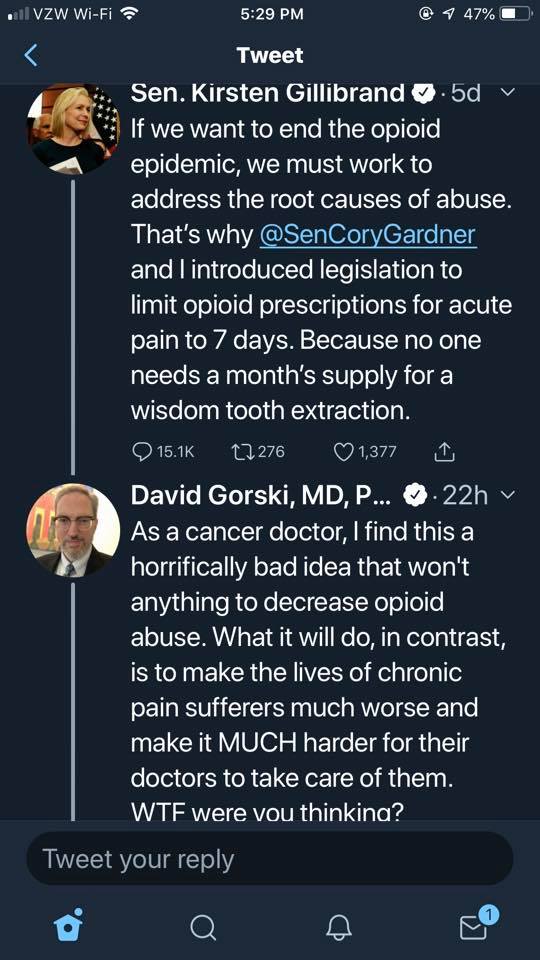
So, the junior Senator from New York, Kristine Gillibrand had this to say (and let me just cheer Dr. Gorski’s response):

54419098_2043205179068320_6910136770449375232_n

“Nobody needs a month’s supply for a wisdom tooth extraction.”

Thank you, Dr. Gillibrand.  May I ask where you studied medicine?  Where you served your internship and residency?  Or is it from a position of dentistry where you make this ex cathedra pronouncement?  Please, tell me by what authority you make pronouncements on appropriate care for pain management?

Oh, wait a minute.  According to your Wikipedia page, you studied law, not medicine.  Nowhere in there is a medical or dental school even mentioned.  You’re not even a medical school dropout.  You’re a “never were.” And yet, you speak with such confidence on a medical (or dental in this case) matter.

Nobody needs a month’s supply for a wisdom tooth extraction?  Well, maybe, provided there are no complications.  Are you familiar with all the possible complications that might occur in the aftermath of oral surgery such as extracting impacted wisdom teeth?  I’m not.  And I seriously doubt you are either.  And extracting wisdom teeth is not the only, and certainly not the worst, pain issue that patients and their doctors might have to deal with.  But you still feel justified in mocking them with your flippant little comment?

There are other things than wisdom teeth that require serious pain management you addlepated twatwaffle. (Readers:  I did warn you).  What in the coldest reaches of Niflehel makes you think you know what’s best for those patients, you disgusting collection of rotting entrails?  How about letting the fucking doctors and their fucking patients make the fucking decisions, you vomitous mass of diseased filth?

I wouldn’t accept “just take a couple aspirin” from that vile scumsack that was the former US Attorney General, and I won’t accept it from you, you putrescent meatsuit.  Pain, hurts, in case you in your sheltered little life have never encountered it.  Chronic pain in particular can drive people to despair such that it kills. I’d say “get that through your head” except I’m pretty sure that your head is totally impervious to anything resembling facts or logic.

If we simply leave it up to the doctors and their patients will people use opioids when they should not leading to overdoses and death?  Yes.  However, your policy taking the decision out of doctors who have their patients’ interest at heart, and putting it in the hands of people who’ve never seen the inside of a medical school–people like you, you cowbrained lickspittle–will cause far more pain and suffering, far more death than addiction to and accidental overdoses of prescription medicines ever can.  If prescription drug abuse were a cold, you’d be the fucking plague–pneumonic form (have someone look that up for you and explain it in small words, you tinheaded snotrag).

You are a greater evil than all the prescription drug abuse from Hippocrates to the present day combined.

Haul from the Indy 1500 Gun and Knife Show

I was helping a friend run his booth at the show today.  Among other things, it got me comped admission and parking. (Plus the fact that I got to hang with my friend and talk about cool stuff.)

And, well, my daughter and I did some shopping.

One of the things my daughter wanted was a revolver.  After some looking around she selected this one, a single-action six shot revolver in .22 LR.

SA 22 Revolver

While we were doing the paperwork on that one, I said to the vendor. “I’ve been looking for a High Power, would you by any chance have one?”

As luck would have it, he did.  A Hungarian made, surplus High Power, with three magazines:

High Power

Next thing my daughter wanted was another rifle (I think I’ve created a monster) to add to the AR pattern rifle and the Remington Model 12 she has.  We found this one, a bolt action “Glenfield Model 25” (made by Marlin).

Glenfield

And it’s a gun and knife show and we did not go empty handed when it came to blades.

First, we picked up a katana we had on layaway with my friend the vendor:

Katana 1.jpg

The blade had been “stained” in a way that really brings out the layers of the pattern-welded carbon steel:

Katana 2.jpg

In addition, my daughter picked up a replica of a Chinese sword from the warring states period:

And, finally, after first looking at a cute little folder, my daughter once again fell in love with this fixed blade knife:

knife.jpg

She particularly liked the “rough finish” of the blade.

You’ll notice there was a lot of “my daughter this” and “my daughter that” here.  The only thing there chosen what I specifically wanted was the High Power.  But you know what?  I’m happy with that.

Incentives

Whenever someone rolls out a new program, they always talk about the intentions, the goals, of the program.  This new program will make our streets safer.  That new program will reduce the cost of healthcare.  This other program will improve education.  Another will make college more affordable.  Reduce poverty.  Improve the economy.  And so on and so on and so on.

However, as the late economist Milton Friedman was wont to say, “One of the great mistakes is to judge policies and programs by their intentions rather than their results.”

Now, all too often, by the time we know what the results are, it’s far too late.  Thomas Sowell, however, gave us a key to helping predict what the actual results (as opposed to the intended results) a policy is likely to have.  That is, to look for the incentives that it creates.  What behaviors lead decision makers to benefit under a particular program vs. what behaviors lead to disadvantage.

I discussed a particular example of that before:  public education.  For a very long time now, the surest way for those involved in education to get more power, more funding, and more authority, was to produce excuses for failing to teach basic skills to our young people.  They were rewarded not for producing well educated, knowledgeable young adults.  They were rewarded for producing excuses for failure:  “We need more computers.” “We need bigger buildings with smaller classrooms.” We need to hire more teachers (and a lot more administrators).” “We need education to be a cabinet level post.” And on and on.  And we get what we pay for.  We get what we reward.  Given the incentives, the wonder, indeed, is that we produce children as well educated as we do.

It’s not rocket science.

In the private sector, this is something of a self-correcting situation.  In the ultimate extreme the incentive is to provide goods or services that people will part with some of their own resources (usually represented by money) in exchange.  If enough people are willing to part with enough of their own resources  for your product instead of for any of the other products they could purchase with those resources, your business prospers.  If they do not, you either have to find some way to make your product more appealing–either improving your product, offering it at lower cost, or some combination of the two–to more people or you’ll have to do something else.  If you attempt to press on without making those changes, bankruptcy awaits, forcing you to do something else.

Government, however, lacks such an automatic self-correction mechanism.  If a government program fails to accomplish its stated intentions, consider what usually happens.  How often has some government program failed and those in authority said “this isn’t working”, cancelled the program and tried something else?  You might find a few cases if you look hard enough but mostly, the response is “Oh, they just didn’t have enough money/resources/authority/power to do the job.” And, once again, we reward not success but excuses for failure.

Indeed, there is one perverse incentive that’s endemic to government programs of all types, and that is that by their very nature they reward those who seek power over others because that’s what government is–the license to forcibly exert power over others.  All government programs, by definition, involve force.  There’s no need to please the “consumer”.  Even elected officials don’t really need to please the consumer, to produce results in line with their stated intentions.  Entirely too many people are willing to vote based on the stated intentions and except endless excuses (there’s always someone at whom the politician can point the finger of blame).  Often times, the politician who implements a policy is long gone by the time the results roll around and it’s the new crop, who might even be trying to fix the problem, who then shoulder the blame. (City council imposes higher taxes on local industry in order to finance some “civic improvements.” A lot of businesses have rather immobile assets and can’t just pull up and leave but over time in the normal ebb and flow of business, fewer new businesses open to replace those that close.  Eventually, the drop in business starts pinching.  But by that time it’s a whole new city council who had nothing to do with the tax hike who are called on to “do something” about the struggling city.)

This kind of political “kick the can” is entirely rational for those engaging in it.  The immediate behavior is rewarded.  The longer term consequences are left for someone else.  It’s an inherent incentive of the political system and may well be insolvable.  There may well be no way to eliminate this kind of drain in any government structure.  Putting in new government programs to attempt to deal with it simply moves the perverse incentives to different locations.

Thus, we may have to accept that government, any government, is going to have perverse incentives that produce results far short of what we might wish.  Since it cannot be removed, the question is how to keep it as small as possible.  And, when stated that way, the answer also becomes clear.

The way to keep the perverse incentives endemic to government as small and innocuous as possible, is to keep government itself as small and endemic as possible.  National defense.  Minimal police and courts.  And, really, not that much else.  Only there do the benefits possibly counterbalance the very large millstone around ones neck that government has always proven, must always prove, to be.

Benefiting from Prosperity. (Originally “The Poor get Poorer”): A Blast from the Past

So Freshman Congresswoman has apparently claimed that the majority of people in the US don’t benefit in our national prosperity.

What, is she smoking?  Seriously.  The stupidity of that statement stands out among a litany of stupid statements.

As it happens, I answered that ridiculous claim January a year ago when someone else was making equally ridiculous claims:


People of a certain political persuasion say that the rich get richer while the poor get poorer.  Let’s take a look at that.

Imagine if you could go back 100 years.  You’d have to live life 100 years ago but you would have the wealth of the richest American of the day.  As it happened, Forbes created its first “Rich List” in 1918, 100 years ago, and listed John D. Rockefeller as far and away the richest American with a net worth of $1.2 billion then (roughly equivalent to $21 billion today).  Number two on the list was Henry Frick at $221 million.

So, Rockefeller’s $1.2 billion but in 1918 instead of today.  Would this be a trade you would make?

For the vast majority of us you’d be a fool to take that deal.

Consider:  I’m diabetic not insulin dependent (thankfully) but still diabetic as are a lot of Americans.  Insulin to treat diabetes was not invented yet.  So diabetes meant an agonizing death.

I have cholesterol issues–diet doesn’t touch it.  Believe me, I’ve tried.  If not treated, that’s a quick route to high blood pressure, heart attack, stroke, and an early death.  Medication to control cholesterol was still decades away.

Well, if we can’t control cholesterol perhaps we could control the high blood pressure resulting from the failure?  Nope.  Sorry.  It was an “essential malady” and not a treatable condiction.

Now, maybe you’re one of the lucky ones and diet and exercise can prevent these issues, or push them back as far as they can be for me with modern medicine, but are you really willing to gamble your life on that?

Wealth doesn’t do you a lot of good if you are left immobile from a stroke, or dead from a heart attack.

But, hey, with the wealth of Rockefeller  you could spend money on fancy, and fast, cars, right?

The Indy 500 was not held in 1918 (or in 1917 for that matter) because of World War I.  But if we peek ahead at 1919 we can get a look at what some of the fastest cars in the world could do and…

The winning car averaged just a hair over 88 miles per hour.  The cheapest beater I have ever owned (and I’ve owned some dogs) would have blown that car away, and do so with more comfort, more luxury than the fanciest Touring Car (air conditioning!).

And speaking of automobiles and medicine, a modern ambulance has more ability to keep you alive–saving only actual surgery–than even the hospitals of 1918.  And the only thing the ambulance would actually need to compete with those hospitals on surgery would be a surgeon and anesthesiologist–both of whom would be far, far more capable than the surgeons and anesthesiologists of 1918.

But…you could travel to exotic places with Rockefeller’s wealth in 1918.  Well, I’ll give you that one if you don’t mind taking forever.  You couldn’t hop in your car for a road trip down to Disney World (leaving aside that Disney World didn’t exist).  The modern network of highways with fuel stations every few miles did not yet exist.  Okay, there were a few airlines in operation but they were small and limited in operation.  Perhaps their expense wouldn’t matter with the wealth of Rockefeller at your beck and call, but there just aren’t that many places you can go by air.  Transoceanic flights don’t exist (Lindbergh is still years in the future) and neither do transcontinental.  The big thing in aviation at this time is “air mail”.  And that’s still chancy with things getting lost when the planes crash. (Look at that again and maybe think twice about that air travel.)

Train or ship, that’s pretty much your only option for long distance travel at any kind of speed at all, and those take days where in the modern day we travel in hours.

And if you want to just relax at home and maybe listen to music?  No Radio stations.  First commercial broadcast is still years away.  You can go out to listen to a live performance–in a public venue with neither adequate heat nor air conditioning (I’ll get to that shortly).  Or perhaps you can listen to a device like this:

If you’re lucky, you might actually have a couple dozen records.

I’ll take MP3’s [Ed:  and I have well over a thousand and growing now] on my cell phone, thank you very much.

Individual rooms in your house are probably heated with wood or coal burning stoves.  The first patent for central heating isn’t for another year and forced air central heating isn’t for another 17.

Air conditioning?  Yes, it’s been invented.  You, having the wealth of Rockefeller might have one of the early gigantic “air conditioners” that were just appearing but they really didn’t start getting into homes for another decade.

Well, I could go on and on and on, there’s so much available to the poor today that all Rockefeller’s wealth could not have bought him 100 years ago.

This is without going into the computer technology revolution, portable computers, and cell phones that contain within them more computing power than existed in the world as recently as a few decades ago.

Even many if not most of today’s poor in American know wealth that the John D. Rockefeller of 100 years ago could not even have dreamed that, if you were to describe it to him, would just be so much noise because the concepts were just too alien to the time.

The poor of today, far from getting “poorer” compared to the poor of times past, know wealth beyond the dreams of Midas.

Feeding the Active Writer: No Cook Chili

I was really in a hurry when I knocked this one out.  I was running late and needed something to take to work for my lunch entree.

“No Cook” is, perhaps a bit of a misnomer since I used pre-cooked canned meat in the recipe.  Still, the results were surprisingly tasty.

Ingredients:

  • 1 28 oz can “Keystone” beef
  • 1 16 Oz jar Chi-Chi’s “thick and chunky” medium salsa
  • 1 Tbsp garlic powder
  • 1 Tbsp chili powder
  • 1 Tbsp dried cilantro
  • 1/2 Tbsp ground cumin

Mix it all in a bowl.

Really.  That’s it.

Heat it up (microwave is fine) when you’re ready to eat it.  Serve topped with a bit of cheese and with whatever side dishes you prefer (I usually use non-starchy vegetables–it’s a diet thing).