Something Cool at Ice Follies.

Had a kind of neat event yesterday, up here at the local rink. The new round of classes was starting and one of the coaches mentioned that they had like 26 kids in the “Snowplow Sam” class (that’s the class for children 5 and under). They’re always shorthanded on coaches so I offered to help if they needed it. “I’m not exactly an instructor but I’m an extra pair of hands and an extra pair of eyes.”

They grabbed onto that really quickly. So I ended up out on the ice during the first session (my own class is in the second) helping to give young kids their very first ice skating lesson.

From a different series than I usually use for examples–one more appropriate to the kiddos.

After the classes were over–both the one I helped with and my own (got my two foot turn pretty good and actually started working backward edges on the circle–just had time for one attempt, about a second, at the very end of class) I told the coach I had spoken to before that if they ever needed a hand I’d be more than willing. She said “We always need a hand.”

Oh, that backward edge on ice?  That looks something like this (although much better than I did):

So I guess I’m now involved in volunteer teaching of the kids right alongside my daughter. 😉

And that, my friends, is cool.

My Musical Awakening

Back when I was younger.  A lot younger. (No, younger than that.) My musical tastes was pretty much limited to the softest of rock, love songs and ballads, and, well, things like this:

The “Donny and Marie” show was on the air and, yep, I was a big fan.  Which should tell you pretty much all you need to know about my musical tastes back then.

About the time I was going into the Air Force, MTV (yes, they used to play music) was founded.  Now, most of the places I was stationed I didn’t have cable.  But at some point I encountered this video–best guess is it was while I was stationed in England:

The “story” in the video is what roped me in but it got me to listen, actually listen, to a different style of music than I had paid attention to before.  I started listening to more “Rock and Roll” in addition to the softer love songs and ballads–which I still enjoyed and still do.

So this was the first break in the wall, the first glimmer of light passing through my eyelids in the course of waking up.

More years passed and I ended up in a place that actually had cable both MTV and VH1.  And I encountered this one:

Okay, it was the babe with the sword that drew much of my attention here but still, my musical horizons expanded still more.  I had previously been rather dismissive of The Artist Formerly Known as the Artist Formerly Known as Prince.  The reasons don’t really matter but here, once again, I actually paid attention.

More years passed.  I encounter work by John Ringo.  if you don’t know who he is, no he isn’t a musician.  He’s a writer.  My first encounter with his work was in his “Posleen Trilogy” (which turned into four books then expanded into a series including other co-authors and so forth). Music played a roll in that by reference–a gimmick was that certain styles of music “fit” as a movement cadence for…well, the details don’t matter.  And here I got this one:

Later, I picked up another of his books, Ghost. Look, I’ll warn you, this book is not for everybody.  It’s violent.  It contains explicit fetish sex, including non-consensual.  The main character is not a nice man. (It also won a romance award, but that’s another story.) But what it, and the series that spawned from it, did do was introduce me to several artists and music genres that I had not encountered before and I was just…wow.

There was this piece by the Dark Wave group The Cruxshadow. (It was called “Goth” in the book and marks when I started thinking of myself as “goth” and breaking out of the bad advice I had received many years before.)

In addition to the dark wave, that same series introduce me to power metal:

And Symphonic metal:

And with those as starting points I started some explorations of my own:

Evanescence:

Hammerfall:

And, continuing my Goth exploration, I tried Bauhaus:

However, I didn’t much care for Bauhaus.  An interesting change of pace, but not something I’d listen to much.  Thought I’d have to turn in my Goth card (while still being allowed to keep my Metalhead card).  But then I discovered some others.

The Sisters of Mercy:

The 69 Eyes:

Type O Negative:

And that’s where I am now.  So maybe I get to keep my goth card after all.

Iran

So, the other day, a group of terrorists launched an attack against our embassy in Baghdad.  In response, Donald Trump ordered immediate military support of the embassy, Osprey tiltrotors loaded with 100 marines plus their gear, with many more “on deck” if needed.

In addition, he attacked a site where terrorist leaders were clustered and from which the attack was being commanded.  At this site was located Qassem Soleimani, a major general in the Iranian Revolutionary Guard (a “regime protection” force–similar in role to the NKVD in the former Soviet Union or the Geheime Staatzpolizei in Germany under the National Socialist German Workers Party) and the head of Quds–basically, their state-sponsored terrorism force.

In short, he was Iran’s head terrorist and chief of terror operations.

Qasem_Soleimani_with_Zolfaghar_Order.jpg

People went nuts.

We had the following:

screenshot_2020-01-03-brad-torgersen-remember-when-jimmy-stewart-and-clark-gable-

And she went on to say:

screenshot_2020-01-03-1-brad-torgersen-remember-when-jimmy-stewart-and-clark-gable-e1578076062570

This, this right here, is why you really can’t expect much from people who play pretend for a living. (In case you don’t know, McGowan is an actress, most notably as Shannon Daugherty’s replacement on the TV Series “Charmed”.

Let’s review the situation.  An attack was launched against our embassy.  That right there is an act of war.  It was an act of war when Iran attacked the US Embassy in Tehran in 1979.  And it was still an act of war when Soleimani orchestrated the attack against our Baghdad embassy the other day.

Soleimani wasn’t back in Iran setting policy.  No, he was out in the field, in Iraq (when, as it happens there is a UN resolution calling for him not to leave Iran–a resolution in which he was in violation).  Basically, he had set up a field command post in Baghdad (and in case you missed it, Baghdad is in Iraq, not Iran) from which to conduct an attack against the US embassy.

Whatever his official rank he was acting as a field commander operating from a forward base being used to launch an attack against the United States.  You don’t get a more legitimate military target than that.  If Donald Trump were to shake off his protection detail, use his authority as Commander in Chief to take command of a company of Marines and personally command an attack on a foreign power in the field, that field command would not suddenly stop being a legitimate target because a person of that rank made the foolish decision to take actual tactical command in the field.

But, folk say, this attack will make Iran angry leading to them retaliating.

Please note, that the attack itself was a retaliation.  They attacked us.  They didn’t even attack a military target but a diplomatic one–an embassy, not a military installation.  And they’ve been doing it for decades.

  • Embassy takeover and hostages 1979-1981
  • Lebanon suicide bombing 1983
  • Mining the Persian Gulf 1988
  • Truck bombing in Saudi Arabia 1996
  • Shiite militia attacks in Iraq 2003-2011
  • Attempt to assassinate Saudi ambassador in the US 2011
  • Bomb plots against American business interests in Nigeria 2011-2013
  • Attack plots in the US by Iranian backed Hezbollah agents, 2017
  • More attack plots against the US in 2018
  • And now we have this attack against the US embassy.

All the stuff that people are wringing their hands over?  Iran has already been doing.  To our good fortune, they’ve generally been rather inept at it.  Unfortunately, if you throw enough fanatics at an issue you’ll occasionally have a big success.

And, frankly, they are lucky that we haven’t decided to play by their rules.  McGowan’s egregious nonsense about “terrorist nations” aside, if we did play by their rules, Iran and anyone supporting them would be a smoking ruin in short order.  We don’t play by their rules because we are better than that.  But a lot of people are getting a lot angrier about the continued terrorism.  And sooner or later we’ll get angry enough to throw the rulebook of “civilized” war aside.

So you want to play?  Let’s play.  I’m your Huckleberry.


Ice Follies on the Road

Another late one.  I need to rebuild my buffer.

Was traveling a bit last week, visiting a photographer friend down in Nashville. (The incomparable Oleg Volk.) While we were there we took the opportunity to visit one of the local (more or less) ice rinks:  Ford Ice Pavilion Bellevue.  The justification was for Oleg to get pictures of me and my daughter skating.  Unfortunately, he didn’t get any good pictures of my daughter (she had issues that day not directly related to skating) but there is this one:

82226337_979169335963_773113968913809408_o.jpg

THat’s e at the far left in black.  The scowl is my “concentrating face”.  I was actually having a good time.  Technically, my hands should have been up at shoulder level, gracefully extended to the sides, but as crowded as the rink was, I didn’t want to take up that much space.  My daughter is in the frame.  She’s the one at far right in the image, with the bleached tips in her hair and the pink laces on her hockey skates.

My daughter skates rings around me.  I take lessons.  She teaches (up to pre-free-skate at least).  Volunteer teaching since she’s only fifteen, but there’s talk of actually hiring her once she turns 16 later this year.

Instructors kind of trade around from class to class depending on who’s there both among the instructors and among the students.  As a result there was one session where my daughter was my instructor.  She’s good, both as a skater and as a teacher.

So, the visit to the Belleview rink was the 31st.  Today, I was back at the local rink and it, too was packed.  I heard someone mention “last hurrah before school starts again.” Whether true or not, it was crowded.

I try to push some limit whenever I get on the ice.  When possible that “limit” is whatever new (or newish) technique I’m learning.  But when the ice is as crowded as it was tonight and in Belleview that’s just not safe.  In that case I try to push endurance–conditioning.  I try to do that anyway even when I’m working techniques.  I’ll work new techniques when I’m still fresh, then spend the rest of available time skating to build my condition.

Now one thing that’s been particularly frustrating is that I continue to occasionally stumble while doing one foot glides.  I expect to stumble and even fall when I’m doing something new–backwards one foot glides, two-foot turns, crossovers (although those are coming along nicely)–but it’s frustrating when, for no apparent reason, I catch a toe pick and either have to take some running steps to recover or end up on hands and knees on the ice.  It’s not even the pushing foot that’s catching, but the gliding foot which means I’m getting my weight too far forward (or letting my foot lag behind center of gravity which is a different perspective for looking at the same thing).  More rarely, my issue will be off the back of the blade in which case I end up flat on my back.

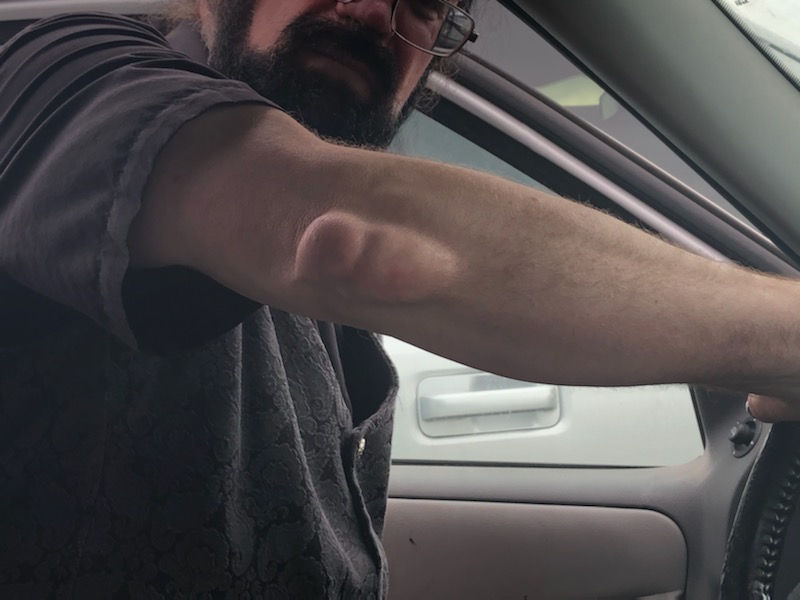
Recently, I’ve taken to wearing elbow pads, well, strictly speaking they’re knee pads in size “M” but they fit snugly around my elbows so that’s what I use them for.  I have found that when I do fall, particularly backward, I have a really bad tendency to crack an elbow against the ice leading to a swollen lump that turns into a large purple bruise that takes several weeks to heal, something like this:

226

I’m hoping the habit of wearing elbow pads will prevent that in the future.  However, for the trip to Nashville, we were looking for pictures so I didn’t want to wear them.  Fortunately, aside from a couple of stumbles, only one of which took me to hands and knees, I didn’t have any problems.

But those continued stumbles are frustrating.  I’d really like to figure out how to get to a point where I’m not doing them any more.  Yeah, I know.  Top level competitive skaters still fall, but not generally when simply doing a one-foot glide.

Google Suite Woes

Late today.  Had things going on.

monitor-1307227_640.jpg

My boss is unhappy with our current hosting service. (And, to be honest, I agree with him, on the one hand our email keeps getting marked as “unreliable”–i.e spammy, which we don’t do–and on the other their tech support can be prodigiously unhelpful.) The idea of using G Suite for email and Google Compute for hosting has captured his fancy and he has had me looking into it. I bit my tongue over my own feelings about Google and reminded myself that he signs the paychecks.

So, after having looked into online documentation and having reviewed a number of tutorials, I thought I’d try some experimenting. I have a domain thewriterinblack.com, you know…this one, which did not have any email associated with it (my current email is through hotmail–they let me have thewriterinblack without any punctuation or trailing numbers). So I set up a trial G Suite account, created a gmail account and set it up with an email address with @thewriterinblack.com.

First problem was when I tried to set it up for POP3 access for my email clients (which is what everybody at our office uses). Gmail didn’t want to talk to my client. I eventually got that worked out but then I set it up on my office computer (an old XP machine–I know. I know. I have been lobbying for an upgrade but my boss has been resistant) and set it up on my personal laptop. Both were set to leave messages on server, much like I have my other emails set–work computer and home computer so that I can read on either. One is generally told to “leave it” and the other is told to “delete after X days”. This gives time for me to get email on both computers to grab the message before it’s deleted from the server to save mailbox space.

I use Thunderbird. Other folk use Outlook Express.

This may not be best practice but it’s worked and it’s what everyone here is used to. Resistance is high to changing. The thing is it did work. It works with our current host. It worked with our previous host. It worked with at least a half dozen private accounts I’ve had over the years.

It doesn’t work with GMail. Oh, sure I can download messages using either computer but any messages I download on one do not show up on the other. Apparently once a message has been downloaded by one client it is no longer considered “new” for the other client to download. And I can’t figure out what makes this one different from everything else I’ve ever worked with.

My best guess is Google is just being evil.

“If you don’t like it, why don’t you go to…”: A Blast from the Past.

I was travelling and didn’t have posts set up in advance so I missed a few days.  Sorry about that.  Home now, and to get things started here’s a blast from the past:


I keep hearing from people telling me “if you don’t like it, why don’t you just move?”

There’s just one problem with that.  For those of us who prefer limited government on Constitutional principles (as written according to the understanding of those who wrote it, and as properly amended not just redefined away), where could we go?  Short of building new colonies on Earthlike planets around other stars there is no place to go.

As Ronald Reagan put it in a 1964 speech:

The enemy he was referring to then, of course, was the Soviet Union.  That enemy collapsed 27 years after Reagan gave that speech.  Now it’s a new enemy or enemies, the rise of militant Islam is one threat.  The apologists who object to treating it like an enemy, much like those who did the same regarding the old Soviet Union, serve to heighten and extend that threat.

But in many ways we face a more insidious threat.  Many of the ideas the Soviet Union tried to spread to the US in its effort to achieve suzerainty still live on in the US.  They are propagated in the entertainment media, spread in schools and universities, often by people who are not even aware that they are Marxist ideas.  Ideas like class warfare, the idea that someone who is financially successful is the enemy.  Ideas like zero sum economics so that the only way someone can have more is by depriving someone else.  The idea that those who seek wealth are “greedy” and unworthy, but those who seek power (so long as they are opposed to those who seek wealth) are somehow virtuous and good.

Got news for you, to paraphrase an ancient proverb:  Wealth might not always get you power, but power can always get you wealth.

And the folk fomenting that, those who want to turn the US into a carbon copy of Europe, say “if you don’t like it, go somewhere else.”

We did go somewhere else.  We came here.  Unless somebody develops true space travel there’s no place left to go.  In Reagan’s words, this is the last stand on Earth.

This, of course, is the point where someone suggests “If you hate government so much, then move to Somalia.”

Look.  A failed state broken into warring factions led by local warlords who are essentially absolute (until violently deposed) in their local authority is a far cry from a Constitutional government of limited powers with the rights of the people (actual rights not “whatever I want I have a right to and someone else has to pay for it” type “rights”) held sacrosanct.  Indeed, it’s at least as far from that as the US is today.

Now, perhaps Somalia could be used as a starting point to make such a society, but the local warlords will not give up their petty fiefdoms willingly.  So such a transformation would not be bloodless.  And, not being bloodless, the international community would with near certainty take it upon itself to intervene and prevent the transformation.

So no, “going to Somalia” is not an option for those who actually desire a free society.

The same is not true for those who want European style socialism/social welfare.  Europe, after all, is right there.  It’sexactly what they say they want.  No transformation necessary.  If you’d be more happy in that system it’s there.  You can go there.  I would not deny you.

But you would rather stay here and deny me the kind of government that would make me happy.  Not just me, but a lot of other people like me.

It’s not that you want to live under the social, political, and economic system that pleases you that bothers me.  It’s that you want to force me to live under that system.  I can wave my arm indicating all the choices you have for your desired system.  You, and others like you, have worked hard through long years and decades to make sure there is no other choice for folk like me.

And that is why I will never stop fighting to leave at least one place in the world where Constitutional principles and individual liberty are given more than lip service.

And if you wish to deny that to me, if you oppose me in that and work to undermine the freedoms that are enshrined and protected by the Constitution then I will oppose you with every breath in my body.

Because if you will do that, then you. are. the. enemy.

Adulthood

adolesence-to-adulthood

The law defines when a child becomes an adult.  Only the law seems to be more than a little confused about the matter.

You can drink alcoholic beverages when you’re eighteen, no twenty, no twenty-one.

You can use tobacco when you’re sixteen, no eighteen, no twenty-one.

You can vote when you’re twenty-one, no eighteen, and now talking about 16.

You can drive three-thousand pound metal monstrosities capable of twice the legal speed limit at sixteen.

You can decide to get an abortion without parental consent at, well, at menarche.

You need parental consent to take Tylenol in school until you’re eighteen.

Make.  Up.  Your.  Damn.  Mind.

The theory is that young people don’t have the life experience and maturity to make good decisions and, so, their actions need to be restricted for the safety of themselves and others.  Okay, I can buy that.  Even with my libertarian bent, I have to take an authoritarian position sometimes (less so as time goes on, but even still) with my daughter.  I have a responsibility to see that she has the mental and emotional tools to make good decisions when she’s grown and on her own.  And while I could take the approach of “let her learn the hard way” and make all her own mistakes without stepping in offering more than advice, well, how do you explain to a two-year-old who is just coming off learning that objects still exist when they’re not in view that stepping in front of moving cars on the street is a very bad idea?  You can’t.  So you snatch her back from the brink and give some mild punishment, something she can understand (could be a scolding, could be a swat on the rear–whatever works for that particular child) that, no, she is not to step into the street.

As she gets older, she understands more.  More things can be explained.  And more things she can be allowed to learn for herself through painful experience that they are bad ideas.  But even then, some things you really can’t afford to risk.  That guy involved with gangs (actual, real gangs committing real crimes, not just liking music and fashion with which you disapprove)?  No, she is not allowed to hang out with him no matter how much he flatters her (leading her to think that she’s in love).  You restrict her because the price of “learning the hard way” can be that the lesson is learned far too late and you end up being called to identify a body.

And in a larger context on the same idea, we have laws that restrict what minors can do compared to adults.  It’s for their protection and it’s for the protection of society as a whole.  Sometimes it goes overboard.  In fact, it probably goes overboard a lot.  If I want, for instance, to introduce my child to alcohol in a controlled fashion so it’s not something new and glamorous when she goes off to college, that should be my choice.  Indiana law, however, sees it otherwise.

Still, some such restrictions are nevertheless probably in order and probably, on the whole, a good thing.  I just wish they made sense.  On the whole the age of majority, where one is considered an adult and able to make one’s own decisions for better or worse has been moving upward.  See what has happened with alcohol and tobacco, what they’re talking about with “vaping”, and the movements already started regarding gun ownership.  But there are a few where they are moving down.

Most of these movement are not based on any actual assessment of maturity and the ability of an individual to make decisions for his or her self and accept responsibility for the results.  They are driven by political motivation.

Nobody should be able to use tobacco, certain Bertha Better Than You types will think.  They can’t get it banned entirely, but what they can do is get the age where a person is allowed to use tobacco raised. “For the children.” (Because, what kind of monster wouldn’t want to protect children?) Alcohol, guns, vaping, whatever.  Look closely at the people calling for raising the age where people are allowed to decide those things for themselves and you’ll find that most of them are folk who don’t think anyone should be allowed to do those things.  They can’t get what they want, so they go for what they can get.

On the flip side, we have the ones moving down.  Voting is a big one on this.  And, once again, the  motive is not any actual assessment of the maturity and capability of the young people.  No, it’s simply another matter of self-serving their own ends.  In the late 60’s there was the agitation to lower the voting age in Federal elections from 21 (as generally set by the States) to 18 (mandated nationally). A common argument was “you’re old enough to kill but not for voting” (Barry McGuire’s protest song “Eve of Destruction”) as if the two things had any connection to each other.  Why, no, in fact, wading through jungle muck lugging an M-16 around and shooting at folk who are shooting at you has absolutely no connection on intelligent and rational exercise of the franchise.  Completely different skillsets.

But it was politically a hot topic.  And there were political reasons to move the age down.  But it’s even worse today, with calls to reduce the voting age still further to 16.  There isn’t even the “old enough to be conscripted…” argument since we haven’t had a draft in forty-six years.  An person enlisting on the day after the draft was abolished, rising to the highest enlisted rank, would have been forced into retirement sixteen years ago.  General officers can stay in the military a bit longer but when Marine General Robert Neller retired in July of 2019 he was the oldest serving general officer and he had only joined the Marine Corps four years after the draft ended.  So as bad as the “old enough to kill, but not for voting” argument was, not even that applies to the new move.

No, the only motivation for lowering the voting age is political.  The folk promoting it believe that it will work to their advantage politically.  And, they’re probably right.  Young people don’t have a lot of life experience.  They are susceptible to pretty ideas that sound good if attractively presented and you don’t think about them too much, ideas like Marxism.  Young people are still caught up in “it’s not fair!” thinking.  “It’s not fair” that some people have more than others. “It’s not fair” that people have lots of money but not “working” for it. (The years of delayed gratification, careful husbanding of resources, and wise investment of time, effort, and money that it took to create that wealth is not so apparent as the benefits now being reaped of having done so.) “It’s not fair” that people with  minimum skills who do only the minimum required for their minimum wage job don’t live a middle class lifestyle.  Lots of things “aren’t fair” when you only see part of the picture–as young people almost always do.  So they are easily swayed by promises of “fair” or at least “fairer.”

Mind you, that isn’t to say that things are fair when you do see the larger picture.  The world is a non-remarkably unfair place.  It’s just that most attempts to make it “fair” have been tried before with uniformly disastrous results.  We can’t make it fair, certainly not with crypto-Marxism (as most if not all left-wing policies are).  We can, however, make it better for people within that unfairness.  And we have, as a simple comparison of the “poor” of today with the “rich” of the past demonstrates.

When you consider that voting can do far more harm than any of the other things that are different between children and adults–underage drinking can be harmful to the child.  Combine it with driving and you have accidents that can even kill one or more people.  But underage voting, if it leads to implementation of the horrible policies of those who are promoting it, can kill thousands to millions.  If anything should be kept out of the hands of children, it’s the ballot.

So, while there are reasons to treat “minors” and “adults” different in law, those reasons have very little to do with the actual setting of law.  The personal desires and biases of those who promote changes in age of majority are the driving factor.  Nowhere is this more evident than in the drive to push the age up in some cases and down in others.

How about this:  pick an age.  One age.  At that age a person will be able to use tobacco if they choose, vape if they choose, drink alcoholic beverages if they choose, vote if they choose, buy firearms if they choose, and so on.  One age for all of that.  Either folk of that age are mature enough to be able to make those decisions responsible or they are not.  One age.

Now, in an ideal world it wouldn’t be a single age for everyone (although I still submit a single age for each individual).  Some people do mature earlier than others.  Some never mature at all.  In that ideal world we would have some kind of standard by which we would be able to say that this person, whatever age he or she is, has the maturity, responsibility, and understanding to be treated as an adult.  But I do not know how to implement any such standard.  I do not know who could set such a standard.  And I do not know how to trust that it would be implemented fairly.  So, this being a less than ideal world we go by age.

Just…pick one.  One.

My Life, Part 3, “Pinkwood” Drive.

house-1001419_640.jpg
Not representative of the actual house:  This one is an order of magnitude too nice.

Sometime after my mother and the guy I knew as “Dad” but that my mother didn’t “count” among her husbands (see Part 2, The Trailer Park) we moved to a place in Portsmouth Virginia.  Portsmouth is flanked on three sides (no, really) by Chesapeake and, with the rest of it’s boundary mostly defined by Norfolk and the mouth of the James River.

We lived on a Greenwood drive.  My mother at that time was waiting tables in a bar/restaurant and we shared a house with one of her waitress friends:  My mother, my sister and I, my mother’s friend and her two daughters.  I was maybe six, so this would have been 1967.  The house was a modest three bedroom arrangement with pink clapboard siding.  It was this distinctive pink coloration that caused my sister, then 4, to dub the street “Pinkwood Drive.” We all thought it was great and so that’s what we called it.

We had a swing set out back.  I remember playing on it with some of the neighborhood children.  Behind the house was a large field.  Looking at maps today, it looks like the neighborhood has been rebuilt as a more upscale place and the big field I used to play in is now a subdivision.

My mother was being courted by two men at the time, both men in the Navy, serving on destroyers.  One was named Eddy, the other Bruce, George Bruce Savage III.  My sister and I favored Eddy.  Eddy was great.  We got to tour his ship once.  I don’t remember much detail.  A block and tackle that Eddy said, was used to drop marines over the side (in a boat, I presume looking back on this) and rolled up cargo netting that marines used to climb aboard.  In my childish imagination I pictured Marines being dropped in the drink and then, wet marines having to climb up the net.

Eddy “popped the question” to my mother just before shipping out on a sea tour, with the idea of marrying her once he returned, but my mother was unready to make a decision between the two men.  She tried to reassure my sister and I that she hadn’t made up her mind.  I predicted that if she didn’t accept Eddy’s proposal Bruce would have her convinced before Eddy got back.

I was right, and this proved to be a very bad thing indeed as things would turn out.  My mother’s waitress friend moved out, my mother married Bruce, and Bruce moved in.

It was about this time I started school.  I’m not quite sure whether it was before or after my mother and Bruce were married, but it was somewhere close to then.

I did not do kindergarten, starting directly with first grade.  Apparently that was optional in Virginia at that time.  (When I later moved to Ohio, my classmates thought it quite shocking that I never attended kindergarten.) The school I attended was just a bit up the street from our house.  Up to the corner, cross the street, turn left, cross the street again, then a couple of blocks to the elementary school.  Academy Park Elementary which appears to have been closed.

First day of school, my mother walked me to class.  Second day, I walked myself.  On that second day, I went to the same entrance my mother took me to.  This proved to be wrong.  Someone showed me to where I was supposed to line up with the other kinds in my class to be let in when the bell rang.

The two biggest problems I had in first grade were 1) learning to write the numeral “2”.  I don’t know why that caused me trouble, but it did.  I had no trouble with threes and eights and fives, but twos?  Gave me fits.  Eventually my mother sat me down and we spent an evening practicing.  Over and over again until I could write that pesky “2” consistently.

The other problem I had was reading.  Oh, not that I had problems reading but that my mother had already taught be to read before I started first grade.  We had the World Book Encyclopedia and Book of Facts with the Childcraft collection (1965 edition, I’m pretty sure).  Oh, how I loved those.  And I loved them right up until they were lost in a move something like a decade later.

I could read and read pretty well for a six-year-old.  So in class, I grew to loathe those insipid Dick and Jane stories.  Hated them with a passion.

The reading class was divided into two groups.  One group, the one I was in, read Dick and Jane.  The other group, some book about a character named Tom.  There would also be a daily instruction session where the teacher had a giant book at the front of the class where we would all sit and she would read it aloud while pointing to each word in turn.  On the one hand, this was mind numbing to me.  On the other, at least it wasn’t Dick and Jane…again.

A minor problem I had was my mother showed me writing “1’s” with serifs.  I thought that was cool and so used it when writing my own.  Unfortunately, I didn’t do it consistently so I ended up having math problems marked wrong when I used serifs because my teacher counted them as twos–since I did some ones as a simple stroke and others with serifs.

One day the teacher said we would have a bit of a challenge the next day.  We would each go up to the front of the room and count from one until we made a mistake.  It was just to see how well we would count.  That night, when I went to bed, while I lay in bed I practiced.  I don’t recall how far I got, but it was well over a hundred.  The next day, most of the other kids would stumble somewhere along their teens or twenties.  But when my turn came I just kept going and going.  Got to over a hundred and twenty before the teacher stopped me as I clearly knew my counting.

One of my neighborhood friends was named Milton.  He lived two doors down from the pink house we were still living in.  Now, Bruce was an Amateur Radio Operator (AKA Ham Radio).  He had at least a General class license back then.  I know eventually he reached Amateur Extra class (the highest level for Amateur Radio), whether he had that rank at this time or not, I don’t know.  I do, however, remember his callsign:  WA4OGZ.

Now, as it happened, Bruce had several mobile radios in his car, a little gray Corvair (yes, that care of infamy–frankly, unjustified infamy but infamy nonetheless).  As a result of this, the car was festooned with various antennae.  Now, one of those antennae are why this relates to my friend Milton.  You see this antenna had a vertical mast up from the rear bumper, then extending backward from it a horizontal loop about 18 inches in diameter.  So one day, I was just getting ready to go outside and saw Milton standing behind Bruce’s car with a basketball in his hands.  My mother was right behind me and she shouted at Milton and scared him away. “That is not a basketball hoop.”

Probably to Milton’s good fortune that it was my mother who caught him, not Bruce.

Bruce also had some taller antenna’s at the house.  He had taken over the third bedroom as his amateur radio lab.  One of the antennae was tall enough to require guy lines.  And one of those lines fastened to the swing set in the back.  I remember one day when climbing on the set–after all, we didn’t just swing on it; if it was climbable, I climbed it–and touching the guy wire.  I received a very mild electric shock.  Nothing serious, or even painful.  Just a mild tingle.  Hardly worth noting except I do remember it even after all these years and, so since part of the purpose of these things is to get down my early memories as fully and completely as possible, I note it here.

About halfway through first grade we moved.  Not far, just a mile or so up the street, still on Greenwood drive.  But that will wait for next time.

Doctrine of Emergency

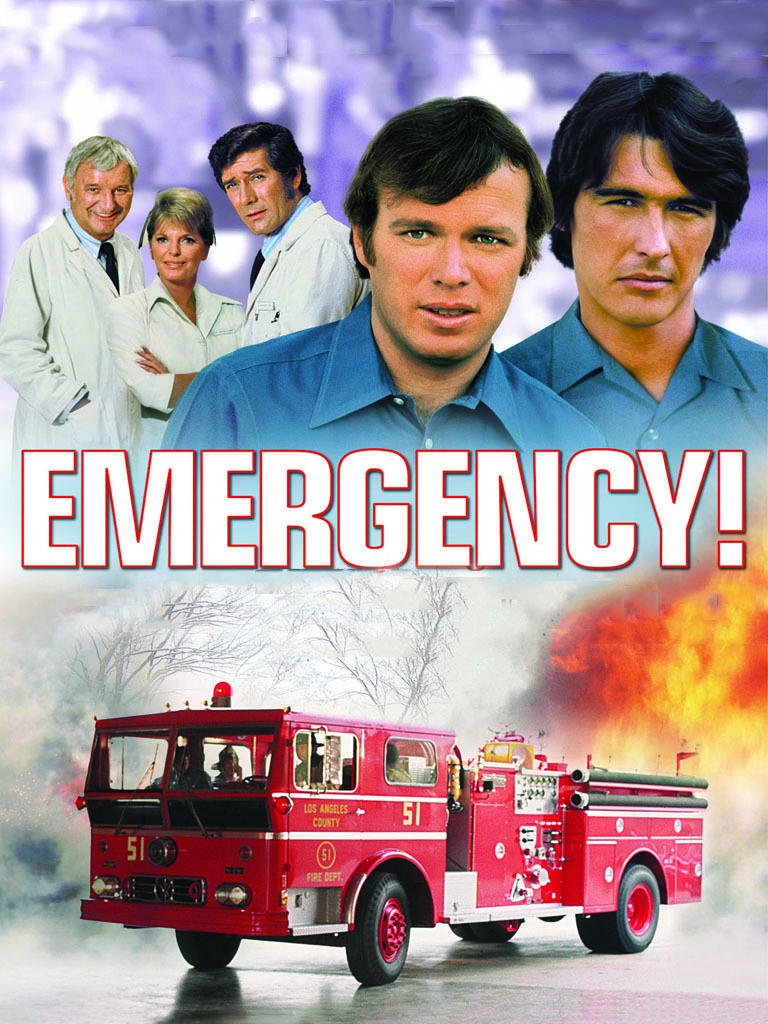
Emergency.jpg

Long ago there was a TV show “Emergency” about a team of fire department paramedics.  My family used to watch it religiously.  It actually has nothing to do with this post except…a recurring theme on the show, from the actual pilot, was that they had to skirt what the law permitted in order to do what they had to do to save lives.

They never really went into it but there is a concept called “Doctrine of Emergency” or “Emergency Doctrine.” Basically, this allows people, when faced with an urgent need for aid to take action without being subject to ordinary standards of reasonable care.  If a car is on fire, a person can act to pull an injured person out of the burning wreck even if doing so can make the person’s injuries worse.  The immediacy of the situation, and the risk of far greater harm from not acting, outweighs the usual recommendation of not moving an injured person until qualified medical help arrives even the “reasonable care” to stabilize injuries and ensure that movement doesn’t make matters worse.  One has a reasonable expectation in a burning car that not moving the person would make matters far worse than moving them will and the situation does not allow for careful, reasoned response.  A burning car has to be dealt with now, before the fire spreads.

Unfortunately, Emergency Doctrine has become rather tattered as people injured in such cases sue their rescuers for not being supermen able to deal with the emergency, get them out of harms way, and do so in such a way that there is not even the possibility that they might have done additional injury in the course of the rescue.

The term I use for such people is assholes.

I’m not a lawyer and cannot go into the details of the legal issues involved in the rescue of individuals from dangerous crises.  Instead I want to go in a different direction.

Taxation is theft.

Didn’t expect that coming, did you?

There’s a meme going around which says “When you respond to ‘taxation is theft’ by asking who will build the roads, you aren’t saying that taxation isn’t theft.  You are saying that sometimes theft is necessary.”

Yes.  Exactly.  The question is…when?  How does one justify “necessary” theft against “but I want it” theft?  I think the answer is in an analog of Emergency Doctrine.  Is the issue of such import that we would excuse an individual taking action under Emergency Doctrine?  In such case, then it might be one where the State can use its coercive force to make it happen.

Existential issues like national defense (to which I would add controlling the borders and immigration for reasons I have discussed elsewhere) qualify.  Indeed, it’s pretty much the perfect case of applying an analog of Emergency Doctrine.  Oh, you don’t have the immediacy generally required in an individual DoE (Didn’t want to use the obvious abbreviation of “Emergency Doctrine” so I’m going to call it Doctrine of Emergency from here on out)–a burning car doesn’t leave time for carefully considering all possible options–but failure here can easily lead to so much worse than the harm to “liberty” involved in using the coercive power of the state to build and maintain armed forces.

Likewise, in the case of international diplomacy.  Foreign powers don’t have to invade to harm Americans (I am an American and so my perspective is American–but this applies equally well to other nations and their peoples as well) and American liberty.  Clausewitz called war “Diplomacy by other means” but that works both ways.  Diplomacy an also be “war by other means”.

Internally, things like firefighting and police?  Right up there in DoE type stuff, practically by definition.  Note that while the concept of police is defensible under DoE, not all uses of police are since not all (or even most) laws are.

Civil courts?  Study some of the multi-generational blood feuds that have gone on throughout history and then see if having a way to peacefully settle disputes, that can enforce the settlement on the “losing” party, might not fit under an analog of DoE?

Scientific research?  I’d say some does, some of it falls under things like national defense (an obsolete military is of little use in national defense).  Others?  Well, nice but not DoE level critical.

And what about those roads?  Well, consider the National Interstate and Defense Highway Act of 1956.  Some have attempted to dismiss the “Defense” angle as being window-dressing to justify it, logistics and the ability to move men and materials rapidly from where they are to the point of conflict is vital to success so, yes, a lot of roads are DoE.

But, there are plenty of things that are not justified under an analog of DoE.  And those things should not be funded by taxes.  Because taxation is theft and absent dire need, justified under an analog of Doctrine of Emergency, then that theft should not be done.  In such cases voluntary transactions are the only justifiable approach.

So, yes, taxation is theft.  And that theft is sometimes, but only sometimes, justified.


Options and Constraints

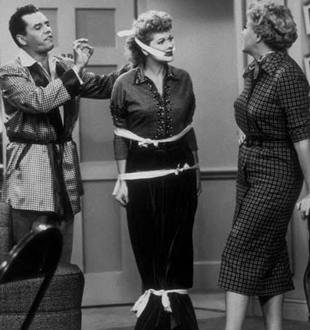
lucy-tied-up1

No, not that kind of constraint.

It is popular these days to look back on people in the past and criticize them for not living up to whatever ideals the person looking back holds.  Clearly these folk were evil, people say.  Look at the things they did and supported.

Thus do they tear down the icons, heroes, and “great men” of the past, dismissing their accomplishments, all their accomplishments whether related to the supposed “flaws” or not.

Thus, we have Thomas Jefferson, primary author (with others; it was a collaborative document) of the Declaration of Independence and mentor of James Madison, one of the people behind the Constitution and the primary author (again, with others) of what became the Bill of Rights, being summarily dismissed, and the importance of those documents he helped create wiped away because Thomas Jefferson owned slaves.  What a hypocrite, talking about “freedom” and “equality” while owning other people as property.

However, the situation was more complicated than that.  You need to start with the fact that slavery was an existing institution long before Jefferson was even born.  It was what he grew up with.  And it was what he had when he first inherited property.  Now, Jefferson had his flaws.  Among them was a spendthrift nature (particularly when it came to books) and poor personal financial discipline.  He was constantly in debt.  This was one of the constraints he faced.  The slaves on his various properties were capital assets, part of the security against his various loans.  As much as he might have wanted to free his slaves, his creditors would never allow it.  Likewise, law in Virginia was specific on how and when slaves could be freed.

It’s easy to say that Jefferson should have just ignored his creditors and the law and freed his slaves anyway.  The problem is that unless he immediately transported them to someplace “safe” they would just be re-enslaved since he didn’t have a legal right to free them.  But he didn’t have the finances to relocate them, either.

Similarly we have Patrick Henry.  He opposed slavery and wrote to that effect on more than one occasion.  But, like Jefferson, he owned slaves.  Henry, however, had different issues than Jefferson.  While he opposed slavery, he also feared that if it were simply abolished and the slaves freed, there would be massive reprisals by former slaves against not just their former masters (who were always a small minority of the population–slaves were expensive to own and maintain) but against white people in general.  Several uprisings gave credence to such fears.  He thought that freeing the slaves had to be accompanied by repatriating them back to Africa (which, given the tribal nature of most of Africa at the time, had its own problems of which Henry might not have been aware) or otherwise handled carefully.  In the meantime, the institution continued to exist and while it continued to exist he saw no reason not to be part of it.

From this side of history it’s easy to say he should have pushed to abolish slavery anyway.  It’s easy to look back and see that when slavery finally was abolished we didn’t have the massive retribution that Henry feared (which is information we have that he did not).  It’s even easy to say that if there were, why that’s nothing more than what those evil slave owners deserved. (Well, maybe, but their families and their neighbors and folk who never owned slaves in their lives but only share a skin color with those who did?) It’s easy to say when it’s someone else who will be suffering the consequences of the precipitous change.

The idea of slavery is an extreme case but it’s not the only one.  Fighting on the “wrong” side of a war, because you happen to be born to that nation.  The main case of that in the US today is talking about Confederate soldiers. (The modern penchant for casting the United States as the villain, or at least no better than its enemies, tends to insulate most others from this effect.) Most of them didn’t care about the slave issue one way or another, they were fighting for their State.  It’s difficult for many today to understand but before the Civil War one’s State was or more import to the individual than the Federal government.  Indeed, the whole term “state” came from the idea that each was its own nation-state, ceding certain powers to the Federal government for dealing with the rest of the world and for smoothing out certain interactions between the States.  “These United States” as opposed to “The United States.” A person’s loyalty was first to his or her State, and only secondarily to the United States as a whole.  Their “nation” as they considered it, was at war so they fought for their nation, just like English have fought for England, French have fought for France, Germans have fought for Germany, Chinese have fought for China, and so on and so on and so on.

And even if they didn’t fight simply because it was their nation at war?  Well, once again, options and constraints.  The combination of social pressures (which can be amazingly strong) and the fact that the Confederacy, like the Union, used conscription, put a lot of people who might or might not have really cared about the issue into uniform to be hurled into battle.

A lot of people, looking back at earlier times, or across the sea to other cultures, like to think that they would be different.  They would be the ones who stand strong and refuse to support the “evil” nation, refuse to obey the unjust laws, and so on.   They think they would be John Brown, launching a doomed attack against slavery, or August Landmesser, staunchly refusing to salute Hitler even though he alone in the crowd is doing so.

However, how many these people truly ignore laws they disagree with?  I’m not talking about breaking the law.  If you hide the fact that you’re breaking it, take steps to avoid getting caught, then you are not ignoring it.  You’re not an abolitionist freeing the slaves he’d inherited despite laws saying you can’t.  You’re not John Brown and you’re not August Landmesser.  And yet, a lot of people who have equally strong feelings about modern laws, that they don’t openly violate exactly as they are castigating those of the past and of other countries from doing, do not themselves do so.  They think they would have been the “heroes” doing so if only they they lived then and there.

They are, to put it bluntly, delusional.

And so, they castigate historical figures and others, people living in other times and other places, people facing different options and constraints, for not being better than they, themselves prove themselves to be.

They are, put simply, hypocrites.